You can hear it before you see it.

Two streets away. That steady thud, thud, thud, like somebody's beating a carpet they really hate.
And that's been the soundtrack by Mahane Yehuda for a while now. Which is where Daniel comes in. He walks past this site regularly, and he wrote in because the noise finally got him asking questions.
About Beit Alliance.
Right. The historic house near the market, and underneath it they're carving out a seven story underground car park. While keeping the building above standing. Daniel says the civil engineering write ups call it top-down excavation, and one of them described it as one of the most extensive uses of the technique ever conducted. Which is the kind of sentence that makes you stop and ask what the technique actually is, because from the street, excavating is just digging a hole.
It really isn't.
So he wants to know what's unique here. Why the historic preservation requirement and the market proximity forced this method. Whether the method is what's stretching the timeline out, because that site has been active a very long time. And then the bigger one. How do cities weigh residents' need for quiet, which means speed, against preservation, which usually means the opposite. He notes, dryly, that Jerusalem doesn't seem to have given that dynamic much thought. And he asks whether that tension can actually be negotiated openly in a more democratic planning process.
That's four questions stacked on top of each other.
Daniel tends to do that. So let's start with what top-down excavation actually is, because it is not just digging a hole.
The standard way you dig a basement, or a car park, is you dig an open pit. You shore up the sides so they don't collapse, you dig down to the floor level, you pour your foundation slab, and then you build upward. Bottom-up. It's intuitive. It's how you'd dig a hole in the garden, just with more concrete.
And the problem with that next to a historic building?
The building is sitting on the ground you're removing. You dig a pit beside a hundred year old stone house and the soil under that house starts moving toward your pit. It settles. Cracks appear. In a dense market district like Mahane Yehuda, you're also surrounded by other buildings you don't own, narrow streets, and a market that has to keep functioning.
So you can't open a pit.
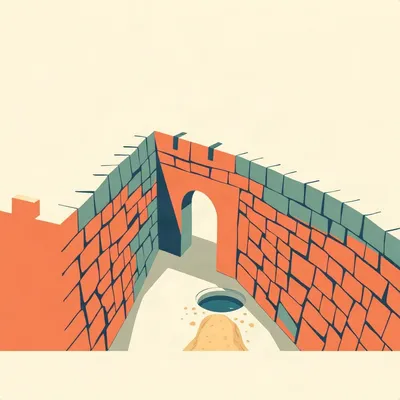
You can't open a pit. So instead, you install the perimeter first. Before you've dug anything, you build the walls that will hold the whole excavation. Either diaphragm walls, which are poured concrete panels sunk into a trench in the ground, or secant piles, which are overlapping drilled columns that form a continuous wall. You build the box before you empty it.
The box being the outside of the car park.
Then you excavate in stages. You dig down one level, and instead of just exposing the walls and hoping, you cast the floor slab for that level. And that slab isn't just a floor. It's a structural brace. It spans across the excavation and pushes back against the walls on either side, which are being pushed inward by all the soil and the buildings behind them.
So every floor you pour is also a strut.
Every floor you pour is also a strut. You go down, slab, down, slab, down, slab, seven times. And at the bottom, you've got your car park, and the building above never had a moment where the ground fell out from under it.
That's the part that gets people. The floors are holding the walls up.
And, as we'll get to, the walls are holding the floors up too. It's mutual. But the sequencing is the whole trick. You can't skip a slab. You can't dig two levels ahead of your concrete. Every stage depends on the stage before it being finished and cured.
Which is where the timeline question starts to bite.
Right. Top-down is slower per cubic meter of dirt. You can't bring in a fleet of excavators and just chew through the site. You're working in a confined space, under slabs, hauling material up through openings. And you can't dig faster than you can pour and cure concrete, because the concrete is what's keeping the walls from closing in on you.
So the method itself is a brake.
The method is a brake. But here's the counterintuitive part. It can still reduce total project time, because you're not building and then dismantling temporary shoring. And once the first slabs are in, you can start work above ground while you're still digging below. The building and the hole go up and down at the same time.
So the answer to Daniel's question is, it depends.
It depends. And in this specific case, the comparison is a bit dishonest, because the alternative isn't a faster method. The alternative is demolishing the building. That's the real choice. So asking whether top-down extends the timeline is like asking whether the stairs are slower than the elevator when the elevator doesn't go to your floor.
That's the thing. There's no fast version of this. There's only this version and the version where Beit Alliance comes down.
And Beit Alliance doesn't come down. That's the whole point of the project. The preservation requirement isn't a nice-to-have bolted onto the car park. It's the constraint that generated the method. Seven stories down, under a building that stays up, in a market district with no room to stage a conventional site.
Seven stories is the number that keeps coming back to me. That's deep.
It's unusually deep for top-down. Most top-down car parks are two, three, maybe four levels. Seven puts you in a much smaller club, and doing it under a preserved historic building next to an active market is what pushes it toward the most extensive ever conducted framing. It's not one hard thing. It's four hard things stacked.
Four hard things. Let me try to name them, because I want to see if I've got this right. Historic building that can't move. Active market that can't close. Seven stories of depth. And a footprint so tight you can't stage equipment normally.
That's the four. And any one of them alone is a normal engineering problem. Stack them and you start eliminating options. You can't use driven piles because of the vibration and the noise next to the market. You can't use an open pit because of the building. You can't go shallow because the whole point is seven stories of parking. The method isn't chosen because it's elegant. It's chosen because everything else is ruled out.
Which means the engineering is impressive.
It's impressive. And it sounds like a war.
Which brings us to what Daniel actually experiences, which is the noise.
The noise he's describing, the hammering that runs all day, is coming from the front end of the process. Diaphragm wall installation, pile driving, rock breaking. Those are impact and percussion activities. They're loud at the source, and they're low frequency, which is the worst kind, because low frequency sound doesn't attenuate the way you'd hope. It goes through walls. It goes through windows. It goes through you.
Is that why it carries two streets? Because I've walked past construction sites that were deafening at the fence and basically silent a block away.
That's the high frequency stuff. A jackhammer on a sidewalk, you hear it and then you don't. Low frequency is different. It has a long wavelength, so it bends around buildings instead of being blocked by them. It couples into the structure of the buildings themselves. That's why a pile driver two streets away can rattle your windows in a way a closer but higher pitched noise can't. Your windows are being driven, essentially. The building you're sitting in is acting like a big drum.
So the neighborhood isn't just hearing it. The neighborhood is physically inside the noise.
It's not a short phase. It's the setup phase, and the setup phase here is enormous, because the walls have to go all the way down seven stories before the slabs start doing their work.
The walls are the deepest single element on the site.
So the loudest part of the job is also the part that runs the longest.
So the method that protects the building is also the method that maximizes how long the neighborhood hears hammering.
That's the tension in one sentence. Preservation forces the method. The method forces the duration. The duration lands on the people living next to it.
And those people didn't get a vote on whether Beit Alliance was worth it.
That's the civic half of Daniel's question, and it's the harder half. Because the engineering has a right answer. The governance doesn't.
Let's take the tradeoff seriously, though. Cities do this all the time. Every significant project has a noise cost, and somebody has to absorb it.
And the standard tools exist. Restricted working hours. Acoustic enclosures around the loudest equipment. Quieter piling methods, like rotary bored piles instead of driven ones, which trade speed for a fraction of the noise. Real time noise monitoring with published data. Community liaison officers. Compensation schemes for residents.
So why doesn't every project use them?
Cost, mostly. Quieter methods are slower and more expensive. Acoustic enclosures are expensive and they get in the way of the equipment. And there's a structural reason too. The contractor's incentive is to finish. Noise mitigation costs money and time, and neither of those shows up as a benefit on the contractor's balance sheet. The benefit lands on residents who aren't party to the contract.
The classic externality.
The person making the noise and the person hearing it are different people, and the person making it has no reason to care beyond what the rules force them to.
So the rules are the whole game.
The rules are the whole game. And this is where Daniel's observation about Jerusalem lands. He says the site has been active a very long time with constant hammering, and he suspects the city hasn't given the noise dynamic much thought. If mitigation were being negotiated seriously, you'd expect to see it. Quieter methods where feasible. Predictable hours. Some communication about how long this goes on.
And what you actually get, walking past, is a fence and a sound.
A fence and a sound. Which tells you something about where the noise burden sat in the planning process. It wasn't a negotiating position. It was a byproduct.
Now, can that be fixed? Daniel asks whether this can be handled openly in a more democratic process. And I want to push on that, because more democratic doesn't automatically mean better here.
Go on.
Preservation and noise are both public goods, in a sense. The building belongs to the city's memory. The quiet belongs to the residents. If you put both to a vote, the residents vote for quiet, every time, because they're the ones hearing it. And the building loses, because the people who care about it are diffuse and not standing at the fence.
That's the argument against pure local democracy on these questions. The people with the strongest incentive to show up are the ones bearing the cost, and they'll vote to shift it elsewhere. Which is how you get cities that preserve nothing.
And the argument for it is that the people bearing the cost are the ones who actually live there, and a planning system that ignores them entirely is how you get cities that people stop trusting.
Both true. Which is why the interesting question isn't democracy versus expertise. It's what gets negotiated, and when.
Meaning?
Meaning the noise conversation usually happens after the method is already locked in. By the time residents hear the hammering, the decision that created it was made years earlier, in a room they weren't in. So the open question isn't whether residents should get a veto. It's whether the noise cost should be on the table at the same time as the preservation decision, so it's priced in from the start.
So you'd have the preservation people, the engineers, and the residents in the same conversation.
In the same conversation, before the method is chosen. And the engineers would have to say, out loud, this method protects the building and it will hammer your neighborhood for this many years. Here's the cheaper faster alternative and here's what it costs the building. Now choose.
And you'd probably still get the building preserved.
You'd probably still get the building preserved. But you might get quieter piling on the loudest phase. You might get a commitment on hours. You might get a published timeline instead of an open ended fence. The decision might come out the same, but the process would have produced mitigation, because the mitigation would have been a condition of the decision instead of an afterthought.
That's the part Jerusalem seems to have skipped.
That's the part. And it's not uniquely Jerusalem. It's how most cities do it. The preservation argument is made by people with standing, the noise argument is made by people without it, and the noise argument loses by default.
Which has a knock-on effect Daniel didn't quite name but is worth pulling out.
Which is?
If preservation always wins and the noise always lands on residents, you slowly teach people that heritage protection is something done to them rather than for them. And that's how you get a city where the next preservation fight is harder, because the neighborhood remembers the last one.
That's the erosion argument, and it cuts the other way too. If noise always wins, you lose buildings, and buildings don't come back. So the honest answer to Daniel's question is that this tension can't be resolved. It can only be managed, and the management is better when it's explicit.
Can the method itself be quieter, though? That's the engineering escape hatch. If the noise is the problem, can you build the same wall more quietly?
Some of it, yes. Rotary bored piling is dramatically quieter than driven piling. You can enclose the rigs. You can schedule rock breaking into defined windows instead of all day. The techniques exist. They're just not free, and they're slower.
The quiet version costs time.
The quiet version costs time, and time is exactly the thing the neighborhood is already angry about. So you're asking residents to accept a longer project in exchange for a quieter one. That's a real tradeoff, and it's the kind of thing you can only negotiate with the people affected, not decide for them.
Which is the answer to Daniel's democratic question. Not more democracy. More negotiation, earlier, with the noise on the table.
Hilbert: Eight inch grab. Forty foot trench. That's what makes the noise.
The diaphragm wall grab.
Hilbert: The grab goes down on a cable and bites the trench out in panels. Then they drop the cage and pour. The whine you hear when it comes up is the winch, not the bite. The bite is quieter than people think. The winch is what carries.
The thing Daniel's hearing all day is the machinery lifting, not the ground breaking.
Hilbert: Mostly. And I'll correct you on something. You said the slabs brace the walls.
That's the standard description.
Hilbert: It's half of it. The walls brace the slabs too. Every slab is sitting on the walls, and every wall is being held by the slabs. It's one system. You pour the slab and it holds the wall, and the wall holds the slab, and neither one works alone. That's why you can't skip a stage. If you dig past your last slab, you've got nothing holding the wall, and the wall's holding nothing.
It's not a wall with floors in it. It's a single structure that happens to be hollow.
Hilbert: That's right. And I did that on nights, on a garage in a city center, back when they still poured by hand on the night shift. The foreman used to say the building above us was standing on the floors we were pouring below it. Took me a while to understand he wasn't joking.
And the sequencing.
Hilbert: The sequencing is everything. You can design it perfectly on paper and still lose it if the pour is late. We had one where the concrete truck got held up and the foreman wouldn't let anyone near the face until it came. Two hours of standing around. He was right. You don't dig past your slab. Not once.
The safety of the whole thing rests on a guy with a schedule saying no.
Hilbert: It rests on a guy saying no. Every time. The drawings don't enforce themselves.
Which is a point the analysis misses. The method isn't just a design. It's a discipline. The structure only works if every stage is finished before the next one starts, and that's a human decision made under pressure, over and over, for years.
Hilbert: Years is right. And the noise doesn't stop when the digging does. The pumps run all night. That's a different sound. Lower. You stop noticing it after a while, which is worse.
The residents aren't just getting the hammering. They're getting the whole apparatus.
Hilbert: Nobody tells them how long.
That's the piece the research can't give you. The method works. The method is safe. And the method is only safe because somebody, every single day, refuses to go faster.
Which loops back to the timeline question in a way Daniel might not have expected. The timeline isn't long because the method is slow. It's long because the method is disciplined. You can't compress a sequence that has to hold.
The honest answer to why the site has been active so long is that the slowness is the safety.
The slowness is the safety. And that's a hard thing to explain to somebody who just wants the hammering to stop.
Which is the whole tension, and it doesn't resolve. So if top-down excavation is the only way to preserve a building like Beit Alliance in a dense city, and it necessarily means years of noise, then somebody has to bear that cost. The question is who, and how that gets decided, and by whom.
As cities densify and heritage protection tightens, this stops being a Jerusalem story. More projects are going to hit exactly this wall. Which makes Beit Alliance worth watching, not because of what it is, but because of what it sets up for the next one.
The one thing I'd take from this. The method isn't the problem. The method is the price of keeping the building. The problem is that nobody priced the noise into the decision when the decision was still open.
The fix isn't a better method. It's an earlier conversation. Put the residents in the room before the walls are chosen, and you might still get the same building, but you'd get a quieter, shorter, more honest version of the years it takes to build it.
That's the episode. Thanks to Hilbert Flumingtop for producing, as always.
This has been My Weird Prompts. If you want to find us, we're at my weird prompts dot com, and you can email us at show at my weird prompts dot com.
Leave us a review if you've got a minute. We'll be back soon.