Most coverage of the ancient symposium leads with the philosophy. Plato, Socrates, the good life, the examined argument. And then it treats the drinking as set dressing.

Which is backwards.
Completely backwards. The drinking was the technology. The philosophy was what happened once you'd got the mixture right. And the man who set the mixture, the master of drinks, ran the whole evening with a jug and a set of social penalties that would get you arrested at a modern dinner party.
Or at least uninvited from the next one.
Daniel watched us do the Master Bibendi last time and came back with a follow-up. He says the office itself was entertaining, but what caught his attention was the enforcement arm. The penalty for not keeping up, and not being sufficiently entertaining, was to be forced to be more entertaining. Parade around the room naked, or with the flautist, or both. Sing a song. Recite poetry.
The naked parade is the one people remember.
It's the one that photographs. But Daniel flags the poetry as the least colourful and the most interesting, and he's right. Because it implies a relationship to poetry we don't have. Anyone who's read Shakespeare wonders whether people actually talked like that. Probably not. But poetry sat at the centre of elite society in a way that has no direct modern equivalent. So: why were the ancients so into poetry? And could your average denizen of Rome or Greece actually produce beloved lines on demand, if a stern master of drinks demanded it?
Two questions, and the second one has a sharper answer than people expect.
So let's take the Master Bibendi seriously as an institution first, because the poetry thing only makes sense once you understand what kind of room he was running.
Start with the name, because Daniel's prompt says "ancient Roman Greece" and that's two different places wearing one coat.
Gently corrected.
The Greek office is the symposiarchēs. The symposiarch. The Roman titles are magister bibendi, master of drinking, and rex convivii, king of the feast. And the Romans didn't invent their own version from scratch, they took the Greek symposium framework and ran it as the comissatio, the revelry after the meal. The dinner itself was the convivium. So the Greeks gave us the institution and the Romans gave us the Latin names for it.
And the actual power of the office was one decision.
One decision, made once, and it governed the entire evening. The ratio of wine to water.
Which sounds like a bartending question until you remember that nobody drank wine neat.
Nobody. Greeks and Romans always mixed. Drinking merum, unmixed wine, was the habit of barbarians. That's not a joke, that's the actual framing in the sources. Unmixed wine was what the uncivilized did. So the mixing wasn't dilution for taste, it was the line between civilized and not, poured into a jar.
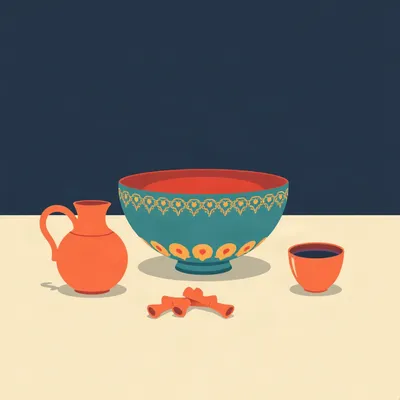
And the jar is the krater. The big mixing vessel. Wine goes in, water goes in, and then slave boys carry pitchers, oenochoe, and fill each guest's cup from the mixture. So the master's ratio propagates through every cup in the room.
And here's the part that makes him the director of the evening rather than the drinks guy. He set the strength depending on whether serious discussion or sensual indulgence was on the menu. That's the actual description. He was choosing the register of the night. Philosophical symposium, or something considerably looser.
So the ratio is a dial, and the master is the only person holding it.
And the stated purpose of the office was moderation. Sōphrosynē. The symposiarch existed to stop the party getting away from itself.
Which brings us to the built-in irony, because literature and art show the three-krater limit being blown past constantly. The office was supposed to enforce restraint and its main historical function seems to have been managing the pace of the opposite.
And the best evidence for what that room was actually like comes from a playwright, not a historian.
Eubulus. About three seventy-five BC. The play is Semele or Dionysus, and the speech is put in the mouth of Dionysus himself, which is the part I love. The god of wine stands up and delivers a calibration chart.
Read it properly, because it's funny.
"For sensible men I prepare only three kraters. One for health, which they drink first. The second for love and pleasure. The third for sleep. After the third one is drained, wise men go home."
That's the instruction manual.
"The fourth krater is not mine any more. It belongs to bad behaviour. The fifth is for shouting. The sixth is for rudeness and insults. The seventh is for fights. The eighth is for breaking the furniture. The ninth is for depression. The tenth is for madness and unconsciousness."
Ten stages. A god, on stage, reading out the escalation ladder.
The eighth krater is furniture. That's a specific man's job description and he's describing it as a known quantity.
And notice the shape of it. It's not a warning, it's a menu. He's not saying don't go past three. He's saying here's what you're buying at each price point.
So who gets the job?
Chosen by lot or by vote, from among the guests. That's the detail that changes everything about the shaming.
He's not a servant.
He's not a professional, he's not staff, he's one of the diners, elevated for the evening. Which means when he tells you to get up and perform, it's not top-down. It's peer to peer. Your friend, who got the short straw, telling you the room has noticed you're not pulling your weight.
That's a much worse sentence.
It is. And that's why the enforcement worked.
So the symposium is competitive. Not a passive evening.
Actively competitive, and the guests are the entertainment. Start with skolia. Singular skolion. Banquet songs, often patriotic, often bawdy, and performed competitively. One symposiast sings the first part, and another is expected to improvise the ending.
Expected.
Expected. Not invited. The turn comes round and you either have an ending or you don't.
And then capping. Participants exchange verses by varying, punning, riddling, or cleverly modifying whatever the previous person just did.
Which is a game with a loser. If you can't modify the line, you've just told the room something about yourself.
There were rhetorical contests too, weren't there.
There were, and that's why the English word symposium now means a conference where people give speeches. We named the academic conference after the drinking party, because the drinking party was where you practised giving speeches.
That's a hell of a fossil.
And kottabos. Guests swirl the wine dregs in the cup, the kylix, and fling them at a target. Skill game, winners and losers, and it requires a certain amount of wine to have been drunk first, so it's also a progress bar.
The whole evening is a progress bar.
And the mechanism that puts you on the spot is physical. The lyre gets passed hand to hand, singer to singer, as each person's turn comes. You can't hide at the back. The instrument arrives at your hands and the room is looking at you.
That's the ancestor of Daniel's line. Force them to be more entertaining.
Exactly that, and it's a real object doing the forcing.
Now the honest part. The naked parade, the flautist, the singing, the poetry recitation. How well attested is the specific ritual?
This is where I want to be careful, because the competitive mechanisms are documented concretely. Skolia, capping, rhetorical contests, kottabos, the lyre going round, all of that is solid. The specific humiliation set, parading naked with the aulos player, that's consistent with the culture and with the presence of flute girls, hetairai, entertainers, slaves drawn into the revelry, but I'd want the primary source named.
Which would be?
Athenaeus, Deipnosophistae, is the usual place these banquet anecdotes live. Or a comedy fragment. If Daniel's got a citation, I'd like to see it, because the shape of it is right but I don't want to hand you a ritual that turns out to be one line in one fragment.
Noted, and we'll flag it as the part of the prompt with the thinnest paper under it.
Thin paper, right shape.
One more structural thing before we get to the poetry, and it's the class point. Who was actually in the room?
Small room. Typically seven to nine couches. Call it fourteen to twenty-seven people at the top end. Oswyn Murray puts a standard drinking group at fourteen to thirty.
So this is not a banquet hall. This is a dinner party.
It's a dinner party with a strict guest list. Greek symposia excluded women of status entirely. Only hetairai and entertainers attended. Rome loosened that, women of status could attend the convivium, but Roman women were legally prohibited from drinking wine as a matter of public morality.
So the Roman woman is at the table and not at the cup.
That's the rule on paper, and rules on paper are their own genre.
Which brings us to the penalty Daniel flagged as the least colourful and the most interesting. The poetry recitation. Because that one only works if poetry was something you could actually be expected to produce on demand.
And it was. But the reason it was is that poetry in that world was not a text. It was a skill.
Unpack that, because it's the hinge of the whole episode.
The symposium was the venue for poetry. Poetry and music were central to the pleasures of the evening, and the crucial part is that the art form was performed by the participants themselves. Not by specialists for a passive audience. There's no stage. There's no poet up front doing a reading. The room is the performance.
So the comparison isn't to a modern poetry reading. It's to something else entirely.
It's closer to a jam session. Or freestyling. It's a live, improvised, competitive skill that you either have or you visibly don't, in front of people whose opinion of you matters.
And it's an elite marker.
It's the marker. Symposia were a forum for the sons of respected families to debate, plot, boast, or revel. And here's the circular part, many of the archaic poetic sources we have were written by members of the social elite. So the surviving poetry is essentially the self-expression of a ruling class, preserved by the class that produced it, for the class that performed it.
We are reading the winners' songbook.
We are reading the winners' songbook, and then concluding that everyone sang.
So who were the poets? Because Daniel's framing is that being a poet was an elite social position.
Skolia were written not only by professional poets, Alcaeus, Anacreon, Simonides, Pindar, but also by Sappho. Which tells you the esteem the form was held in. Sappho writing drinking songs is not a minor poet's side hustle. That's the top of the culture working in the genre.
And the celebrity case.
Agathon. He hosted the most famous symposium of all, in Plato's dialogue, to celebrate his victory in the four sixteen BC theatre contest. The party exists because a poet won a prize. That's the poet as celebrity host, and Plato built the most famous dinner party in Western literature around him.
And the gods are imagined doing it.
The gods of Olympus sang at their banquets. If the highest model of existence you have is a banquet, and at your banquets people sing, then your gods sing.
So now Daniel's question. Could your average denizen of Rome or Greece recite beloved lines on demand if a stern master of drinks demanded it?
Two different people are hiding inside that question, and they get opposite answers.
Give me the elite first.
For the elite, yes, plausibly. These were people trained from childhood in paideia, elite education, and reciting, capping, and impromptu composition were core social skills. A well-born symposiast could very likely produce a known line, or improvise a fitting one, on the spot. That's not a party trick for him. That's a competence he's been drilled in since he was a boy.
And the average denizen.
Almost certainly not. And the sources are explicit about this. Many archaic poetic sources were written by members of elite communities and may not be representative of the whole local society. The symposium was a closed aristocratic institution. The farmer, the artisan, the slave, none of them were at the banquet and none of them were the audience for this poetry.
So the honest answer to Daniel is: the question is malformed, and the malformation is the interesting part.
The question assumes one ancient public. There wasn't one. There was a small room where poetic competence was a survival skill, and there was everybody else, who never got asked.
Now the modern comparison, and why it fails. Because Daniel's hypothetical is a modern dinner party where the master of drinks puts someone on the spot to recite a poem by a well-known contemporary poet, and he's right that the person would have a very hard time.
Three reasons, and they're structural, not a lament about culture.
First.
Performance versus consumption. Ancient poetry was performed by the participants, live, competitive, improvised. Modern poetry is largely consumed privately, books and screens, or performed by specialists, poets, rappers, spoken word artists, for audiences that are there to receive it. The roles are separated now. In the symposium they were the same person.
Second.
No shared canon of memorized text. The symposium assumed a common stock of songs and verses that everyone in the room knew and could extend. Modern culture has no equivalent universal canon that a dinner guest is expected to reproduce from memory. There's no song everyone at the table can finish. There's no poem the room assumes you carry.
And third.
The institution is gone. The symposium was a specific social technology. A structured, recurring, elite gathering with rules, a master of ceremonies, and competitive norms. Take the institution away and the art form loses its social function. Poetry didn't get worse. The room that required it stopped existing.
So what are the closest things we have?
Freestyle rap battles, karaoke, pub quizzes, toasts and roasts. And the one the etymology people actually point at, the Japanese renga tradition, linked verse, where poets alternate and extend each other's stanzas. The skolion is explicitly compared to renga in the scholarship.
And none of them is an equivalent.
Each one captures a dimension. Freestyle has the improvisation and the competition. Karaoke has the performance and the shared canon, but nobody's improvising, you're reproducing. Pub quizzes have the shared knowledge and the public failure. Toasts and roasts have the social stakes, but they're prepared, and they're usually one person's job for the night. Nobody's got all four at once.
Which is the second-order point, and I want to land it properly, because it's the answer to Daniel's question and it isn't a compliment or an insult to anybody.
Go.
The reason the hypothetical modern dinner party fails is not that we're less clever or less cultured than a Roman aristocrat. It's that we removed the institution that made poetic competence a social survival skill. The master of drinks wasn't asking his guests to do something hard. He was asking them to do something everyone in that room had been trained to do since childhood, in a room where failing was visible and costly.
That's the difference between a hard task and a dangerous one. Reciting a poem is not hard if you've been doing it your whole life. Reciting a poem in front of people who will notice if you can't is a different thing entirely.
The training made it possible. The room made it matter.
The room is the part we can't reconstruct by trying harder at dinner parties.
Hilbert, you've been quiet, and I have a feeling you have something to say about being the person whose job is to make a room perform.
Hilbert: A hundred and forty dollars. That was the per-head price for the murder mystery dinner. That's the food, the actors, the room, and me.
The banquet captain.
Hilbert: Banquet captain. I stood up between courses and got a room of strangers to perform. Sing a song, tell a joke, do a bit. Forty people who'd never met, and I had a microphone and a schedule.
You ran the enforcement arm.
Hilbert: I ran the enforcement arm. No wine ratio. I couldn't water anything down. All I had was the microphone and the fact that the dessert hadn't come out yet.
And some people refused.
Hilbert: Some people refused. And here's the thing, because you two got most of it right and then stopped one step short. You said the training made it possible. That's true. But it's not the training that saved them. It's that everyone had the same training.
Say more.
Hilbert: The ones who froze at my dinners weren't untalented. I had a woman who ran a regional sales team, forty people under her, could talk to anybody. She froze. Because she couldn't guess what the room would find acceptable. Was a joke too blue? Was singing too much? Was a story too long? She had no idea where the edges were, so she didn't move.
A Roman symposiast never had that problem.
Hilbert: Never. The canon was the safety net. You knew the song. You knew the register. You knew the room would laugh at the bawdy one and nod at the patriotic one, because you'd all been in the same room since you were boys. You couldn't fall, because there was a floor.
The shared canon is what makes public performance survivable.
Hilbert: It's the whole thing. Talent's the smaller half. Knowing what the room will forgive is the bigger half.
You kept notes on this, didn't you.
Hilbert: I kept a notebook. Best and worst, every dinner, two years of them. I still have it. I can quote from it.
Give us one.
Hilbert: There was a retired actuary. Sixty-something, quiet man, sat at the back, and I had him marked as a freeze. He stood up and did four minutes on wine dilution ratios. Ratios. How much water, why the Greeks watered it, what happens to a room when you get it wrong. And it killed. Forty strangers, dying.
Why did it work?
Hilbert: I've never been able to explain it. I've thought about it for years. Best I've got is he found the one subject where the whole room was on the same floor. Nobody there had performed at a symposium. Everybody there had been to a dinner where somebody had too much and the evening changed temperature. He picked the thing everyone had in common and then he was safe.
He built the canon in the room.
Hilbert: He built it in four minutes, which is the part I still can't do.
That's the thing the sources can't give us. What the moment of refusal actually felt like.
Hilbert's got the mechanism. It's not that the ancients were braver. It's that a shared canon is a floor, and we spend most of our evenings standing on nothing.
Which raises the question I can't answer. If the symposium was a social technology that turned poetic competence into a survival skill, what are we inside right now that will look equally strange to someone two thousand years out? Whatever it is, we won't be able to see it, because the whole trick is that it's the floor.
The second one, which I find harder. The Master Bibendi's office was supposed to enforce moderation. It ended up enforcing participation. Is that a failure of the office, or is that what every office that claims to enforce moderation actually does?
Leave it there, because I don't think we get to answer it.
Then the housekeeping. This has been My Weird Prompts, episode five thousand six hundred and fourteen. We're at my weird prompts dot com, and the RSS feed is there too if that's how you listen.
If you want to send us something, email us at show at my weird prompts dot com. And if you enjoyed this one, a review helps more than you'd think.
Thanks to our producer, Hilbert Flumingtop.
This has been My Weird Prompts. We'll be back soon.
See you tomorrow.