
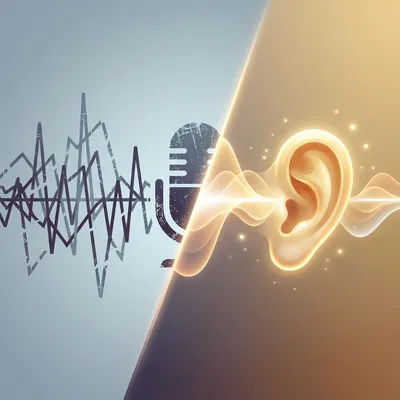
Episode 10
How ASR Went From Frustration To ... Whisper Magic
Speech to text: from frustrating to fantastic. Uncover the magic behind its rapid rise and connection to the AI boom!
34:09 Transcript

Episode Details
- Episode ID
- MWP-129
- Published
- Duration
- 34:09
- Audio
- Direct link
- Pipeline
- V3
- TTS Engine
-
 chatterbox-tts
- Script Writing Agent
-
 Gemini 2.5 Flash
AI-Generated Content: This podcast is created using AI personas. Please verify any important information independently.
Mentions
- Attention Is All You Need 2017 paper introducing the transformer architecture
- CMU Sphinx Legacy open-source speech recognition system
- CTranslate2 Fast inference engine for transformer models
- FAA US aviation regulator
- GGUF Quantized model file format for llama.cpp
- Hidden Markov model Statistical model used in legacy ASR
- Mel-frequency cepstral coefficients Acoustic feature extraction for speech
- OpenAI AI research and deployment company
- Viterbi algorithm Decoder for most-probable word sequences
- Whisper OpenAI's speech-to-text model
Downloads
Transcript (TXT)
Plain text transcript file
Episode Book (PDF)
The episode's record — date, duration, models, sources — with the full transcript
You Might Also Like
Featured In
Never miss an episode
New episodes drop daily — subscribe on your favorite platform
New to the show? Start here#10: How ASR Went From Frustration To ... Whisper Magic

So, if you've ever tried to use speech to text technology, and I mean really tried, not just, you know, casually yelling at your phone say a decade ago, you probably recall this deep, churning sense of frustration.

Oh, absolutely.
Maybe you were trying to use a a cutting edge system for the time, something like CMU Sphinx on a a clunky old Linux box, just hoping to get some meeting notes down.
And what was the result?
The result was, I mean it was often this bizarre, almost hilarious series of just incoherent syllables, spelling so far from reality, you just had to type the whole thing over anyway.
It was so disappointing. It was what we call a usability cliff. The tech existed, sure, but the reliability, the word error rate or WER, was so high that it actually made you less productive.
Right. You were basically just a free data corrector for the machine.
Exactly. You were working for it, not the other way around.
And now, fast forward to today, we have tools like Whisper, and suddenly it feels, well, it feels almost magical. You can speak into your phone, there can be background noise, you can even switch languages mid-sentence. Yeah. You know, jump between English and some technical Hebrew jargon and it just gets it almost every time. It's not just an improvement, it's a quantum leap.
It really is the definition of a paradigm shift. And that's really the mission for this deep dive. We need to understand precisely how we got over that cliff. What was the, the engineering masterpiece that replaced that old, brittle architecture?
Yeah, let's get into that.
We'll explore the history, the exact architectural shifts that made modern automatic speech recognition or ASR actually viable. And I think this is critical, we need to reveal what the highest stakes industries do.
The mission critical stuff.
The mission critical applications where cost is no object and they need life and death accuracy.
And we're also going to unpack some really surprising, I think, truths about local performance. You know, if you, the listener, are running these models on your own desktop GPU, which is becoming super common. So let's just frame the core question for today. What was the fundamental architectural shift that happened between say the early 2010s and today that took ASR from a frustrating research project to a reliable daily tool?
To really appreciate the magic, I think we have to spend a little time in the misery of the past.
Right, the age of disappointment.
Exactly. The ASR systems from the 80s up through the early 2010s, the ones that gave speech recognition its bad name, they were built on this massive, really complex and slow pipeline of separate components.
So it wasn't one big model trying to do everything. It was more like an elaborate, delicate stack of different tools that all had to work together perfectly.
A very delicate stack. And that's the key. Unpack that for us. What were the main layers in that old architecture that basically defined its failure?
Okay, so you had four core segmented tools that all had to execute flawlessly one after the other. First up, you had the acoustic models.
For decades, these were things called hidden Markov models or HMMs, often paired with Gaussian mixture models, GMMs. Their job was super technical. Take the raw audio, turn it into some standard features.
Often called MFCCs, right?
Exactly. Mel-frequency cepstral coefficients or MFCCs, and then map those acoustic patterns to distinct speech sounds, you know, phones.
Hold on, you just threw out MFCCs there. What what exactly is an MFCC? To the average person, that's just a complex technical term.
That's a great question. An MFCC is often called the acoustic fingerprint of a sound.
An acoustic fingerprint?
Yeah. Think of it this way. Your voice and my voice have different pitches. If we both say the word cat, the raw sound waves are totally different. The job of the MFCC process was to strip away all of that irrelevant stuff, the pitch, the volume, the tone, and just distill it down to its fundamental spectral characteristics.
So it's the core shape of the sound.
The core shape of the sound that defines the word itself, no matter who said it or how loud they were.
Ah, so it was standardizing the input. That way the model wouldn't get confused by different speakers or microphones. It was looking for the essence of the sound.
Exactly. It was translating messy sound into these clean, standard sound units. But that's just step one.
Okay, so what came next?
Then you needed the language models. These were absolutely crucial for context because the acoustic model is, well, it's fundamentally stupid. It only understands sound.
Right.
So if the acoustic model hears something that could be I scream or ice cream, it has no idea. It needs help. The language model uses statistics, specifically n-gram models, usually trigrams.
Trigrams, so?
Three words. It looks at the previous two words to determine which sequence is more likely. I want some. Well, ice cream is way more likely than I scream.
So the language model is only looking backward a couple of words to make its guess. That seems like a huge limitation.
It was a massive restriction. That context window was incredibly short, usually just three to five words. To give you an example that would just absolutely break an old n-gram model. Imagine a complex sentence like this. The chief scientist, after reviewing the entire four-volume report and consulting with outside experts, deemed the experiment a success.
Right. So in that sentence, the acoustic model hears a sound that could be teamed or deemed.
Exactly. And if the language model is only looking at the words outside experts, the probability of deemed or teamed, it could be 50/50 or just plain wrong.
Because the crucial information, the subject, the chief scientist, is like 15 words away.
And the n-gram model has zero chance of seeing it. It can't look that far back to connect the verb to the subject.
It's totally blind to long-range dependencies. That that explains so much of the frustration right there.
Yeah. But there were two other components you said.
There were. The third was the pronunciation dictionary. This was a huge, manually curated list mapping every single word to its phonetic sequence.
So if you said a word that wasn't in the dictionary?
The system failed. Instantly. It was an out-of-vocabulary word. Didn't matter how good the acoustic model was.
Wow. And the last piece?
And finally, tying it all together, you had the Viterbi algorithm. This was the decoder.
That Viterbi algorithm sounds like the traffic cop trying to manage all this probabilistic chaos.
How hard was its job?
Its job was terrifyingly difficult. It wasn't just guessing, it was searching for the single most probable sequence of words among, I mean, potentially millions of possibilities.
Millions?
Oh yeah. Every phone the acoustic model identified had a probability. Every word transition the language model allowed had a probability. Viterbi had to search through all those possible paths at the same time.
So the path for ice cream is cold, the path for I scream is sold, ice cream is sold.
All of them. And it had to pick the one that maximized the total combined probability score from all the other components.
That sounds incredibly complex and, like you said earlier, incredibly fragile. One failure in any of those components and the whole thing just falls apart.
Precisely. If your dictionary missed one technical term, or if a dog barked and messed up the MFCC extraction, or if the context was too long for the n-gram, the whole transcription just collapsed.
Which is why those systems struggled so badly with any kind of real-world messiness, right? Accents, background noise.
Anything that required flexible, long-range understanding.
Now, we know deep learning started to, you know, creep in before the big revolution, around 2012 to 2017.
Right, the incremental steps.
Yeah. If the stack was so fragile, why didn't just plugging in a neural network fix the problem right away?
Well, the first big step was replacing the GMMs in the acoustic stage with deep neural networks, or DNNs. This created what they called HMM DNN hybrid systems.
Okay. And this was a pretty big improvement in accuracy.
DNNs are just deeper and more complex, so they could learn way more subtle and resilient patterns from the audio than the old GMMs ever could.
So, if the acoustic model got smarter, if this hybrid could find that acoustic fingerprint better, why didn't that alone solve the problem? Was the language model really the main bottleneck?
That is the critical insight, yes. The language model was the primary, insurmountable bottleneck. The HMM DNN hybrid improved the raw material, you know, the accuracy of the phone prediction, but the core problem was still there. You still had this complex, multi-part pipeline that needed the HMM structure, the brittle n-gram language model, and that rigid dictionary.
So you couldn't fix the lack of long-range context just by making the front-end acoustic model a little bit better.
Exactly. You were faster, slightly smarter on the acoustic side, but still fundamentally chained to that fragile sequential stack and that short-sighted three-word context window.
Fascinating.
Then came the era of recurrent neural networks, RNNs and LSTMs. These were attempts to fully replace HMMs and move toward end-to-end modeling.
And they were better at handling sequences, right?
Better, but still sequential. They had to process the audio step-by-step, which made them computationally very expensive, hard to parallelize, and still, at their core, bad at grasping those long-range dependencies. The ultimate problem was the inability to see the entire transcription at once. That was the bottleneck we needed a complete break from.
That inability to see the whole picture simultaneously brings us right up to the moment everything changed. If the old way was sequential, fragile, and short-sighted, what was the architectural innovation that just blew that paradigm wide open?
It was the transformer architecture, which was introduced in that famous 2017 paper, Attention is all you need.
A legendary paper.
It fundamentally changed sequence modeling across all of AI, not just speech. It solved the sequencing problem by, well, by making the system stop needing to read information word by word.
Attention is all you need. A truly deserving title. But for ASR, what does self-attention actually mean in practice? How does it let the model overcome that sequential blindness of the older RNN and LSTM models?
It means moving from sequential processing to parallel processing.
Okay. In an RNN, if you have a 30-second audio clip,
the model has to consume the first second, then the second, then the third, building its context piece by piece. That creates huge bottlenecks. The transformer, using self-attention, can process the entire audio sequence at the same time.
So wait, instead of reading word by word, the model sees the whole 30-second chunk of audio at once, like a single snapshot. And it just knows which parts are most relevant.
Exactly. It's like having a universal index for the entire piece of information. The self-attention mechanism assigns different weights, different levels of importance to every part of the input, identifying relationships no matter how far apart they are.
Let's go back to that broken anagram sentence from before.
Perfect example. The chief scientist deemed the experiment a success. The attention mechanism knows that when it's trying to predict the word deemed, it needs to pay very high attention to the subject chief scientist, even though it's 15 words earlier.
And it pays less attention to the words right before it, like outside experts.
Precisely. It learns what's contextually important, not just what's nearby.
That contextual understanding is just immense. And this innovation is what paved the way for Whisper, which came out in late 2022. That really felt like the moment ASR became viable for everybody. So we know the transformer was the base, but what were Whisper's three game-changing attributes that really made it work for the masses?
It was really the combination of these three things that made it revolutionary. First was the unified architecture, what we call end-to-end modeling.
Okay. End to end.
Because of the transformer, Whisper is a single encoder-decoder model. It completely eliminated that entire brittle legacy stack. No separate acoustic models, no separate language models, no pronunciation dictionary.
So it takes raw audio in and just spits formatted text out all in one go.
In one unified pass.
Yeah. Which dramatically reduces the points of failure. That architectural simplicity alone must make it so much more robust. But the sheer volume of data was a huge factor too?
That's the second and equally crucial factor, massive scale training. You know, traditional high-quality ASR was maybe trained on hundreds or a few thousand hours of clean, studio quality audio.
Right.
Whisper was trained on an unprecedented 680,000 hours of multilingual web-scraped audio.
680,000 hours. That's just astronomical. Why did that sheer diversity of data matter so much, especially since a lot of it must have been really messy?
That's the key. The sheer diversity guaranteed an inherent robustness to real world messiness.
Ah.
Older models trained only on clean data were like perfectionists. They just broke the second they heard an unfamiliar accent or a dog barking. Whisper was trained on that messiness. Noisy rooms, cheap mics, heavy accents, people switching languages, jargon from 98 different languages.
So it learned to filter out the noise because it saw so much of it during training.
It learned what real world audio actually sounds like, so it became naturally resilient to the very things that crippled the older systems.
And the third factor you said was about its utility, like a Swiss army knife.
Exactly. The third attribute is multitask learning. Whisper wasn't just trained to do basic transcription. It learned transcription, translation to English, language identification, and voice activity detection, all at the same time.
From the same data.
All simultaneously. And training on all those tasks at once forced the model to develop this really highly generalized, deep understanding of the features of human speech, no matter the language or the specific task.
This brings up the classic paradox, though. It's the question everyone asks. If ASR was so bad before 2022, where did OpenAI get 680,000 hours of transcribed audio to train Whisper? Who transcribed all that if no good ASR existed?
It's the ultimate chicken and the egg puzzle, and the answer is this idea of multi-generational bootstrapping.
Bootstrapping.
Yeah, back in the 80s and 90s, the first data sets were small enough, maybe 50 or 100 hours, that they could be manually transcribed by linguists.
Okay. That makes sense for the start.
Then, as the models got a little better, say 50% accurate, researchers switched to a hybrid approach. They'd manually transcribe a small core set, use that imperfect machine to create drafts of the rest, and then pay human reviewers to just correct the machine's transcript.
Which is way faster than transcribing from scratch.
Way faster. So the data used to train the next generation models was transcribed and then corrected by humans who were reviewing the flawed output of the previous generation.
I see, so it's an iterative process.
Precisely.
Yeah.
But Whisper took this and accelerated it exponentially with a method called weakly supervised training.
Weakly supervised.
They didn't rely on perfect gold standard human transcripts for most of those 680,000 hours. Instead, they just scraped the internet for any audio that already had a transcript, even if that transcript was known to be imperfect.
Like what? YouTube captions?
Exactly. YouTube captions, closed captions, audiobooks.
Mhm.
A lot of which were created by older, less accurate ASR systems.
Ah, so Whisper was literally trained on data transcribed by its own ancestors. It inherited and then corrected the mistakes of the earlier models, but at a massive scale.
It was a monumental filtering task. OpenAI used automated metrics to weed out the absolute worst audio transcript pairs. But the core insight was that the sheer quantity and diversity of this weakly supervised data, when you pair it with the context-aware transformer architecture, allowed the model to learn the generalized structure of language and override the little inaccuracies in the ancestral transcripts.
So quantity and diversity beat perfect quality in this case.
It proved that in the age of transformers, a massive quantity of diverse, even slightly imperfect data could overcome the quality issues that had plagued every system before it.
That completely answers our core question. The shift wasn't just incremental, it was a fundamental architectural break. The transformer's parallel processing, supercharged by an unprecedented scale of weakly supervised data. That is the difference between the brittle CMU Sphinx and the near magical utility of Whisper.
Now, we need to shift our focus pretty dramatically from general consumer viability to enterprise necessity. Because an off-the-shelf model like Whisper gives you great results for general use. That 3 to 5% word error rate on clean audio is fantastic. But when we're talking mission critical systems, that 3% error rate is still a complete deal breaker.
It's not good enough.
Not even close. These systems need near zero error tolerance. They're aiming for less than one or 2% EER, and they have to meet these incredibly stringent regulatory compliance standards.
So if the budget is basically unlimited and a mistake could literally mean a safety risk, loss of life, or a huge financial penalty, what separates that enterprise strategy from what a developer is doing with a slightly customized Whisper model?
Let's start with medical transcription. This is a great example.
Okay.
Here, the accuracy requirements are sky high, not just because of complex medical terms, but because of the real danger of medication errors. For example, transcribing Celebrex, a pain reliever, instead of Cerebyx, an anti-epileptic drug.
Wow, they sound almost identical.
The acoustic difference is tiny, but the context is everything. That kind of error could be lethal.
That is a perfect high stakes example. So what specific engineering steps do medical systems take to mitigate that risk that a general model like Whisper just doesn't?
They require extreme specialization. They absolutely do not use a general ASR model. They use models that are specialty specific.
So a model just for radiology?
Or just for oncology.
Or just for oncology.
Exactly. Radiology, oncology, pathology. Models trained for years on those specific vocabularies. And furthermore, these systems have to strictly comply with regulations like IPAA.
Right, data privacy.
And that compliance often mandates an on-premise deployment or a very strict private cloud. You are prohibited from using a general external API where patient data might get sent to a third party. The entire platform has to be dedicated and auditable.
That on-premise mandate is key. It's not just about accuracy, it's total control over the data environment. Okay, another terrifying mission critical example would have to be air traffic control.
ATC is maybe the apex challenge for ASR.
I can imagine. The noise, the terminology.
You have highly specialized aviation phraseology, proper nouns like airport codes, unique call signs. And the audio itself is just terrible. You've got radio static, engine noise, cockpit alarms, and often non-native English speakers.
A slight misinterpretation of altitude, 3,000 instead of 2,000.
Catastrophic. It's a catastrophic failure.
So the systems that major players use, they must be certified platforms, right? They go through regulatory bodies.
Absolutely. They need strict certification from regulators like the FAA in the US or EASA in Europe, and they have to incorporate mandatory safety features like real-time confidence scoring.
Confidence scoring?
Yeah. If the model is 99% confident in the transcription, it passes through the screen. If that confidence drops to say 85%, it gets flagged for immediate human review. It might even show two competing possibilities. It's a built-in fail safe system.
Okay, this brings us to the big question then. If an organization has an essentially unlimited budget and time, what is the mandatory, non-negotiable process they follow to get that sub 2% error rate? How do they build that system when they can't just scrape YouTube like Whisper did?
It starts with the custom data mandate. This is completely non-negotiable.
They can't use public data sets at all.
Under no circumstances. They have to collect proprietary data specific to their environment. For ATC, that means collecting actual legally approved communications from towers and cockpits. For hospitals, that means recording real physician-patient interactions, all under strict legal compliance.
And how resource intensive is that data collection? We're not talking about a quick download.
No, this process is mandatory and often takes between six to 18 months just for the data acquisition phase. It's a huge, slow, expensive effort just to get the raw material that's going to make their model different.
And once they have the audio, they can't use that weekly supervised approach. They need perfect transcripts to serve as the ground truth.
They require gold standard transcripts. This means extensive human in the loop verification and QA. They use professional human transcriptionists and domain specific linguists, people who actually understand the difference between Celebrex and Cerebex in context.
And they do multiple passes.
Sometimes three or four human reviews before that transcript is considered gold and can be fed into the training pipeline.
That level of human rigor turning messy audio into absolutely perfect training data, that has to be where a huge chunk of the cost is. You mentioned a total cost of two million dollars to 10 million dollars or more for deployment. Where does that money go?
It's spread across a few key areas that just don't exist in consumer ASR. First, the data pipeline and curation. That's millions right there in linguist salaries and data compliance infrastructure. Second, the model stack and integration. They don't just fine tune one model, they deploy multi-model ensemble systems.
A stack of models working together. Can you break that down?
Yeah. So they might use one highly tuned model just to clean up the terrible radio noise. Then a separate, highly customized language model handles only the domain specific jargon. And maybe a third model handles who spoke when.
So instead of one unified brain like Whisper, it's more like a pit crew of highly specialized regulated systems all working in concert.
Exactly. And finally, a huge part of that budget goes to regulatory audit and continuous compliance. They have to constantly prove to the FAA or the hospital accreditation board that the system is stable, accurate, and secure. It's not a one-time setup.
They're building pipelines to continuously feed corrected data back into the model to retrain it.
Exactly, to make sure the system evolves as procedures or flight patterns change.
That distinction is so important. For mission critical ops, ASR isn't a cheap API call, it's a high cost, long-term platform investment, backed by years of proprietary data rigor.
Moving back to the individual user, we need to address a really common and often misunderstood technical point when people start running ASR models locally on their own GPUs.
Oh, I think I know what you're talking about. The panic.
The panic, yes. A user sees their GPU usage spike to 95 or 100% during the transcription and their immediate thought is, oh no, I'm bottlenecked, my GPU can't handle it, I need to upgrade.
Right, the GPU utilization myth. It's based on a gaming analogy because in gaming, 100% GPU utilization often is a bottleneck. So what's the crucial difference here with ASR? Why is 100% GPU a good thing?
The key is understanding the workload. AI inference is a burst workload. It's not continuous like gaming, which is constantly drawing frames. In ASR, the process is, wait for a chunk of audio, process that chunk as fast as humanly possible, and then the system immediately drops back to idle.
So that spike to 100% for maybe half a second just means the GPU is efficiently mobilizing all its resources to do that one calculation instantly. It's minimizing latency.
Precisely. It's the optimal outcome. You want it to spike to 100% because it means you're getting maximum throughput. If it were only at 50%, you'd be wasting compute cycles and your transcription would be slower.
So GPU utilization percentage is completely irrelevant to the quality of the output.
Totally irrelevant. What matters is how fast you achieve the real-time factor or RTF.
Explain RTF. That sounds like the metric people should actually be watching.
RTF is simple. It's the ratio of processing time to audio duration. If you have 30 seconds of audio and your model processes it in 15 seconds, your RTF is .5.
Okay.
If your RTF is .1, you're processing the audio 10 times faster than a real time. That's the goal. If your GPU is spiking to 100% but you're getting an RTF of .2, you're at peak efficiency.
So utilization isn't the constraint. What is the real hardware constraint for local ASR, especially for bigger models?
DRAM. Video RAM is the real constraint. Your VRAM capacity dictates which model size you can even load into memory.
Right.
You need enough VRAM to hold all the model weights. For instance, the large Whisper model needs about 7.5 gigs of VRAM. An 8 gig card is ample for the medium model or smaller. If the model fits in VRAM, that utilization spike is just the engine revving to max speed for the burst.
That clears up a huge point of confusion. Now, let's talk about that 30-second constraint that often plagues the user experience during live transcription. It causes that choppiness. Why is that window so rigid?
That 30-second window is a hard architectural constraint of Whisper, and it's baked right into the model structure because of how the transformer works.
Okay.
The audio input is converted into a fixed-size mel spectrogram, which represents about 30 seconds of audio. The problem is that self-attention mechanism we were praising earlier. Its computational cost scales quadratically with the length of the sequence.
Quadratic scaling. So if you double the audio length, the memory and compute needed goes up by four times. Triple it, it goes up nine times.
Exactly. The memory cost just explodes. So extending the input past 30 seconds becomes computationally infeasible on consumer hardware and incredibly expensive even on big servers. It's unavoidable.
So when a user is speaking for more than 30 seconds straight, the app has no choice but to use this sequential chunking, cutting the audio arbitrarily.
Correct. And that leads directly to a bad user experience. You get boundary errors where words get cut in half, you get latency while the system processes the last chunk. It's not smooth.
Which brings us to the live versus batch tradeoff. If I'm taking notes in a critical meeting, should I be using live dictation or is it better to just record the whole thing and transcribe the file later?
For maximum accuracy and quality, batch processing almost always wins. And the difference can be significant. We're talking 5 to 20% better accuracy.
If they're using the exact same underlying Whisper model, what gives batch processing such a big edge?
The primary advantage is bidirectional context.
Okay.
In live transcription, the system has to process in real time. It can only look backward at what was just said. In batch transcription, the entire audio file is available before it starts. So the system can use bidirectional context, it can look forward in the audio stream.
Can you give a concrete example of how looking forward changes the output?
Sure. Imagine the acoustic model hears something that could be, I went to the store to buy tires, or it could be, I went to the store to buy tears.
Right.
If the model is only looking backward, it might pick tears. But if it can look forward and see that the next phrase is for my new truck, the model instantly knows with high certainty that the word has to be tires.
That future context resolves the ambiguity in the present. Live transcription can't do that.
It can't because the future hasn't happened yet. And beyond that, batch processing also allows for optimal segmentation. Instead of cutting the audio every 30 seconds, it can analyze the whole file and split it at natural pauses or sentence breaks. You get far fewer boundary errors.
So the recommendation is clear. For quality critical long form notes where accuracy trumps immediacy, asynchronous batch transcription is the way to go. You record the full file first.
You prioritize quality over speed and you gain the power of looking ahead.
So we've established that the transformer and massive data got us, you know, 90% of the way there. It provided this near magical utility. What are the current frontiers in ASR research that are trying to close that last 10% gap to flawless?
The focus is definitely shifted from just raw accuracy, which is already pretty high in clean audio, to enhancing usability and structure and deep understanding. One key frontier is enhanced formatting.
Moving beyond just a raw stream of text, I assume, to something more organized.
Exactly. We need models that can automatically generate paragraphs, section breaks, proper capitalization, really a semantic structure, not just based on acoustic cues, but on the meaning of the content.
Right now you have to use a separate LLM for that as a post-processing step.
You do. The frontier is native ASR that outputs structured text that's ready to read, not just raw transcriptions.
Another key area has to be addressing the limits of multilingual support, right?
Absolutely. That gets into robustness and code switching. Even Whisper struggles when you switch languages mid-sentence, which is super common for bilingual speakers.
Yeah, switching between English and a specific technical phrase in German or Hebrew.
Exactly. The frontier is developing truly deep multilingual models that can handle that seamless switching and also be resilient to the extremely noisy environments that still trip up current systems.
And what about the problem of long conversations? If I transcribe a two-hour meeting, a unique name might get spelled differently in the last 15 minutes than it did in the first five. That inconsistency is really frustrating.
That's the challenge of long form context. That's a perfect symptom of the system treating the audio as a bunch of isolated chunks. Researchers are working on using massive memory efficient context windows and critically, integrating the ASR output directly with large language models for post-processing.
So the LLM would act as a kind of global memory, reviewing the entire two-hour transcript to ensure that if Jansen was spelled correctly once, it stays spelled correctly for the whole thing.
Precisely. It uses the intelligence of the LLM to clean up the transcription globally, ensuring consistency and adding that semantic structure that a human transcriptionist provides naturally.
Now, let's pivot back to the individual user. Why is fine tuning for your personal voice and your unique vocabulary like technical jargon, why is that such a valuable strategy, even with a huge general model like Whisper out there?
It's highly legitimate because the general models, even Whisper, will fail hardest in these niche areas. If you're a developer using terms like C Translate 2 or GGUF quantization.
Or if you use specific Hebrew words in the middle of an English sentence.
Exactly. Those are minority patterns in the massive training data. Fine tuning personalizes the model to recognize those unique voice and vocabulary patterns as the rule for you, not the exception.
And what about the crossover effect you mentioned? For someone with limited hardware who can only run a smaller model locally, what's the benefit?
The crossover effect is the key to local efficiency. It's this realization that fine tuning a smaller model can lift its accuracy so much that it matches or even surpasses a stock larger model for your specific use case.
So a fine-tuned Whisper small model specialized on my voice and my tech jargon could be as accurate for me as the stock Whisper medium model.
It could, yes. And that's a huge practical advantage. You get medium level accuracy while keeping the tiny VRAM requirement and lightning speed of the small model. It's the optimal strategy for fast local use on modest hardware.
It's the ultimate efficiency play.
It is. You're focusing the model's limited capacity precisely on what you needed to know.
And finally, let's get even more granular. Punctuation. Can you fine tune a model for your own idiosyncratic punctuation style? Like if you prefer using a dash for emphasis instead of a colon.
That's a highly nuanced challenge, but yes, it is possible. Though the the most practical approach is often to separate the task.
What do you mean?
Well, punctuation is often more about your written style than your acoustic cues. Trying to teach the ASR model your punctuation by how you speak is really inconsistent.
So what's the better approach for an individual?
The more practical approach is to fine tune a separate punctuation restoration model on your existing written samples.
Ah, so use your emails, your notes, your documents.
You have thousands of examples of your preferred punctuation style right there.
So instead of trying to teach the ASR model your writing habits through your speaking, you teach a dedicated smaller LLM your written style.
Exactly. The process is, first, use a raw ASR model to get the text without punctuation. Second, collect a big corpus of your own writing. Third, train a separate lightweight punctuation model on that corpus. And finally, you run the raw ASR output through your personalized punctuation model.
That gives you maximum control. It can learn your comma usage, your dash preferences, everything.
And it ensures that your final output style perfectly matches your desired writing voice.
We've covered some immense ground today. We've gone from the frustrating, segmented ASR pipelines of the past, where you had these fragile HMMs and short-sighted N-grams, all the way to the robust, unified transformer revolution led by Whisper.
And we saw the huge, crucial difference between consumer grade ASR and those mission critical systems in medicine and air traffic control, where proprietary data and millions in cost are mandatory for safety and regulation.
And on a practical, personal level, we demystified local hardware performance. 100% GPU use is good, not a bottleneck. And for quality, batch transcription beats live streaming every time, thanks to bidirectional context.
And the future is clearly moving towards smarter formatting, better multilingual support, and these highly personalized experiences driven by LLM integration.
Which leads us to our final, actionable, and I think provocative thought for you to consider. The most efficient and powerful path for the individual user is not to rely solely on massive cloud services. Their general purpose models will always be a little bit confused by your niche terminology and your unique voice.
The real path forward is to embrace the efficiency you gain from fine tuning. Train smaller, localized models like Whisper small or tiny, specifically tailored for your unique voice and your professional domain.
This strategy lets you achieve accuracy that's competitive with the stock larger models, while at the same time guaranteeing 100% of the privacy, the speed, and the offline capability that no cloud API can ever truly match.
The future of ASR isn't just about who has the biggest centralized model. It's about tailor-made, efficient, and local expertise. The best ASR system for you is the one you trained yourself.
Something profound to mull over as you dictate your next meeting notes.
This episode was generated with AI assistance. Hosts Herman and Corn are AI personalities. It may contain errors: disclaimer · report an error