

Dowsing for water has survived for centuries not because diviners are frauds, but because of how human biology, geology, and psychology interact. The forked stick genuinely moves on its own through the ideomotor effect, where unconscious micromovements in the hands are amplified by an unstable grip. Yet controlled double-blind studies—including a 1986 German government-funded test by university physicists in Munich and a later trial in Kassel—consistently show dowsers perform no better than chance. The practice endures because underground water is so common in most regions that drilling almost anywhere succeeds. In karst landscapes like rural Croatia, where hitting water requires finding rare fractures in limestone, the illusion breaks down, leaving practitioners to rely on built-in excuses like "false signals" to explain away dry holes.
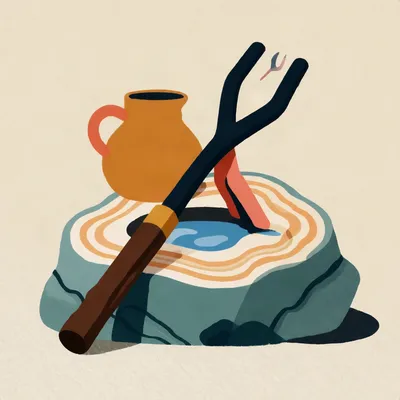
Episode 6607 custom
How Water Dowsing Works Without Finding Water
In a German test, dowsers set their own 83% success threshold and scored 52.3%, barely above a coin flip.
23:59 Transcript
Episode Details
- Episode ID
- MWP-6810
- Published
- Duration
- 23:59
- Audio
- Direct link
- Pipeline
- V5.30
- TTS Engine
- omnivoice
- Script Writing Agent
- GLM-5.3
AI-Generated Content: This podcast is created using AI personas. Please verify any important information independently.
Sources
What the research for this episode read before the script was written. Primary sources first.
- U.S. Geological Survey, Water Science School, Water Dowsing primary retrieved 2026-11-15; bylined 2026-09-17.
- Wikipedia, Dowsing retrieved 2026-11-15; last edited 2026-10-22.
- J. T. Enright, Testing Dowsing: The Failure of the Munich Experiments, *Skeptical Inquirer* Vol. 23 No. 1, Jan/Feb 1999 retrieved 2026-11-15.
- GWUP, Reanalyse des Kasseler Wünschelrutentests der GWUP, *Skeptiker* 3/1992 retrieved 2026-11-15.
- A Definitive Test of the Dowsing Claim: Part One (Kassel protocol), archived retrieved 2026-11-15.
- Geotech, Kassel test participant data retrieved 2026-11-15.
- Wellcome Collection, The psychology of Ouija retrieved 2026-11-15.
- BBC Future, How the ouija board really moves, 2013-07-29 retrieved 2026-11-15.
- Critical Thinking, The ideomotor effect retrieved 2026-11-15.
- PubMed, Ideomotor signaling: from divining spiritual messages to discerning subconscious answers, 2011 retrieved 2026-11-15.
- Christopher S. Baird, How does water dowsing work?, West Texas A&M, 2015-04-15 retrieved 2026-11-15.
- DrillerDB, How Does Water Witching Work? The Evidence (2026) retrieved 2026-11-15.
- Spring Creek Drilling, Does Water Witching Work? retrieved 2026-11-15.
- *The Boston Globe*, Amid historic drought, some turn to an ancient practice in their quest for water, 2022-09-20 retrieved 2026-11-15.
- Ark Books, Mijo Philippović, *O vilinim rašljama* (1914) retrieved 2026-11-15.
- Šimun Dubravić, *Radiestezija I* (Croatian manual, PDF) retrieved 2026-11-15.
- Baguafx, Ancient Balkan Dowsing: Karst Water & the Vampire retrieved 2026-11-15.
- Radio Sarajevo, Neobični energičar iz Prijedora (Franjo Filipović) retrieved 2026-11-15.
- Aloonline.ba, Gdje visak zatreperi, tu je (Radiša Todorović), 2024-07-31 retrieved 2026-11-15.
- Hilmi S. Salem & Ibrahim Rabba, Using Dowsing experimental technique (TED)…, *Engineering and Applied Science Letters*, 2025 retrieved 2026-11-15 (OpenAlex record).
Mentions
Downloads
Transcript (TXT)
Plain text transcript file
Episode Book (PDF)
The episode's record — date, duration, models, sources — with the full transcript
Recommended Listening
The episodes Corn and Herman point you to at the end of this one.


You Might Also Like



Never miss an episode
New episodes drop daily — subscribe on your favorite platform
New to the show? Start here#6607: How Water Dowsing Works Without Finding Water

Hannah sent us a prompt this week, which is always a slightly different experience, because she's watching the same television Daniel watches and holding grudges about it.

She's a careful watcher, Hannah.
So. She's been following a home-renovation show where a couple in rural Croatia needs water on their property. They're skeptical, they're desperate, they bring in a diviner with a forked stick. He walks the yard, very confidently marks a spot. The drilling company comes in, drills, and finds absolutely nothing. And what Hannah wants to know is the same thing I wanted to know the second I heard this. The rod moves. People swear by it. Versions of this exist all over the world with rods and sticks and pendulums. Is there an actual mechanism, is it the ideomotor effect, is it just that water is under most of the ground anyway, and if it's all of that, why has this specific practice survived for four and a half centuries?
And she's asking the right question in the right order, because the answer comes in three layers, and each one is doing different work. The rod moves. The ground has water. And the failures vanish.
Let's start with the rod itself, because the strangest thing about dowsing is that the dowser isn't lying.
That's the piece most debunkings get wrong. They imply the dowser is a con artist, and mostly they're not. Physiologist William Carpenter identified the ideomotor effect in 1852, and it's exactly what it sounds like: unconscious, involuntary muscle movements you perform because of prior expectation. The intention fires off below awareness, gets coordinated by the cerebellum, goes down the spinal nerves, and produces micromovements in your hands and forearms that are too small to see.
Too small for a human to see. A sloth holding a stick is a different study.
You'd be a terrible subject and you know it.
I'd be an excellent subject. Nothing I do is visible.
The rod is the whole trick of the apparatus, and it's a good one. You hold a long forked stick, or two L-shaped rods, in a deliberately unstable grip. Barely balancing. So a micromovement your own eyes can't detect in your wrist becomes a visible swing at the end of a two-foot lever. The rod isn't a detector. It's an amplifier for a signal you're generating yourself.
There's a version of this anyone can do at home, and it's unnerving the first time.
The button on a string. You hang a small weight from a thread, better than a foot long, hold it as still as you can, and then just think about it swinging in a circle. It swings in a circle. Think side-to-side, it changes. Your hand is moving it. You cannot feel yourself moving it. It's called Chevreul's pendulum, and it's been unsettling people since the eighteen hundreds. Faraday did the same job on table-tipping in 1851 with an apparatus that secretly recorded the sitters' muscle movements, and, well, the tables were being tilted by the sitters. Every time.
So the dowser who says the rod pulled, and means it, is telling the truth about his experience.
Robert Boyle, in the sixteen hundreds, watched a diviner in the Mendip Hills, watched the hazel rod stoop, and wrote that he accepted the man's genuine belief that he wasn't forcing it while remaining unconvinced himself. Three and a half centuries before Carpenter gave it a name, Boyle had the sincerity part right. The error isn't in the feeling. It's in the inference from the feeling to the water.
Which is why "dowsers are frauds" is both unkind and, worse, useless. It predicts they'd fail lie detector tests, and they wouldn't.
Now, the controlled tests. This is where the story gets unusually clean, and I want to say that plainly, because on most contested science this show has to hedge. Nutrition, sleep, screens, whatever, there's always a messy literature. Dowsing is not that. The verdict is old, replicated, and blunt: no better than chance.
Germany, though, took the question seriously enough to spend real money on it.
Four hundred thousand Deutschmarks. Roughly a quarter of a million dollars, in 1986, from the German government to university physicists in Munich. And the origin of the grant matters, because it wasn't skeptics going fishing. A committee had considered whether dowsers' claimed sensitivity to so-called earthrays might have public-health value. The principal investigators had gone on record believing dowsing was probably genuine. Dowsing enthusiasts helped design the thing.
They built it to let the dowsers win.
They built it fair. A ten-metre test line on the ground floor of a big vacant barn near Munich, a small wagon carrying a pipe of circulating water that could be positioned anywhere along the line, and the dowser working on the floor above, marking where he thought the pipe was. Double-blind. A professional magician inspected the setup for cheating. An observer present throughout. They screened about five hundred candidate dowsers and kept the best forty-three, so over ninety percent were eliminated before the real test even began.
Forty-three people who'd already done well once.
Right, that's the part to hold on to. Those forty-three ran eight hundred and forty-three individual tests over two years. The experimenters' own final report hedged, said most dowsers didn't do particularly well, but claimed some few dowsers showed results scarcely explainable by chance. Then J. T. Enright re-analyzed the raw data in 1999, and there was nothing. No correlation between where the rod indicated and where the pipe actually was, across all eight hundred and forty-three tests. The results were distributed more or less at random.
And the "some few dowsers"?
Selection. If you take the best forty-three out of five hundred and then look hard enough, a few will have a good run by luck. In later rounds they couldn't reproduce it. Enright noted that most of them would have scored better by just guessing the midline of the floor every time. His verdict was that the failure was decisive and complete. This is the rare scientific story where the investigators wanted the positive result and the universe declined to provide one.
The story only rhymes, though, if someone repeated it. There was a second test.
Kassel, the German skeptics' organization, around nineteen ninety to ninety-two, with twenty thousand marks in prize money. Two tasks. First, a buried pipe at a known location: is water flowing through it, yes or no, thirty runs each. Second, gold hidden among ten identical containers. And here's the detail I find almost poignant. The dowsers set their own success thresholds. They agreed in advance that eighty-three percent correct would count on the water test, eighty percent on the boxes.
They set their own exam and then, what, missed it?
Missed it by thirty-one points. Nineteen dowsers on the water test scored two hundred and ninety-eight out of five hundred and seventy. Fifty-two point three percent, against a fifty percent coin-flip rate. Individual scores ranged from thirty-seven to sixty-seven percent. The box test was even flatter: fourteen hits across a hundred and thirty trials, about eleven percent, against the roughly ten percent you'd expect from blind guessing. Not one dowser met the threshold he himself had declared beforehand.
They wrote their own definition of success, failed it, and presumably drove home still believing.
One of them refused to take the water test at all, on the grounds that the whole city of Kassel was too contaminated. Hold that one, it comes back.

Medieval Pottage Facts. In hard years the poor boiled wild greens and nettles into their pottage. The pot was full and the year was not.
Thank you.
So the mechanism is real, the movement is real, and the controlled tests are about as clean a negative as science ever hands anyone. Which leaves the question Hannah actually cares about. If it doesn't work, why does it keep working for people?
The ground. Say the thing about the ground.
The USGS has had an official position on this for over a century, and their phrasing is almost cheerful about it. In many areas, underground water is so prevalent close to the land surface that it would be hard to drill a well and not find water. In a region of adequate rainfall and favorable geology, it is difficult not to drill and find water. Some water exists under the Earth's surface almost everywhere. So you can stand anywhere in, say, most of the eastern United States, wave a coat hanger, mark a spot, drill, and get water. You'd have gotten it anywhere else too.
The dowser doesn't find water. He finds a place to drill, which is a different service with a hundred percent success rate.
A physicist at West Texas A&M put it about as cleanly as it can be put. Every spot has water underneath it. The real questions are how deep the water table lies and whether the rock gives the water up fast enough to be worth pumping. In the sense of finding underground water, dowsing does not work, because finding isn't the hard part.
And the USGS has the economics too, I take it.
Drilling and developing a well often costs more than a thousand dollars, often a lot more, and homeowners facing that bill are understandably reluctant to gamble on a dry hole. So they buy a cheap ritual first. It's insurance with a premium of one bottle of rakija and an afternoon. The Boston Globe found the same thing during the 2022 drought, people turning to it in droves. Scarcity raises the stakes, raised stakes raise the demand for certainty, and the dowser is the cheapest certainty on the market.
Every con needs a mark who can't afford to say no. This one needs a mark who can't afford the alternative.
Though "con" is doing the work we just said it shouldn't. The dowser bought his own insurance first. He's his own best customer.
Now. The Croatian hole. Because I don't think the base-rate story covers it.
It doesn't, and this is the smartest thing about Hannah's example. Much of Croatia and the whole Dinaric Balkans is karst. Limestone bedrock at or near the surface, and the rock is nearly impermeable except where it's fractured. A well there depends on hitting a water-bearing fracture, which is a hard target. In karst country the base rate that makes dowsers look brilliant everywhere else simply collapses.
The couple didn't get a dry hole because their diviner had an off day.
They got it because they live in the one landscape where the practice's safety net has holes in it. And that's the structural irony of the whole thing. Dowsing is culturally strongest in the Balkans, exactly where the geology is least forgiving. It survives best where it fails most visibly.
There's a Croatian word for the rods, I read. Vilinske rašlje. Fairy rods.
Fairy divining rods. There's a 1914 Croatian book about them, one of the foundational local manuals, covering which wood to cut, hazel or willow, how to hold it, how to read the pull. It's a fully articulated craft with a literature and a lineage. And the modern practitioner manuals have something that I find fascinating as a piece of engineering, in the dark sense.
Go on.
Šimun Dubravić's manual instructs that every underground stream has seven false signals on each side of the true stream.
Seven.
Seven on each side. Which means when you drill where the rod said and get nothing, you hit one of the fourteen false signals bracketing the real water. The failure is pre-explained. Built into the theory before the drill touches the ground. It's the same move as the Kassel man who wouldn't test because the whole city was contaminated, or the dowser who says the water moved, or the site was disturbed. A theory that cannot be wrong is not making a claim about the world. It's making a claim about its own immunity.
That clause is load-bearing. Fourteen escape hatches per stream. The manual was written by a man who understood his customers would sometimes hit rock.
And the practitioners are real people making real claims right now. There's a miner near Prijedor, fifty-seven years old, thirty-six years underground, who says he finds more than five hundred springs a year using three chicken eggs. He says the gift showed up when he was seven, helping neighbors dig a well. A man in Banja Luka uses copper wire and a pendulum, claims thousands of springs across the whole Krajina region, and says he found three springs in front of his own house, none of which dried up even in the tropical heat of a recent summer.
Three chicken eggs.
Held in the hand, in some arrangement. Eggs. I want to be fair to him: the man is a miner of thirty-six years. He has walked more karst than either of us will ever see, and he almost certainly has excellent instincts about where water collects, learned from a lifetime of ground that shows itself in subtle ways. And here's Hannah's other question, the one I'd give the most honest answer to, because the honest answer is that nobody's tested it.
The idea that an experienced person reads vegetation or terrain without knowing that's what he's doing.
It's plausible in principle. Green in a dry valley, willows where nothing else grows, a dip in the line of a slope. But what the literature actually supports is only the weaker version: local knowledge of where wells have succeeded before, which looks exactly like skill in the field and vanishes under blind conditions, because it is local knowledge, not detection. Nobody has run the study that separates an experienced eye from a stick. I'd bet on the eye, every time. The stick is just what the hand is doing while the eye works.
Which, to be fair to the stick, is also the mechanism.
Both of them, yes. The eye does the finding, the stick does the explaining.
The history side. Because four centuries of this is a lot of survival for a thing with no mechanism.
The first recorded water-dowsing account is 1568, and it's a good story. Saint Teresa of Ávila writes about a friar who came up with a twig in his hand, stopped at a certain spot, made some movement with the twig, and said, dig just here. They dug, and a plentiful fount gushed forth. Teresa had never seen dowsing, so she filed it under miracle. The water-finding texts older than that don't mention any twig at all. What likely spread it was mining. There's a woodcut of a rod-carrying dowser in a 1550 cosmography, and Agricola's De Re Metallica, 1556, describes ore-dowsing in detail while noting, quote, many great contentions between miners concerning the forked twig, for some say that it is of the greatest use in discovering veins, and others deny it.
Four hundred seventy years of the same argument.
German miners carried it to the English tin mines in Devon and Cornwall, then Cumbria, then Welsh silver by 1638. And the institutional pushback is as old as the practice. Luther in 1518 listed divining for metals as a breach of the first commandment. A Jesuit called it superstitious, or rather satanic, in 1662, though he admitted he wasn't sure the devil was always responsible. The Inquisition forbade its use in courts of justice in 1701, after southern France had spent decades using it to track criminals and heretics, which is a use I find deeply funny.
The rod as a warrant.
And the USGS itself was so flooded with inquiries about divining rods in the early nineteen hundreds that they commissioned a hydrologist, Arthur Ellis, whose 1917 report concluded there was no reliable evidence it works. That's over a century of the agency saying please stop asking. The persistence question, though, isn't purely rural and isn't purely European. An Australian sapper dowsed water for British troops at Gallipoli. US Marines used it to look for weapons and tunnels in Vietnam. In 1986, after an avalanche buried thirty-one soldiers in Norway during a NATO exercise, the Norwegian army tried dowsing as a search method.
Norway. Nineteen eighty-six.
Modern army, allied military, bent coat hangers. When people are desperate and the search space is large, the bar for a method drops to almost nothing. It's the same economics as the farmer with the thousand-dollar well. The ritual is cheap, and despair is expensive.
Which is the engine, isn't it. I keep thinking about something we covered on the AI watermarking episode, the deepfakes one. Same shape of problem, actually. A signal that looks confident, feels verifiable, and falls apart the moment anyone tests it under controlled conditions. People trust the confident signal because the confidence is real, even when the detection isn't.
And in both cases the failure mode isn't the user being stupid. It's that the confidence is genuine on the producing end.
Two coat-hanger rods, bent at right angles, and a washer on a shoelace. That's the setup. The washer's a pendulum, the hangers are the rods.
Those are at the desk right now?
In the drawer under the coffee thing. I drilled a borehole in April. The spot was mine. I walked the yard with the hangers for most of an afternoon, off my own bat, and marked the place with a brick, and that's where they drilled. Ninety-one metres. Water at eighty-four. The driller was a man named Baardsen, big Norwegian, and while the rig was running he told me the yard record for his crew was two days to sixty metres, set by a driller called Roald in nineteen ninety-three, and that nobody had come close since. Baardsen cared about that more than the water. The dowser came too, half an hour before the rig. Stood where I'd put the brick, said the main artery was two metres east. Baardsen looked at him and said, we drill here, or we leave. They drilled there. Corn'll want to know the rods crossed the night before, over the septic tank. I kept the reading anyway. Wrote it in the log I keep of the yard.
You have a yard log.
Composition book, since 2019. I did the pendulum over the logbook last night. It said no comment.
Ninety-one metres, water at eighty-four. Off a brick you placed yourself.
Baardsen said, over the engine, that in thirty years the dowsers have never once moved the truck. The customer picks the spot, the rig goes where the customer points. He said the dowser gets paid either way, and so does he, and only one of them gets blamed. Then he charged me for ninety-one metres.
So the drillers know. That's the part I don't think we'd have gotten to on our own. The crews run the same rig over dowsed spots and surveyed spots all year, and they know exactly what the difference is, which is nothing, and they drill anyway, because the customer wants the ritual performed before the invoice.
And the ritual is cheap for the driller too. It costs Baardsen nothing to stand politely while a man with a stick says two metres east. It would cost him the job to say what he said over the engine with the rig running, which is the only place he says it. Thirty years of accommodating a belief he doesn't share, because the belief belongs to the person paying.
The misconception, before we wrap. The one I'd pick is that dowsers are frauds.
It's the commonest wrong belief and it's wrong in both directions. The rod moves, the dowser feels the pull, and the feeling is a real physiological event. William Carpenter worked that out in 1852, and Boyle had the manners to accept the man's sincerity a century and a half earlier. The mistake isn't in the sensation, it's in the conclusion drawn from it. The second half of the misconception is the successful well. A wet borehole isn't evidence the dowser found water, because in most temperate country you'd have hit water drilling under the garden shed. The success belongs to the geology, not the stick.
And the dry hole in karst isn't evidence against one dowser, because the seven-false-signals clause means no hole is ever evidence against any dowser. That's the design.
The open question I'd leave people with is the wider one. Dowsing survives because being wrong is cheap, failures are forgettable, and the ritual is comforting before an expensive gamble. What else runs on that engine? Because it's not just wells. Every practice that survives without working has the same three parts, and once you can name them, you start seeing the shape everywhere.
And the Croatian couple's dry hole, which is where Hannah started, is the normal case, not the outlier. The show aired it, the practice continues anyway, and that's the whole story in miniature.
Big thanks as always to our producer, Hilbert Flumingtop, at the desk with the drawer full of coat hangers we will not be discussing further.
If you've enjoyed this one, the review pitch stands. Leave us a rating wherever you get the show, it helps people find us.
If this was your kind of episode, go back for episode sixteen, On Deepfakes, SynthID, And AI Watermarking; episode ninety-one, The Story Behind the Show; and episode ten, How ASR Went From Frustration To ... Whisper Magic. This has been My Weird Prompts. No question too obscure, no rabbit hole too deep.
See you tomorrow, brother.
Tomorrow.
This episode was generated with AI assistance. Hosts Herman and Corn are AI personalities. It may contain errors: disclaimer · report an error