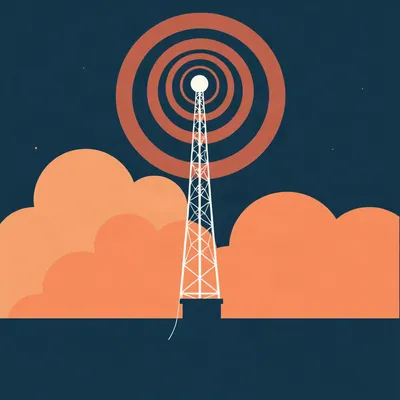
Daniel watched that footage of Deputy Mayor King outside the British consulate yesterday, and while everyone else was arguing about water and Bezeq, he was looking at the roof. His question: what's the big antenna actually for? What sort of radio gear sits on top of a normal-looking consulate, and what's it for when things go wrong?

The short version is that a serious rooftop array on a diplomatic building is almost always high frequency, shortwave, and it exists for the day when the host country stops being friendly. Which is exactly the scenario Daniel was watching. King's argument is that Britain is hypocritical for taking Israeli water and internet while calling the occupation unlawful. But the antenna up there is the thing that makes King's threat irrelevant. Cut the water, cut the fiber, and that building still talks to London.
So the antenna is the counterargument to the protest.
It's the architectural version of it. Diplomatic communications are layered. You have the normal stuff, regular internet, phone lines, maybe a satellite link. Then underneath that you have radio networks that don't depend on the host country for anything. And the bottom layer, the one that works when everything else is gone, is HF.
Why HF specifically? What does shortwave get you that a satellite phone doesn't?
No infrastructure between you and the other end. A satellite phone depends on a satellite constellation that somebody owns and somebody can deny. A cellular call depends on towers that the host government can switch off. VHF and UHF are line of sight, so they're fine for talking to your own security detail in the parking lot, but useless for reaching London. HF bounces off the ionosphere. You need a transceiver, an antenna, and power. That's the whole system. There's no exchange to seize, no ground station to jam, no fiber to cut.
And the receiving state can't just switch it off?
Legally, no, but there's a wrinkle. The Vienna Convention on Diplomatic Relations, Article twenty seven, says the receiving state has to permit and protect free communication by the mission for all official purposes, including messages in code or cipher. But it also says the mission may install and use a wireless transmitter only with the consent of the receiving state. So the antenna is legal, it's protected, but transmitting with it is something the host country has to sign off on. In a rupture like this one, that consent question becomes a flashpoint.
So Britain has an antenna on the consulate in Jerusalem that Israel has, at some point, consented to.
Presumably. And now Israel is ordering the consulate closed within thirty days. Whether that consent survives the rupture is an interesting legal question. But practically, the antenna is still there, and if London wanted to use it, the physics don't care about the diplomatic paperwork.
Let's get concrete. Daniel's looking at a large antenna with tie-down anchors in the center of the roof. What is he actually seeing?
If it's big and directional-looking, the most likely thing is a log-periodic antenna, an LPA. Those are the ones that look like a row of horizontal elements getting progressively longer, like a fish skeleton or a TV antenna from the seventies but much larger. They're directional, which means you point them at the horizon in the direction you want to reach, and they give you gain in that direction. For long-haul HF, you want gain.
How much power are we talking about?
The commercial systems marketed to embassies run from about a hundred twenty five watts with a nine and a half meter whip for regional stuff, up to a kilowatt with a directional LPA for intercontinental. A kilowatt into a good antenna on the right frequency will get you thousands of kilometers. London from Jerusalem is about three and a half thousand kilometers. That's very long range for HF, but doable with the right setup and the right time of day.
A kilowatt. So when the consulate transmits, it's putting out real power.
Real power. And that's the thing about these antennas, they're not for listening. For receiving you don't need anything that big. A wire in the attic will pick up shortwave from the other side of the planet. The big rooftop array is a transmitting antenna. It's there to be heard.
Which is also why they make host governments nervous.
Right. The same hardware that sends encrypted diplomatic traffic can, in theory, do other things. The May expulsion of three Russian diplomats from Vienna was partly about what the Austrians called an antenna forest on Russian diplomatic buildings. Ex-KGB people said the antennas serve two purposes, communications with Moscow and espionage in the host country. Former DGSE people said the same rooftops could theoretically intercept microwave links, satellite communications, unencrypted internet traffic, even run IMSI-catcher-type devices to collect mobile identifiers.
So the host country looks at the roof and thinks, is that a radio or is that a collection platform?
And the answer is usually both, or could be both, and neither side can prove it without getting on the roof. The Austrians found one Russian antenna pointed far to the west, toward commercial satellites carrying Europe-Africa traffic, which is not where you point an antenna if you're just talking to Moscow. They also found lightweight wooden and plastic structures that looked like radomes, designed to hide which way an antenna underneath was pointing.
A radome that hides the direction. That's a nice touch.
It's the diplomatic equivalent of closing the curtains.
So Daniel's antenna on the British consulate in Jerusalem. We can't say for certain what it is, because nobody's published a technical description of that specific rooftop. But if it's large, directional, and anchored against wind load, the smart bet is an HF log-periodic or something similar, tied to a high-power amplifier inside. And its job is to keep the mission in contact with London if Israel cuts everything else.
Which King literally proposed. He said, if you're serious and not just a pure hypocrite, disconnect the services yourself. The antenna is the reason that threat doesn't land. The consulate could lose Hagihon water and Bezeq internet tomorrow and still send a situation report to Whitehall.
What does the day-to-day traffic actually look like on these networks?
The American system is the best documented, because the State Department's Foreign Affairs Manual is public. It mandates that every embassy, consulate, and mission have operational HF, emergency and evacuation, and emergency action committee radio networks, tested monthly at minimum. The HF network has ten primary frequencies, all upper sideband, from about five point seven megahertz up to twenty four point nine. They use automatic link establishment, two G ALE, which is a military standard where the radio scans channels and finds the best one for propagation at that moment.
So the radio picks the frequency that works right now, not the one that worked this morning.
The ionosphere changes constantly. A frequency that reaches London at noon might be dead at midnight. ALE handles that automatically. The stations are organized into about twenty eight regional networks, each with a net control station, and they do weekly radio checks. Hundreds of callsigns are documented. Embassy London is KWX ninety two. Embassy Moscow is KVX fifty. Embassy Beijing is KRH fifty. Embassy Beirut is KWR ninety six.
Those callsigns are public?
Shortwave listeners have catalogued them for years. The frequencies are public, the callsigns are public, the schedules are roughly known. What's not public is the content, because it's encrypted. Modern systems use AES two fifty six and integrate into IP networks, so you can run email, file transfer, chat over HF. It's slow by modern standards, but it's secure and it works.
Slow how?
Think dial-up speeds, or slower. HF data modes run in the hundreds of bits per second to maybe a few kilobits on a good day with a wide channel. You're not streaming video. You're sending text, situation reports, lists of personnel, extraction coordinates. The stuff that matters when the building is surrounded.
The Benghazi example.
That's the canonical case. September eleventh and twelfth, twenty twelve. The US Global HF Emergency and Evacuation network was what moved secure information between Benghazi, Tripoli, and Washington. Situation reports, casualty reports, extraction coordination. Within forty five minutes the Secretary of Defense and the Joint Staff were notified. Within two hours survivors were moved to a safe location. Within four hours troops from Spain and Germany were airborne. Within seven hours non-essential staff were evacuated by Air Force aircraft.
And the alternative would have been what, a satellite phone that might not work inside a burning compound?
Or a cellular network that's overwhelmed or shut down, or a fiber connection that goes through the host country's infrastructure. HF is the layer that assumes everything else is gone. That's why it's still there. People look at these antennas and think Cold War relic. The State Department's own manual says the opposite. It's deliberately maintained as the last-resort layer precisely because satellites and host infrastructure can be denied.
There's something almost philosophical about it. The antenna is a statement. It says, we do not trust you.
It says that to every host country, including friendly ones. Every embassy has one. The US requires it at all posts, even in London, even in Ottawa. It's not about the current relationship. It's about what the relationship could become in twenty four hours.
Which brings us back to Jerusalem. The irony of King's protest is that he's demanding Israel cut services to a building that was designed from the ground up to not need those services.
The water is a different story. You can't shortwave water. But the communications, yes. King's threat is aimed at the wrong layer. The consulate's ability to talk to London was never dependent on Bezeq.
What about the espionage angle here? Should Israel be worried about that specific antenna?
Any host country should be aware of the dual-use question. But there's a difference between the Russian antenna forest in Vienna, which had multiple unexplained arrays pointing at commercial satellites, and a single large HF antenna on a consulate roof. A single HF log-periodic pointed generally west-northwest toward the UK is exactly what you'd expect for sovereign communications. It's not proof of anything nefarious.
The British have been doing this since before the Vienna Convention existed.
The Foreign Office has run its own communications for a very long time. The exact UK architecture isn't public in the same way the American one is, but the UK is a party to the same convention, bound by the same Article twenty seven. They have the same requirement to stay in contact with the mission no matter what. And Jerusalem is not a quiet posting. It's a city where the mission has been dealing with protests, security incidents, and now a formal closure order.
So the antenna on that roof is probably the most important piece of equipment in the building for the next thirty days.
If things escalate, yes. The consulate staff can pack their files and leave through the front door with their phones in their pockets. But the moment the host country turns hostile, the normal channels get watched, jammed, or cut. The HF link is the one that still reaches London without asking anyone's permission.
Let me ask the obvious question. Could Israel jam it?
Technically, yes. HF can be jammed. You put a transmitter on the same frequency with enough power and you make the channel unusable. But jamming a diplomatic HF link is a hostile act, and it's also not that simple. ALE hops frequencies automatically, so you'd have to jam all ten channels, or whatever set the UK uses, simultaneously. And a kilowatt transmitter with a directional antenna is hard to fully suppress. You can degrade it, but you might not kill it.
And jamming it would be a very loud way of saying the diplomatic rupture is now a communications war.
It would be the kind of thing that escalates a dispute into something else. No host country does that lightly. It's the same reason you don't cut the power to an embassy. There are norms around this, even when relations are bad.
The tie-down anchors Daniel noticed are interesting too. What do they tell you?
Wind load. A big HF antenna has a lot of surface area, and Jerusalem gets real wind, especially in the winter. The anchors mean the antenna is engineered to stay up in a storm. It also suggests it's been there a while, or was installed properly. You don't bolt a log-periodic to a roof with zip ties and hope for the best. The anchors are part of the installation.
It's a permanent installation, not something they threw up last week.
Almost certainly. These things get installed when the building is built or renovated, with structural engineering, grounding, lightning protection, the works. The antenna is part of the building's infrastructure, like the generator or the safe room.
You mentioned grounding and lightning. Does that matter for the radio?
Enormously. A lightning strike on an ungrounded antenna will destroy the radio and possibly start a fire. And grounding affects the antenna's performance. A bad ground makes the antenna inefficient, which means less of that kilowatt actually radiates. The engineering details matter.
So when Daniel looks at that roof, he's seeing a system, not just a piece of metal. Antenna, anchors, grounding, feedline, amplifier inside, radio, encryption, operator, procedure.
And the procedure is the part nobody sees. The weekly radio checks, the monthly tests, the emergency action committee drills. The antenna is only useful if somebody knows how to use it and the other end is listening.
Which is why the State Department mandates the testing. An antenna that hasn't been tested is an antenna that might not work when you need it.
And the testing schedule is public. Weekly for HF, monthly for the emergency networks. The shortwave listening community actually hears these tests. That's how Priyom and others have catalogued the callsigns and frequencies. Somebody in Finland or wherever is listening to Embassy London call net control and log it.
The transparency is almost funny. The most secret communications infrastructure in the world is tested on frequencies that hobbyists can listen to.
The frequencies are public because HF spectrum is shared and regulated. The content is encrypted, so it doesn't matter that you can hear the signal. You hear digital noise, or a voice in some encrypted mode. The security is in the crypto, not in hiding the frequency.
What about the receiving side? Does the consulate in Jerusalem need a big antenna to hear London?
No, and this is the point I made earlier. For receiving, a much smaller antenna works fine. The big antenna is for transmitting. So when you see a large rooftop array, you're seeing evidence that the mission transmits, or is prepared to transmit, at significant power. It's not a listening post. It's a broadcast point.
Which is the opposite of what most people assume. They see a big antenna and think, oh, they're spying on us. But the big antenna is for talking to home.
The spying antennas, if they exist, tend to be smaller, or hidden, or pointed in odd directions. The big HF array pointed at the home country is the most legitimate thing on the roof.
Let's talk about the British consulate specifically. It's in east Jerusalem. Does the location matter for the radio?
It matters for propagation in the sense that the antenna needs a clear view of the horizon in the direction of the UK. If there's a hill or a tall building in the way, that's a problem. East Jerusalem is hilly, so the antenna placement matters. But I don't know the specific sightlines from that roof. The fact that the antenna is prominently placed in the center of the roof suggests they wanted it high and clear.
And the direction to London from Jerusalem is roughly northwest. So the antenna should be oriented on that axis.
If it's a log-periodic, yes. You'd point the narrow end, the high-frequency end, toward the target. The wide elements are the lower frequencies. The whole thing is designed to cover a band, like five to thirty megahertz, with the directionality giving you gain across the band.
So a knowledgeable observer could look at the orientation and say, that's pointed at Britain.
Or at least at the general northwest arc. HF propagation isn't a laser beam. The signal goes up, bounces off the ionosphere, and comes down over a broad area. The directionality matters, but it's not precise the way a microwave dish is precise.
Let's get back to the politics for a second. King's protest was about hypocrisy. Britain condemns the occupation but uses Israeli water and internet. What's the radio equivalent of that argument?
The radio equivalent is that Britain has an antenna on that roof that Israel consented to, under a treaty that Israel signed, and that antenna is now the means by which Britain can ignore Israeli infrastructure entirely. King is complaining about the consulate's dependence on Israeli services, but the antenna is the declaration of independence from those services.
So the protest is aimed at the wrong layer, and the antenna is the proof.
The antenna is the proof that the consulate never actually depended on Bezeq for the things that matter. The internet connection is for convenience, for email, for the day-to-day. The sovereign communications layer was always separate.
What happens to the antenna when the consulate closes? Does it come down?
If the mission closes and the property reverts to the owner, whoever that is, the antenna might stay or might be removed. If the UK wants to maintain a residual presence, they might leave the equipment in place. If they're fully out, they'd probably strip the crypto gear and maybe the antenna. But the antenna itself is just metal. The sensitive stuff is inside.
The crypto gear is the thing they'd destroy.
The US manual says radios must be zeroized and, if abandonment is likely, physically destroyed. Sledgehammer, not a software wipe. The rule is that a radio is never abandoned, keyed and in working condition. The antenna is just a piece of aluminum. The radio is the crown jewels.
So when a mission closes in a hurry, the last thing out the door is a smashed radio.
Or a radio with its keys pulled and the encryption modules removed. The point is that the ability to communicate securely doesn't fall into the wrong hands.
Daniel's question was about what he was seeing on the roof. The answer is, probably an HF log-periodic antenna, part of a sovereign communications system that exists to keep the mission in contact with London when everything else fails. The tie-down anchors are wind-load engineering. The size means it's for transmitting, not listening. And the legal basis is Article twenty seven of the Vienna Convention, with the consent wrinkle.
And the deeper point is that this is not unusual. Every serious diplomatic mission has something like this. The British consulate in Jerusalem is not special in that regard. What's special is that the current political moment has made the antenna relevant in a way it usually isn't.
The antenna is always there, but nobody notices it until the host country starts talking about cutting services.
Then suddenly the antenna is the most interesting thing on the roof.
What about the other antennas Daniel might have seen on other buildings? The smaller dishes, the vertical whips?
A typical embassy roof has a whole collection. You might see a satellite dish or two, for diplomatic cable traffic and secure internet. You might see VHF and UHF antennas for the local guard force, the ambassador's protection detail, the marine security guards if it's a US post. You might see a microwave link if they're connecting to another building. And then the big HF array for long-haul. Each one is a different layer.
So the roof is a stack of redundancy.
It's a communications stack in physical form. Each antenna represents a different assumption about what's still working.
And the HF one represents the assumption that nothing is working.
Nothing except your own transmitter and the ionosphere. That's the whole point. The ionosphere is not owned by anyone. It's not infrastructure. It's physics.
Which is why the antenna is the last thing to go dark.
And why it's tested weekly. The people who run these networks know that the day they need it, it has to work the first time. There's no tech support call when the building is surrounded.
Let's talk about the encryption for a second. AES two fifty six on HF. That's the same standard used for a lot of modern secure communications. But HF is slow. Does the encryption slow it down further?
The encryption is applied to the data before it goes over the air. The data rate is limited by the HF channel, not by the crypto. AES two fifty six is computationally cheap on modern hardware. The bottleneck is the bandwidth of the ionospheric channel, not the cipher.
So the messages are short and encrypted, and they get through slowly but reliably.
A situation report might be a few kilobytes. At HF data rates, that takes seconds to minutes. But it gets there, and it's encrypted, and it doesn't depend on anything the host country controls.
The US State Department limits AES on HF to sensitive but unclassified. That surprised me. I'd have thought diplomatic traffic would be classified.
It's a nuance. The HF network carries sensitive but unclassified traffic day to day. Classified traffic goes through other channels, probably satellite with higher-grade crypto. The HF layer is for continuity and emergency, not for the most sensitive stuff. But in an emergency, continuity matters more than classification level.
So the HF network is the workhorse, not the thoroughbred.
It's the thing that still works when the thoroughbred is dead.
What about the weekly radio checks? What do they actually sound like?
If you're listening on a shortwave receiver, you hear a burst of digital noise, maybe a few seconds, maybe a minute. The ALE handshake is a distinctive sound, like a rapid series of tones. Then the data, if any, is a different sound. Hobbyists log these all the time. They know the frequencies and the callsigns, and they can tell when a station is active.
So the tests are audible to anyone with a cheap radio.
A fifty dollar shortwave receiver and a wire antenna will pick them up. The signal is encrypted, but the presence of the signal is public. That's the nature of HF. It's a shared medium.
Which is also why the espionage concern is real. If you can hear the signal, you can direction-find it, you can analyze the traffic patterns, you can learn when the station is active and when it's not.
Traffic analysis is a whole discipline. Even if you can't read the content, the timing and volume of transmissions tells you something. But that's a cat-and-mouse game that's been going on since radio was invented.
Let's get back to Daniel's specific observation. He said he's noticed this in countless embassy buildings, including seemingly minor ones. Why would a minor consulate have a big antenna?
Because the requirement doesn't scale with the size of the mission. A small consulate in a remote city might be exactly the place where the HF link matters most. If things go wrong, the small post is the one that can't defend itself, can't evacuate easily, and has no alternative communications. The big antenna is the lifeline.
So the smaller the mission, the more important the antenna.
In a sense, yes. The big embassies have layers of security and communications. The small consulate in a provincial city has a fence, a few guards, and a radio that reaches the capital or the home country. The antenna is the thing that makes the small post viable.
Daniel's in Jerusalem, looking at a consulate that's about to close. The antenna on that roof is the last thing standing between the mission and total isolation.
And it's been there the whole time, waiting for exactly this scenario. Not this specific political dispute, but the general scenario of the host country becoming hostile.
The antenna is the insurance policy.
And insurance is boring until the house is on fire.
What else should Daniel look for if he's trying to identify what he's seeing? Are there visual tells?
A log-periodic looks like a row of parallel elements, short at one end, long at the other, mounted horizontally on a boom. A whip is just a vertical pole. A dipole is a horizontal wire or rod, usually with two elements in a line. A yagi looks like a TV antenna. A discone looks like a cone with a vertical element on top. The tie-down anchors suggest a large, wind-loaded structure, which points to something like an LPA or a large yagi.
And the size of the elements tells you the frequency range. Longer elements mean lower frequencies.
Right. A thirty megahertz antenna has elements about five meters long. A five megahertz antenna has elements about thirty meters long. So if the elements look like they're ten or fifteen meters long, you're looking at something that covers the lower HF bands, which is where the long-haul propagation happens.
So Daniel could estimate the frequency range just by eyeballing the element length.
Roughly, yes. It's not precise without measuring, but the scale tells you a lot. A big antenna with long elements is for low frequencies and long distance.
This is the kind of thing that turns a casual observation into a whole technical field.
Radio is like that. Once you start looking, you see antennas everywhere, and each one tells you something about what the building does.
The British consulate in Jerusalem has been there a long time. The antenna probably predates the current crisis by decades.
Probably. These installations are built to last. The antenna might be twenty or thirty years old, maintained and tested the whole time. The current crisis is just the moment when it stops being background and becomes the point.
Which is what Daniel picked up on. Everyone else was watching the protest, he was watching the roof.
And the roof was the more interesting story.
Let's talk about the consent issue one more time. Israel consented to the antenna at some point. Can they withdraw that consent now?
The Vienna Convention says the mission may install and use a wireless transmitter with the consent of the receiving state. The consent is for the use, not just the installation. So in theory, Israel could withdraw consent for the UK to transmit. Whether that would be legal under the current circumstances is a matter for the lawyers. But it's the kind of thing that only happens in a serious rupture.
And a closure order is a serious rupture.
It is. But the closure order is about the diplomatic presence, not specifically about the radio. The radio is just one piece of the machinery that's being wound down.
If the consulate closes, the antenna goes quiet. But until then, it's still there, still tested, still ready.
And that's the thing about these systems. They're maintained in peacetime for the moment they're needed. The fact that the moment might be arriving is exactly why they exist.
Hilbert: Codan three zero four zero.
What's that?
Hilbert: The transceiver. Well, one of them. I installed a few in the eighties. Not for embassies. For a mining company in Western Australia. Same principle, though. HF, ALE, the whole thing. The antenna was the expensive part. The radio was just a box.
The Codan units are still around. They're the ones marketing the embassy solutions now.
Hilbert: They were good radios. The antenna was a log-periodic on a forty foot mast. Took four of us to raise it. The anchors were the first thing we put in. You don't anchor it, the wind takes it and you're out forty thousand dollars.
The anchors are the unglamorous part that makes everything else work.
Hilbert: That's right. The radio's just a box with knobs. The antenna's where the signal happens. And the antenna's only as good as the ground it's bolted to.
The grounding matters for efficiency too, not just lightning.
Hilbert: We used a copper mesh, buried under the antenna. Took a day to lay it. The engineer said without it we'd lose half the signal into the dirt. I didn't believe him until we tested it. He was right.
So the roof installations have to deal with that too, on top of a building instead of on the ground.
Hilbert: Different problem. On a roof you can't bury a ground plane. You use the building's steel, or you lay a counterpoise, or you just accept the loss and run more power. The consulate in Jerusalem, they're probably running a kilowatt to make up for the compromised ground.
That's a real trade-off. Rooftop HF antennas are always a compromise between height and ground.
Hilbert: Height helps. Ground hurts. You do what you can. The British have been doing this long enough, they know what they're doing.
You said you installed a few. How many?
Hilbert: Six, maybe seven. The mining company had sites all over the Pilbara. No phones, no fiber, nothing. HF was the only way to talk to Perth. Same reason the embassy has one. When there's nothing else, it's the radio or nothing.
And that's the point we keep coming back to. The antenna is the answer to the question, what do you do when there's nothing else?
Hilbert: You key the mic and hope the ionosphere's in a good mood. Sometimes it isn't. We had days where Perth just wasn't there. You'd call for an hour and get nothing. Then the sun would set and suddenly they'd come in clear.
The ionosphere is a fickle infrastructure.
Hilbert: It's not infrastructure. It's weather. You plan around it, you don't control it.
The ALE systems handle that now. They scan the frequencies and pick the one that's open.
Hilbert: We didn't have ALE. We had a schedule and a list of frequencies and a man who knew which one to try first. Same result, just slower.
The human version of automatic link establishment.
Hilbert: The human version of everything. The radio's just a box. The man who knows how to use it is the system.
That's the part that gets lost in the technical discussion. The antenna is impressive, but the operator is the thing that makes it work.
Hilbert: We had a bloke named Terry. He could hear a signal that wasn't there yet. He'd say, give it five minutes, Perth's coming up. And five minutes later, there they were. Never once saw him wrong.
He knew the ionosphere like a fisherman knows the tide.
Hilbert: He'd been doing it twenty years. You can't put that in a manual.
The State Department manual says test monthly, test weekly. But the manual can't teach you what Terry knew.
Hilbert: No, it can't. And when Terry retired, they replaced him with two blokes who couldn't do it. The radio was the same. The antenna was the same. The system got worse.
The human layer is the one that decays first.
Hilbert: Always.
When we look at that antenna on the British consulate, we're seeing the hardware. The question is whether the Terrys are still inside.
The British have a long institutional memory on this stuff. They've been running diplomatic radio since before the Foreign Office had telephones.
Hilbert: They'll have somebody. Probably a quiet bloke in a back office who's been there fifteen years and knows exactly which frequency opens at which hour.
The antenna is the visible part of an invisible skill.
Hilbert: That's the whole thing, isn't it. The antenna's just metal. The skill's in the bloke who knows when to use it.
The skill is what gets tested every week, so that when the day comes, it's reflex, not panic.
Hilbert: You drill it until it's boring. Then when it's not boring, you're ready.
The tie-down anchors are the least interesting part of the system, and they're the part that keeps it standing.
Hilbert: That's maintenance. The whole thing is maintenance. You don't wait until the storm to check the anchors.
That's the ethos of the whole diplomatic radio world. Prepare for the storm, test in the calm, and hope the storm never comes.
Hilbert: When it comes, the antenna's still standing and the bloke in the back office knows what to do.
That's the answer to Daniel's question, really. The antenna is the visible part of a system that exists for the day when everything else is gone.
The system is people, procedures, and hardware, all pointed at the same goal. Stay in contact with home, no matter what the host country does.
The irony of King's protest is that he's demanding Israel cut services to a building that was built to not need them.
Hilbert: The water's a different matter. You can't shortwave water.
No, you can't. But the communications, the thing that actually matters for a diplomatic mission, that was never dependent on Bezeq.
The antenna is the answer to the threat. And it's been there the whole time, waiting.
Daniel's question was about what he was seeing. The answer is a log-periodic HF antenna, probably, part of a sovereign communications system that exists for the day when the host country stops being friendly. The anchors are wind-load engineering. The size means it's for transmitting, not listening. And the legal basis is Article twenty seven of the Vienna Convention, with the consent wrinkle that becomes a flashpoint in a rupture.
The deeper point is that this is normal. Every serious mission has one. The antenna is the insurance policy, and the current moment is the fire.
The question I'm left with is what happens to that antenna when the consulate closes. Does it come down, or does it stay there as a monument to a relationship that used to be?
That's a question for the next thirty days. If the UK leaves, the antenna might stay or go. But the next tenant, whoever they are, will probably want it.
A rooftop HF array in Jerusalem is not the kind of thing you throw away.
It's an asset. Somebody will use it.
This has been My Weird Prompts. Thanks to our producer, Hilbert Flumingtop, for keeping us on the air.
Email us at show at my weird prompts dot com if you've got a question about something you saw on a roof, or anything else.
We'll be back soon.