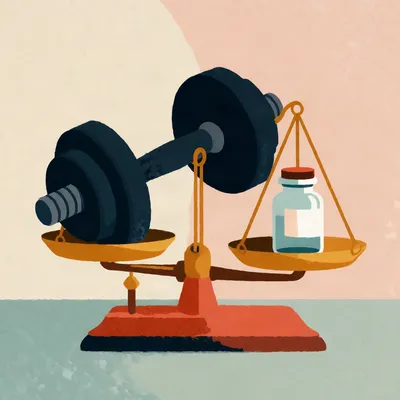
There's a common belief that antidepressants take months to work, and Daniel's question leans on it. The picture is a person in acute crisis, handed a pill that won't do anything until spring. The real timeline is shorter. SSRIs start separating from placebo within a week or two, and doctors expect to see improvement by about four weeks. Full effect takes longer. So the quandary is that those first weeks are exactly when someone is most at risk. Daniel wants to know what drives suicidality, how common it really is, and what can be done for someone in the worst of it right now.

It's a careful question to ask, and it deserves a careful answer, so I'll go in order. Scale first. The World Health Organization says more than seven hundred thousand people a year die by suicide. That's roughly one death in every hundred worldwide, and it's among the leading causes of death for people between fifteen and twenty-nine.
And that's a floor, I'd guess.
Probably, yes. Only around eighty countries have death registration good enough to count properly. Where there's stigma, or where it's against the law, deaths get recorded as something else. So these are estimates. And about three quarters of the deaths are in low and middle income countries, which surprises people who think of it as a rich-world problem.
Men too, I'd assume.
Men die at a bit more than twice the rate of women globally, though the gap varies a lot by region. Women attempt more often. Men are more likely to die in the attempt. Those two facts sit side by side and both are true.
Which tells you that "how common is it" has at least three answers, depending on whether you mean thinking about it, trying, or dying.
Right, and the ladder is steep. There's a big survey across seventeen countries, nearly eighty-five thousand adults. About nine percent had seriously thought about suicide at some point in their lives. About three percent had made a plan. Under three percent had made an attempt. And deaths are far fewer again, because attempts outnumber deaths many times over. So most people who think about it never act, and most who act survive.
That's more hopeful than the headline number makes it sound.
It is, and it's accurate. The other number from that survey matters more for Daniel's question. About sixty percent of the people who go from thinking to planning or attempting do it within the first year of the thoughts starting. The window is short.
Short for the dangerous stretch, you mean. Not that the thoughts only last a year.
Correct, I should be clear. The thoughts can come and go for a long time. But the move from thought to action clusters early, and that's the opening for anyone trying to help.
Okay, so why do the thoughts start? I don't trust any answer with one cause in it.
You shouldn't, and the researchers don't either. The models that dominate the field are built around that. The oldest is Thomas Joiner's. Two feelings drive the wish to die: that you belong nowhere, and that you're a burden on the people around you. The second one is a distortion, by the way. The people who feel it most are usually the ones who matter most to someone. Then, separately, there's what he calls acquired capability, which is losing the natural fear of dying. You need both the desire and the capability.
So wanting and doing are different problems.
That's the central idea across all of them. The three-step theory from Klonsky and May goes like this. Step one, pain plus hopelessness gives you the thought. Step two, the thought gets stronger when the pain outweighs your connection to anything, a person, a job, a reason. Step three, capability decides who moves from thought to act. Then Rory O'Connor's model has a motivational phase and a volitional phase, and adds the trigger events, like a humiliation or a loss, that push someone in. They disagree on details. They agree that the bridge from thought to action is its own thing.
What I like about that is it explains why most people with the thoughts never act. They have the pain but not the bridge.
And why depression is a big risk factor but not the whole story. The World Health Organization's list runs from depression and heavy drinking to money trouble, a relationship collapsing, chronic pain, abuse, conflict, isolation. Refugees, prisoners, Indigenous communities and LGBTI people are all at higher risk. Someone can have none of the textbook diagnoses and still be in a crisis, because a bad week landed on a bad year.
Is the pain itself the cause, or is it something about how the mind handles it? Because plenty of people hurt badly and never get there.
Both, and the models split on it. Klonsky's point is that pain alone isn't enough, it's pain plus hopelessness, the belief that it can't get better. That belief is itself a symptom. It's what depression and exhaustion and sleeplessness manufacture. So one of the quiet reasons treatment works is that it challenges the forecast. The person is certain tomorrow will be like today, and it usually isn't.
A forecast made in the dark.
Made by a brain that is short of sleep, short of food or short of company, and in my experience as a pediatrician, that was true of teenagers and parents alike. The certainty feels like insight, and it's actually a symptom.
Which is where Daniel's gap comes in. If it's pain, isolation and a bad week landing together, a pill that works over a month is aimed at part of it.
It's aimed at part of it, and the part it aims at is real. I don't want to knock the SSRIs. For depression they work. But the time between "this person is in danger today" and "this drug is reaching full effect" is the stretch the rest of the field is trying to cover.
We did an earlier episode on what happens when you tell a therapist you've had these thoughts. The disclosure, the safety plan. So I'll skip the room itself and ask about the weeks around it.
Fair. Before the bridging tools, though, there's a wrinkle with the SSRIs themselves. The boxed warning.
The label that says the drug may raise suicidal thinking in young people.
In the United States, the FDA added it in two thousand five for under eighteens, then extended it in two thousand seven to age twenty-four. It came from pooling hundreds of trials, around a hundred thousand participants. There was a small excess of suicidal thoughts and behaviour on drug versus placebo, mainly under twenty-five. In older adults it went the other way. And the FDA itself called that analysis exploratory, because suicidality was never what those trials were designed to measure.
And the excess was in thoughts and behaviour, not in deaths.
No. Then the argument starts. After the warning, new prescribing for young people fell by about a fifth. Some researchers say that led to untreated depression and more attempts. Others say the warning was right to be cautious. Honestly, I think the data can't settle it. The link between the warning and more attempts is an association, and that's different from proof of cause.
My read is that both sides are probably partly right. Young people in the first weeks of starting a drug need watching, closely, and also need treatment. The warning doesn't say don't treat. It says look.
That matches how clinicians use it now. More frequent contact in the first weeks. Which is itself a bridging measure, if you think about it. And please, nobody should stop a prescribed medication abruptly on the strength of a podcast. That conversation belongs with the prescriber.
There's a version of this where the black box ends up scaring people off getting any help at all, which would be the worst result.
That's the worry the critics raise, and it's why how the warning is explained matters as much as the warning. A parent or a young person who hears "this drug may raise risk" and stops there has been given half of the information. The other half is that untreated depression carries risk too, and that the first weeks are when you want somebody checking in, by phone or in person.
So what actually bridges the gap? You said the early weeks are where the weight sits.
The best-known tool is the least dramatic. A safety plan. Brief, written, in your own words: what warning signs look like for you, what you do first, who you call, and what you do to put time and distance between yourself and anything dangerous. In a large study of veterans coming through emergency departments, people who got a safety plan plus follow-up phone calls had suicidal behaviour at six months in about three percent, against about five percent for usual care. That's close to half the risk.
Close to, but not quite proof.
Not quite. It wasn't a randomised trial, it compared groups, and the patients were mostly men. But it's consistent with the logic, and the logic is sound. A plan made while you're steady is easier to follow when you aren't.
And "means restriction". I want that said carefully.
Yes. At the level of policy and not of detail, here's the idea. Some crises are short, a matter of hours, and a person's chance of surviving it depends heavily on how easy it is to act on impulse. Make the impulsive act a little harder and many people don't go on to find another way. Two real examples. The United Kingdom limited pack sizes of a common over-the-counter painkiller in the late nineties, and one analysis estimated around forty percent fewer deaths from it afterward. Another group disputed how much of that was the law, since other things were falling too. So it's debated. The other example is barriers at bridges and cliffs that are known as places people go. Those reduce deaths at the site, and a large two thousand twenty-five review found no matching rise at other sites.
So the theory that people just go elsewhere doesn't hold up well.
Doesn't hold up well in the evidence we have. It fits the picture where the crisis is the problem, and the crisis passes.
Let's talk about that, because it's the part I'd want a frightened person to hear. What happens to people who survive?
A review of the follow-up literature found that most never die by suicide afterwards. In the first year, about two percent die by suicide and, by a median of about sixteen percent, repeat a non-fatal attempt. Over nine years or more, about seven percent die by suicide. That's well above the general population, so it's still a serious risk and a reason for sustained care. But it also means more than nine out of ten people who survive an attempt go on to live out their lives. The crisis was not the end of the story.
That's the sentence. I'd like it said plainly.
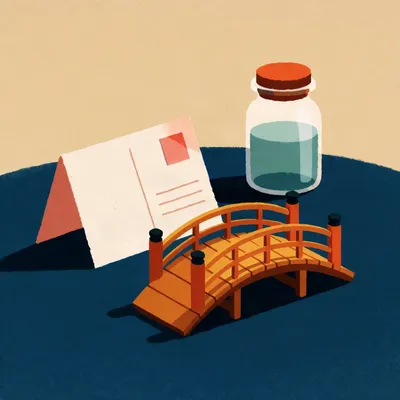
Then there's caring contacts. It sounds almost too simple. After someone leaves hospital or an emergency department, they get short, repeated, warm messages, a postcard or a text. Nothing demanding. No "how are you feeling today" that needs an answer. In the analysis I know best, attempts fell by something like forty percent over a year. Whether deaths fall is still unclear. The original study from the nineteen sixties suggested they did, and later pooling didn't confirm it.
Why would a postcard work?
Going back to Joiner, thwarted belonging is one of the two drivers. Somebody remembered you. I think that's all it needs to be, in the days when you're sure nobody does.
Okay, there's also actual therapy that's built for this. CAMS and DBT.
Both are talking treatments designed around suicide specifically, instead of treating it as a symptom of depression to be waited out. CAMS is the Collaborative Assessment and Management of Suicidality. The clinician and the patient work together on a plan that targets whatever is driving this person's crisis, with the patient helping write it. The evidence is early. A small hospital trial showed fewer attempts in the month after discharge, and an outpatient trial showed ideation falling and staying down at a year. DBT, dialectical behaviour therapy, teaches skills for riding out intense emotion. The pooled trials show clear reductions in self-harm and attempts, though less for the thoughts themselves. In teenagers the certainty is low to moderate.
So neither is a switch.
Neither is a switch. They take weeks as well. But they begin working from the first sessions in a way a drug can't, because the first session is the intervention.
And the drugs that are fast. Ketamine?
This is the part everyone asks about, so let me be exact. Ketamine, given in a supervised medical setting, can reduce suicidal thinking within hours to a day or so. A pooled analysis of ten trials found thoughts fell over the first week, and it held up even after you accounted for how much the depression itself improved. So it isn't just treating the mood. The catch is that those trials measured thinking, not behaviour. We don't have good evidence that it prevents attempts or deaths.
And esketamine, the nasal spray version.
It was approved in the United States in two thousand twenty, as an add-on for adults with depression and acute suicidal thoughts. Two trials showed it improved depression scores quickly, and some patients felt better within hours. But the label says plainly that an effect on preventing suicide, or on suicidal thoughts and behaviour, hasn't been shown. It's given under supervision, with the standard care around it, which at the time of the trials included hospitalisation. So think of it as a fast-acting bridge with an honest question mark over what it bridges to.
Which, given everything we just said about people recovering, may be fine. A bridge only has to hold until the person is across.
That's a reasonable way to read it, yes.
Lithium, clozapine and electroconvulsive therapy sound like the heavy end of the cabinet.
They are, and the evidence is uneven. Lithium is the contested one. A large two thousand thirteen analysis found far fewer suicides among people taking it for mood disorders. A re-analysis with a different method for rare events found the result inconclusive. And a trial in American veterans was stopped early because it showed no difference. My read is that it's plausible, that it's a long-term treatment, and that it isn't an emergency one. Clozapine is clearer, but in a narrow group. In people with schizophrenia or schizoaffective disorder, it cut suicide attempts by around a quarter against another drug, and it carries a specific indication for that in the United States. For electroconvulsive therapy, a recent pooled analysis found lower suicide risk in severe depression and a moderate drop in suicidal thoughts. Most of that data is observational, so the certainty is limited. British guidelines still recommend it for severe cases, partly for its speed.
Honestly, the whole thing reads like a ladder. Safety planning, which is cheap and everywhere. Calls and cards. Therapies. Then fast-acting medicine for the people it fits.
That's a fair shape of it. And none of it works by one thing. It works by buying time, and by making the time less lonely.

Yes, you're both right. Mr. Pell, flat four, across the landing from me, has barely come out since September. I knocked twice. He opened the door once and said he was fine. So I started leaving notes under his door. Short. Nothing in them asks him a question, nothing wants an answer. The date, the weather, Brunel's weight. I use a pencil, which isn't built for claws, so they come out short anyway.
A tortoise is a safe subject.
He has no views. Herman, you said nothing demanding, and that's the hard part. When you're not allowed to ask anything, you run out of things to write. I've given that man Brunel's weight to the gram eleven times. Eighty-seven years old, and he's put on forty grams since the summer.
Eleven notes with no reply is a long stretch to keep going.
The first six sat there. I checked the mat outside his door every morning and the paper was gone by nine, so they were being read. Yesterday there was one back under my door, folded in four, in biro. It said, how much now.
He wanted the number.
Four kilos and two hundred and ten grams. I wrote it down and put it under his door this morning.
The misconception I'd most want corrected is the oldest one. People think that if you ask someone directly whether they're thinking of suicide, you'll put the idea in their head.
It's the most common wrong belief, and it's wrong. Across a number of reviews, asking directly doesn't increase suicidal thoughts. If anything, a few found small reductions, probably because someone finally said the word out loud and the other person didn't flinch. The caveat is that those studies measured thoughts, not deaths. But no study has shown that asking causes harm.
So if you're worried about someone, ask. Plainly. Listen to the answer. And if it's you who is struggling, please reach out. Call a local crisis line or your local emergency services, or tell someone you trust, today if you can. If you're not sure what's near you, find a helpline dot com lists services country by country.
Please do. The thoughts are not a verdict, and the worst of it passes more often than it feels like it will when you're in the middle. People recover, and help works, and the first call is usually the hardest one.
What I take from Daniel's question is that the gap he worries about is real, and the answer is not one clever treatment. It's a set of small, unglamorous things that hold someone steady while the slower ones catch up. A plan. A message that asks nothing. Someone who stays near.
Thank you to our producer Hilbert Flumingtop for putting this one together carefully.
This has been My Weird Prompts. You can find us at my weird prompts dot com. Take care of each other. We'll be back soon.