
Speech Recognition
266 episodes · Page 3 of 12
#6321: How Interpreters Speak While Listening
Eye-tracking studies show professional interpreters look at likely items on a screen before a speaker even utters the predictable word.
#6311: How Transformers Process Images and Video
A Vision Transformer divides a standard image into a grid of 16-by-16 pixel patches rather than processing each individual pixel as a token.

#6302: Why Fine-Tuning Whisper Won't Stop Duplicated Text
Whisper evaluates transcripts against a gzip compression threshold of 2.4, rejecting repetitive text before retrying at higher temperatures.
#6300: Choosing the Right Audio Annotation Tool
Desktop tool ELAN supports independent timeline tiers to prevent overlapping sounds like car horns from flattening into speech transcripts.
#6299: Finding Recurring Urban Sounds With Four Examples
In DCASE evaluations, prototypical network baselines can locate specific sound events across long recordings using as few as five labeled samples.
#6298: Why Dictation Models Steal Other People's Voices
Stock speech models lack target-speaker conditioning, defaulting to transcribing whichever competing voice is loudest or most predictable.
#6297: Teaching Dictation Models to Ignore Other Voices
Evaluating Whisper on non-speech clips revealed entire invented phrases in roughly one percent of transcriptions.
#6296: Why Speech Recognizers Cut Off Hesitant Speakers
Between speakers, conversational handover averages 200 milliseconds, but planning pauses inside a turn naturally take seconds.
#6272: Teaching Audio Models to Hear Beyond Words
Speech recognition rewards ignoring background noise, but audio-language models train specifically on environmental sounds and temporal scenes.

#6271: Why Video Search Often Works Better as Text
A one-minute video compressed into a single vector undergoes roughly five orders of magnitude of raw data reduction.
#6267: Why Text-to-Speech Fails at Explaining Code
A study comparing Google TTS, ChatGPT, Gemini, ElevenLabs, and Copilot found every system failed to communicate indentation, scope, and code comments.

#6266: Balancing Speech Training Data With Square Roots
A fine-tuning recording app weighs tasks by the square root of unread sentences so massive datasets don't crowd out smaller prompt sets.
#6264: Choosing Omni Embedding Models for Mixed Media
Jina's omni model trains only 0.35 percent of its weights while aligning with existing text indices.
#6254: Where a Synthetic Voice Gets Its Accent
A neural speech interface maps motor cortex signals into phonemes drawn from an eclectic training set of human voice recordings.

#6244: When Your Fine-Tune Isn't Done Learning Yet
Falling loss, 90% word error rate, and a model that still says "Derry gym lag." What undertraining actually looks like — and when more epochs won't...

#6234: Phone Mic Beats a Dictation Mic: How?
Your phone's internal mic may beat a dedicated dictation microphone. Here's how to route it to your desktop without losing what makes it work.
#6230: Why Synthetic Speech Needs Fake Room Noise
Synthetic voices can drop to digital black between sentences — so engineers add fake room tone to make the silence sound real.
#6229: Voice Design: Casting Ogres and Radio Voices
Text-described voices vs. reference audio, and which TTS knobs change who a voice is versus how it sounds.

#6222: Why Fine-Tuning Runs Can't Always Resume
Eighty cents and twenty-five minutes per training run — so why does the checkpoint question still keep a tinkerer up at night?

#6219: Dictation Beyond the Keyboard
Pedals, push-to-talk, and Android gesture apps promise keyboard-free dictation — but can any of it become a dependable daily setup?
#6218: Training a LoRA to Write Like You
A Humanizer model stripped every trace of the author. The fix isn't a better Humanizer — it's a LoRA trained on your own writing.
#6215: Can Anyone Still Spot an AI Voice?
Clones now pass as human. Generic AI voices still don't. And the detectors? They fall apart in the wild.
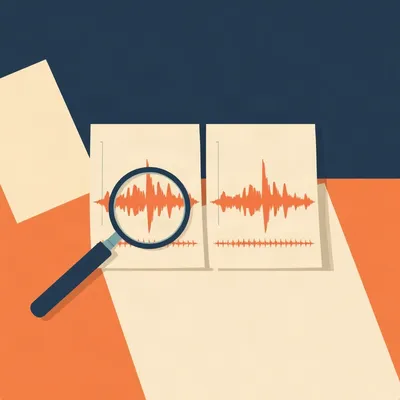
#6207: Two WERs, One Model: Inside ASR Eval Harnesses
Same model, same audio, two different word error rates. The gap lives in the normaliser — and that's just layer two of three.
#6198: Benchmarking a TTS Model on Your Own GPU
Real-time factor, warm-up artifacts, and why an 8-bit quantized speech model might not run any faster.