
Speech Recognition
266 episodes · Page 2 of 12

#6444: Teaching Speech Models to Collapse Spelled Words
Fine-tuning formatting rules takes surprisingly little data: a Johns Hopkins study found truecasing accuracy jumps with only fifty documents.
#6432: Why Speaker Embeddings Fail Across Time and Noise
A standard speaker embedding compresses an entire human voice into just 192 abstract numbers, yet error rates jump from 17% to 47% in the wild.
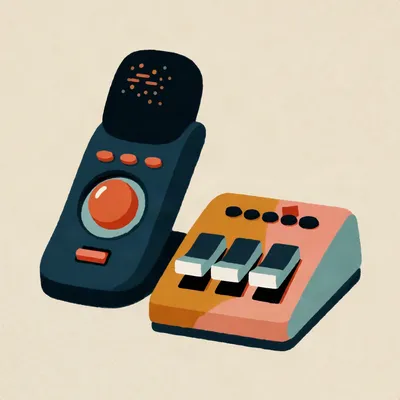
#6424: Why the Five-Hundred-Dollar Hospital Microphone Won
Microsoft designated the Philips SpeechMike as the successor to Nuance's PowerMic, consolidating a medical market by default.
#6423: How Spoken Safety Rules Became Machine Training Data
A 1994 Eurocontrol study showed early speech recognition parsing controller commands correctly eighty-one percent of the time in simulator trials.
#6421: Why Diarized Transcription Requires a Cascade
Open-source speech tools cannot transcribe and identify speakers in a single call, forcing pipelines to rely on timestamp-overlap math.

#6419: Why Bluetooth Headsets Still Sound Like AM Radio
Turning on a Bluetooth headset microphone drops the connection to narrowband audio as low as 8 kHz, even when using a bundled USB dongle.

#6410: Why Morning Voice Happens and What Warming Up Does
Overnight, cilia slow down and mucus pools at the vocal folds, leaving voices stiff and prone to irritation.
#6409: Why Speech Models Break at Chunk Seams
Shifting an audio transcription window by just one second can lose entire words or drop capitals mid-sentence without changing the model weights.

#6408: Why Speech Model Fine-Tuning Demands Clean Restarts
Fine-tuning only on new vocabulary causes catastrophic forgetting, whereas joint training on old and new data provides the optimal benchmark.
#6381: Turning Anonymous Diarization Clusters into Names
Shortening an enrolment sample to two seconds can triple the verification error rate compared with full-length recordings.
#6380: Choosing the Right Voice Activity Detector
A compact model file can hide a massive runtime, while Cobra bundles its proprietary detector and engine into just 450 kilobytes.

#6379: Porting Voice Models to Core ML and MLX
Core ML packages separate computation specs from raw weights, while MLX runs on CPU and GPU without touching the Neural Engine.
#6378: Running Speaker Identification Locally on Phones
Exported voice embedding models like CAM++ run offline on mobile devices in packages as small as twenty-eight megabytes.

#6377: How Audio Models Tell Voices Apart
A diarization model can tell two voices apart without understanding a single spoken word or assigning a real name.

#6370: Why Modern Audio Datasets Ship as Parquet Files
Parquet files store metadata at the end so clients can query durations or transcripts via HTTP range requests without downloading audio bytes.

#6366: Why Training Recipes Matter More Than Model Size
Altering learning-rate timing alone improved global word error rates by twelve absolute percentage points in speech recognition experiments.

#6365: Teaching Speech Models to Transcribe Bilingual Slang
Fine-tuning Parakeet with 77 minutes of speech cut Hebrew-English code-switching errors nearly in half, but later gains required far more audio.

#6364: Collecting Speech Data on Outdoor Walks
Walking changes breath timing and phrase length, making outdoor speech recordings crucial for fine-tuning NVIDIA's Parakeet model.

#6344: Training Text Models to Know When Not to Edit
In a 2023 WMT Marathi task, an LLM post-editor modified over 90% of sentences but improved only around 20%.
#6343: Why Live Video Generation Still Struggles With Timing
A streaming video model can render fifty-eight frames a second while still delivering pictures that are noticeably late.
#6342: Why Pitch Shifting Fails to Protect Witnesses
Modern generative voice conversion models can swap vocal identities live with less than eighty milliseconds of delay.

#6341: Why Fast Speech Detectors Still Struggle with Onsets
Aalto and Genelec experiments reveal human ears can detect sound timing shifts down to half a millisecond at certain frequencies.
#6340: Disguising Voices Without Losing the Emotion
Benchmark tests show speech anonymizers can protect identity while preserving emotion at an unweighted recall of under 44 percent.

#6332: Why Extra Voice Hours Settle Bilingual Speech
Fine-tuning Parakeet TDT on fifteen hours of bilingual speech cut error rates from 13.7% to 4.9% by resolving contextual variation.