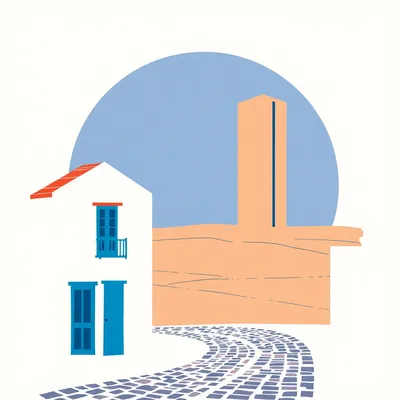
Dinner, a skyscraper, and a sudden vision of a city tower where nobody avoids eye contact. That's Daniel's prompt. He'd been thinking about the earlier urbanism episodes, the idea that density comes bundled with noise, chaos and cramped living. Then over dinner he pictured a dense tower in a city centre that runs at village pace. People are at ease in the common spaces, a bit like a retirement community. He knows it sounds like a contradiction in terms, but he points out every great experiment starts with something that looks preposterous.
He wants to know whether anyone has deliberately designed that, the community and the calm both, into the urban fabric. Is it a ridiculous fantasy, or is there precedent?

Herman Poppleberry, and I'll say up front the precedent exists. It's more than a century old. The twist is that the thing that worked isn't the thing Daniel pictured.
You've been holding that since breakfast.
Since the shower, actually. Okay. Two ideas are glued together in Daniel's image, and the whole episode is about prying them apart. One is density, meaning how many people per hectare. The other is atmosphere, meaning how those people behave around each other. We assume they're one dial. Turn up the people, turn up the hostility.
In my experience the dial goes the other way in a lift. More people, less eye contact, and a sudden deep interest in the floor numbers.
That's the folk theory, yes. And the planners who took the question seriously mostly ended up arguing the opposite. Density is what makes the calm possible, if you get the ground floor right. That's the reframe we'll keep returning to. But I want to flag now that the built examples are real and partial, and the mechanism that actually produced the village feeling was not architecture.
Then I'll hold you to that. But first, why do villages feel the way they do? And why does it vanish? Because I'd say people don't miss the cows.
No, nobody misses the cows. What people name is pretty consistent. You see the same faces repeatedly, so a nod costs nothing. Nothing rushes you. And the shared space belongs to somebody, in the sense that someone would notice if it were trashed. Cities erode each of those. Speed, because everything is built for getting through. Anonymity, because you meet ten thousand people once instead of forty people four hundred times. And scale, which means the shared space belongs to nobody. The stairwell is everybody's and so it's nobody's.
The stairwell is mine until the light goes out. Then it's definitely someone else's.
Which is the whole governance point, and it comes back later. Now, the first person to treat this as a design target rather than an accident is Ebenezer Howard. His book came out in eighteen ninety-eight as To-Morrow, a Peaceful Path to Real Reform, and was reissued in nineteen oh two as Garden Cities of To-Morrow. He wanted the benefits of the countryside and the city and none of the disadvantages of either. Letchworth started in nineteen oh three, Welwyn Garden City in nineteen twenty.
So Howard is on Daniel's side.
Not quite, and this is the catch. Howard's answer was to leave. Small satellite towns, green belts around them, the city decanted. He's the ancestor of escaping the city, not fixing it. Daniel's image is the opposite bet: keep the density in the centre and import the calm.
A garden city is a village with a rail timetable.
Fair. And it's worth noticing how deliberate he was. He drew the thing as a diagram, with the town at the centre, farmland around it, and a fixed population ceiling. When it filled up, you didn't squeeze more in. You founded another town. The calm was protected by a cap.
So the village stays a village by turning people away at the gate.
Which, again, is a selection mechanism. Hold onto that thought, because it keeps turning up. Then in nineteen sixty-one Jane Jacobs publishes The Death and Life of Great American Cities and goes after the planners of the era, Robert Moses and Le Corbusier in particular. Her prescription is dense, mixed-use, walkable streets, with what she called eyes on the street. Shopkeepers, people on stoops, a constant supply of passers-by keeping the place honest.
Right, and that's a village. Everyone knows everyone's business.
Sort of, except look at what her village actually sounds like. It's busy. It's mixed. It's full of strangers. The safety comes from there always being someone looking out a window. There's nothing calm about it.
How does that work in practice, though? Strangers watching strangers sounds more like surveillance than neighbourliness.
Her point is that it's casual and unorganised. The man who runs the corner shop doesn't know your name, but he knows you don't belong to the group of lads hanging around his door at midnight, and he'll glance up. Nobody has to like each other. They just have to be present at different hours, which is why she insisted on mixing homes, shops and workplaces on the same street.
So Jacobs' village is not calm at all. It is busy and full of strangers.

Hilbert's Mid-Show Haiku. To the Broken Kettle in the Studio Kitchenette. You sit there, cold and scaled. Nobody fills you. The switch stays off all winter.
Hm. Harsh on the kettle.
So Jacobs sets up a genuine fork, Corn. Daniel's retirement-community calm is a different thing from her loud, crowded street. Who picks up the calm half?
Somebody Danish, I'm going to guess.
Jan Gehl. Nineteen sixty-five, he and his wife Ingrid, who's a psychologist, go to Italy on a New Carlsberg Foundation scholarship. They study everyday public life in Tuscan and Umbrian towns and in Rome, and what hits them is the human activity in cities that hadn't been formally planned. They come home asking why architects aren't looking after the human side. Life Between Buildings comes out in Danish in nineteen seventy, sorry, nineteen seventy-one, and in English in nineteen eighty-seven. It's been published in more than forty languages.
Sixteen years to get to English. That's even my pace.
Ha. His taxonomy is the useful bit. Necessary activities, like walking to work. Optional ones, like sitting in the sun because you feel like it. And social ones, which grow out of the other two. Calm, in his sense, is the optional category. People only linger where lingering feels safe and pleasant. And his claim, in Cities for People, is that the compact city is the only environmentally sustainable form, but that for densities to rise, a city has to raise the quantity and quality of public space that's human in scale, safe and lively.
Quantity and quality. So density buys you the calm, provided you pay for the sidewalk.
That's the deal. Density and village atmosphere are complements if public space scales with it. Which is Daniel's image turned inside out. The village isn't what the tower removes. It's what the ground floor produces.
So the test of a bench is whether anyone sits on it for no reason.
Close to how Gehl would put it. If people are only using a space because they have to cross it, you've built a corridor. If some of them stay when they don't need to, you've built a place.
Hang on. That doesn't square with Jacobs. She wants the noise and strangers. He wants people lingering. Do you actually think those are the same city?
I think they're two different theories of what makes a place feel human, and they don't fully agree. Honestly, I'd put Daniel's tower closer to Gehl's Copenhagen than to Jacobs' Greenwich Village. What would you want, Corn? Your own tower. Loud and crowded, or quiet and lingering?
Quiet. Obviously. I'd like the lingering to be optional and the stairs to be somebody else's job.
You'd pick Gehl and then complain the lift was too busy.
The lift is always too busy. That's not a theory, that's a Tuesday.
There's a formal attempt to bottle all this. Britain in the late nineteen eighties, the Urban Villages Group, and then it becomes national planning policy between nineteen ninety-seven and ninety-nine. Medium density, mixed use, good transit, pedestrianisation, decent public space. It was explicitly justified as a solution to the demise of community, using the shape of the traditional rural village as inspiration. Jacobs is named as the biggest influence.
A solution to the demise of community, with a zoning map.
Last piece of theory before we go to the ground. Clarence Stein and Henry Wright, Radburn, New Jersey, nineteen twenty-nine. A town for the motor age. The trick was separating traffic by mode, so the pedestrian path system crosses no major road at grade. They invented the residential superblock, some of the first culs-de-sac in the country, houses with backs to the street and fronts facing each other across common greens. It's a National Historic Landmark District since two thousand five.
Fronts facing each other over a lawn. Neighbours forced to wave.
Forced to, yes. And remember the word forced when we get to what happened at Radburn later. So that's what the theorists wanted. Did anyone actually get it? The answer starts on a former French military base in Freiburg.
Not what I expected, but go on.
Vauban. The French army left in nineteen ninety-two, construction began in nineteen ninety-eight, the first two residents moved in in two thousand one, and by two thousand twenty there were five thousand two hundred and sixty-seven people living there. The masterplan and the car-free concept came out of the city council working with a citizens' group, Forum Vauban, which was handed the mandatory community consultation.
So the neighbours wrote their own neighbourhood. Already unusual.
And here's the mechanism, and it's the uncomfortable one. Most plots were sold not to developers but to Baugruppen, community-led building groups. And their bids were scored against criteria that favoured families with children, older people, and people already living in Freiburg.
So the village was preselected.
Yes. The atmosphere came from who was allowed to build and buy, more than from the buildings. Then the streets reinforce it. Most residential streets are stellplatzfrei, free of parking spaces. Vehicles can come through at walking pace to load and unload, but they can't park. Walking and cycling cover somewhere between thirty-eight and seventy-three percent of trips, depending on the measure, against five to sixteen percent by car.
What stops a guy from just parking?
Mostly other people. The system depends essentially on social consensus, with few official controls. Households sign an annual declaration of whether they own a car. If they do, they buy a space in a peripheral multi-storey car park, about seventeen thousand five hundred euros one-off at two thousand six prices, plus a monthly fee.
Seventeen and a half thousand euros to park somewhere you can't see from your window. That's not a village, that's a very strict auction.
It's a fee that selects too. People who want a car-centred life don't bid. There's a car-sharing club in Freiburg with about twenty-five hundred members, and its heaviest concentration is in Vauban.
Okay, but I'm suspicious. Selecting for families and older residents who already like walking is cheating. You've filtered for the answer.
I think that's the finding, not an objection to it. I'd argue it's the most important thing the project teaches. If you could get the same result from architecture alone, Vauban wouldn't need the scoring sheet.
And the children presumably do the rest. A street with no cars is a street where a seven-year-old can be sent out to play.
That's the visible payoff, and it feeds back. Kids on the street mean parents standing at doors, which means conversations that nobody scheduled. It's Jacobs' eyes on the street, just with a lower noise floor.
Hm. Fine. I concede the fact and keep the grumble.
Vauban shows the mechanism. Barcelona shows whether it scales, and, more interestingly, who it leaves out. Superblocks, since twenty sixteen, in Poblenou, Sant Antoni and Horta. You restrict vehicle access inside a group of blocks, push motor traffic to the surrounding main roads, and give the internal streets to pedestrians and cyclists. There was an evaluation project, Salut als Carrers, running from twenty nineteen to twenty twenty-one, and the paper came out in BMC Public Health in February of this year, I mean in twenty twenty-five. Pérez and colleagues.
Careful. You're supposed to be the one who knows what year it is.
I'm correcting it as I say it, which is what a professional does. What they found is that residents and workers in all three superblocks reported improved well-being, tranquillity and sleep, some reduction in noise and pollution, and more social interaction. Barcelona's public health agency summarised it as a calmer, more comfortable and safer environment that facilitates interaction between neighbours.
Which is Daniel's sentence, almost word for word.
It is. And the authors are careful. It's small-scale and non-experimental, before-and-after. They say it supports expanding the model, and that's all they say.
I like authors who don't oversell. It's rare. Usually the abstract promises a cure for loneliness and the body delivers a bench.
Here's the equity problem inside the success. In Poblenou, older people said they don't use the superblock, and that they think it hurts their mobility and their access to some places. And the paper itself flags the risk of gentrification, of residents being pushed out as the area improves and housing costs go up.
So you build the calm and the price of calm goes up.
Calm turns out to be a luxury good, yes. And the people who'd value it most, the older residents, are exactly the ones it may not work for. Taking away the cars takes away the taxis and the delivery vans that some of them rely on.
What would you do about that, Herman? Honestly. You spent decades in a clinic watching people get to appointments.
For me in particular. I'd say you don't pedestrianise anything until you've counted the bus stops and the kerb heights and the places a person with a frame can actually rest every fifty metres. Door widths and chair placements. A superblock that's lovely at thirty and a wall at eighty is a design decision, not an accident.
So you're saying calm should have benches.
Put that on the plaque.
All of that is at street level, though. Daniel's image was a tower. What happens when you try to build the village upward?
Two precedents. The Interlace in Singapore, by OMA and Ole Scheeren, named World Building of the Year in twenty fifteen. It's described explicitly as a vertical village, a network of living and social spaces, stacked blocks hexagonally rather than as a single slab. And Fælledby in Copenhagen, by Henning Larsen, running from twenty eighteen to twenty thirty-one, the city's first all-timber neighbourhood, with housing organised on the model of a rural village.
Twenty thirty-one. The village is still on the scaffolding.
And here I have to be straight with you. As far as I can tell neither has published measured social outcomes. The closest built answer to Daniel's skyscraper exists. The evidence that it delivers the atmosphere does not yet.
So it's a village in the sense that the brochure says so.
That's actually the sharpest critique of the whole field. The urban village label has been used by private developers as an advertising pitch, or to win government support for a project. Many developments that meant to build a true urban village didn't achieve it, and some planners question whether a genuine one has actually been built.
It's a fair bet that the word village adds a few percent to the asking price.
There's another line that I think is the killer. It has been suggested that the demise of neighbourhood community is a function of conscious economic and social choice rather than a product of urban form.
Meaning nobody's stopping you from knowing your neighbours. You're just busy.
People are choosing out of it. We pick the job across town, the flat for the commute, the phone on the lift. If that's right, no architect can design village-ness in, because the architecture was never the thing that removed it. There's a practical worry too: self-contained villages get questionable as work and activity patterns get more complex, and a small population base makes them shaky.
That would explain why the Howard cap is awkward now. Nobody lives and works inside the same few streets any more.
Right. A village assumed your whole week happened within walking distance. Most of us split it across three postcodes, so even a perfect design only captures the evenings.
So what actually holds a shared space together?
That's Radburn again, and it's not flattering. A residents' lawsuit in two thousand six against the Radburn Association over how it was governed. It ended when the New Jersey Supreme Court denied certification in June twenty ten, Moore versus Radburn. In twenty seventeen the state passed a law guaranteeing membership rights in common-interest communities. And in twenty sixteen the Association refused schoolchildren permission to build a playground they'd raised sixty thousand dollars for, on aesthetic grounds.
Sixty thousand dollars of children's money, turned down for how it looked.
The common greens that were supposed to make neighbours wave turned out to need a body that decides things. Shared space means shared control, and shared control means disputes. So who gets to decide, who sits on that body, is where the village either holds or turns into a lawsuit.
Who decides what goes on the third-floor landing? That's the whole building. Somebody has to own the question of who changes the bulb, or the question owns you. And I do think there's a real question who changes the timer on the stairwell light. Because it has a timer. They all have a timer.
And who sets it? Corn, honestly, if you live on the fourth floor and the light cuts out on the landing below you, who do you ring?
Nobody. You stand in the dark. Flat three B has it set to forty seconds. I've counted. Forty-one if you don't run. It's a Finder relay in the cupboard on the third landing, and Mr Pruitt in three B has the only key now, since the agent collected mine in March. He says forty seconds is what it came at. It didn't. I have the old light bill from when it was at ninety.
I call that stretch the dark mile. It's eleven steps. I've taken to walking it with my claws on the rail, because the lever switch on the wall is built for a thumb, not for me, and I have never once reached it before the light goes. I keep a notebook on the sill. Date, time, how many steps in.
Eleven steps in forty seconds should be fine, Hilbert, unless you're carrying shopping. Timer relays like that usually have a dial that goes much longer. It's a screwdriver job, if somebody's allowed in the cupboard.
That's what a man on the train from Crewe told me. He'd been a caretaker at a school for thirty years. Sat opposite me, ate an apple the whole way, told me the dial on those goes to three minutes. I've thought about that man every day since. I never got his name. I got the three minutes.
So the dial exists, the key doesn't.
Mr Pruitt says he'll look at it when the committee, sorry, when the agent sends someone. That was the second of October. The notebook is on page nine.
Nine pages for eleven steps. That's more careful data than the Barcelona evaluation.
Three minutes of light for the price of a key. That's cheaper than the seventeen thousand five hundred euros.
It's the Radburn playground in miniature, except the stakes are your knees on a staircase. Somebody holds the key, and that somebody's preferences become the atmosphere.
And notice nobody in that story is villainous. Mr Pruitt isn't plotting anything. He's just the person who happens to be holding the key.
That's the usual shape of it. Governance failures in shared buildings rarely look like tyranny. They look like one tired person with the only key and no one asking them to account for it. A village has the same problem, it just has a pub where people can complain.
Which is where I'd be skeptical of Daniel's tower in one respect. Before we go to the misconception, you said the thing underneath all of this is that selecting for calm is a governance choice. If that's true, what exactly is a village? The people, or the key?
Hold that, it's the closing question. Misconception first. Corn, you pick.
Easy one. People think a village atmosphere needs quiet, that you have to turn the noise down to get the warmth. The thing everyone assumes about density is that it's what ruins it.
Both are wrong in a way the record supports. Jacobs' village is loud, mixed and full of strangers, and she treats that as the source of its safety. And Gehl's whole argument is that density is what fills the street with enough unhurried life to make calm possible, as long as the public space quality scales up with it. The one thing the evidence doesn't support is that you can get there with architecture alone. Vauban's atmosphere came from the allocation criteria and the car declaration, not from the buildings.
And that a village label means a village.
Planners are still arguing about whether a genuine one has ever been built.
So here's what I can't shake. If the atmosphere is a product of who gets in and who holds the key, then Daniel's skyscraper is buildable, but whoever sets the timer sets the mood. And a place that selects for calm, is that still a village or is it a club?
And Jacobs and Gehl still haven't agreed. Do we want the busy village or the calm one? Daniel's image sits closer to the calm one, but the superblock evidence is small-scale and the vertical villages are unmeasured, so the experiment is still running.
Thanks to our producer Hilbert Flumingtop for keeping the show on the air.
For more along these lines, there's episode twenty, Architectural AI; episode ninety-one, The Story Behind the Show; and episode nineteen, AI Images. This has been My Weird Prompts. If you've enjoyed it, leave us a review wherever you listen, it helps.
See you tomorrow.


 chatterbox-regular