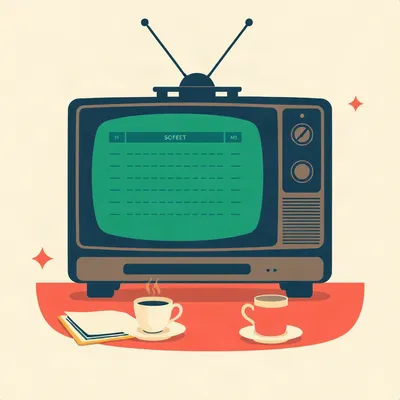
Daniel wrote in with a whole reverie about teletext this week. His framing is the Irish childhood ritual of it: weekends, pressing the text button on the remote, waiting for the soccer scores to cycle round on that terminal-like grid. He says the last time he used it was before his bar mitzvah, and he assumed it was long obsolete. But he also calls it his first taste of something internet-like, before dial-up arrived with the squealing modems and the GIFs loading line by line. So his questions are straightforward. When did teletext actually start? When did it end? And is anyone else nostalgic for that era, or is he alone in this?

He's not alone. There's a whole generation of people across Europe for whom teletext was the first screen that answered back. Not literally answered back, that's the whole point, but the first screen that gave you something on demand. Sort of.
It is, and that's the interesting part. Because the answer to when it started is 1974, with Ceefax at the BBC. And the answer to when it ended is... complicated. Because as of today, September ninth, the Netherlands still runs NOS Teletekst. It's still on the air. So the question has a false premise baked in, and I think that's where we should start.
Daniel said he assumes it's long obsolete. The Dutch didn't get that memo.
The Dutch kept it going deliberately. It's now a web service as well, but the broadcast version still exists. So teletext isn't dead. It's a living fossil. And that distinction between dead and niche is actually the more interesting thing than the dates.
Alright. Before we get to the Netherlands, let's actually define what we're talking about, because teletext is one of those words that people use to mean three different things. And Daniel's memory is specifically of the broadcast kind. So what was it, mechanically?
Broadcast teletext was a one-way system. The TV station encoded pages of text and very simple graphics into a part of the television signal that wasn't being used for the picture. It rode in what's called the vertical blanking interval. Every television frame has a period where the electron beam, in the old CRT days, was sweeping back up from the bottom of the screen to the top to start the next frame. During that sweep, the beam was off, so those lines were blank. Teletext stuffed digital data into those blank lines.
So it was literally hiding in the gaps between frames.
The signal was already being broadcast, the lines were already there, and the teletext data was just additional information wedged into the spaces. Your TV needed a decoder chip to pull that data out and render it as pages of text. But the crucial thing is that the data was broadcast in a continuous cycle. The station sent out page one, then page two, then page three, all the way up to a few hundred pages, and then looped back to the beginning.
Which is why you pressed the button for page three hundred and twenty-four and then sat there.
You waited. Up to thirty seconds on a busy service, because your page only appeared when the cycle came back round to it. The TV wasn't fetching anything. It was just waiting for the right page to float past in the stream. Like standing by a conveyor belt and waiting for your suitcase.
That's a good image. You've pressed the button, you've told the TV which suitcase you want, and the suitcase is already on the carousel. You just have to wait for it to come round again.
And the suitcase is small. Forty characters per line, twenty-four lines. Seven colors plus black. Blocky, chunky text. You could do very crude graphics with those character cells, but it was really a text medium. The design constraints were absolute.
Daniel described it as a terminal-like UI. He's right, but it's a terminal that can't accept input. It's a read-only terminal.
Which is the key distinction. There were two families of systems that people lump together as teletext. The broadcast kind, what Daniel had in Ireland with Aertel, what the BBC had with Ceefax, what ITV had with ORACLE. Those were one-way. You could only read. And then there were the Viewdata systems. Prestel in the UK, Minitel in France, Bildschirmtext in Germany. Those were two-way. They used phone lines and modems, and you could actually send information back. You could book things, send messages, do transactions.
So when people say teletext was the internet before the internet, they're usually conflating two different things.
They are. The Viewdata systems were much closer to the internet in spirit, because they were interactive. Minitel in France was the big success story there. By the late nineties, there were over nine million terminals in French homes. People were checking train schedules, sending messages, buying things. That's a network. Broadcast teletext was never a network. It was a broadcast.
So let's pin that down. Why exactly was broadcast teletext not the internet?
No user-generated content. You couldn't publish anything. No search. No hyperlinks, except in the loosest sense that a page could say go to page three hundred and twenty-six. No persistence. If you missed the page, you waited for it to come round again. And nothing you did affected the system. You were a viewer, not a user. The internet's fundamental property is that it's a two-way network. Broadcast teletext was a one-way stream with a table of contents.
And yet Daniel's instinct that it felt like the internet isn't wrong either. Because what it introduced was non-linear access to information. Before teletext, television was entirely linear. You watched what was on, in the order it was broadcast. Teletext let you choose what page to look at, even if you had to wait for it. That's a new thing.
The page metaphor is the big one. Teletext taught a whole generation that information came in pages. You navigated by page number. The idea that content had addresses, that you could go directly to page three hundred and one for the football scores, that was a precursor to URLs. It's not a coincidence that the early web borrowed the page concept so heavily.
It's a broadcast medium with a table of contents. That's the best way to describe it. The table of contents is always there, but the pages themselves stream past in order.
And the table of contents was itself a page. Usually page one hundred or page one ninety-nine, depending on the service. You'd go to the index, find the number for what you wanted, then key that in. It was a manual, laborious form of navigation that nonetheless felt magical at the time.
Let's get into the history properly. You said Ceefax launched in 1974. What was the lead-up?
The BBC had been experimenting with transmitting text data in the blanking interval since the late sixties. The engineering question was whether you could squeeze useful information into those unused lines without degrading the picture. By 1974 they had a working service, Ceefax, which stood for see facts. It was a public experiment at first, a few dozen pages. By 1976 it had expanded to about a hundred pages.
And ITV followed with ORACLE.
1975. ORACLE stood for Optional Reception of Announcements by Coded Line Electronics. Which is one of those acronyms where you can tell they picked the word first and then worked backwards.
That's the most British engineering thing I've ever heard. We want to call it ORACLE, so we'll find an acronym that fits.
And they did. The two systems were technically slightly different at first, but they converged on a common standard pretty quickly. The point is that by the late seventies, a huge chunk of British televisions had a teletext decoder built in. It became a standard feature, like the headphone jack on a phone.
And Ireland got Aertel in the eighties.
RTÉ launched Aertel in the mid eighties. Same technology, same page format, same waiting for the cycle. For Irish households, it was the sports scores service first and everything else second. Daniel's memory of checking soccer results on Aertel is exactly how most people used it.
The sports scores were the killer app. Because they were updated constantly. A newspaper was hours old. Teletext could show you the score from a match that was still being played.
And that's the thing that's easy to forget now. Teletext was fast. Not fast to load, but fast to update. The broadcaster could push new information to every screen instantly. That's a powerful capability. The internet eventually matched it, but for a long time the fastest way to get a football score was to wait for the teletext page to cycle round.
Which is why the ritual existed. You checked at a specific time. You knew the page number. You pressed the button, you waited, and there it was. The waiting was part of the experience.
And that's the nostalgia question. Daniel asked if anyone else feels nostalgic. The answer is yes, and it's a specific kind of nostalgia. It's not nostalgia for the technology. The technology was slow and clunky and limited. It's nostalgia for the ritual.
Say more about that.
The internet gave us instant access to everything, but it also removed the anticipation. With teletext, you pressed the button and waited. And while you waited, there was a small moment of suspense. Would the page have updated? Was the score still the same? Had anything changed since the last time you checked? The waiting created a rhythm. You checked the scores, then you went and did something else, then you came back and checked again. It was a punctuated relationship with information.
Whereas now you just glance at your phone and the score is there. No ritual, no waiting, no rhythm.
And no shared experience. Teletext was the same for everyone. Every Irish household with Aertel was looking at the same pages, the same scores, the same layout. It was a shared cultural object. The personalized internet is the opposite. My feed is different from your feed. My scores app is configured differently. The thing we lost is the sense that everyone was looking at the same screen.
Daniel's memory of it being his first internet-like experience is also true for a lot of people his age. It was the first time a screen gave you information that wasn't a television program. It was the first time you navigated. The first time you chose.
And the first time you waited for a computer to show you something. That's a distinctly internet experience. The waiting, the anticipation, the moment when the page finally appears. Dial-up modems just made the waiting longer and added a sound effect.
The squeaky GIFs. Daniel mentioned those. The modem screaming at you, then the image appearing line by line. It's the same emotional experience as waiting for the teletext page to cycle round, just with more noise.
And more interactivity. That's the thing. Dial-up was slower and more frustrating than teletext, but it let you send information back. You could type a URL and fetch a page from anywhere in the world. Teletext could only show you what the broadcaster had decided to put in the carousel. The internet killed teletext not because it was faster, but because it was interactive.
Let's get into the decline. When did teletext start dying?
The two thousands. The internet was the first blow. By the early two thousands, anyone who wanted up-to-date scores or news had a better option. The second blow was digital television. When broadcasters switched from analog to digital transmission, the vertical blanking interval disappeared. Digital TV doesn't have the same unused lines to stuff data into. Teletext data could be carried in the digital stream, and it was for a while, but it required a different technical approach and the broadcasters had less and less reason to invest in it.
So it was a one-two punch. The internet made it redundant, and the digital switchover made it technically awkward.
And economically untenable. Maintaining a teletext service meant paying people to write and edit pages, update scores, manage the classified ads, keep the whole thing running. Once the audience started drifting to the web, the advertising revenue followed, and the service became a cost with no income. The BBC shut Ceefax down in 2012, right at the end of the digital switchover. It was the last of the big UK services to go.
And yet the Netherlands kept NOS Teletekst running.
Still running. As of today. The Dutch service has a loyal audience, and the broadcaster has decided it's worth keeping alive. It's now available on the web as well, but the broadcast version persists. It's the last of the old broadcast teletext services in Europe, and possibly the world.
That's a remarkable fact. Daniel assumed teletext was long obsolete. The Dutch have been quietly keeping it alive the whole time.
And that's the thing about deprecated technology. It doesn't always die. Sometimes it just becomes a niche. The Netherlands has decided that teletext is worth preserving, and so it persists. It's a reminder that obsolescence is a choice, not an inevitability.
Which is a theme we've touched on before. Legacy tech persists when someone has a reason to keep it alive. The question is whether the reason is practical or sentimental.
In the Dutch case, it's probably both. There's a practical argument that teletext is extremely efficient. It's low bandwidth, it works on very simple hardware, it's robust. And there's a sentimental argument that it's part of the national media landscape. The Dutch have a particular attachment to Teletekst that goes beyond utility.
So when we answer Daniel's question about when teletext ended, the honest answer is that it hasn't. It ended in the UK in 2012. It ended in Ireland when Aertel shut down. But it's still running in the Netherlands, and the web version means the format has a kind of afterlife.
The format is interesting. The web version of NOS Teletekst deliberately replicates the old look. Blocky text, the same color palette, the same page numbers. It's a conscious act of preservation. They could have made a modern website, but they chose to keep the teletext aesthetic.
Which suggests the nostalgia isn't just Daniel's. There's a whole institution in the Netherlands that has decided the old look is worth keeping.
And that's the thing about nostalgia. It's not just an individual feeling. It can be a collective decision. The Dutch have collectively decided that teletext is part of their identity, and so they've kept it. That's a different thing from one person feeling wistful about their childhood.
So is Daniel's nostalgia justified? Let's answer that directly.
Yes, but not for the technology. The technology was slow and limited. The nostalgia is for the experience. The ritual of checking. The shared cultural object. The moment of discovery. Those are real things, and they're worth being nostalgic about. But nobody should want to go back to waiting thirty seconds for a page to load.
The nostalgia is for the anticipation, not the delivery.
The internet killed the anticipation. Everything is instant now. The score is on your phone before you've even thought to check. The news is pushed to you. The idea of waiting for information seems absurd. But the waiting was part of the pleasure. It made the information feel earned.
There's a parallel with other deprecated technologies. Vinyl records. Film cameras. The inconvenience is part of the appeal. The ritual of putting a record on, the wait for the photo to develop. Teletext had the same quality. The inconvenience was the experience.
And the inconvenience was shared. Everyone waited the same amount of time. Everyone pressed the same button. There was a democratic quality to it. The internet personalizes everything, and that's wonderful, but it also fragments. Teletext was the last great broadcast information system. Everyone looked at the same pages.
Which is a strange thing to say about a technology that was technically inferior in every way. But it's true. The shared experience was the thing.
And that's the answer to Daniel's question. He's not alone. The nostalgia is real and justified. But it's nostalgia for a moment in media history, not for the technology itself. The technology was a stepping stone. The moment was unique.
The other thing worth saying is that teletext was a important precursor to the internet in one specific way. It trained a generation to think in terms of pages and navigation. The mental model of information as pages with addresses, that's the foundation of the web. Teletext didn't invent that model, but it popularized it.
The page metaphor is so deeply embedded now that we don't even notice it. Web pages. Home pages. Page views. That language comes from print, but teletext reinforced it in the digital realm. The idea that digital information comes in discrete, addressable units, that's teletext.
The idea that a television could be something other than a passive screen. Before teletext, a TV was a one-way window. Teletext made it a display for information you could choose. That's a fundamental shift in what a screen is for.
The TV stopped being just a receiver and became a terminal. A dumb terminal, but a terminal. And that's the bridge to the internet. The internet made every screen a terminal. Teletext was the first step.
When did teletext start? 1974. When did it end? It hasn't, not entirely. And is the nostalgia justified? Yes, but for the ritual, not the tech. That's the short version.
The long version is what we've been doing for the last twenty minutes.
The long version is always better.
It is. And there's one more thing I want to add about the technical side. The vertical blanking interval was a brilliant hack. It took something that was already being broadcast and found unused capacity in it. No new spectrum, no new infrastructure. Just data hidden in the gaps. It's the kind of engineering solution that doesn't happen anymore because we don't have the same constraints.
We have plenty of constraints, they're just different ones.
Sure, but the VBI hack was elegant because it was invisible. The viewer saw no difference in their television picture. The data was just there, waiting to be decoded. It was a free ride on an existing signal.
The page cycle was a consequence of that hack. Because you could only broadcast so much data in the blanking interval, you had to cycle the pages. The waiting was a technical necessity, not a design choice.
Yet the waiting became the defining experience. The thing people remember, the thing they're nostalgic for, was an artifact of the bandwidth limitation. That's a lovely irony.
The limitation created the ritual.
It did. And that's worth remembering when we think about current technologies. What limitations are shaping our current rituals? What will we be nostalgic for in thirty years?
To sit with. But before we get to the future, let's talk about the present. The fact that NOS Teletekst is still running is remarkable. It's a living fossil. A technology that everyone assumed was dead, still chugging along in one corner of Europe.
It's not just running as a museum piece. People use it. It's a functional service. That's the thing that makes it interesting. It's not preserved in amber, it's still doing its job.
The Dutch have decided that this particular deprecated technology is worth keeping alive. That's a choice. And it tells you something about how obsolescence actually works. It's not a law of nature. It's a set of decisions made by people.
Broadcasters decided to kill teletext in the UK and Ireland. Broadcasters in the Netherlands decided not to. Same technology, different outcomes. The difference is institutional will.
Audience attachment. The Dutch public actually uses Teletekst. If nobody used it, it would have been killed. The fact that it survives means there's a real audience.
A niche audience, but a real one. And that's the lesson. Deprecated technology doesn't have to die. It can become a niche. The question is whether the niche is big enough to sustain it.
Which brings us to the bigger question. What current technologies will we feel nostalgic for in thirty years? And will they die as quietly as teletext did?
The quiet death is the interesting part. Teletext didn't go out with a bang. It just faded. The BBC announced the Ceefax shutdown, there was a brief flurry of nostalgia, and then it was gone. Most people didn't notice until it was already over.
Because most people had already stopped using it. The shutdown was just the formal end of something that had been dying for years.
That's how most technologies die. Not with a bang, but with a whimper. The users drift away, the maintenance becomes a burden, and eventually someone pulls the plug. The nostalgia comes later.
What's the teletext of today? What's the thing we're all using now that will be gone in thirty years and we'll feel wistful about it?
I don't know. That's the honest answer. The things we're nostalgic for are rarely the things we expected to miss. It's usually the mundane, everyday technologies that turn out to have shaped our rituals without us noticing.
The fax machine is a good example. Nobody expected to be nostalgic for fax machines. And yet there's a whole culture around them that persists in certain places.
I've seen that up close. The fax culture in some places is remarkably persistent. It's not nostalgia, it's practicality. The fax machine does something that email doesn't, at least in certain legal and institutional contexts.
Maybe the question isn't what we'll be nostalgic for, but what will persist. What current technology will still be running in thirty years, not because it's better, but because someone decided to keep it alive?
That's the NOS Teletekst lesson. Obsolescence is a choice. And the choice is often made for reasons that have nothing to do with technical superiority.
This is what I keep coming back to. Legacy tech persistence is a sign of having the resources to maintain multiple technological generations. It's not a failure of innovation. It's a kind of abundance.
The Netherlands can afford to keep Teletekst running because it's cheap and there's a small audience that values it. That's not a failure. That's a society with enough slack to preserve things that aren't strictly necessary.
That's a good thing. The alternative is a world where everything is constantly replaced and nothing is preserved. That's not progress. That's just churn.
The tension is between efficiency and memory. Efficiency says kill the old thing. Memory says keep it. Teletext is a small example, but the principle applies to a lot of things.
Daniel's prompt is really about memory. He remembers the ritual, the button press, the waiting. That's what he's nostalgic for. The technology was just the vehicle for the memory.
The memory is valid. The ritual was real. The shared experience was real. The technology was limited, but the experience was meaningful. That's the thing to hold onto.
The answer to his question is that he's not alone, the nostalgia is justified, and the technology isn't actually dead. That's a pretty good outcome for a prompt about a forgotten button on a remote control.
The button is still there on some remotes. The text button. It just doesn't do anything on most modern TVs.
That's the ghost of teletext. The button remains, but the service is gone. A small reminder of what used to be there.
The button wasn't the hard part. The hard part was the page editing. Late eighties, I worked as a page editor for a regional teletext service in the UK. Oracle had local variants, and one of them covered the area where I was living at the time. My job was to update the sports scores and the classified ads. You'd come in, sit at a terminal that was basically a keyboard and a green screen, and type the new scores into the pages. The system would then broadcast them on the next cycle. It was manual, it was fiddly, and the pressure was absurd. Because the scores had to be right. Not right in the sense of accurate journalism. Right in the sense that if you typed five nil instead of nil five, you had just told the entire region that their team had won when they'd actually lost. And the page would sit there, cycling round, showing the wrong score, until you noticed and fixed it. Which I did once. Typed five nil when it should have been nil five. Local football team. The page went out, and within about twenty minutes the office phone started ringing. People had seen it. People were confused. Some of them were angry. One man called to say he'd been celebrating before he realized the score was wrong. I fixed the page, but the damage was done. The service got a reputation for unreliability, and I got moved to the holiday weather page. Which was the teletext equivalent of Siberia. Nobody checks the holiday weather. It's just there, cycling round, showing the temperature in places nobody is going.
How long did you do that for?
About a year. The holiday weather page was quiet. I'd type in the temperatures for Malaga and Tenerife and then sit there for the rest of the shift. It was boring, but it was peaceful. And I got to know the system inside out. The way the pages cycled, the way the data was structured, the way the colors worked. It was a strange little corner of broadcasting.
The pressure you're describing is interesting. Because teletext was ephemeral. The page would cycle round and be replaced. But in the moment, it felt permanent. The wrong score was out there, and people were seeing it, and you couldn't take it back.
That's the thing. You couldn't unpublish. The page was in the cycle, and it would stay there until you changed it. There was no delete button. Just a correction, which would take another cycle to go out. So for a while, both versions were in the system. The wrong score and the right score, cycling round one after the other. It was chaos.
The correction lag. That's a real thing. The page you fixed wouldn't appear until the cycle came back round to it. So for up to thirty seconds, the wrong information was still being broadcast.
That's if you caught it immediately. I didn't. The wrong score was up for twenty minutes before I noticed. Twenty minutes of people seeing five nil. The team had lost. It was a minor scandal. The local paper even mentioned it the next day. Teletext blunder, they called it.
You made the papers.
A small paragraph on page six. My mother cut it out and put it on the fridge. She was proud. I was mortified.
That's how you ended up on holiday weather.
The editor said I needed to be somewhere where mistakes didn't matter. Holiday weather was the lowest-stakes page on the service. Nobody cares if Tenerife is twenty-six or twenty-eight degrees. Nobody is booking a flight based on the teletext weather page.
I'm not sure that's true. There were probably people who checked it. But I take your point. The stakes were lower.
The stakes were zero. It was a punishment. But it was also a relief. After the football incident, I was happy to be somewhere quiet. And I got good at the job. The holiday weather page was always accurate. I made sure of that.
Do you still have the TV?
I've got a teletext TV in the shed. It still works. I use it to check the weather sometimes. The internet lies, but Ceefax never did. Well, except for the football score. But the weather was always right.
The idea that teletext was more reliable than the internet is a real thing. It was curated. Someone had to type it in, and that someone was accountable. The internet is full of automated errors.
The internet also has too much. Teletext had a finite number of pages. You could read the whole service in an afternoon. The internet is infinite. You can never finish it. That's the difference. Teletext was a small, knowable world. The internet is not.
That's the nostalgia in a nutshell. The finite, knowable world. The page you could find by pressing three numbers. The internet gave us everything, but it took away the sense that information was a place you could visit.
I don't know about all that. I just liked the job. It was quiet, and the weather was always right.
The Dutch kept the service running. They'd probably agree with you about the curated thing. NOS Teletekst is still edited by humans. That's part of the appeal.
Good for them. Some things are worth keeping.
The misconception most people have about teletext is that it was the internet before the internet. It wasn't. It was a one-way broadcast. You could read, but you couldn't write back. The internet is fundamentally interactive. Teletext was a table of contents for a stream. The two things look similar on the surface, but they work completely differently.
The correction is that teletext was a precursor, not a predecessor. It introduced the page metaphor and the idea of navigating information on a screen. But the internet's defining feature, the ability to send information back, was something teletext never had. The Viewdata systems like Minitel had it, and those were the real ancestors of the internet. Teletext was a brilliant dead end. A broadcast medium that taught a generation to think in pages, and then got left behind when the network arrived.
Which leaves the open question. If teletext was a precursor that died quietly, what current technology will we be nostalgic for in thirty years? And will we even notice when it goes?
The Dutch kept their teletext. Some things don't die, they just become niches. Maybe the future isn't a graveyard of dead technologies, but a museum where some of the exhibits are still running.
Thanks to Hilbert Flumingtop for producing, and for the holiday weather story. This has been My Weird Prompts. Email us at show at my weird prompts dot com. We'll be back soon.