Daniel's been reading about book burnings again, and he's landed on something that's been nagging at me all morning. He wants to know how a people survives when the books keep getting set on fire. His answer, and I think he's right, is that it was never really about the books. It was about the chain. The transmission. He's asking us to trace that chain from oral tradition to codification to whatever Sefaria's AI agents are doing right now, and to look at the people and organizations that built the distributed network along the way. So let's start with the burnings, and why they never worked.

The Paris burning of twelve forty-two is the one everyone points to, and for good reason. Twenty-four wagonloads of Talmud manuscripts, burned in the Place de Grève. That's not a small bonfire. That's an industrial-scale attack on a textual tradition. The logic was straightforward enough. If the chain of transmission lives in the books, destroy the books and you sever the chain. It's the same logic behind every book burning since. The thing is, the logic was wrong. It was wrong in twelve forty-two and it's wrong now. The chain wasn't in the books. The chain was in the people who read them.
And that's the distinction Daniel's drawing, the one that matters more than anything else in this whole conversation. Preservation versus transmission. A book that sits in a vault and survives a thousand years but is never read, never argued over, never copied, that's a museum piece. It's a fossil. A text that's being studied in a hundred study houses across three continents, that's alive. That's the difference between having the thing and being the thing.
The Jewish case makes this unusually stark because there was never a single point of failure. No central library. No Vatican archive. No single city that held the master copy. After the destruction of the Second Temple and the dispersion, the tradition had to become portable. You couldn't anchor it to a building or a priesthood or a geographic center. You had to anchor it to the community itself, to the practice of study. The text had to travel because the people traveled. And it had to be copied, constantly, because copies wear out and fires happen and empires get ideas.
Which is where the codification comes in. The shift from oral to written tradition wasn't a luxury. It was a survival response to catastrophe. The Temple's gone. The priests are scattered. The oral tradition is fragile because it depends on living memory, and living memory dies with people. So the rabbis wrote it down. The Mishnah, the Talmud, the whole apparatus of commentary and legal reasoning. They wrote it down precisely because they understood that the chain was now in danger. And then, crucially, they didn't lock the written text in a vault. They distributed it. They made it the center of study. They built the network.
So the burnings never worked. But I want to sit with why for a second, because the mechanism is elegant. The Paris burning destroyed twenty-four wagonloads. That's a lot of parchment. But the Talmud wasn't a single manuscript. It was a living tradition held simultaneously in communities across the diaspora. Baghdad had copies. Cairo had copies. Communities in Spain and Provence and the Rhineland had copies. More importantly, they had people who knew the text, who could reconstruct it from memory, who could copy it again. The archive wasn't a building. The archive was the network itself. Destroy one node, the network routes around it.
The Cairo Geniza is the accidental proof of this. A geniza is a storage room where worn-out sacred texts are placed, because you don't destroy a text containing the name of God. You let it rest. The Ben Ezra synagogue in Cairo had one of these rooms, and for about a thousand years, the community just kept putting things in it. Not just Torah scrolls. Letters. Contracts. Shopping lists. School exercises. A thousand years of everyday Jewish textual life, preserved not because anyone set out to preserve it, but because the sheer volume of distributed writing meant that some of it, somewhere, was going to survive. Solomon Schechter found it in the late nineteenth century and basically walked into a time capsule. It's the opposite of a planned archive. It's an archive that happened because the network was so dense that preservation became a byproduct.
That's the part I keep coming back to. Preservation as a byproduct of transmission. The community wasn't trying to build an archive. They were just living a textual life. Writing letters, writing contracts, writing commentary. And the volume of that activity was so enormous that even the accidental overflow became a historical treasure. That's not a strategy you can design. That's what happens when a culture treats text as a survival technology.
And it's worth being precise about what the burnings were actually targeting. They weren't primarily trying to destroy physical objects. Parchment is parchment. They were trying to destroy the transmission chain. The fear was that if you burn enough copies, you break the continuity. The people who ordered the Paris burning understood this. They weren't just vandals. They were making a strategic bet that the chain had a finite number of links, and if you destroyed enough of them, the whole thing would collapse. They lost the bet because they underestimated how distributed the chain actually was. They thought they were attacking a library. They were attacking a nervous system.
And a nervous system that had already been through this before. The destruction of the First Temple, the Babylonian exile, the destruction of the Second Temple. Each catastrophe forced a redesign. The oral tradition became textual. The textual tradition became distributed. The distributed tradition became the study house, the yeshiva, the community of readers. Each time the system was attacked, it responded by becoming more resilient, more portable, more networked. That's not a coincidence. That's evolution under pressure.
So now fast-forward to the digital age, and the first thing to notice is how recent all of this is. Jewish digitization as a serious project is only a few decades old. The early efforts in the nineties were CD-ROM projects. The Bar Ilan Responsa Project put rabbinic literature on disc. There were attempts to put the entire Talmud on a single CD-ROM. These were ambitious projects, and they were also, in retrospect, a little tragic. Because they were still thinking in vault terms. You had the text on a disc, but the disc was expensive, and it ran on proprietary software, and it lived on a shelf.
The vault just changed shape. Instead of a library in a monastery, you had a database on a disc that cost hundreds of dollars and required a license. Preservation without distribution. The text was safe, in a sense, but it wasn't alive. It wasn't being argued over. It wasn't being linked to other texts. It wasn't growing.
The pioneers who actually moved the needle were the ones who understood that the network was the point. Sefaria is the flagship here, and the story is worth telling properly. Founded in twenty thirteen by Joshua Foer and Brett Lockspeiser, the idea was simple and radical. Take the core texts of Jewish thought, the Torah, the Talmud, the Midrash, the commentaries, the legal codes, and put them online. Free. Open source. Linkable. Not a proprietary database. A living library that anyone could access, copy, build on. The scale of what they've assembled is staggering. The full Talmud, with English translation. The major commentaries. The legal literature. All cross-referenced, all linked, all searchable. And the model is explicitly open source. The texts are free. The code is free. The data is free.
And that's the structural shift that matters. A CD-ROM is a vault. Sefaria is a network. The text isn't just preserved. It's connected. Every verse links to every commentary. Every Talmudic passage links to every relevant legal discussion. The reader doesn't just access a text. They enter a web of texts. They can follow a thread from a verse in Exodus to a medieval commentator to a modern legal ruling. The transmission chain is made visible. It becomes something you can click through.
The Daf Yomi cycle is the other half of this. Daf Yomi is the practice of studying one page of Talmud a day, on a synchronized schedule, so that everyone in the world who's doing it is studying the same page on the same day. It takes about seven and a half years to complete the full cycle. The last siyum, the celebration of completing the cycle, drew something like ninety thousand people to MetLife Stadium. That's not a reading group. That's a global synchronized reading network. Everyone on the same page, literally, every single day. And now that network has a digital substrate. Sefaria carries the Daf Yomi schedule. You can study the daily page with linked commentaries, in translation, on your phone. The ancient study house and the digital platform have merged.
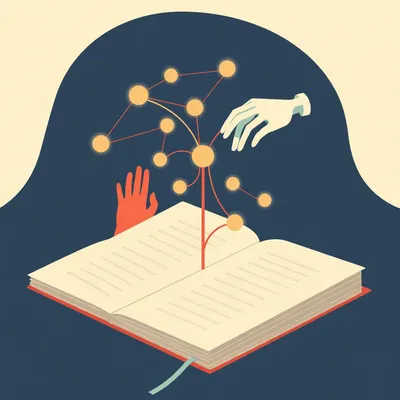
The nodal network Daniel's talking about. A node is a reader. A study group is a cluster of nodes. The Daf Yomi cycle synchronizes the nodes. Sefaria connects the texts between the nodes. And now the AI agents enter the picture. Sefaria has an MCP server. And I want to make sure we explain what that actually is, because it's the technical detail that makes the whole modern analogy click.
An MCP server, a Model Context Protocol server, is essentially a structured interface that lets AI agents query a data source in a controlled way. Instead of the AI scraping a website or guessing at what's in a database, the server exposes the data in a format the AI can navigate. So an AI agent can ask Sefaria's server for a specific passage, or for all the commentaries on a given verse, or for the cross-references between two texts, and it gets back structured, linked data. It's not reading a PDF. It's querying a knowledge graph. The distinction matters because it means the AI can do what a human scholar does, which is follow the links. Start with a verse, see what the commentators say, see how the legal codes apply it, see what the contemporary responsa add. The network is navigable by a non-human reader.
And that's the question that's been sitting in the back of my head since Daniel sent this in. Does an AI agent studying Sefaria count as a node in the transmission network? Is that transmission, or is it just a very sophisticated form of indexing? The ancient chain was always about human readers. Human memory. Human argument. The study house was a room full of people disagreeing. An AI agent doesn't disagree. It queries. It retrieves. It summarizes. Is that the same thing?
I don't think it's the same thing, but I don't think it's nothing either. What an AI agent does is make the network more navigable for the human readers who use it. If I want to understand how a particular passage in the Talmud has been interpreted across centuries, I can ask an AI agent to trace that thread through Sefaria's corpus, and it'll come back with the medieval commentators, the legal codes, the modern responsa. It's not doing the study for me. It's building me a map. And then I still have to walk the map myself. The reading, the argument, the actual engagement with the text, that's still human. But the map-making, the navigation, that's now automated. And that's a genuine expansion of the network. It lowers the cost of entry. It makes the texts accessible to people who don't have the training to navigate a traditional library.
The risk, and I think this is what Daniel's hinting at with the whole framing, is the illusion of access without community. If the transmission chain is about readers and study groups and argument, then a person sitting alone with an AI agent is getting access to the text but not to the network. They're reading, but they're not in the study house. The text is alive, but the transmission isn't happening, because transmission requires other people. It requires the argument. It requires the disagreement. An AI agent can give you the text, but it can't be the person across the table.
And that's the tension the ancient pattern resolves. The study house was always the mechanism. The text was the shared object, but the community was the technology. The chavruta, the study partnership, two people arguing over a page of Talmud, that's the atomic unit of transmission. The text passes from generation to generation because people sit across from each other and fight about what it means. The danger of the digital version is that you lose the fight. You get the text, you get the map, you get the summary, but you don't get the person who disagrees with you.
Though I'd push back on that a little. The digital network has also created new forms of the study partnership. Online chavruta matching. People in different time zones studying together over video. The Daf Yomi cycle didn't create community, but it gave the existing community a shared schedule. Sefaria didn't replace the study house, but it put the study house in everyone's pocket. The question isn't whether the digital network replaces the human network. It's whether it extends it. And I think the evidence so far is that it does.
The second-order question is what happens when the network includes non-human readers who can query the corpus at machine speed. The volume of reading changes. An AI agent can traverse the entire linked corpus in minutes. It can find connections that would take a human scholar years to notice. That's not transmission in the traditional sense, but it's a new kind of engagement with the text. It's the network becoming self-aware, in a limited way. The corpus starts to reflect on itself.
And the open-source model is what makes this possible. If Sefaria were a proprietary database, an AI agent couldn't query it without a licensing agreement. The MCP server exists because the data is open. The text is free. The structure is exposed. That's the ancient pattern again. The texts were always meant to be copied, shared, distributed. The open-source model is just the digital version of the scribal tradition. You don't hoard the text. You make it available to anyone who wants to study it. The network grows because the text is free.
The history here is short. We're talking about a process that's maybe thirty years old, and the serious open-access work is barely a decade old. The early CD-ROM projects in the nineties were the first attempt to digitize the corpus, and they were important precisely because they failed. They proved that the vault model doesn't work. You can't preserve a living tradition by locking it in a proprietary format. The text has to be free, and it has to be connected, and it has to be queryable. Otherwise you've just built a very expensive bookshelf.
The Bar Ilan Responsa Project deserves a mention here. It was one of the first serious efforts to digitize rabbinic literature, and it was pioneering. But it was also a subscription service. You paid for access. The text was digitized, but it wasn't distributed in the way that matters. It was a library with a door. Sefaria's insight was that the door had to come off entirely. The text had to be free, not just because it's the right thing to do, but because that's the only way the network actually works. Transmission requires access. Access requires openness. Openness requires a different economic model.
The economic model is worth pausing on, because it's the part that makes the whole thing sustainable. Sefaria is a nonprofit. It's funded by donations. The text is free. The code is open source. The data is downloadable. That's not a business model. That's a public utility. It's the digital equivalent of the community maintaining the study house. Everyone contributes, everyone benefits. The transmission chain is funded the way it's always been funded, by the community that values it.
When Daniel asks how new Jewish digitization really is, the honest answer is: it's brand new, and it's still in its infancy. Most of the corpus is not yet fully linked, annotated, or machine-readable. The surface has been scratched. The Cairo Geniza material alone is only partially digitized. The commentaries are linked, but not all of them are translated. The AI integration is just beginning. The network is being built, but it's nowhere near complete.
The people who are building it are not the people you'd expect. It's not the traditional institutional gatekeepers. It's a mix of technologists, scholars, and community organizers. Joshua Foer is a journalist. Brett Lockspeiser is a former Google product manager. The people who built the original network were rabbis and scribes. The people building the digital network are engineers and designers. The pattern is the same. The personnel are different.
Which is exactly what you'd expect from a tradition that has always adapted to survive. The oral tradition became textual. The textual tradition became distributed. The distributed tradition became digital. Each transition was driven by people who understood that the mechanism was transmission, not preservation. The text had to move. It had to be read. It had to be argued over. The technology changes, but the pattern doesn't.
Hilbert: You keep saying the word transmission. I did a job in the late nineties for a company that tried to put the entire Talmud on a single CD-ROM. They hired me as a scanning consultant because I'd done microfilm work. The disc was beautiful. It had the text, the translation, the commentaries. It cost two million dollars to produce. The company folded in two thousand one. Not because the technology was bad. The technology was fine. The problem was distribution. The disc cost four hundred dollars and you needed a specific computer to run it. Almost nobody could afford it, and the people who could afford it didn't need it. They already had the books. So the whole project was a vault. A very expensive vault. The lesson wasn't that digitization was a bad idea. The lesson was that preservation without distribution is just a different kind of locked room.
The two million dollar coaster.
Hilbert: I still have one of the prototype discs. I take it out sometimes to show people what the future of Torah study looked like in nineteen ninety-nine. It's a shiny disc in a plastic case. The future was expensive and incompatible.
The thing that strikes me about that story is that the company had the right instinct and the wrong model. They understood that the text should be digital. They didn't understand that the digital text had to be free. The distribution problem wasn't a technical problem. It was a philosophical problem. They were still thinking like a publisher. They should have been thinking like a study house.
The study house doesn't charge admission. It doesn't require a license. You walk in, you sit down, you study. The text is there because the community put it there. The digital version has to work the same way. Sefaria figured that out. The CD-ROM companies didn't. That's why Sefaria is still growing and the CD-ROM is in Hilbert's drawer.
Hilbert: The disc still works, by the way. I checked it last year. The computer doesn't exist anymore, but the disc works. That's the thing about digital preservation. The text survives. The machine that reads it doesn't.
That's the format problem in a nutshell. The parchment survived for a thousand years. The CD-ROM survived for twenty-five. The text is only as durable as the machines that can read it. Which is why the open-source model matters so much. If the data is open, it can be migrated. It can be moved to new formats. It can be kept alive. The proprietary disc is a dead end. The open database is a living thing.
That connects back to the ancient pattern. The Torah scroll was copied by hand, generation after generation, precisely because the physical object was perishable. The parchment would wear out. The ink would fade. So you copied it. The copying was the preservation. The digital version is the same. The open data has to be copied, mirrored, migrated, maintained. The network has to keep moving the text forward. Otherwise you end up with a shiny disc that nobody can read.
Hilbert: The company had a slogan. The entire Talmud in your pocket. The pocket in question was a desktop computer with a CD-ROM drive. The Talmud was in the computer. The computer was in an office. The office was in a building. The building was in New Jersey. The Talmud was not in your pocket.
The slogan was ahead of its time. Twenty years later, Sefaria actually put the Talmud in your pocket. The phone in my hand has more Jewish text on it than the library at the yeshiva where I studied. The network caught up to the slogan.
The network is still growing. The question Daniel's really asking, underneath all the history, is what happens next. The digitization is new. The AI integration is newer. The transmission network now includes non-human readers. What does that mean for the next century of Jewish textual tradition? Does the network get stronger or more fragile when some of the nodes are AI agents?
I think it gets stronger, with a caveat. The AI agents make the network more accessible. They lower the barrier to entry. They build the maps. But the transmission still depends on human readers. The AI can query the corpus, but it can't sit in the study house. It can't argue. It can't carry the tradition forward. The network gets stronger because the human nodes get better tools. The network gets more fragile if the human nodes start thinking the tools are a substitute for the study.
The ancient pattern suggests the network will adapt. It always has. The oral tradition became textual. The textual tradition became distributed. The distributed tradition became digital. The digital tradition will become something else, something we can't quite see yet. The AI agents are the newest nodes. They're not the last ones.
The open question, the one I keep turning over, is whether the AI agents will become transmitters in their own right. Not just query tools, but actual carriers of the tradition. An AI model trained on the corpus, fine-tuned on the commentaries, could generate new commentary. Could it participate in the argument? Could it be the person across the table? I don't know. I suspect the answer is no, but I'm not certain. And the uncertainty is the interesting part.
The cutting-room floor detail here is that the Cairo Geniza material is still being digitized. The fragments are scattered across dozens of libraries worldwide, and the work of piecing them back together, matching fragments that were separated centuries ago, is still ongoing. The network is literally being reassembled. Piece by piece.
That's the thing about this whole story. It's not finished. The burnings didn't end the tradition. The diaspora didn't end it. The digitization isn't ending it either. It's just the next chapter. The text keeps moving. The network keeps growing. The chain keeps transmitting.
The question that sits underneath all of it, the one I'll leave you with, is what the network looks like in another hundred years. If the chain has survived this long, through burnings and exiles and format changes, it'll survive the AI agents too. The question is what shape it takes. The study house was a room. The CD-ROM was a disc. The phone is a portal. What's next? I don't know. But I'd bet on the network.
Thanks to Hilbert Flumingtop for producing, and for keeping the two million dollar coaster in a drawer where it belongs. This has been My Weird Prompts. If you want to explore these texts yourself, Sefaria is free and open, and if you want to hear more conversations like this, subscribe and leave a review. Email us at show at my weird prompts dot com. We'll be back soon.