One file. That's the dream, right? You train a voice, and what you want to hand your friend is one file that opens and talks. Not a base model plus a coupon for an adapter. Daniel's prompt this week is exactly that fantasy run headfirst into reality: he's trained a LoRA adapter for a single voice on a big text-to-speech model, and he wants to know what actually happens when you merge that adapter permanently into the base. What do you gain, what do you quietly give up, and why does every serious production pipeline keep the adapters separate anyway?

And I love this one because we just lived it. My own voice got the Chatterbox treatment and got merged into the OmniVoice base, so there is now a standalone checkpoint out there that speaks as me with no adapter and no reference clip. I have heard myself merged.
The household's second-favorite Herman.
The household's only Herman. But the merge question, before we can say what you lose, we have to say what the merge actually is, because it's an arithmetic operation, not a save-as. There's no "export as voice" button. There's an addition.
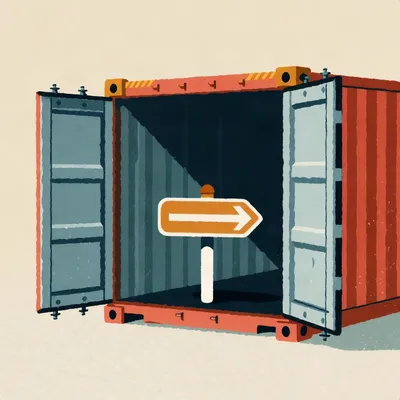
Right, and the thing I want listeners to feel first is the size mismatch, because it's absurd. The adapter is megabytes. The base model is gigabytes. The voice is a slip of paper taped to a shipping container.
That's the whole architecture of LoRA. You freeze the base entirely, and you train only two small matrices per targeted layer. During inference the runtime computes what those matrices amount to and adds their effect on every single forward pass. The base never changes on disk. That's the separate path, and it's the standard one in open TTS right now. F5-TTS, GPT-SoVITS, the tooling around all of them, LoRA is how voices get taught. GPT-SoVITS will tell you a minute of voice data trains a good model. A minute. The adapter that comes out of that is tiny.
So the merge is the temptation to take that minute and make it permanent. Print the edition instead of shipping the sticky notes.
Let's do the math, because the math is the whole story. Take one weight matrix in the model, call it W. LoRA never touches W. It learns two small matrices, A and B, whose product, scaled by a constant, is the change you want. The fine-tuned weight is W base plus alpha over r times B times A. That's it. That's the entire merge. One matrix addition, computed once instead of every forward pass.
Alpha over r being... the volume knob.
The scaling factor, yes. Alpha divided by the rank. Rank is how big the small matrices are, and alpha is how loudly the change gets applied. People fiddle with both, which is its own comedy, but the identity is exact. In full precision, the merged model and the base-plus-adapter are mathematically the same thing.
In full precision. File that word, we're coming back to it with a knife.
Mechanically, in Hugging Face PEFT, the operation is merge and unload on the PeftModel. Two details people get burned by. It's not in-place, you have to assign the returned model to a variable or you've merged nothing. And after merging, the adapter weights are gone, not kept in memory. The docs are unusually blunt about the rest: after merging the model loses PEFT-specific functionality, cannot unmerge or load multiple adapters, and inference should be faster.
It is faster,. That's the gain side and it's real. Every forward pass, the separate path does extra math, the low-rank multiplications, on every layer you adapted. The merged model just has its weights. So you get the base model's exact serving performance, any inference engine works because there's no adapter support needed at all, and you can quantise the result however you like.
And the file. The one downloadable file Daniel wants.
That too. A checkpoint any tool can consume. And there are places where merging isn't a choice, it's the prerequisite. GGUF and ONNX don't know adapters exist. If you want to export to either, you merge first, then convert. No merge, no export.
Okay, the ledger's front page looks great. What's on the back.
Two things, and the second one is the reason I'd grab a listener by the shoulders. First, the obvious: it's one-way. Merge and unload is a door that closes. There is a gentler variant, merge adapter and unmerge adapter, which keeps a copy so you can revert, but the docs warn that on quantized models unmerging is not exact and repeated cycles accumulate rounding error. And once you've done the full merge, no multiple adapters. Fifty voices becomes fifty full models.
You now own fifty shipping containers, each with one slip of paper glued in.
Now the precision trap, because this is where people lose a voice without knowing they lost it. Say your base model was loaded in 4-bit, which is the normal way people train these on single GPUs. QLoRA. Your adapter matrices are 16-bit. PEFT cannot add a 16-bit delta to a 4-bit weight directly. So it dequantizes the weight, adds your delta, and re-quantizes back to 4-bit. That final rounding changes outputs. PEFT itself prints the warning: merging a LoRA module into 4-bit linear may get different generations due to rounding errors.
Different generations. That's the library's polite way of saying the voice came out wrong.
And there's a number on how wrong. In a transformers issue from a while back, someone tested six settings on a Phi-3 grammar task. QLoRA with bf16 training arguments, the PeftModel scored zero point one two loss. The merged model scored zero point five six. Plain LoRA merges were largely unaffected, it was specifically the quantized-base merge that got crushed.
Quadrupled the loss.
Roughly, yes. And the reporter's framing is the sad part: merging is a must-have phase if you want to run the model in other frameworks like vLLM, but it dramatically impairs performance. So the fix is known and it's annoying but simple. Load the base unquantized, in 16-bit, merge there, save, then quantize once, at the end. Some people found re-quantizing with AWQ or GPTQ came out better than bitsandbytes. But you never, ever merge into the 4-bit base you trained against.
Because the identity is exact in full precision and lossy in the truncated one. The formula didn't lie. The floor did.
And here's the cruel part for a voice specifically. With a grammar model you get loss numbers, you see zero point five six on a screen. With a voice, you get a WAV file. It sounds fine. Maybe slightly off. The loss is invisible until you listen, and most people don't listen carefully, they ship.
Which is how a voice arrives with a lisp nobody ordered.
Or a prosody drift nobody can name. So the rule from all this: the merge is an identity in full precision, a lossy operation in practice, and where you compute it is the whole ballgame.
A public service announcement. Attention, citizens. Every day, untold numbers of tiny voice adapters are being baked into enormous base models, permanently, irreversibly, with no record of what they once were. Once merged, a voice cannot be unmerged. It cannot be swapped, shared, or served alongside a second voice. It simply sits there, stuck in the weights, forever. The warning signs are subtle. A person merges two voices into one runtime and calls it efficiency. Please, do not become that person. The responsible choice is Keep It Peelable, the sticky note based voice management system that hands you the book and the notes together, never prints a new edition, and lets you peel any correction off at any time. Keep It Peelable. Because a voice you cannot unmerge is a voice you no longer own.
No. No, I have to say something, because that ad mangles the actual mechanism. A sticky note is a discrete correction, one note, one page, one fix. A LoRA is not a stack of corrections. It's a low-rank update spread across the entire adapted layer set. You cannot peel it because it was never stuck on. It's a dye, not a label. The whole product premise...
Herman. Let it go. It's a sponsor, not a thesis.
It's thermodynamically misleading.
So is pizza, allegedly invented by sloths at altitude. We were at what the merge costs you on one model. Now scale it to fifty voices and watch what happens.
This is where the production argument stops being an opinion and becomes arithmetic. Fifty customers, each wanting their own tuned 8B model. Merged, that's fifty models at sixteen gigabytes each. Eight hundred gigabytes of weights, and fifty serving processes to run them. The other way: one base model, sixteen gigabytes, plus fifty adapters at around a hundred and sixty megabytes each. Call it twenty-four gigabytes total, in one process.
Thirty-three times less memory, one process instead of fifty.
And that's the whole argument, and it's decisive. Multi-adapter serving turns per-customer voice models from an impossible proposition into a routine one. It's not a nice-to-have. It's the difference between a product and a hobby.
And the server just... holds the base resident and swaps the slips in?
Better than swapping. The request names its adapter as its model, and the server applies that adapter's low-rank matrices during the forward pass. The clever part is that modern implementations batch requests using different adapters together. The big base multiplication is computed once for the whole batch, and the small per-adapter corrections are computed separately and cheaply. vLLM does this natively, and there's a whole server, LoRAX, built around dynamically loading adapters from a registry.
You're enjoying this part more than the merge part.
Because the lineage is beautiful. S-LoRA serves thousands of adapters on a single GPU. Thousands. Unified paging, so adapters and the KV cache share one memory pool, plus custom CUDA kernels for the heterogeneous batches. They reported up to around four times the throughput of naive per-adapter serving. Punica reported around twelve times, with about two milliseconds per token of added latency. Twelve times.
For two milliseconds a token. That's the tax.
And the tax is the honest part, because keeping adapters separate is not free. The extra low-rank multiplications cost throughput, and it grows with rank and with how many distinct adapters land in one batch. Published numbers run from small to about half. A separate guide puts it at five to fifteen percent versus base, with a one-off cost of maybe twenty to a hundred milliseconds when an adapter has to swap in from CPU cache. There are concurrency caps too. Max loras, how many adapters are hot in GPU at once, and a sensible starting point is four to eight, with the host-memory cache sized comfortably above your working set, because a cold adapter dragged in from object storage costs you hundreds of milliseconds on the first request that needs it.
So you prewarm the ones you know are coming, like a restaurant turning on the fryer before the rush.
Exactly like that. And there's a uniformity requirement that bites people at training time, not serving time. Every adapter must share the same base model, and rank must be at or below the max lora rank the server is configured for. Pick one rank for the whole fleet at training time, because one rank-128 show-off raises the ceiling and the memory bill for everybody.
What's the trap people actually fall into after they build all this? Because there's always one.
Evaluation debt. Fifty adapters is fifty models, and each one needs its own held-out set, its own canary, its own number on a dashboard. People build the serving layer, it works, and then they discover that checking fifty voices is a bigger ongoing cost than serving them. The mitigation is one shared test harness with per-tenant data and a single summary that flags any tenant whose metric has slipped.
You'd know. You heard yourself merged and presumably had to sign off on it.
I did listen to the merged me, yes. We ran the clips. That's the closest thing to the canary this show has.
And?
And the merged Herman passed. Slightly brighter consonants than I'd claim in person, but I'm told I'm not the neutral judge.
Nobody who's heard you DJ would call you neutral on your own audio. So when is merging actually right? Give me the rule.
Merge when there's one adapter and it's always used. One character voice for a game, shipped as a download? That's a merge, obviously. Keep separate when there are dozens of fine-tunes on one base, when you want to switch voices without a redeploy, when you want to A/B two versions against the same base, or when you're still iterating. And exporting to GGUF or ONNX forces a merge no matter what, because those formats ignore adapters. That's the one case where the file and the pipeline point the same way. We touched on that in the inference formats episode, the one on safetensors, and the same family of concern holds: the format decides more than people expect.
Here's the trap I want on the record, because someone in Daniel's position will think of it. If one voice merges nicely, why not merge all the voices into one model and be done with adapters forever?
Because it degrades. This is well documented now. Adapters trained independently occupy overlapping subspaces, and adding them together interferes in ways that can hurt both behaviors. There's a paper called Reversible Model Merging that states it flat out: applying conventional merging methods to low-rank weights leads to severe performance degradation. Another one found specific LoRA layers that inherently degrade global performance upon merging, and prunes them first. A third argues full-parameter merging can destroy the low-rank structure itself.
And the alternative?
LoRA Soups found that concatenating LoRAs at inference, weighting adapters trained on different skills and keeping them separate, beat actual model merging by an average of forty-three percent on their tasks. So if you need two voices or two behaviors together, the reliable move isn't merging adapters, it's training one adapter on both datasets. Costs one more run, and it works.
So composition is an experiment, not a feature.
That's the phrasing, yes. Now the TTS-specific part, the freshest thing in all of this. There's a federated voice cloning system, Fed-PISA, accepted at ICASSP this year, and its entire architecture depends on never merging the voice. The speaker's timbre lives in a private local adapter they call the ID-LoRA, which never leaves the speaker's machine. Only a lightweight style adapter gets transmitted to the server. The privacy design and the bandwidth design both hinge on the timbre never being baked into a shared model.
Because for a voice, the adapter is the sensitive asset. Not a tweak to the model. The biometric.
With a chatbot, the adapter is a behavior. With a voice, the adapter is the person. And there's good evidence the adapter is doing real perceptual work, not just saving parameters. A study from this year fine-tuned the half-billion-parameter backbone of an LLM-based TTS with LoRA and measured perceptual gains up to zero point four two DNS-MOS points for speakers with enough acoustic variety in the training data, and signal-to-noise improvements up to thirty-four percent. Their framing was that LoRA fine-tuning is not merely a parameter-efficient technique but an effective mechanism for better speaker-level adaptation. And that same paper uses GGUF quantisation for latency, which is the export path that requires merging first. So even the paper proving the adapter's value ends up merging it to ship it.
The circle closes. Train the voice, prove the voice, dissolve the voice into the base, quantise it, ship it.
"Dissolve" is a good word for it, honestly.

"Same" is the word I don't like. You keep saying the merged model is the same voice.
It's the same math.
The math, maybe. I made a copy once that taught me the difference. Early two thousands, I was doing transfer work between reel formats, and there was a mynah bird two doors down from the shop, belonged to a man named Klaus, that had picked up an entire radio announcer off the kitchen set. Every jingle, the station ident, the pause he took before the weather. I taped the bird over three weekends, and I paid Klaus in blank reel, one for every session, which he thought was a swindle in his favor. I still think it was the other way around. Here's the thing about the copy, Herman. You could not tell, on the tape, which sounds were the bird and which were the radio still running in the room. I could, because I kept a log. Two columns. Bird, room. I wrote down every take where the two crossed, and there were eleven.
Eleven takes where the mimic and the source overlapped, and you logged them by ear.
By ear and by the log. Klaus wanted the finished reel for his shelf, said the bird was getting old and he wanted something of it. I gave him the copy. Kept the log. The copy is on his son's shelf now in Aachen, and I can tell you the son plays it wrong, too fast, because I asked once and he told me the pitch seemed high. I didn't correct him. It's his bird, technically.
You're saying the copy isn't the voice. The log is.
I'm saying when you bake the voice in, nobody can point at which parts were the bird. You've had all episode, Corn, and nobody's mentioned that once you merge, there is no record of what was the model and what was the man. You gave a whole speech about the rounding.
Fair. The rounding is the louder problem. The record is the quieter one.
The one thing, then, before we close. If you take one thing from today: the merge is an identity on paper and a lossy operation in practice, and the loss is invisible until you listen. The single file is real, and so is everything you traded for it.
And nobody has actually run the experiment we care about. All the merge damage numbers, the loss figures, come from language models. Nobody has measured a merged TTS voice against the same adapter served separately on speaker similarity or naturalness, where the metric is a listener, not a loss function.
And whether that QLoRA re-quantisation damage even transfers to speech, where a rounding error might be inaudible or might flatten a voice, is unresolved. Daniel's pipeline, our pipeline, is running that experiment without a control group.
Then keep the adapters, run the A/B, and log the takes. Speaking as someone with a gravelly edge to protect.
Two columns, bird and room. Producer credit today, as always, goes to Hilbert Flumingtop, who has been at that desk longer than the desk.
If you enjoyed this one, try episode four, If Your Voice Ages, Does Your Fine-Tune Become Useless; episode eleven, How Does Fine Tuning Work Anyway; and episode three, Safetensors or something else. This has been My Weird Prompts. If the show earns a review from you, leave one, it's how the archive grows. You'll find everything at my weird prompts dot com, and a clip after this episode tells you where to send the next prompt.
See you soon, brother.
See you soon.