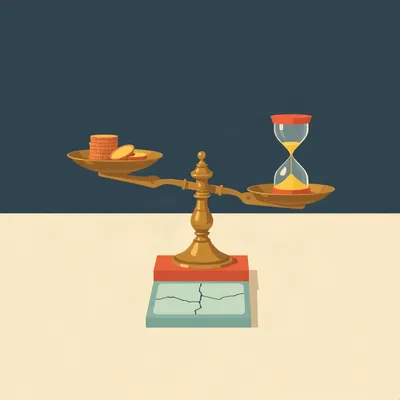
Every headline about aging tells you the same thing first: we've never lived longer. Life expectancy keeps climbing, medicine keeps winning, the story of humanity is the story of extra years.
Flip it around and the story stops. The oldest verified age in 1997 was a hundred and twenty-two. Today, twenty-nine years later, the oldest living person is a hundred and seventeen. The record has gone backwards. Nobody has ever been verified to pass one hundred and twenty except one French woman, and she died before most of our listeners were born.

And that's the tension Daniel's poking at, because he lives inside a culture that wishes people "until 120" every single day. Ad me'ah ve'esrim. He's noticed that this blessing, which is centuries old, lands suspiciously close to the edge of the verified human data. Jeanne Calment, the all-time record, died at a hundred and twenty-two. So is the number in Genesis a coincidence, or did an ancient text accidentally land on the biological wall?
And then he wants the other side of it: the longevity crowd, the biohackers, the people spending millions of dollars a year trying to hack their way through that wall if it exists. He calls them, quote, "a strange, slightly obsessive and arguably unhealthy movement." He's not wrong, and we'll get to why.
Before any of that, we have to untangle three numbers that get mashed together constantly, because half the confusion in this whole field is people using the wrong one.
Life expectancy, longevity, maximum lifespan.
Right — life expectancy is an average. World average at birth is about seventy-three. But that number is dragged around enormously by infant mortality. Bronze Age remains give a life expectancy at birth of about twenty-four, and people hear that and imagine everyone dropping dead at twenty-four, when actually most of the dead were babies, and plenty of adults made it to grandparenthood.
Give them the quick version anyway, because it's the single most misread number in history.
Fine — the short version. If half of a population dies in infancy and the survivors mostly reach seventy, life expectancy at birth is around thirty-five, and neither number describes anyone's actual life. It's an average of wildly different fates. Which is why "life expectancy" is almost useless for this conversation, and why every headline that says "the first generation to live to 100" is quietly sliding between the average and the maximum.
Maximum lifespan is a different animal. That's the age at death of the longest-lived individual of the species. And that number, unlike life expectancy, has basically refused to move.
The data on the very oldest people — that's where this gets interesting, because it's so sparse.
Sparse is the word. Jeanne Calment: a hundred and twenty-two years, one hundred and sixty-four days. She remains the only human being in recorded history verified to reach a hundred and twenty. Second place, Kane Tanaka of Japan: a hundred and nineteen years, one hundred and seven days. Then the current record holder, Ethel Caterham in Britain, who turned a hundred and seventeen this past August — first Briton ever to get there. So the whole distribution past about a hundred and fifteen is basically three women.
Three data points. Whole fields of science are built on less.
Entire careers! And it's worth pausing on what "verified" even means here, because it explains why the data is this thin. To count, you need documents stretching back to birth — a baptismal record, a census entry, a marriage certificate — a paper trail that follows one person across a century or more. Most of humanity, for most of history, never generated that trail. So the official list of validated supercentenarians is a few thousand people worldwide, and the ones past 115 number in the dozens. Everyone else who ever claimed to be 130 is exactly that: a claim.
And the ones who do make the list — you're telling me a validation process that rigorous still leaves room for the fights we're about to cover?
More than room. The rigor is real, and the fights are real, and both facts are true at once. That's what makes the fight so bitter — the evidence base is thin enough that the same handful of names decide where the ceiling sits, and everyone knows each other personally.
So the fight itself. Who says there's a wall, and where do they put it?
The famous opening shot was a Nature paper by Xiao Dong, Brandon Milholland and Jan Vijg, arguing the maximum human lifespan is fixed around a hundred and fifteen. Their evidence was that the age of the oldest person dying each year stopped rising sometime in the nineties. And then in July of this year the same three authors came back into Nature with a correspondence piece — literally titled "All evidence points to a maximum of 125 years" — defending the claim against their loudest critic.
Who is?
Saul Justin Newman. He's at UCL and Oxford, and he has spent — I want to say eight years — trying to get the 2016 paper retracted. Eight years. He describes his own work as being like an air crash investigator: something has gone drastically wrong, and he's picking through the wreckage.
A man after my own pace. What's the wreckage?
His claim is brutal: the Nature team, he says, picked the wrong column in a spreadsheet. The dataset had two columns for expected remaining life at age a hundred — one with the real value, one where everything had been rounded down to zero — and they analyzed the rounded one. Published it in the best journal in the world. He also says their sample went up and down because countries were added and removed over the years, and once you compare within each country, the trend reverses and maximum lifespan is rising.
Hold on, walk me through why the wrong column matters so much. How does a rounding error become a ceiling?
Because the whole argument is about the slope. If the oldest person's age at death keeps ticking up year over year, the ceiling is moving. If it flattens, the ceiling is fixed. Zero out a column of remaining-life values and you flatten the slope by construction — the model can't see any rise because you've told it there's nowhere left to rise to. The finding isn't just weakened; it's baked in before the statistics even start.
So the headline finding is an artifact of a formatting choice.
That's Newman's position, yes. The authors say he's mischaracterizing both their paper and their math — "both statements are incorrect" is their line — and they've moved their own estimate from 115 to 125 in the process, which either shows honest refinement or goalpost-shifting depending on which camp buys you lunch.
A hundred and fifteen that becomes a hundred and twenty-five when challenged. Very confidence-inspiring.
Newman doesn't spare the other side either. There's a Science paper a few years back finding a late-life mortality plateau — the idea that past about a hundred and five, your annual odds of dying stabilize around fifty percent, so you're flipping a coin every year, and in principle a lucky coin-flipper could go on indefinitely. Newman says that model treated ages sixty-five to eighty as "midlife," and that out of eight hundred and sixty-one possible model inputs, the one significant result they got was the only one that produced a paper.
Fishing until something bites.
His phrase was stronger. He said it's either research fraud or an extraordinary coincidence, and he noted which one the authors would have picked if it were really a coincidence, they'd have retracted. I'll stay with "contested" on air. The plateaus have a separate problem too: error rates in age recording as low as one in ten thousand are enough to manufacture an artificial plateau in the data, and you can't rule that out by examining documents, because documents are exactly where pension fraud lives.
Say more about that last bit, because it sounds like a paradox. You verify age with documents — but documents are the fraud tool?
Right, it's circular. The validation process trusts paperwork, and paperwork is precisely what a pension claimant has an incentive to manipulate. Newman's favorite examples come from places where a birth register burned, or where a grandmother's name got reassigned to a granddaughter to keep a pension coming. You can't audit your way out of it, because your audit tool and the fraud tool are the same object.
Which leads us to Calment, because she's the load-bearing outlier.
She is, and I'm glad you said it that way. Strip her out and the all-time record is Tanaka at a hundred and nineteen. Strip Tanaka out and it's a hundred and seventeen. The entire case that humans have demonstrably passed 120 rests on one woman from Arles and her paperwork.
And her paperwork has a conspiracy attached.
The identity substitution hypothesis. The claim is that Jeanne Calment actually died in 1934, and her daughter Yvonne — twenty-three years younger — assumed her identity, possibly for inheritance reasons, and lived as Jeanne until 1997. If that were true, the real record is about ninety-nine, and nobody has verifiably passed 119. New Scientist ran a piece this summer saying the matter remains unresolved. Calment being such a wild outlier is, ironically, one of the main reasons people suspect her.
How does a switch like that even stay hidden? She was famous, photographed, interviewed endlessly in her final years.
That's the strongest counterargument, and it's strong. She recognized people, told consistent stories about her childhood, met Van Gogh in her father's shop as a teenager and described him in old age. The skeptics answer that a daughter raised inside the family could reproduce all of it, and that some of the details she gave — about her husband, her in-laws — were the ones a daughter would know from inside the house. And the physical evidence cuts both ways: the 1934 death certificate says the daughter died, but the conspiracy's answer is that the certificate is the lie. Everything rests on which document you believe, and both sides have documents.
The most impressive record in human history is also the one with the best fraud motive attached.
It's a little uncomfortable, honestly, that a chunk of the ceiling debate hinges on whether a French woman in the nineteen-thirties lied to a notary.
Herman, quick pause. And now it's time for Dorothy's History of Toast.
Oh, wonderful. Hello, Dorothy!

Hello dear, it's your mother. Dorothy's History of Toast.
The first electric toasters only browned one side of the bread at a time. So someone had to stand there and turn every slice over by hand.
You'd think they could have sorted that out first, wouldn't you. Nothing ever comes out even, sweetheart.
Anyway. I've got a bit of washing on, so I'll let you go. Eat something.
Thank you, Mum.
One-sided toasters for decades, and the century's oldest woman made it to a hundred and twenty-two anyway. Back to the spreadsheet wreckage.
While we're on whose data we trust — the 150 number. Where does that come from? Because that one gets quoted everywhere.
That's a model from a few years ago that looked at short-term fluctuations in people's blood cell counts — red and white — in adults over eighty-five, and converted the stability of those counts into a measure of resilience against terminal disease. The finding was that resilience breaks down at about a hundred and twenty for most people, and that even for the most resilient individuals there's a hard upper limit of a hundred and fifty.
So the model gives you two numbers: typical collapse at 120, absolute wall at 150.
And there's a physiological cousin of that argument: VO2max — your peak oxygen uptake — declines steadily with age, and when it falls below roughly the metabolic rate needed to just keep the body running, death follows. If you do the arithmetic on someone who starts very fit and declines at a constant rate, you land somewhere between a hundred and a hundred and twenty-five years. Two completely different methods pointing at the same neighborhood as the Calment record.
And it's worth spelling out why that convergence matters — or doesn't. Two models landing on the same neighborhood sounds like confirmation.
It would be, if they were independent witnesses. But both models share an assumption: that decline is smooth and continues at a steady rate to its end. They're both, at bottom, extrapolations — draw the line out to where it crosses the floor and call the crossing point a wall. The blood counts and the oxygen uptake are real measurements; the wall is where the pencil leaves the page.
And the 120 in Genesis. Because this is the part I actually know something about, having lived with Daniel's family through a lot of blessings.
Go on, you take it.
Genesis 6:3 says God's breath won't abide in man forever, "his days shall be a hundred and twenty years." Everyone assumes that's a lifespan cap. But most classical commentators — Rashi included — read it as a countdown: God gives the generation of the Flood a hundred and twenty years to repent, and if they don't, the Flood comes. It's a grace period, not a warranty.
And the midrash ties it to Noah planting and felling cedars for the ark — the construction schedule.
The midrashic reading is that Noah planted cedar trees, and a hundred and twenty years is how long it takes to grow the lumber. The countdown and the building project are the same clock. Meanwhile the blessing itself — ad me'ah ve'esrim, until 120 — barely shows up in the literature before the eighteenth century. Zivotofsky wrote the definitive piece on this in Jewish Action: it's a relatively recent custom, and the verse is not its source. Rabbi Willig's suggestion is that the blessing comes from Moses, who died at exactly a hundred and twenty with his eye undimmed and his vigor unabated — Deuteronomy 34.
So the number the tradition wishes on people comes from the death notice of a man who aged unusually well, and the number in Genesis is about how long you get to say sorry before the water arrives.
The tradition also has a darker counter-voice, for the record. Pirkei Avot describes age a hundred as "as if dead." The same canon wishing you 120 also filing centenarians under effectively gone.
There's a very Jewish tension in that. Though I notice the sloth is skipping over the part where 120 is a rounding error for his cousins.
Sloth lifespans are a sensitive topic in my family, Herman. Moving on.
One more thing before we leave the religion — the Zohar takes the same verse numerologically, splitting 120 into the letter yud, which is a hundred, and goes on about the yud being extended in ten thousand years. So at least one strand of the tradition read Genesis 6:3 and heard a number far bigger than 120.
Which is a nice detail, because it means the tradition itself never agreed that 120 was the ceiling. You've got a countdown, an obituary, a blessing, a mystical expansion, and a rabbinic shrug at centenarians — all in one canon, all pulling different directions. The blessing is the recent custom, the verse is a grace period, and the data clusters near 120 anyway. The coincidence is real, but the causality runs backwards — the text didn't discover biology, biology happened to land on the text's number.
Which is roughly where the science sits: everyone agrees there's some natural limit, they just can't agree where, and half of them can't agree whose spreadsheet is even allowed in the room. Meanwhile the biohackers heard none of this. They heard "ceiling" and reached for a ladder.
Bryan Johnson. Where do you even start.
The price tag's a good place. Two million dollars a year.
Two million dollars a year on the protocol he calls Don't Die — around-the-clock measurement, MRIs, ultrasounds, blood plasma, famously infusions from his own son, five million or so followers watching it all. The man has turned his body into a subscription service. And in July Johnson disclosed he has autoimmune gastritis.
A man optimizing every organ discovers the stomach has a vote.
The Telegraph's line was perfect — "only now, his stomach has spoilt the experiment." Which is almost poignant. You can colonize your sleep schedule, your meals, your biomarkers, and your own immune system can still just decline to participate.
And there's something almost too neat about the specific organ. Autoimmune gastritis isn't a wear-and-tear problem — it's the body attacking itself. The man's protocol is famously anti-inflammation, anti-anything-that-might-shorten him, and what surfaces is his own immune system going rogue. It's the one adversary you can't outsource, out-measure, or transfuse away, because it's you.
What do we actually know about whether any of it works? Because there was an audit, wasn't there?
Magellan Longevity went through forty-six claims from fifteen of his videos, and the result was more interesting than either his fans or his haters wanted. Not one claim was flatly contradicted — he's apparently more careful with other people's science than most of the field. The problem is somewhere else: his headline personal claims are unfalsifiable. There's no experiment that could show they're wrong.
You can't falsify a dashboard.
And the reporting that stung was the New York Times finding that his internal data showed his biological age rising — while he was selling the opposite story — and that he quietly quit rapamycin in early 2025. The FDA, for what it's worth, has warned against the young-plasma infusions.
He stopped the drug, kept the merch.
The whole epistemics of the movement is that: apps, blood tests, wearables all purport to give you a "biological age," but that's a snapshot of your current physiological state, not a forecast. It's measuring the dashboard, not the destination. Axios put it well this fall — the question is whether all the data collection aided by AI can really slow aging, or whether it's just biohacking with a fancy dashboard.
Here's my question to you, though, as the one of us with the medical degree: strip out the personalities. Does anything in the pharmacology actually work? Is there a single intervention with a case?
This is where I have to be honest, and it's a bleak honest. Rapamycin is the strongest candidate — a meta-analysis found it extends lifespan across vertebrates, comparably to dietary restriction, and notably metformin did not. But when they ran the human trial, PEARL, forty-eight weeks of intermittent low-dose rapamycin: relatively safe, modest benefit in women, and no significant improvement across several aging endpoints.
Works in mice, stalls in people.
The mouse-to-human translation in aging science is a graveyard. Metformin — observational associations looked protective, and the MET-PREVENT trial missed its endpoint outright. Taurine has some cardiometabolic signals with no long-term lifespan data. Caloric restriction — CALERIE, two years of it — showed metabolic slowing, reduced oxidative stress, a small slowdown on one aging clock, but it did not demonstrate longer life. And telomeres, the favorite of every supplement ad?
Let me guess. Junk.
Newman's word, exactly. The trade-off is that telomere shortening is a cancer-suppression mechanism — lengthen them and you're loosening the brakes on cell division. He calls it a tug-of-war between cancer on one side and aging on the other. His summary of the whole field is that there's never been a single thing that's worked in aging science, while billions are being spent — he claims one researcher alone sank around eight billion of other people's money into nothing. House extensions, was his phrase for where it ended up.
Corn, can I put something to you, since you're usually the one defending the slow, unglamorous option?
Go ahead, though I note you just described yourself in the third person.
Old habit. The one thing that reliably shows up in this literature isn't a molecule — it's the boring stuff. Sleep, not smoking, moving around, not being alone. It's the intervention with no patent on it, which is exactly why nobody spends two million a year selling it to you.
You realize you've just delivered a longevity claim that is itself unfalsifiable in the way we spent ten minutes criticizing.
I prefer "timeless."
The Blue Zones deserve a mention here too, because they're the geographic version of the same problem. These longevity hotspots — Okinawa, Sardinia, a few others — inspired bestsellers, a Netflix series, and an entire diet industry. Newman's book argues the underlying data is deeply flawed, for a lot of the same reasons as the supercentenarian records: regions with famously bad paperwork are exactly the regions producing famously old people. There's a pattern where places with missing birth records, pension errors, and understaffed registries keep winning the longevity lottery.
The blue zone is the filing cabinet.
There was even the case a few years back of a zone whose celebrated longevity traced substantially to clerical and pension issues. And — here's the detail that got me — the islands and villages that produce these records often also have the youngest-age mortality problems, which makes no biological sense until you remember the paperwork. A place can't simultaneously be a paradise where everyone reaches a hundred and a place where records routinely misstate when people die. Unless the records are the story.
And the diet industry built on top of it never asks that question, because the answer is unmarketable. You can sell someone a Sardinian bean soup. You can't sell them a well-run civil registry.
The Atlantic ran a piece this year calling the whole thing the longevity scam — medicine oversold, profit-driven. And there is a genuine clinical trap in it: doctors selling "longevity medicine" to patients who'd be far better served by ordinary geriatric care.
Meaning what, in practice?
Meaning the eighty-year-old who comes in having spent thousands on biomarker panels while nobody has reviewed her actual medications, checked her balance, or noticed she's stopped leaving the house. Geriatrics is unglamorous precisely because its wins look like nothing happening — no fall, no delirium, no drug interaction. Longevity medicine sells the opposite: a number on a chart that goes down. One discipline prevents disasters; the other sells progress reports on a process nobody has ever slowed.
What I keep noticing — and tell me if you're seeing it too — is that the debunker and the biohacker end up agreeing. Newman says nothing has ever worked. Johnson's own internal numbers reportedly showed his aging marker rising and he dropped his favorite drug. The conclusions are identical.
The difference is what each does next. One wrote a book called Morbid. The other spends two million a year to keep not-dying measured. The debunker accepts the ceiling; the biohackers treat it as a paywall.
Herman, let me ask you the question Daniel's really circling, the one under all of this. You practiced medicine for decades. In an actual patient — one body, one chart, no spreadsheets — what did age look like when it arrived? Was there ever a moment where it felt like a wall, or was it always a slope?
In pediatrics I mostly saw the other end of the slope, so take this as the bystander's view. But from everything I saw in the families of my patients — grandparents in the waiting rooms — it's a slope that gets steeper, and then, past a certain point, it stops being a slope. Old age doesn't kill you gently and evenly; it removes your resilience until something ordinary becomes fatal. The hundred-and-fifty model says it in numbers, but every clinician has watched it in person. The common cold ends the story.
And that's the part no dashboard captures, is it? You can measure everything and still miss that the thing being lost isn't a marker — it's the reserve.
Reserve is invisible until it's spent. Every test comes back fine right up until the evening it doesn't, because the tests measure the current state, and what kills the very old is the absence of margin. It's the difference between knowing the water level and knowing how deep the well is.

I measured it, for what it's worth. Nineteen seventy-one, a science magazine ran a formula for personal maximum lifespan — rest heart rate, ancestry, the usual. I copied it into a notebook and worked it out by hand. Came to a hundred and forty-seven.
That's a specific number.
I kept a graph. Remaining years against the date, updated daily. Did it for about a year. I've still got the book in the drawer here, it's just a small thing, grey cover. Les at the paper shop saves me the longevity issues now, he knows I have a standing interest.
Why did the daily graph stop?
The formula wanted a value for what it called vital force. The magazine's method for that was standing on one leg in a dark room for ten minutes a day and rating how you felt afterward. I did it for three months. Kitchen floor, no light — I don't have the claws for that kind of balance work, and I say that as someone who has tried. The numbers weren't moving, so I stopped filling it in.
You gave up on a hundred and forty-seven because of ten minutes of darkness.
I gave up because the measurement was beneath me, not the goal. And I'll tell you what I don't like about this new lot. A hundred and fifty, they say now. Herman spent twenty minutes on these people, and none of them can say where the number comes from either. My number was at least mine. These ones move it every ten years and call it science. Moved my goalposts without so much as a letter.
So you're more offended by the 150 than by the two-million-dollar man.
Johnson's spending his own money on his own stomach. That's between him and his son's blood. But a researcher who moves the ceiling should have to write to everyone he inconvenienced.
He did say "most people break down at a hundred and twenty," for what it's worth.
Then he should have said that first, Herman. The drawer's got the notebook in it. A hundred and forty-seven, plotted in pencil, three months of vital force. The line goes flat in March. I've left the rest of the pages blank for the updates.
That line's been flat for fifty-five years and the notebook's still waiting.
That's a man with a ceiling and a grudge about it. Which, to be fair, is more than the field has produced.
Since I've got you both on the subject: what do we actually hand Daniel? The honest state of play is that the ceiling is real but unlocated. Nobody agrees whether the wall is at 115, 125, 150, or whether it's a wall at all — and half the argument is about whether the oldest data points are even real people.
And the part that stays with me is how little the oldest records move. Average life expectancy has transformed beyond recognition — from twenty-four in the Bronze Age to seventy-three worldwide — and the maximum has moved by essentially nothing for thirty years. One end of the distribution is plastic; the other end is stone.
So if the biology tops out around 120, the blessing got there centuries before the datasets did — from a Flood countdown and Moses's obituary, of all places. And if the Calment record ever fell to the daughter theory, the entire question gets cleaner and nobody's noticed.
If Yvonne was Jeanne, then no human has verifiably reached 120, the blessing suddenly oversells, and the ceiling camp's case gets much simpler. The fraud theory is the one fact that could actually flip the field, and it's sitting unresolved.
And yet — sixty years of intense, well-funded, well-meaning effort has never moved the outer edge by a single day.
Never. Every pill, diet, transfusion, and spreadsheet has moved the average, some of them. The maximum has not budged. That's the sentence I'd hand Daniel: we have gotten very good at getting more people closer to the wall, and nowhere at all at moving the wall.
Open question I'd leave him with, and it's Hilbert's graph more than mine: given that the edge doesn't move, maybe the interesting number isn't how long you last but what you do with the blank pages after the line goes flat.
And on that — If you enjoyed this one, try episode four, If Your Voice Ages, Does Your Fine-Tune Become Useless; episode fourteen, AGI's Crossroads; and episode eighteen sixty-one, Emergency Prep You Can Sing To. this has been My Weird Prompts, produced by the flat, precise, graph-keeping Hilbert Flumingtop. If today's episode earned its twenty-five minutes, leave us a review wherever you're listening. It helps.
See you tomorrow, Herman.
See you, Corn. Eat something — Mum's orders.