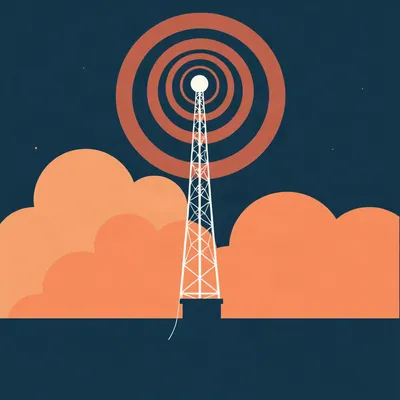
Daniel's prompt this week starts from a very specific image. The antenna on the roof of the British Consulate in Jerusalem during a protest. He wants to know why that thing exists, and the answer pulls in a whole set of questions he's been turning over. First, the nomenclature. Is HF radio the same as shortwave, or are we talking about two different things? Second, the diplomatic scenario. Why does HF matter when a host nation turns hostile and cellular and wired internet go dark? Third, the aviation case. Why is HF still used for position reporting over the Atlantic when satellites and Starlink exist? Fourth, the security layer. In an HF system that isn't being jammed, what basic encryption can be instituted? And fifth, the threat. As electronic warfare becomes more prominent, how safe are HF and other legacy radio transmissions from jamming?

That's a full plate. And the order matters. Nomenclature first, because if we don't collapse that confusion, everything else wobbles.
So let's do that. HF and shortwave. Same thing or not?
Same band, two names. High frequency is the ITU designation for the spectrum between three and thirty megahertz. Shortwave is the colloquial, broadcast-era label for that same slice. The confusion comes from history. In the nineteen twenties and thirties, when international broadcasters like the BBC World Service started beaming programs across oceans, the public called it shortwave radio. That name stuck to the consumer experience. But the same frequencies were also being used for two-way traffic, maritime, aviation, military, diplomatic. Those users called it HF. So it's not two technologies. It's one slice of spectrum with a public-facing name and a technical name.
So when someone says shortwave, they're usually picturing a radio in a basement with a long wire antenna, tuning through static to catch a broadcast from the other side of the world.
Right. And when someone says HF, they're usually picturing a transceiver on a ship or a consulate roof. But it's the same physics underneath.
Which is the part that actually matters. Why does this band behave differently?
Ionospheric refraction. The signal goes up, hits the ionosphere, and bends back down to Earth, sometimes thousands of kilometers away. That's skywave propagation. It's why HF can go beyond the horizon without any satellite, cable, or tower in between. VHF and UHF, by contrast, are essentially line-of-sight. They go until the curvature of the Earth gets in the way, and then they need a repeater or a satellite to keep going.
So if I'm standing on a beach with a VHF radio, I can talk to a boat maybe twenty or thirty kilometers out, and then the horizon just swallows the signal.
The radio horizon for VHF is slightly farther than the visual horizon because of atmospheric bending, but the principle holds. Once the Earth curves away, the signal keeps going in a straight line into space. It doesn't follow the ground. HF is different because the ionosphere acts like a mirror. The signal goes up at an angle, hits a layer of charged particles somewhere between a hundred and four hundred kilometers up, and gets bent back down. Sometimes it bounces off the ground and goes back up again for another hop.
So it's not that HF is more powerful. It's that it's using a natural reflector.
A natural reflector that is constantly changing. The ionosphere is not a stable mirror. It's a plasma that shifts with solar radiation, time of day, season, and the eleven-year solar cycle. That's why HF operators have to change frequencies throughout the day. A frequency that works at noon might be completely dead at midnight, because the ionosphere has thinned out and no longer refracts that frequency back to Earth.
So the band's value is not that it's modern or fast. It's that it's independent.
That's the whole episode in one line. Infrastructural independence. The ionosphere is not owned by anyone. It cannot be cut at an exchange, shut down by a regulator, or denied by a hostile state. That single property explains why HF persists in diplomacy, aviation, and emergency planning. And it's also the property that makes it a target in electronic warfare.
So if shortwave and HF are the same band, the real question is why that band keeps showing up when everything else has failed.
Let's walk the diplomatic scenario. Daniel's image is the British Consulate in Jerusalem. A consulate is sovereign territory, but it sits inside a host nation. All the normal communications infrastructure, cellular, wired internet, fiber, it all routes through the host state's networks. If that host state turns hostile, or even just selectively uncooperative, those networks can be shut down, degraded, or monitored at the exchange.
And the host state doesn't need to cut the cable physically. It can throttle, redirect, or simply route everything through a surveillance point.
The infrastructure is theirs. The consulate is a guest on it. But an HF transceiver and an antenna are not a guest on anyone's infrastructure. The entire dependency chain is a radio, a wire, and the ionosphere. You can't turn off the ionosphere. You can't deny access to it. You can't cut it at the exchange.
So that antenna on the roof is the consulate's sovereign communications path. The one that doesn't ask permission.
And it's maintained precisely because it might be needed. It's a failover, not a primary. HF is slow, bandwidth-constrained, and subject to propagation variability. The ionosphere changes with time of day and solar conditions. Some frequencies work at night, others during the day. You have to pick the right band for the right hour. It's finicky.
And this is where I want to press on the practical side. What does a consulate actually do with this thing when the networks go dark? Are we talking about voice? Data? Morse code?
In a modern context, mostly data. HF data links can carry email, position reports, short messages. The bandwidth is tiny by modern standards, but it's enough for essential diplomatic traffic. You're not streaming video or doing video calls. You're sending text, maybe some low-resolution images if you're patient. Voice is also possible, and it's often the most intuitive fallback. But voice over HF requires the operator to deal with fading and interference in real time, which is exhausting.
So there's a human skill component here that we tend to forget.
Operating an HF radio well is a skill. You have to understand propagation, know which frequencies to try at which times, and be able to pull intelligible audio out of a signal that's fading in and out. It's not like picking up a phone. It's more like flying an aircraft in instrument conditions. You need training and practice.
Which raises the question of whether that skill base is being maintained.
That's a real concern. As HF has become a failover rather than a primary, the number of people who are skilled at operating it has shrunk. The equipment is still there, but the human expertise is thinner. You can have the best antenna in the world, but if nobody knows which frequency to try at 2 AM local time, it's useless.
So the consulate antenna is only as good as the operator behind it.
And the training program that produced that operator. Which is another reason why HF persists in places like the military and diplomatic services. They're the ones who still invest in the training because they're the ones who anticipate the scenario where the training matters.
So it's not the thing you use for routine diplomatic traffic. It's the thing you fall back to when the good options are gone.
Which is why it's maintained rather than retired. The consulate doesn't use that antenna for its daily email. It uses it so that if the daily email path disappears, there's still a way to reach London.
And the same logic plays out at thirty-five thousand feet over the Atlantic.
The aviation case is the cleanest example. Over the ocean, beyond radar coverage and beyond VHF line-of-sight range, someone still needs to know where the aircraft is. Historically, HF has been used for oceanic position reporting. The aircraft reports its position, altitude, and estimated time to the next waypoint over HF voice or data link. That's a procedural safety function. It's not about convenience. It's about the fact that if something goes wrong, someone needs to know where to start looking.
And the obvious objection is, why not just use satellite? Inmarsat has been doing oceanic communications for decades. Starlink is increasingly available on aircraft. It's faster, more reliable, and you don't have to deal with ionospheric fading.
The objection is correct on every performance metric. Satellite beats HF on speed, reliability, and bandwidth. But the failover logic is identical to the diplomatic case. Satellite terminals can fail. They can be jammed. They can be politically restricted. A satellite constellation is infrastructure owned by someone, and that someone can deny access or be denied access. HF is independent in a way satellite is not.
But here's the thing I keep coming back to. If the satellite path is so much better, and the HF path is so marginal, at what point does the marginal path become so unreliable that it's not actually a meaningful backup?
That's the right question to ask, and the answer is uncomfortable. HF is not a drop-in replacement for satellite. It's not even close. The data rates are orders of magnitude lower. The reliability is worse. The operational burden is higher. But the key word is not reliable. The key word is independent. In a scenario where the satellite path is denied, the question is not whether HF is good. The question is whether HF is better than nothing. And the answer is yes.
So the standard isn't performance. It's existence.
The bar is not how fast you can send the message. The bar is whether you can send it at all. And HF clears that bar in a way that no satellite system can guarantee, because no satellite system is under the user's sovereign control.
So you maintain the inferior path because it's the one that still works when the superior path is unavailable for reasons you don't control.
That's the whole argument. It's not that HF is good. It's that HF is independent. And independence has value precisely when everything else is compromised.
Which brings us to the security problem. Once you accept that sensitive diplomatic or safety traffic is going over HF, the question of what protects that traffic becomes unavoidable.
An unencrypted HF link is readable by anyone with a receiver and the right frequency. And the right frequency is not hard to find. HF is a shared band. Anyone can listen.
So what's the basic encryption that can be instituted on an HF system that isn't being jammed?
The starting point is not exotic. The radio itself is just the transport. You can layer voice encryption or data encryption on top of the link. The question is what you can practically institute on a narrowband, high-latency, variable-quality channel.
That's where the constraints start to bite.
Limited bandwidth is the big one. HF data rates are typically in the hundreds of bits per second to a few kilobits per second, depending on conditions. You cannot simply bolt on a heavy modern cipher suite without eating the channel. The encryption overhead has to be small, or the link becomes unusably slow.
You're not running TLS over HF.
Not in any practical sense. The handshake alone would consume the channel. You need something leaner. The latency and fading also make key exchange and synchronization harder than on a clean digital link. If the signal fades mid-handshake, the protocol has to recover gracefully.
This is where I want to get concrete. What does a lean HF encryption system actually look like? What's the crypto that fits in a few hundred bits per second?
Think in terms of symmetric encryption with pre-shared keys. Both ends have the same key material, loaded before the link is needed. The encryption itself is a stream cipher or a lightweight block cipher that adds minimal overhead. Modern systems can use AES in a streaming mode, but there are also specialized modes designed for very low bandwidth. The key point is that the key exchange doesn't happen over the air. It happens in advance, through a secure channel, when the operators are still in friendly territory.
The security model assumes that you provision the keys before the crisis.
Right. That's the difference between diplomatic and consumer communications. The consulate doesn't do a real-time key exchange with London over the HF link. The keys are loaded into the equipment before the operators deploy. The HF link just carries the encrypted traffic.
Both ends need to be interoperable. In diplomacy, that means allied or coalition standards rather than bespoke systems.
Right. The British Consulate in Jerusalem doesn't get to invent its own encryption scheme. It has to talk to London, and London has to talk to Washington, Canberra, Ottawa. So you use a standard that everyone has agreed on. The NATO standards for HF data and voice encryption are the obvious example. They're designed for exactly this environment.
There's a distinction we should make clear. Link encryption versus end-to-end encryption.
Link encryption protects the hop between two radios. The signal is encrypted on the air, but it's decrypted at the relay or gateway point. If the traffic passes through a station that isn't the final destination, that station sees the plaintext. End-to-end encryption protects the content regardless of how many hops it takes. The intermediate stations can relay it, but they can't read it.
For diplomatic traffic, the end-to-end model is the one that matters. The consulate isn't just worried about someone listening to the radio signal. It's worried about the traffic being exposed at any point along the path.
That's where frequency hopping comes in, or rather, where it doesn't. Frequency hopping is an anti-jamming and anti-interception technique. The radio jumps between frequencies according to a pattern that only the two ends know. That makes the signal harder to find and harder to follow. But it does not protect the content. If someone finds the signal and follows the hop pattern, the content is still there in the clear.
Hopping is not encryption. It's a different layer entirely.
Complementary, not a substitute. Hopping makes the signal harder to target. Encryption makes the content unreadable if the signal is found. You want both, but they do different jobs.
Let me push on the frequency hopping for a second, because I think there's a common misconception that hopping is a form of encryption. Can you explain why it's not?
The distinction is between hiding the signal and protecting the content. Frequency hopping hides the signal by moving it around. The hop pattern is a secret, and if you don't know it, you can't follow the transmission. But the pattern is just a sequence of frequencies. Once you know the pattern, you can follow the signal perfectly, and if the content isn't encrypted, you can read it. So hopping is a form of obfuscation, not encryption. It makes the signal harder to find, but it doesn't make the content unreadable.
It's like moving a conversation from room to room in a building. If the eavesdropper doesn't know which room you're in, they can't listen. But if they figure out the pattern, they can follow you, and then the conversation is just as exposed as it would be if you'd stayed in one room.
Encryption would be speaking in a code that the eavesdropper can't understand even if they find the room. The two things work together, but they're solving different problems.
That brings us to the jamming threat. Because encryption only matters if the signal gets through.
Here's the thing about jamming. A jammer does not need to break encryption. It doesn't need to find the signal and decode it. It only needs to raise the noise floor enough that the link becomes unusable. That's a denial-of-service attack on the physical layer. Encryption does nothing against it.
You can have the best encryption in the world, and a jammer with enough power on the right frequency makes it all irrelevant.
That's the asymmetry. Jamming is cheap. A relatively low-power transmitter on the right frequency can deny an HF link over a wide area. The jammer doesn't need to be sophisticated. It doesn't need to understand the protocol. It just needs to be loud.
The ionosphere, which is HF's great advantage, is also its vulnerability. Because the signal is bouncing off the ionosphere, a jammer's signal bounces too. It can interfere over a huge area.
That's why frequency agility, spread spectrum, and hopping matter. They force the jammer to spread its effort or chase the signal. A jammer that has to cover the entire HF band is much less effective than one that can park on a single frequency. But it's a game of economics. The jammer can always add more power or more transmitters.
Let me ask a practical question here. If I'm a jammer operator, what am I actually doing? Am I sitting at a console with a frequency dial, or is this automated?
Modern jamming is largely automated. You have receivers that scan the spectrum, identify signals of interest, and then task jammers to those frequencies. The whole loop can happen in milliseconds. Against a fixed-frequency HF link, that's devastating. The jammer finds the frequency, parks on it, and the link is gone. Against a hopping signal, the jammer has to predict or track the hop pattern, which is harder but not impossible. And against a spread-spectrum signal, the jammer has to raise the noise floor across the entire band, which requires much more power.
The countermeasure to jamming is not any single technique. It's a combination of agility, spread spectrum, and redundancy.
Even then, it's not a guarantee. A determined adversary with enough resources can jam almost anything. The question is whether the adversary wants to spend those resources on your link, or whether they'd rather spend them elsewhere.
The question of how safe HF is from jamming has an uncomfortable answer. It's not safe. It's survivable, under some conditions, against some threats. But it's not immune.
The second-order implication is the one that matters. The more a state relies on any single communications path, HF, satellite, or cellular, the more attractive that path becomes as a jamming or interdiction target. The failover logic that makes HF valuable in diplomacy is the same logic that makes it worth jamming. Resilience comes from having multiple independent paths, not from any one path being unjammable.
The antenna on the consulate roof is not a guarantee. It's a hedge. And like any hedge, it works until someone decides to specifically target it.
The honest story is that HF is marginal but independent. It's not a good technology. It's a stubborn one. And stubbornness has value.
Which is a version of the story that doesn't show up in the technical literature.
Hilbert: It's not heroic.
Hilbert.
Hilbert: I did eighteen months on night shift for a maritime weather and position-reporting service in the early nineties. Logging HF position reports from ships crossing the Atlantic. Green hardbound ledger, columns for call sign, position, time. I still have it.
You logged HF traffic.
Hilbert: Every night. Ships would call in their position reports, and I'd write them down. The link was never good. Fading, interference, operators on the ships who'd been on watch for eight hours and were half asleep. Half the time you'd have to ask them to repeat the position because the signal dropped out mid-sentence.
The failover argument is right, but the texture is wrong.
Hilbert: The texture is that it was tedious. It wasn't a heroic last resort. It was a job that mostly involved squinting at a speaker and saying, say again, you're breaking up. The reason HF persists is not that it's good. It's that it's the only thing that works when everything else is gone. That's a much less flattering story.
But it's the more accurate one.
Hilbert: There's a column in the logbook for propagation notes. Operators would write things like poor, fading, or good, steady. The entries are almost never good. Year after year, page after page, it's poor, fading. Poor, fading. Maybe one in twenty says fair.
The historical record of HF is a record of marginal conditions.
Hilbert: That's what the logbook says. It's a record of a system that barely worked, night after night, and kept working anyway. Not because it was good. Because there wasn't anything else.
That's the detail that changes how I think about the consulate antenna. It's not a symbol of resilience. It's a symbol of the fact that sometimes the only option is the one that barely works.
The willingness to maintain the barely-working option is what resilience actually is. Not having a better radio. Having more paths, and accepting that some of them will be marginal.
Hilbert: The logbook is in a box somewhere. I haven't looked at it in years. But I remember the entries.
Poor, fading.
Hilbert: Poor, fading.
The open question is what resilience looks like when jamming is cheap and encryption doesn't stop it. The answer is not a better radio. It's more paths, and the willingness to maintain inferior ones.
As electronic warfare proliferates beyond major powers, the argument for HF gets both stronger and weaker. Stronger because you need a path that doesn't depend on someone else's infrastructure. Weaker because that path is increasingly targetable.
Which leaves us with the image Daniel started from. A piece of twentieth-century technology on a twenty-first-century roof, maintained not because it's good but because it's independent.
If you take one thing from this, it's that HF and shortwave are the same band, and the band's persistence is a story about independence, not performance. The antenna on the consulate roof is a hedge against infrastructure you don't control.
The hedge is marginal. The logbook says so. But marginal beats gone.
Thanks to our producer, Hilbert Flumingtop.
This has been My Weird Prompts, the human-AI collaboration podcast. Email us at show at my weird prompts dot com.
We'll be back soon.