There's a strange corner of audio where the boom mic is deliberately left alone. No processing, no tuning, just a capsule on a stick next to a commentator's mouth for four hours. Daniel went digging in it and came back confused, which is usually a good sign.

Usually the best sign.
He's been looking at broadcast headsets, and noticed the USB side of that market thins out almost immediately. What you find instead is XLR models wanting phantom power, electret capsules wanting a few volts of DC bias, and — this is the part that baffles him — plain three-and-a-half and six-thirty-five millimetre jacks at the higher end. He thinks of those as old connectors. He assumed USB or XLR meant better and newer. His real motive is avoiding hassle: phantom power means an interface, and even a passive analog headset needs some USB contraption, because his phone has no headphone jack either.
So he's asking three things, really. Does a power requirement tell you anything about quality. Can a USB mic with no built-in DSP be good. And where the whole thing is heading.
Herman, you've been waiting all week for this one. I can tell.
I have a folder. I'm not going to apologise for it.
How thick a folder are we talking?
Tabs. Colour-coded tabs. There's a phantom power tab, a connector tab, and a tab that's just pictures of the Riedel OnAir with the connector circled in red.
That's a cry for help shaped like research.
It's a hobby shaped like a cry for help. Let's go.
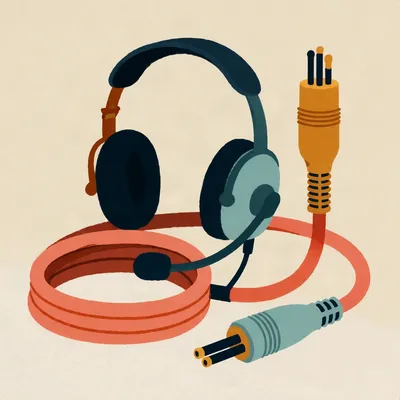
Let's establish what a broadcast headset actually is, because the connector situation is stranger than Daniel thinks. It's a boom mic plus headphones, worn by sports commentators, intercom operators, stage managers — people who talk for hours and need their hands free. Dan Daley wrote a piece for Sports Video Group where he called it the most intimate piece of wearable tech in the business, and also among the least expensive, most ubiquitous, if barely acknowledged pieces of professional audio gear on the truck or in the studio. That's the perfect description. Everybody sees the headset on every referee and sideline reporter, nobody thinks about it.
The most-worn, least-thought-about object in professional audio.
Exactly the shape of thing you love.
One of my top three shapes.
And the use case explains the whole form factor, if you sit with it for a second. A commentator isn't just talking into the mic — he's listening to the director on the same headset, listening to the sideline reporter on another channel, maybe hearing the program feed underneath all of it, while a crowd roars fifty metres away. The boom mic exists because a desk mic would be useless the moment he turns to look at a monitor. The whole object is built around a person whose head is doing six things at once.
So the design brief is "survive a human being for four hours."
That's the entire specification. Comfort, one ear or two depending on the venue, a mic you can position once and forget, and connectors that a stressed person can plug in the dark.
A stressed person plugging something in the dark is the least forgiving user in audio. Fumbling behind a rack, gloves on, director shouting in your ear. The connector has to survive that person, not the lab.
Which is why the industry keeps connectors that look ancient to outsiders. They've been stress-tested by decades of the worst-case user.
Which, conveniently, brings us to the connectors.
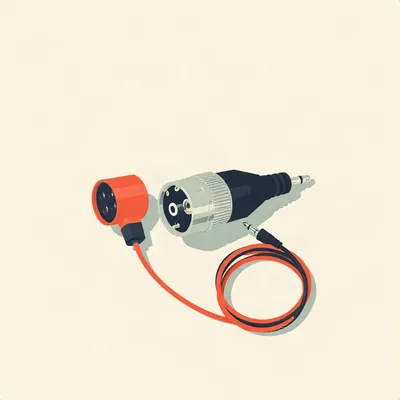
Now, before we answer any of his questions, the shape of the market. When Daniel says he found XLR headsets, he's probably mostly finding XLR-3 mic terminations. But the dominant professional connector in this world isn't XLR-3 at all — it's 4-pin and 5-pin XLR intercom wiring. Clear-Com's broadcast headsets, the CC-110, CC-28, CC-300, all come in XLR4 versions, roughly three hundred twenty to four hundred ten dollars, and that single connector carries intercom audio and power at the same time.
One plug, both directions and electricity.
Which is why a USB version isn't a drop-in replacement. The whole intercom infrastructure is built around that connector. Once you see that, half the puzzle dissolves — this market was never organised by connector modernity, it's organised by use case. Corn, you ready for the power question?
I've been ready since Tuesday.
Daniel's intuition is that a mic demanding forty-eight volts must be doing something more advanced than one that needs nothing. And the answer is — it's doing something different, not something better. Voltage tracks the circuit topology, not the quality. Let me actually explain phantom power, because the mechanism is the whole answer.
Go.
A balanced mic cable has two signal wires carrying the same signal inverted relative to each other, plus a shield. Phantom power puts DC on both signal wires — identically. Because the voltage is the same on both legs, the differential input at the far end, which only responds to the difference between them, can't see it at all. It's effectively invisible to any balanced microphone that doesn't use it, which includes most dynamics. The mic that does want it picks the DC off between either leg and the ground.
It's called phantom because the dynamic mics can't see it.
Right, the circuit doesn't exist from the dynamic's point of view. Hence the name.
Cute. Ghost electricity for the privileged capsule.
It's also why you can leave phantom on permanently and plug whatever you want into the rack. The console doesn't have to know who's living there.
Now, hold on — how does that work in practice? If the DC is sitting on both legs, doesn't the mic's own output ride on top of it? Where does the power actually get stripped back out?
At the receiving end, the differential input only responds to differences between the legs. The audio is a difference — one leg goes up while the other goes down. The DC is a sameness — both legs sit at the same voltage. The input amplifies the difference and ignores the sameness. The power and the signal share the same two wires and never meet, electrically speaking.
Two tenants, same apartment, different rooms.
Now here's my favourite fact in the whole episode. Why forty-eight volts? Not because of audio. In 1966, Neumann presented a transistorised microphone to the Norwegian broadcaster NRK. NRK's studios already had forty-eight volts running in the walls — for emergency lighting. So that was the voltage they used. It's the origin of forty-eight-volt phantom power. The number everybody treats as a badge of seriousness is a lighting rail that happened to be there.
The most prestigious number in professional audio is a fire-safety leftover.
And the first commercially available phantom-powered mic, the Schoeps CMT twenty, was built in 1964 to French radio specifications at nine to twelve volts. So even the founding product of the whole scheme thought forty-eight was negotiable.
So the voltage is an accident twice over.
Twice over. Now why do condensers need power at all? Shure's own knowledge base says it plainly: all condensers contain additional active circuitry to let the element's output work with normal mic inputs, so all condenser microphones must be powered, either by battery or phantom. There's the entire business. The power is running a circuit, not purchasing refinement. A dynamic mic is a moving coil and a magnet and needs literally nothing. A condenser capsule is a charged plate, and the electronics are there to make that usable.
An electret holds its charge permanently.
Pre-polarised, yes — the charge is baked into the material at the factory, so nobody has to bias the capsule. But the output impedance of that element is so high it still can't drive anything, so virtually every electret capsule has a little one-transistor buffer inside, usually a junction field-effect transistor, just to convert impedance. And that transistor is what the three-to-five volts of plug-in power is running.
Wait. The low-voltage bias that Daniel read as a mid-tier feature...
Is a single transistor.
He's been ranking headphones by how many volts feed one transistor.
Roughly. Plug-in power is the cheapest scheme there is — Sound On Sound's glossary notes it's only ever provided on three-and-a-half-millimetre mini-jack sockets on domestic recorders, phones, laptops. Micpedia pegs the budget at maybe ten to twenty milliwatts. The capsule draws half a milliamp, often less. This is not premium electronics. It's the smallest possible amount of electricity that makes a signal survivable.
And at the other end of the price scale?
Here's where Daniel's intuition really falls apart. The DPA 4088 — DPA's own description calls it the industry standard in professional headset mics — is about nine hundred ninety-five dollars, and it's a pre-polarised condenser that for wireless use needs five to ten volts through a DPA adapter. It only reaches full forty-eight-volt phantom when you fit an XLR adapter on the end. So one of the most expensive headset microphones on the planet runs happily on the same voltage class as a cheap lavalier.
A thousand-dollar mic on phone power.
Five volts. That's the industry standard.
My alarm clock runs on more than that.
Now, the killer counter-example for the quality question lives inside a single product family. Audio-Technica's BPHS2 broadcast headset comes in two versions. The standard BPHS2 has a hypercardioid dynamic boom mic. The BPHS2Ca has a cardioid condenser boom. Same headset, same market, same price tier, same ear cushions, different power requirement. If voltage signalled quality, that pair couldn't exist. Audio-Technica isn't confused about their own lineup — they're offering a transducer choice.
Pick your chemistry.
And each chemistry has real trade-offs. Shure says condensers can be built with higher sensitivity and give a smoother, more natural sound, especially at high frequencies, and they're easier to make flat and extended. But they add electronics noise, they have a maximum sound pressure level, and they can be adversely affected by temperature and humidity. Dynamics are simple, economical, rugged, and — Shure's words — it is almost impossible to overload a dynamic microphone.
Which is exactly why you'd put a dynamic on a football sideline.
A crowd hitting a hundred ten decibels next to a referee. The condenser would clip, the dynamic wouldn't notice. Meanwhile the same LedgerNote myth-busting piece from last year says flatly that the claim condensers produce a cleaner, better signal is false, and the idea that they cost more and are therefore better quality is untrue.
Those two can't both be right.
They can, actually — they're answering different questions. Shure describes what the topology enables. LedgerNote describes what marketing claims. A condenser's electronics make extended flat response easier to build. That doesn't mean every condenser is cleaner than every dynamic, and it doesn't mean the power supply is a quality mark.
So the answer to Daniel's first question is a clean no.
A clean no, with one amendment. The power requirement tells you what's inside — a coil, a biased capsule, a buffered electret. That's useful information. It's just not a ranking.
Three circuits, three invoices, zero correlation.
Voltage is a parts list, not a review.
Which raises the second question. If the power requirement isn't the signal, what about the connector? Are the best microphones always analog, or can a no-DSP USB mic be good? Daniel suspects the real problem is that USB mics are pitched at consumers, with processing baked in and no way around it — but he doesn't think that has to be part of the design.
And he's right on both counts, isn't he.
Almost annoyingly right. The products exist. The cleanest proof is the Earthworks ICON. Earthworks is a serious measurement and pro-audio brand — this is not a gaming-peripheral company. The ICON is a USB mic marketed explicitly on the absence of processing. Their copy says there are no EQ mode settings to fuss with, no energy drink hype gimmicks to dial in, no DSP patterns to choose from.
Energy drink hype gimmicks. In a spec sheet.
There is simply phenomenal sound, they say. And it's class compliant, which is the load-bearing part — no drivers, no software bundles, nothing that would stop you plugging it into a corporate machine. Cardioid, twenty hertz to twenty kilohertz, an analog mute, stainless steel body, somewhere around four hundred to five hundred euros depending on the dealer.
No DSP, no drivers. It's a microphone that minds its own business.
That's the entire pitch, and Tape Op said it would be the first product they recommend to anyone adding a USB mic. Second proof: TASCAM's TM-250U. Driverless USB-C condenser, super-cardioid, works across macOS, Windows, iOS, Android, even Chrome OS, with a headphone jack on the mic itself for low-latency monitoring. One honest limitation though — it's sixteen bit, forty-eight kilohertz.
Which matters.
It matters if you're comparing it against an XLR chain running through a proper interface at higher rates. That's a real ceiling on a lot of no-DSP USB mics, and I don't want to hand-wave it — the analog side can still go further. But "sixteen forty-eight is fine for voice" and "USB forces compromise" are different claims, and only the first is true.
And class compliance isn't some exotic trick.
Not remotely. Sound Devices' USBPre 2, a broadcast-standard interface, has been class compliant for years — forty-eight volt phantom, limiters, high-pass filter, up to twenty-four bit at one ninety-two, powered off the USB bus itself. Digigram's professional interfaces, measurement mics with per-unit calibration files, the whole pro-audio world leans on class compliance because it means the device works the moment you plug it in, everywhere, forever. USB is a transport. It does not require an opinion about your voice.
So the DSP objection...
Is real but mislocated. Consumer USB mics do default to processing — noise gates, level riding, "warmth" modes — and the bypass, when it exists, is buried in an app you have to install. That's a product decision aimed at people who don't want to think. What's interesting is how the serious manufacturers are solving it: not by removing DSP, but by routing. Shure's MV7+ is the case study. It's a hybrid USB-C and XLR dynamic mic, and all the processing — auto level mode, real-time denoiser, what they call a digital popper stopper, EQ, reverb — applies only to the USB-C output. The XLR output is always clean.
Both at once?
You can record the processed USB feed and the raw analog feed simultaneously. Shure's own user guide puts it in one line: XLR audio is not affected by software settings. That's the whole problem solved by giving the signal two doors.
The DSP gets its own door and has to stay behind it.
Daniel said he didn't think baked-in processing had to be part of the design. Shure shipped the proof two years ago.
Now the headset question proper. Why does the USB side thin out so fast? He goes looking for broadcast headsets and finds... nothing with a USB plug.
Because of the intercom connector, not audio quality. Those Clear-Com headsets at three hundred twenty to four hundred ten dollars are wired for intercom systems that deliver audio and power over a four-pin XLR. Every broadcast truck, every stadium comms rack, is built around that. A USB headset isn't a modern version of that product — it's a different product that plugs into a different world. The 2017 Sports Video Group survey of this market read like a cast list of analog intercom headsets: Clear-Com, Riedel MAX, RTS. Nothing USB, and nobody was complaining.
The connector survives because the infrastructure around it is worth more than the connector.
A broadcast truck is millions of dollars of kit. You don't rewire it so a headset can feel modern.
And there's a category error in his reading of the three-and-a-half-millimetre jacks.
The biggest one in the whole prompt, and I don't blame him for it. On a broadcast headset, XLR carries the microphone and the three-and-a-half-millimetre or six-thirty-five jack carries the headphones. Look at the BPHS2's cable: six-pin connector at the headset end, then it splits to a three-pin XLR male for the mic and a three-and-a-half-millimetre plug for the phones. Daniel was reading the headphone connector as an old mic connector. The jack persists because headphones are passive — they need no protocol, no driver, no handshake. It's the one connector in the entire rig with nothing to negotiate.
The last honest wire.
You've said that before and I've never argued.
The phone problem, though. Daniel's hassle instinct. Is he right that it's always more complicated than plugging in a USB headset?
He's right, and it's worse than he thinks. Most current iPhones, Galaxys and Pixels don't output analog audio through USB-C at all. So a passive USB-C-to-three-and-a-half adapter just sits there silently. You need an active one with a built-in DAC, usually sold as "digital" or with the word active on the box. Then there's the plug geometry: a mic needs a four-pole TRRS plug, because a three-pole TRS plug has no mic contact. RØDE documents the full chain for their own lavs — a TRS-to-TRRS adapter, then a further adapter for phones without a jack.
Count the chain for me.
Headset, TRS-to-TRRS adapter, active USB-C adapter with a DAC, phone. Three adapters deep before the thing records.
A USB headset is one cable. Daniel's instinct said "more complicated," and the answer is "more complicated by a factor of three dongles."
And each of those dongles is a place for a bad connection, a cheap DAC, or both. So the hassle is real. It just isn't caused by the microphone being analog — it's caused by the phone having amputated its own jack.
The mic didn't get harder. The phone got pickier.
Now the last question — where this is going — and here the answer is already visible, which is rare and pleasant. September, at IBC, Riedel announced their OnAir platform. The OnAir 200 comes in two versions: an analog model with a fixed four-pin XLR connection, and a digital model with a fixed USB-C connection. Same headset, same mic mute, same reversible design, same replaceable parts. Parallel SKUs, not a replacement.
Not "USB replaces XLR." Both, side by side, indefinitely.
It goes further on the 400 and 500 Series. Those use an exchangeable Mini XLR seven-pin connection at the ear cup, so the cable can be changed to suit different devices. They've moved the connector off the headset entirely — one headset, many cables. Pliant did something similar at NAB this year, adding a SmartBoom USB connectivity option to existing headset models plus a standalone USB-C cable. USB arriving as an accessory, not a redesign.
The connector becomes a consumable.
A swappable part, like an ear cushion. Their product manager's line was that exchangeable cables let the headset adapt to different users, devices and workflows — which is quietly the thesis of the whole market. Adapt at the cable, keep the headset.
One honest unknown left, though.
One, and it's the good one. No published spec says whether the OnAir 200's USB-C version is class compliant or carries onboard DSP. The press release covers connectivity, mute, the reversible design, replaceable parts — and says nothing about the USB audio class or any processing. If that USB-C OnAir is class compliant and unprocessed, it is precisely the product Daniel said should exist. And nobody has confirmed it either way.
The most important question in this whole market, and the answer is a shrug from a press release.

Hilbert's Anteater Trivia. Anteaters have a low metabolic rate for mammals of their size. I've been told I have a low metabolic rate for a producer of my size. I prefer to call it efficiency.
Efficiency. Noted.
And the intercom rack doesn't care what the host thinks of the connector — it just expects four pins and power.
That's the thing about a spec. It's a promise you didn't have to make.
Corn, can I ask you something? You keep circling the adapters. If you were Daniel, with the phone and no jack — would you actually run the analog headset, or would you cave and get a USB one?
You know the answer to that.
I do, but the listeners don't.
I'd run the analog one. Three adapters deep, every time. Not because I enjoy dongles — nobody enjoys dongles — but because a USB headset can change while I'm asleep. Firmware, drivers, an app update that moves the bypass button. The analog chain is dumb and it stays dumb. I'd rather own the worse thing that never surprises me.
There it is.
Also, and I want this on record — I have never once had a three-and-a-half-millimetre jack ask me to accept new terms.
The terms of service for a headphone jack.
It has none. It's the only connector I fully trust.
Which, weirdly, brings us back around to what the market's doing. The Riedel approach — swappable cables, one headset, both worlds — is basically the industry admitting that both of us are right. Analog for the people who want dumb and permanent, USB for the people who want one cable to the laptop.
The market split the difference so nobody has to lose an argument.
Have you ever noticed you treat every connector like a marriage prospect?
I treat every connector like it's going to leave. Different thing.
Corn, did you say three adapters? I'm up to eleven.
Eleven.
I have a headset at home. Broadcast type, boom mic, no processing anywhere in it — that's why I bought it. Headphone side is a three-and-a-half jack, mic side is a four-pin XLR. I have never had a minute of trouble out of the three-and-a-half. The four-pin has given me nothing but grief, and my view is that it's doing too much. One plug shouldn't carry power and audio in both directions. That's not a connector, that's a commitment.
Eleven adapters, though.
Built up over years. There's a TRRS one, two active ones with DACs in them, one from a camera shop that only cost eight pounds and I've never trusted it. I keep them in the second drawer down. At my old place, phone company, late seventies, I did the wiring for a switchboard room, so I know what a drawer of connectors is supposed to look like. Mine's better organised.
Which of the eleven actually works?
The big active one with the DAC. The others are cheating, most of them, they just reshape the plug. Cough from the middle desk there, cutting that. The honest one cost forty pounds and the cheating ones cost less, and I don't think that's a coincidence. I'll say this for the headset, though. Never recorded a thing with it. Didn't buy it to record. A headset that doesn't process your voice is a headset that trusts you, and I wanted one in the house.
The four-pin complaint is technically sound, by the way. Power and audio on one connector does mean one failure point for everything.
It means the plug can't mind its own business. That's what it means.
What happened to the eight-pound one?
It's in the drawer. Second from the left. It'll be there long after the rest of us.
So the cutting-room floor. One detail we didn't get to: phantom power is actually specified in tiers — twelve, twenty-four and forty-eight volts — and the feed resistors inside the mixer have to be matched to a tenth of a percent, or you lose the common-mode rejection that makes the whole balanced scheme work. The number that looks like an arbitrary accident on the mic side is held to extraordinary precision on the console side.
The accident is enforced to a tenth of a percent.
Nobody planned the voltage. Everybody measures the resistors.
Where I'd leave this is the Riedel question. If that USB-C OnAir comes out class compliant with no processing, the category Daniel described — professional USB broadcast headset, no DSP — quietly started in September and no one noticed, including probably Riedel. That's the spec sheet to watch.
The pattern is the safer bet than the product, honestly. Cables as swappable parts, parallel analog and USB SKUs of the same headset. The intercom connector isn't going anywhere, and neither is the missing headphone jack, so both worlds are stuck with each other.
Producer credit to Hilbert Flumingtop, who keeps eleven adapters organised better than the phone company kept a switchboard room.
If you enjoyed this one, try episode twenty-two, The Input Bottleneck; and episode five, Fine-Tuning ASR For Maximal Usability. This has been My Weird Prompts. If you enjoy the show, a review on Spotify helps other people find us.
We'll be back soon.
See you tomorrow.