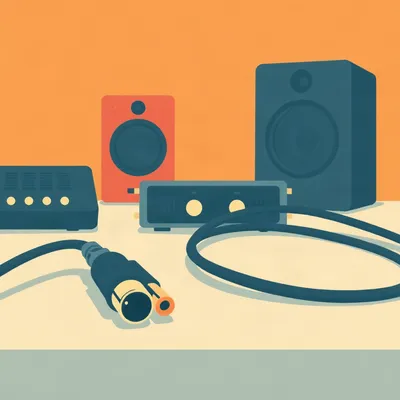
There's a specific kind of embarrassment that only audio gear can produce. You rent a box, it works perfectly, the event goes fine, and you walk away knowing less than when you started.

Which is the opposite of how most rentals go.
Daniel rented a Behringer PK110A for an event. Got the job done. And then wrote in saying he'd come away more confused about the terminology than he went in. His words. He calls it a passive speaker. He wants to know what specifically makes a speaker passive. He wants to know why standalone amplifiers exist at all, and whether separating components gets you more power. Then mic level and line level, what they actually mean and how they change what gear you need. And finally, the busker question, which I love, which is: if you see someone on the street with a microphone and an instrument both wired into one box that's making sound, are you looking at an amp, a speaker, or both?
That last one is the whole episode in one image.
It is. So let's start with the box Daniel actually rented. Because it turns out the receipt is lying to him.
Not the receipt. The receipt's fine. The label he's put on it is wrong.
Walk us through it.
The Behringer PK110A is sold, everywhere, as an active speaker. Behringer's own product page calls it "Active 320-Watt 10-inch PA Speaker System with Built-in Media Player, Bluetooth Receiver and Integrated Mixer." Sweetwater says the same thing. Thomann, Musician's Friend, Walmart, all of them, active or powered. It is not a passive speaker. It has never been a passive speaker.
So Daniel's wrong.
Daniel's wrong, and Daniel's wrong in exactly the way the entire industry wants him to be wrong, which is the interesting part. This isn't a guy who didn't read the manual. This is a guy who did the job and still came away with the wrong noun, because the nouns don't mean anything stable.
Give me the tell. If I'm holding this box, what on the back panel would have told him?
The speakON output. The PK110A has a speakON output described as being for powering passive speakers. Think about what that sentence requires. To power a passive speaker, you have to have an amplifier. The only place that amplifier can be is inside the box you're holding. So the moment you see an output whose job is to drive somebody else's passive speaker, you know the box in your hands is not passive.
The box is announcing what it is by what it can do to other boxes.
And it also has a built-in two-channel mixer with individual mic and line inputs, an XLR and quarter-inch combo jack, RCA, 3.5 millimeter, USB, SD, Bluetooth, and a Class-AB power amp. That's not a speaker. That's a small PA system that happens to have a speaker bolted to the front of it.
There's something funny about the wattage being 320 on Behringer's page and 350 on some retailers.
That's just marketing math. A1 Sound lists it as 160 watts RMS and 320 peak, which is probably the honest version. Ten-inch woofer, one-inch compression driver, twenty hertz to twenty kilohertz claimed, ninety dB max SPL, eight point nine kilos.
Twenty hertz from a ten-inch woofer in a plastic box is a beautiful claim.
It's aspirational. Anyway.
So if the PK110A isn't passive, what actually makes a speaker passive? And why would anyone choose one over the active box?
Passive speaker: no amplifier inside. Full stop. You need an external amplifier or receiver to drive it, and you connect it with speaker wire. That's the classic hi-fi speaker, the bookshelf pair, the tower in your living room. It sits there doing nothing until something else pushes current through it.
And active means the amplifier lives inside.
In consumer and marketing language, yes. Powered and active get used interchangeably. You plug it into mains power, you feed it a signal, sound comes out. Sonos, How-To Geek, Fluance, they all treat the two words as synonyms, and honestly for ninety percent of buying decisions that's fine.
You said consumer and marketing language. Which implies there's a stricter definition somewhere.
There is, and this is the part I actually want to spend time on, because it's the part that almost every explanation skips. There's a piece from Hifiverse this year that argues the real dividing line isn't built-in amplification at all. It's where the crossover sits.
Define crossover for people who've never opened a speaker.
A crossover is a filter that splits the incoming signal into bands and sends each band to the driver that can reproduce it. Bass to the woofer, treble to the tweeter. In a passive speaker, that filter sits after the amplifier. It's made of inductors, capacitors and resistors, and it's working on the full amplified signal, at high voltage, high current.
So the amplifier is doing all the work, and then the signal gets carved up on the way to the drivers.
Right. In a active speaker, the filtering happens before amplification, at line level, and then each driver gets its own dedicated amplifier wired straight to the voice coil. No filter between the amp and the driver. The amp and the driver are effectively one unit.
Which changes what the amplifier is actually doing.
It changes everything about it. The amplifier is now only ever reproducing one band. It's not trying to push twenty hertz and twenty kilohertz through the same output stage. And the Hifiverse line I keep coming back to is this: "A substantial share of the active loudspeakers on today's market are active on paper only. In reality they are powered speakers with a passive filter."
So the word active is being used on boxes that aren't active in the strict sense.
Constantly. Which means a huge number of products sold as active are really powered speakers, meaning they have an amp inside and a passive crossover inside, which is a perfectly fine way to build a speaker. It's just not what the word implies to an engineer.
Your PK110A is almost certainly in that category. Amplifier inside, passive filter inside, honest box, misleading noun.
Almost certainly. I can't tell you the crossover topology in that specific model from the spec sheet, and I'd be inventing it if I said otherwise. But the price point and the form factor say powered-with-passive-crossover.
Okay. So that's the definition fight. Now Daniel's second question, which is the one I think is actually the most interesting. Why do standalone amplifiers exist? His intuition is that when you separate components out, you get more powerful components. Is that right?
Half right, and the half that's wrong is the half everybody assumes.
Go.
Separates give you flexibility and upgradeability and repairability. They don't give you more power. On the engineering, active designs actually win. And they win for reasons that are structural, not incidental.
Like what.
Damping factor, first. A passive crossover puts an inductor between the amplifier and the driver. That inductor adds series resistance, and damping factor is essentially the ratio of amplifier output impedance to the impedance of everything in the path. Across a typical filter inductor, damping factor can collapse from something like eight hundred down to about twenty.
Translate that into what I hear.
The amplifier's grip on the cone. When the amplifier tells a woofer to stop, damping is what makes it stop, instead of overshooting and ringing and muddying everything around it. Take the amplifier's grip away and the bass gets loose. Not necessarily bad-sounding, but less controlled.
And the second reason?
Power distribution. In an active design you can put the watts where they're needed per band. The ATC SCM40A runs a hundred and fifty watts into the bass, sixty into the mid, thirty-two into the treble. That's two hundred and forty-two watts total, but it's not evenly distributed, and it shouldn't be. Bass eats power. Treble doesn't.
Genelec?
The 8361A runs seven hundred watts into the bass and a hundred and fifty each into the mid and the tweeter. Nobody builds a passive crossover that intelligently routes power like that, because in a passive design the amplifier has to be broadband. One amp, full range, split afterwards.
And there's a loss question too.
A three-way passive filter typically eats somewhere between half a decibel and two decibels. So you're paying for amplifier power and then throwing some of it away in the filter as heat.
Now give the passive side its due, because you clearly like these things.
Passive wins on freedom, and the freedom is real. You choose every component of the chain. You pick the amplifier, you pick the speakers, you can insert a separate preamp, a separate power amp, an equalizer, you can swap any one of them without touching the others.
Repairability.
If the amp dies, you replace the amp. That's it. In an active speaker, if the amp module dies out of warranty, you're either paying for a proprietary board or you're scrapping a perfectly good driver and cabinet.
Which connects to the upgrade path.
Hifiverse makes this point well. A passive system keeps an upgrade path open. Buy decent speakers first, economise on the amplifier, upgrade the amp later when you have the money. The value stays modular. Their line is that selling half an active loudspeaker is not possible. And passive boxes are durable in a way electronics aren't. A well-made passive speaker will give you twenty or thirty years of service. The amplifier attached to an active speaker will not.
So the answer to Daniel is: separates give you flexibility and longevity, not power. And he's not the only person to assume the opposite, because the intuition that more boxes equals more capability is basically right everywhere else in life.
It's right about computers. It's right about cameras. It's not right about speakers, because in speakers the integration itself is a benefit.
Hold on. Say that damping number again.
Eight hundred to twenty.
That's not a rounding error. That's a factor of forty.
It's the single strongest engineering argument for going active, and it's almost invisible from the outside, because you can't see a crossover and you can't hear a spec sheet.
There's a broader pattern here that I want to name, because it'll come back. Every time you separate components, you gain the freedom to change them, and you lose the benefit of them having been designed together. That's true of speakers, it's true of computers, it's true of everything. Audio just makes it unusually visible.
Which is also why the whole passive versus active argument never actually resolves. There isn't a winner. There's a set of tradeoffs and a person with a budget.
Right. Speaker end of the chain is settled. Now what actually goes into that chain.
Signal levels.
Which is where I think Daniel's real confusion lives, honestly. More than the passive-active thing. Because levels are the invisible rule that decides whether your gear works or makes an ugly noise.
There are four levels, and they run weakest to strongest. Mic, instrument, line, speaker.
Start at the bottom.
Mic level is the voltage a microphone generates when sound hits it. It's tiny. You're talking a few thousandths of a volt. Practically, mic level gets specified between minus sixty and minus forty dBu. That's the weakest signal in the chain by a wide margin, and it needs a preamplifier to bring it up to something useful.
And line level is the something useful.
Line level is approximately one volt. Roughly a thousand times stronger than mic level. And there are two standards living under that one name, which is its own source of misery. Minus ten dBV is the consumer standard, the CD player, the DVD player, the RCA jack on the back of a home receiver. Plus four dBu is the professional standard, mixing desks, preamps, outboard gear.
Those two aren't the same voltage.
The gap between them is about eleven point eight decibels. Call it twelve. It's the difference between a signal that's a bit quiet and a signal that's a bit hot, and if you cross the two standards without a pad or a level converter, one of those problems is yours.
Now instrument level, which sits in the middle and gets skipped by every explanation.
Instrument level is what comes out of an electric guitar or bass pickup. It's stronger than mic level, weaker than line level, and it needs preamplification to get to line. That's why a guitar doesn't go straight into a mixing desk and sound right. It's the wrong signal for that input.
And speaker level.
Speaker level is what comes out of an amplifier. Post-amplification, much higher voltage than line, and it travels on speaker cable, not on a signal cable. It's the end of the line. Nothing downstream of it, because downstream of it is air.
Now the part that makes this practical. What happens when you get the levels wrong?
Two failures and they're both instructive. Plug a microphone into a line input and you get almost no sound at all. The input is expecting roughly a thousand times more signal than you're giving it, so it just sits there, barely registering.
And the reverse.
Plug a line-level source into a mic input and you get loud and distorted. The preamp is expecting a whisper and you've handed it a shout. It amplifies it to the moon and clips.
Those two failure modes have completely different symptoms, which is actually useful, because the symptom tells you which mistake you made.
That's the diagnostic. No sound at all means you're feeding something too weak. Ugly and loud means you're feeding something too strong. And the fix is completely different in each case, which is why knowing the levels saves you an hour of swapping cables.
Here's where I want to push, though, because I think there's a myth sitting right underneath this. The assumption that the connector tells you the level.
It doesn't. Not at all. An XLR connector can carry mic level or line level. A quarter-inch jack can carry a guitar signal or a speaker signal. The connector is a physical shape. It's not a promise about voltage.
So two cables that look identical can be carrying radically different things.
Radically. And the failure that follows is nasty, because plugging a speaker-level output into an input that expects line level will damage things. The connector matched. The signal didn't.
One more practical thing before the busker. Gain. How much preamplification are we actually talking about?
Depends entirely on the microphone. A condenser mic puts out a healthy signal and might only need ten to thirty decibels of gain. A low-output dynamic like a Shure SM7B, or a ribbon mic, can need fifty to seventy. That's the difference between an interface that's fine and an interface that can't do the job, and it's why the same preamp gets called clean by one person and useless by another. They were using different microphones.
The gear isn't good or bad in the abstract. It's matched or mismatched.
Which is the whole episode, really. Every question Daniel asked is a version of that.
All right. Busker.
Busker.
Microphone, instrument, both wired into one box. It's making sound. Amp, speaker, or both?
Both, and a third thing and a fourth thing. When a busker's rig is making sound with a mic and an instrument plugged into it, that box is simultaneously the preamp, the mixer, the amplifier and the speaker. All four stages of the chain, in one enclosure.
Walk through the internal path, because it's beautiful.
Vocal mic generates mic level. That goes into a preamp inside the box, which brings it up to line level. The instrument, if it's an acoustic with a pickup, comes in at instrument level and gets preamplified too. Both land at line level inside the mixer section, where they get blended and their levels get balanced against each other. Then that mixed line-level signal goes into the power amplifier, which brings it up to speaker level. And that speaker-level signal drives the drivers, which are built into the same box.
So the signal hierarchy happens inside one product, in order, and the audience only ever sees the last stage.
And the tell on stage is the same as the tell on the PK110A. If the box is plugged into nothing but the wall, or nothing at all because it's on a battery, and it's making sound from a microphone, then the amplifier is inside it. There's nowhere else for the amplification to be coming from.
That's what I love about the busker question. It's the same answer as the PK110A, arrived at from a completely different direction.
It is the same category of device. The busker box and the PK110A are both all-in-one powered PAs. Just different sizes and different power sources. And that's the reason both of them confuse people, because they collapse four separate components into one object with one name on the front.
Give us the actual busker gear, since you clearly know it.
The standard rig is a battery-powered portable PA with at least one mic input and one instrument input, a dynamic vocal mic, an SM58 in most cases, and either an instrument cable or a DI box for an acoustic with a pickup. Fifty to a hundred watts covers most street pitches, because you're not trying to fill a room, you're trying to be heard over a street.
Named boxes.
Alto Professional makes one literally called the Busker, two hundred watts, six point five inch woofer, up to twenty-four hours on battery in eco mode. There's a QTX Busker 12, an NUX Busking 200 FR, a Fishman Loudbox Mini Charge. It's a real product category.
And the reason it's more useful than a guitar amp for busking is that a guitar amp handles one thing.
A guitar amp is built to make a guitar sound good and it does that job extremely well. It's not designed to take a vocal mic and an instrument and mix them. A battery PA with two channels is, and that's the whole difference.
Let me put the PK110A and the busker box next to each other, because I think this is the sentence Daniel actually needs.
Go.
In both cases, the answer to "is it an amp or a speaker" is that the question has stopped being useful. The box is a chain, and the chain has been collapsed into one object. You're not looking at an amp, and you're not looking at a speaker. You're looking at the whole signal path in a plastic shell.
And the reason Daniel's rental went smoothly is precisely that the chain was pre-assembled. He didn't have to match anything, because the matching had been done at the factory.
Which is the same argument as active speakers.
Same argument, one level up. Integration removes decisions and removes freedom at the same time.
There's one thing that still nags at me about the crossover point. If most "active" speakers on the market are really powered speakers with passive crossovers, what's the word even doing?
Marketing. It's doing marketing.
It's a word that used to mean something specific and now means a box with a plug.
On the consumer side, yes. And I don't think that reverses, because the incentive runs the other way. Calling something active sounds better than calling it powered. There's no pressure to be precise.
So the confusion is permanent.
For the buyer, probably. The engineering distinction doesn't go away, but the words available to describe it have already degraded past the point of being reliable.
Which is the actual answer to Daniel's whole prompt. The terminology is the problem. The physics is stable and the vocabulary is a mess.
That's the honest summary.
Hilbert: The speakON out is the tell.
Say that again.
Hilbert: On the back of that Behringer. If it's got a speakON output on it, there's an amp inside it. That's how you tell. You don't need the spec sheet.
That's a useful heuristic.
Hilbert: I did sound for a small hall for about six years. Two hundred seat place, Tuesday night lectures, the occasional wedding. We had a pair of passive boxes on stands and one amplifier in a rack, and the amplifier was the thing that failed. Every time. It went in for repair twice in six years, and both times we were dark for a fortnight because there was nothing else to drive the speakers with.
What did you do in the fortnight?
Hilbert: Borrowed a powered box off a man called Ray. One box, mains lead, microphone straight in. Sounded worse. Worked every single night.
That's the integration argument in one sentence.
Hilbert: The rack amp was better. I'd still take the rack amp. But when it's Tuesday and there's a hundred and twenty people in the room, "better" is not the question. "Working" is the question.
How long did it take you to learn that the speakON output meant there was an amp inside?
Hilbert: Long enough. I'd been running that hall for three years before somebody pointed it out. It's not obvious. Nothing on the outside of a box tells you what's inside it.
That's the whole episode, and he said it in nine words.
Hilbert: The one that got me was the wedding. We had a guitarist turn up with his own amp, plugged the desk into it, and got nothing. He'd plugged a line output into an input that wanted a guitar. Sounded like the PA was broken. It wasn't the PA.
Wrong level, right connector.
Hilbert: Right connector. Wrong level. That one cost us about forty minutes and a lot of apologising to a bride.
So the failure pattern with no sound is a level problem, not a broken box.
Hilbert: It's almost always a level problem. The gear is nearly never the thing.
Hilbert, that's a better answer to Daniel's last question than either of us gave.
Hilbert: It's not complicated. It's just not written on the outside of anything.
The PK110A tells you what it is if you know to look for the speakON output. The busker box tells you what it is if it's making sound with nothing plugged into it but a microphone. Everything else is on the spec sheet, which is the one place nobody looks.
Hilbert: The spec sheet is where the manufacturer tells you the truth in the least useful possible language.
I want to sit on that for a second, because it connects to something bigger. If the words on the box are unreliable, and the spec sheet is technically true but practically useless, then the only thing you can actually trust is the topology. What's plugged into what. Where the amplifier sits in the chain.
Which is knowable. You can always work it out. It just takes longer than reading a label.
So the practical takeaway isn't a rule, it's a question. Where is the amplifier.
Where is the amplifier and where does the crossover sit. Those two questions answer every version of Daniel's prompt at once.
Then let's leave it there, because I think there's a open thing here. If a substantial share of the "active" speakers on the market are powered speakers with passive filters inside, the word active has quietly stopped meaning what it used to mean, and it's not coming back. The industry has no incentive to fix it.
The buyer's only defence is the back panel.
And as more of this gear becomes all-in-one and battery-powered, the distinction between amp and speaker and mixer is going to matter less and less to the person using it, while the signal-level hierarchy keeps mattering exactly as much as it always did. That's the asymmetry. The boxes are getting simpler and the rules aren't.
Someone's still going to plug a line output into a guitar input. That's not a technology problem.
If you enjoyed this episode, leave a review on your podcast platform of choice. It helps other listeners find the show.
Thanks as always to our producer, Hilbert Flumingtop.
This has been My Weird Prompts. Email us at show at my weird prompts dot com.
We'll be back soon.