There's a person in every profession who can rebuild your entire system over a weekend, on no sleep, out of pure interest, and then take three weeks to answer the email asking whether they'd like to keep doing it. That's the setup Daniel sent us. His own version: hand him a hard, interesting problem and he'll do great work. But replying to emails, following up when he said he would, filing expenses, updating the tracker — the dull recurring admin that keeps a career ticking — is where he slips. He reckons it costs him more than a bad piece of work would, and he wants to know why the low-stakes stuff is disproportionately hard, and whether you can get better at it.
And the framing I'd add before we start is that the question isn't "why is Daniel lazy." He's plainly not — the man ships open source projects the way other people send calendar invites. The question is why the difficulty lands exactly where the work is smallest, and whether that's structural or fixable.
It's structural. That's the short answer. The rest of the episode is the long one.
Then let's put the frame up. The clinical description that matters most here is that ADHD is a disorder of performance, not of knowledge. The person with ADHD almost always knows precisely what to do — reply to Priya, file the expenses by Friday. The failure happens at execution, at the moment the behavior needs to occur. Barkley's phrase for the spot where the help has to arrive is "the point of performance" — interventions work when they sit as close as possible, in space and time, to the moment the action needs to happen. A system that lives anywhere else is decoration.
Which immediately makes the standard productivity gospel a hazard. Protect deep work, ignore email, let the small stuff slide — great advice if your brain is balanced. For a brain that already sprints toward novel, high-stakes problems and away from boring ones, that advice removes the only counterweight. You're prescribing water to someone who's already drowning in the shallow end.
The other piece of honest ground-clearing: the clinical literature on this is solid, the workplace literature is not. A twenty twenty-two systematic review went through a hundred and forty three studies on supporting ADHD adults at work and found almost nothing context-specific — most of it was pharmacological. ADHD affects maybe three and a half percent of the global workforce, and essentially nobody has run a proper trial of "help this accountant file his expenses."
A hundred and forty three studies, and the best they can say is "take your pills and good luck." That's the gap. Fill it for him, Herman.
Start with the memory system that quietly runs a working life: prospective memory. Remembering to remember. The intention — "follow up with Priya on Friday" — has to be stored, kept alive, and self-triggered at the right moment with no external help. Altgassen and colleagues measured this directly in twenty twenty nineteen: twenty nine adults with ADHD against twenty four controls, and the ADHD group showed clear deficits in everyday prospective memory. They recalled and executed fewer of their own real-life intentions. And here's the part that reframes everything: everyday prospective memory performance mediated the link between ADHD symptoms and procrastination.
Meaning the procrastination is downstream of the memory failure. It's not "I don't want to do it," it's "the intention decayed where I couldn't see it."
That's the cleanest reading of the data, yes. The task didn't get avoided so much as it evaporated — and then, when you rediscover it three weeks later, it reads as avoidance even to you.
And I want to make sure I've got the everyday part right, because that's the sneaky bit. This isn't a lab test where you press a button when a word flashes. These are the person's own real intentions — the birthday card, the follow-up, the renewal deadline. Their own life, their own priorities, and the intentions still slip.
Their own self-chosen intentions, yes. Which is exactly why "if it mattered to you, you'd do it" is a broken diagnostic. It mattered. It was stored. The retrieval is what failed — and retrieval doesn't care how much you meant it at encoding. The everyday version is the one that matters, too, because that's the version that shows up in the mediation analysis. It's not prospective memory in the abstract that carries the procrastination link — it's the everyday, real-life intentions going unexecuted.
Twenty nine against twenty four is a small study, though.
Small, but it's not alone. The finding that I find exciting — and I'll own that I find it exciting, Corn — is a twenty fourteen follow-up by the same lead author. Twenty five adults with ADHD, twenty five controls, and they split prospective memory into two types. Event-based: the cue for the action is something in the world — when this email arrives, reply. Time-based: the cue is the clock, and you have to generate the reminder yourself — on Friday, follow up. No group difference on event-based. Large impairment on time-based.
Wait. Really no difference on the event-based side?
No group difference. And that's the most actionable thing in this whole literature, because it means the machinery for acting on a cue is intact. What's broken is the clock. "Reply by Friday" is a time-based intention, self-initiated, no cue — that's the one that breaks. "Reply the moment the email lands" is event-based, externally cued — that one survives. The deficit isn't "can't do admin." It's "can't do admin that only the calendar tells you about."
So the fix isn't more discipline, it's a translation layer. Turn "by Friday" into "when Priya's email arrives." Same task, different trigger, and the intact half of the memory system picks it up.
And that's a design problem, not a character problem.
Let me stress-test that with a concrete case, because I can hear the objection coming. The expenses claim. There's no incoming cue for expenses — no email arrives that says "file me." The deadline is the last Friday of the month, which is pure calendar. How do you translate that one?
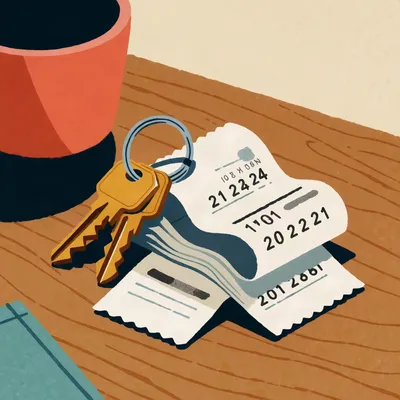
You have to manufacture the event. The classic move is to attach the task to an existing, reliable event rather than to a time: expenses get filed when you close the last receipt of the month, or when you sit down to do the actual banking you already do, or — the crudest and most reliable version — the receipt itself becomes the cue. You don't remember to file expenses; you keep every receipt physically clipped to your house keys, and now the keys are the trigger. The translation layer is allowed to be dumb. Dumb is robust.
I'm having that on a mug. Although — the breakdown actually starts earlier than the trigger, doesn't it?
It does. Fuermaier's group, twenty thirteen, forty five unmedicated adults with ADHD against forty five matched controls, on complex prospective memory tasks. They found a large impairment in task planning. Not in recalling the plan, not in self-initiation, not in execution — those effects were negligible to small. Planning. The task never gets decomposed into steps with a time attached. There is no "by Friday" because Friday was never assigned to it in the first place.
So the intention doesn't just decay, it's malformed at birth. Nothing to execute.
And if you add on top of that what the reward literature says, the whole shape of the asymmetry starts making sense. Marx and colleagues, twenty twenty one, a meta-analysis of thirty seven group comparisons — over three and a half thousand participants — and people with ADHD choose small immediate rewards over large delayed ones more frequently than controls. Steeper temporal discounting. The detail I love is that the effect almost doubled when the rewards were real rather than hypothetical. Abstract future payoff barely registers. Concrete, near payoff registers.
"I'll pay you in reputation, in about four years" is the worst possible currency for this brain.
Exactly the wrong currency. And Sonuga-Barke's dual-pathway model takes it further — this isn't just undervaluing the future, it's that waiting itself registers as aversive. Van Dessel's imaging work in twenty eighteen found adolescents with ADHD showed greater activation to certain-delay cues — just the signal that you'll have to wait — in the amygdala, the insula, the temporal pole, both prefrontal regions. The waiting is experienced as threat. So the boring admin task isn't neutral-with-low-reward. It's actively unpleasant to sit with, and the escape from that feeling is its own small immediate reward.
Two minutes of email versus thirty seconds of relief from thinking about the email. At those exchange rates I know which one I'd take.
You would, and you're a sloth — you're the one population with a credible excuse.
My people invented waiting. Mongolia, twelve thousand years of it. Look it up.
I've looked it up. That's the problem. Now — one thing I want to be careful about, because the folk vocabulary around this has outrun the evidence. "Time blindness" — useful description, not a settled construct. Barkley's own time-reproduction study in adults, a hundred and four against sixty four, found larger time estimations that washed out after controlling for IQ, shorter reproductions, more errors. A twenty twenty three review called the adult research very scarce and mixed. Something is there with time perception. "Blindness" is a metaphor that stuck.
And "interest-based nervous system," which every ADHD corner of the internet says as if it were a brain scan finding.
That one's a clinician's description — Dodson, a psychiatrist who treated hundreds of patients and coined it from that experience. As of this year there's no peer-reviewed literature that uses the phrase at all. It describes something real — that engagement follows interest, novelty, urgency rather than importance or priority — but it's a description, not a model. Use it as shorthand, don't cite it as mechanism.
Fine. So we have the mechanism, honestly labeled. Where I want to push is the part Daniel actually feels: the two-minute email that becomes a three-week avoidance object. The mechanism explains forgetting. It doesn't explain the dread. The task gets harder every day it sits, faster than the task itself could justify.
That's the shame loop, and it's the accelerant. Clinical description, not a trial finding — but it's the one everybody with ADHD recognizes instantly. The task sits. The gap between what you said and what you did generates shame. Shame pulls attention into self-criticism and threat-monitoring, which is working memory you're not spending on planning or starting. The task gets objectively harder to approach. Avoidance offers short-term relief, which is the one reward your brain reliably will take. The task sits longer. The shame grows. That's why the pile grows faster than the tasks come in — each item compounds.
So it's not a to-do list, it's a debt. Accruing interest.
Interest denominated in the exact currency the brain can't discount properly. It's a tidy trap, evolutionarily speaking.
You've been waiting all episode to say something with "evolutionarily" in it.
I've been waiting six minutes, which for me is an epoch.
Medieval Pottage Facts. For Lent, medieval cooks made fake eggs by stuffing empty eggshells with fish roe and almond milk and cooking them in the coals. You make do.
The original substitution engineering.
So the mechanism is structural — planning fails, time-based triggers fail, waiting hurts, shame compounds. Which leads us to Daniel's actual suspicion: that the small stuff costs more than a bad piece of work would. Is that true?
I think it's true, and the person who's argued it best is a writer named Vaishnav Sunil, who wrote a piece in twenty twenty four about exactly this. His term is reputational decay. When you consistently take days to reply, miss logistical commitments, need multiple follow-ups for simple things — you don't develop a reputation for being busy or focused on important work. You develop a reputation for being unreliable. And that cost compounds in ways nobody measures.
He's also blunt about the double reading. Two people both take four days to answer. One gets "he's probably deep in something important." The other gets "he's dropping the ball again." Same behavior.
Same behavior, and the prior reputation decides which sentence you get. And here's the trap in his words: once you're branded unreliable, future delays get read as confirmation, not as the natural cost of focusing on important things. There's no way to be late safely once the label is on.
That's why it beats the bad deliverable, actually. A bad piece of work is a discrete event — you fix it, apologize, move on. The reputation is a lens. A lens sits in front of everything you do afterward, including the good work. Daniel can spend a weekend doing brilliant work and the lens reads "and yet I had to ask him twice for the invoice."
And the standard defense of the behavior doesn't work for him. Paul Graham's famous argument — good procrastination is putting off small errands to do great work. Fine, for a brain with a balanced pull. Sunil's rebuttal is exactly right: for an ADHD brain, choosing important over urgent isn't the challenge, because the brain already gravitates to novel high-upside work. The challenge is managing the accumulating cost of the neglected maintenance. The standard advice isn't just useless here, it removes the only counterweight.
"Just use a calendar" is the advice I want to bury, though. That's the one everyone gets.
Sunil has a good line on that too — those suggestions assume the challenge is knowing what to do, rather than the neurological capacity to consistently execute such systems. The bridge between intention and action is the exact thing under strain. Willpower draws on the executive system ADHD makes inconsistent. You can know what needs doing, care deeply, and still not start, because knowing and caring aren't the broken parts.
The calendar advice is a map handed to someone with no legs. "It's all right there."
Although — I do want to defend the repairable version of this, because the evidence for actual skills training is better than the calendar-people deserve credit for. Solanto's trial: eighty eight adults, twelve weekly two-hour sessions on planner use, time management, task breakdown. Over forty percent of them cut their inattention scores by at least a third, against twelve percent getting supportive therapy. Structured skills training, done properly over months, works for real people.
And I want to be precise about what that trial actually trained, because it matters for the calendar point. It wasn't "here's a calendar." It was twelve weeks of supervised practice — planner use, breaking tasks into steps, time estimation, with someone checking the work every week. The calendar is the prop. The twelve weeks of external accountability is the treatment.
The delivery vehicle is boring; the dosage is the active ingredient. Which is why the person who buys a planner on Monday and abandons it by Thursday hasn't failed the treatment — they've never received it. And Cherkasova's trial adds the medication interaction.
That's the eighty-eight-adult CBT-plus-coaching one?
Yes — twelve sessions of group CBT with coaching, with or without medication. The combination beat CBT alone on organizational skills with a large effect. And the medication finding on its own is the one I'd want Daniel's colleagues to hear: methylphenidate improved memory compared to unmedicated patients, but they were still impaired against healthy controls. The authors say it flatly — additional treatment is necessary. Pills help. Pills do not normalize. That's why well-medicated people still drop the admin ball, and why "are you taking your pills" is the wrong question entirely.
So the ceiling is real even with chemistry on your side. What sits above the ceiling?
Externalisation. Barkley again — the principle is to take the information that's failing to stay inside your head and put it into physical form in the environment, at the point where the action needs to happen. Internal, private information is a weak source of control for an ADHD brain. The test of any system is three questions: is it visible, is it automatic, and is it present at the moment you need to act?
A phone reminder fails that test.
Mostly it does, and the data backs the skepticism. Reminders help neurotypical memory — a big randomized experiment with over five hundred adults found reminders improved completion of delayed tasks, eighty nine percent versus eighty. But a trial of a hundred and nine adults with self-reported ADHD found text reminders did not change completion at all. A notification you swipe away is wallpaper within a week. The object has to be at the point of performance — on the keyboard, physically under your hands — not on the screen you've trained yourself to dismiss a hundred times a day.
And there's a reason the swipe fails that's worth spelling out. The notification arrives at the phone's convenience, not the action's. It pings while you're mid-sentence in something else, and the correct move in that moment is to dismiss it — which trains the dismissal. You're literally rehearsing ignoring your own system.
Rehearsing the swat, yes. The sticky note on the keyboard can't be swatted. It has to be physically displaced by your hands to do anything else, and displacing it means acknowledging it. That's the whole trick — the cue that survives is the cue that taxes you to ignore.
So the system that works looks undignified. Sticky notes, a physical object on the bag you have to move to sit down, a timer you can see counting down from across the room. It's the glamorous-intervention problem again — the impressive-looking system is usually the empty one.
And the failure-point matching matters. If your break is task initiation, you need external go-signals — a timer that says start, a two-minute version of the task, somebody sitting there. If it's working memory, every commitment gets written down at the moment it's made, into one trusted place, not held in your head until you reach your desk — because you won't reach your desk with it. If it's time, analog clocks and calendar blocks with hard edges. Different breaks, different patches.
What about the if-then stuff? Implementation intentions.
Strong general evidence — Gollwitzer and Sheeran, across ninety four tests, a medium-to-large effect on goal attainment. And mechanistically it's the same move as the event-based finding: pre-decide that when situation X arises, you will do Y. You've offloaded the decision from working memory onto an environmental cue — the intact channel. "When Priya's email arrives, I reply within the hour" isn't willpower. It's a trigger waiting for its event.
Which loops back to the nicest fact we've got: event-based memory works. The whole game is converting time-based intentions into event-based ones.
Every reliable system we've named does that conversion in some form. The timer converts a clock into a sound. The physical object converts Friday into an obstacle. Body doubling converts a task into an event that arrives in the shape of a person.
Is body doubling evidence-backed, or is it vibes?
Mostly vibes with a survey attached — a couple hundred adults, most of them ADHD, overwhelmingly said they finish tasks more easily alongside someone. The objective studies are tiny, twelve and twenty six participants, and they disagree with each other. I wouldn't write it off, the self-report is overwhelming and the mechanism is plausible — it makes the start an event. But nobody's proven it.
Vigorous vibes. Noted.
There's a third path, though, and it's the uncomfortable one, and I think Daniel should hear it without flinching. Sunil's accept-and-manage strategy. Accept the core constraint — consistently executing administrative systems will be extraordinarily difficult for you, and calling that realistic isn't defeatism, it's resource allocation. Then manage the reputation instead of the task list. Be upfront early in relationships that you're bad at admin and here's how to reach you when it's actually urgent — build a reputation for knowing your limits rather than denying them. Identify the few admin tasks with catastrophic downside — immigration paperwork, legal deadlines, tax — and build minimal systems for just those. Make the high-value work visible enough to offset the administrative noise. And then explicitly choose which penalties you're willing to eat.
The upfront-disclosure one is the one that makes people flinch, though. Telling a new employer "I'm bad at admin" in week one feels like handing them the unreliable label pre-installed.
It's a real risk, and the framing matters. You're not confessing a flaw, you're proposing a protocol. "I'm slow on email but same-day on Slack; if it's urgent, ping me twice" is a working arrangement, not an apology. The label only sticks to silence. If you never explain the pattern, every delay writes its own story — and you don't get to pick the story.
I like the choosing-your-penalties one most, though. Naming your acceptable losses out loud is the one piece of this that a non-ADHD person should also steal.
It's the piece with no evidence base at all and I still think it's right. Which brings me to the tension I'd want to leave hanging: the clinical literature is optimistic — skills training works, CBT plus medication works, effect sizes are respectable. And Sunil's position is essentially "stop trying to become the system." Those can both be true. Train where training pays, accept where it doesn't, and be explicit about the border. But the research gap is the story: Lauder's review of a hundred and forty three studies found almost nothing on workplace interventions beyond medication. Nobody has run a dedicated trial of anything aimed at routine admin in employed adults with ADHD. The question Daniel is asking has literally never been tested properly.
"Yes, partially, and nobody has measured it properly" is the answer, then. Refreshingly honest, for a field.
That's what I keep saying.
Was that a position or a sigh?
Corn's right, is the thing. The Friday one always goes. I had a timesheet at a studio in Bristol, early nineties, and I never once filed it on time in two years. Every Friday, the tray. The sheet went in on Monday, backdated, and the clerk — Barbara — initialed the lie without a word. We called the form the doily. It was pink and punched wrong, so it looked like one. The doily went in late while the actual work went in early. I'd have the reels labeled and the logs squared by Thursday noon. Barbara said once I was the only one who ever checked the numbers twice, and the only one she had to chase. Both were true and she found that funny. I didn't. And it cost me, in the end — they capped the overtime claims at a month back, and I'd been sitting on eleven weeks of the doily. Eleven weeks of late shifts, gone. I know what it came to. Eighty one pounds and change. I priced a Filofax that same year, fourteen ninety five, because a producer told me a diary would fix me. I didn't buy it. The doily cost more.
You're describing the exact asymmetry — the work pristine, the paperwork ransom — and your fix was to make Barbara a co-conspirator rather than buy the diary.
Barbara was the system. Fourteen ninety five wouldn't have been.
Eleven weeks of overtime to save fifteen quid. That's temporal discounting with the sign flipped.
It wasn't about the money. It was Friday. You don't put a man in a dark studio till four and then ask him to find a tray.
The doily is now the show's official unit of admin neglect. Eighty one pounds.
So the closing question — can you get better — splits in two. The structural part is convertible, and that's where I'd put Daniel's energy. Every time-based intention you can restate as an event-based one is a task moved from the broken system to the intact one. That's not self-improvement, it's engineering. And the rest — where no event exists and none can be built — is where Sunil's frame takes over: minimal systems for the catastrophic few, honesty about the rest, and choosing your losses on purpose rather than by accident.
And the open question I'd leave him with is the gap itself. The thing he's asking about has never had a proper trial — a hundred and forty three studies and not one aimed at routine admin in working adults. The people most rewarded for skipping the boring thing are also the people it costs most, and nobody's measured what actually saves them. Somebody should. Until then: convert the clock into an event, put the cue where your hands already are, and know which Fridays you're choosing to lose.
My Weird Prompts is produced by Hilbert Flumingtop, who has never filed a timesheet on time and never will, and has our complete respect. Find us at my weird prompts dot com.
If you enjoyed this one, try episode twenty twenty-nine, ADHD Brains; episode eight thirty-three, Why Context Switching Drains Your Brain; and episode fifteen thirty-six, From Crisis to Consistency. This has been My Weird Prompts. No question too obscure, no rabbit hole too deep. We'll be back soon.