
Text to Speech
98 episodes
#6473: Why Whispering Breaks Speech Recognition Physics
Whispering completely removes fundamental frequency and pitch, forcing speech recognition models to rely on subtle duration cues.
#6468: Why Tiny Neural Gates Replaced Voice Activity Gates
Legacy WebRTC voice detection misses sixty-four percent of speech frames, while modern neural models compress full memory into a single megabyte.
#6467: Voice Activity Detectors Need Adaptive Thresholds
When speech recognizers receive pure noise from a loose VAD gate, they confabulate plausible sentences rather than returning silence.

#6456: The Unsung Builders of Modern Speech AI
OpenAI's Whisper lists famous co-founders among its six authors, yet shipped with no launch event, demo day, or canonical interview.
#6432: Why Speaker Embeddings Fail Across Time and Noise
A standard speaker embedding compresses an entire human voice into just 192 abstract numbers, yet error rates jump from 17% to 47% in the wild.
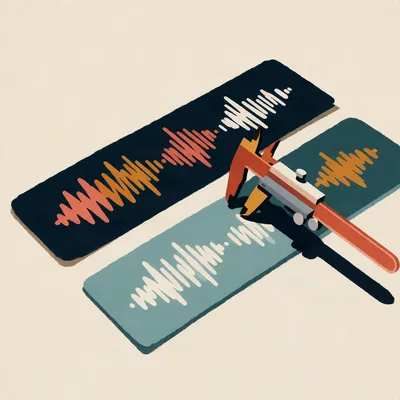
#6421: Why Diarized Transcription Requires a Cascade
Open-source speech tools cannot transcribe and identify speakers in a single call, forcing pipelines to rely on timestamp-overlap math.

#6410: Why Morning Voice Happens and What Warming Up Does
Overnight, cilia slow down and mucus pools at the vocal folds, leaving voices stiff and prone to irritation.
#6380: Choosing the Right Voice Activity Detector
A compact model file can hide a massive runtime, while Cobra bundles its proprietary detector and engine into just 450 kilobytes.

#6377: How Audio Models Tell Voices Apart
A diarization model can tell two voices apart without understanding a single spoken word or assigning a real name.
#6365: Teaching Speech Models to Transcribe Bilingual Slang
Fine-tuning Parakeet with 77 minutes of speech cut Hebrew-English code-switching errors nearly in half, but later gains required far more audio.
#6342: Why Pitch Shifting Fails to Protect Witnesses
Modern generative voice conversion models can swap vocal identities live with less than eighty milliseconds of delay.
#6341: Why Fast Speech Detectors Still Struggle with Onsets
Aalto and Genelec experiments reveal human ears can detect sound timing shifts down to half a millisecond at certain frequencies.
#6340: Disguising Voices Without Losing the Emotion
Benchmark tests show speech anonymizers can protect identity while preserving emotion at an unweighted recall of under 44 percent.
#6332: Why Extra Voice Hours Settle Bilingual Speech
Fine-tuning Parakeet TDT on fifteen hours of bilingual speech cut error rates from 13.7% to 4.9% by resolving contextual variation.
#6298: Why Dictation Models Steal Other People's Voices
Stock speech models lack target-speaker conditioning, defaulting to transcribing whichever competing voice is loudest or most predictable.
#6297: Teaching Dictation Models to Ignore Other Voices
Evaluating Whisper on non-speech clips revealed entire invented phrases in roughly one percent of transcriptions.
#6296: Why Speech Recognizers Cut Off Hesitant Speakers
Between speakers, conversational handover averages 200 milliseconds, but planning pauses inside a turn naturally take seconds.
#6267: Why Text-to-Speech Fails at Explaining Code
A study comparing Google TTS, ChatGPT, Gemini, ElevenLabs, and Copilot found every system failed to communicate indentation, scope, and code comments.
#6254: Where a Synthetic Voice Gets Its Accent
A neural speech interface maps motor cortex signals into phonemes drawn from an eclectic training set of human voice recordings.
#6230: Why Synthetic Speech Needs Fake Room Noise
Synthetic voices can drop to digital black between sentences — so engineers add fake room tone to make the silence sound real.
#6229: Voice Design: Casting Ogres and Radio Voices
Text-described voices vs. reference audio, and which TTS knobs change who a voice is versus how it sounds.
#6215: Can Anyone Still Spot an AI Voice?
Clones now pass as human. Generic AI voices still don't. And the detectors? They fall apart in the wild.
#6198: Benchmarking a TTS Model on Your Own GPU
Real-time factor, warm-up artifacts, and why an 8-bit quantized speech model might not run any faster.
#6197: Talking to Your Own Voice Clone
What actually happens when you sit down and talk with an AI clone of your own voice — and what Evan Ratliff's Shell Game revealed.