
Physics
107 episodes · Page 2 of 5
#5749: From Sand to Trillion-Dollar Chips: Semiconductors in 5 Levels
A bad conductor and a bad insulator — and the most important material in civilization. Semiconductors explained in five escalating levels.
#5747: Jamming Drones: The Physics of the Wearable Skylock Kit
How does a vest-sized jammer take on frequency-hopping drones? The inverse-square law, spread spectrum, and why jamming reaches farther than detect...
#5741: The Bulb That Lit the 20th Century
From Edison's carbon filament to the blue LED that unlocked white light — how we got from 1 lumen per watt to 150.
#5730: What 4 Gs Actually Does to a Body at 17,000 Feet
A cockpit door left open, a passenger who knew one thing, and two off-duty pilots in row 30. What the physics of that descent really felt like.
#5717: What It Takes to Land on the Moon Again
Artemis II flew by the Moon in 2026. Artemis IV plans to land in 2028. The gap between those two missions is enormous.
#5716: One in 13 Million: What It Takes to Be an Astronaut
Only 631–780 humans have ever reached space. Here's the training gauntlet — and the mental toll — behind that number.

#5546: How Fast Before an Engine Can Swallow a Person?
A running turbofan at idle already moves hundreds of kilograms of air per second. Here's why the ramp is lethal long before takeoff thrust.
#5545: Jet Engines on Bicycles: The Physics of Bad Ideas
A pulsejet strapped to a bike sounds like a fighter jet — and burns 55 gallons an hour to move one guy who could have pedaled.
#5321: From Millimeters to Atoms: The Units of Small
A millimeter is the last unit you can feel. Below it, the trades borrow microns, mils, and angstroms — and the atom is a different regime entirely.
#5320: Where Does Micro-Engraving Actually Begin?
The naked eye's real resolution limit isn't what textbooks say — and it changes everything about micro-engraving and micro-soldering.
#5299: Why Bright Lights Make Fog Worse
More light isn't safer light. Why fog, glare, and the moth effect turn your emergency flares against you.

#5168: Ten Inventors You've Never Heard Of
From the yellow traffic light to the geoid model behind GPS — ten inventors whose quiet work reshaped daily life, and why we forgot them.

#5128: The 120 Hz Problem: Why Your Window Can't Stop That Jackhammer
A bedroom-shattering 120 Hz tone reveals why low-frequency noise ignores windows, mocks active noise cancellation, and demands real physics.
#5126: The Volunteers Who Let Science Shock Them
Charles Dalziel's volunteers endured muscle-locking shocks to create the safety standards we rely on today. What do we owe them?
#5112: AC vs. DC: What Actually Happens When You Get Shocked?
Voltage isn't what kills you. Current is. Here's what really happens when AC meets the human body.
#5030: How the Blue LED Quietly Rewired the World's Energy Grid
From 15% of global electricity to under 10%—how a semiconductor breakthrough made lighting nearly free and what's next.
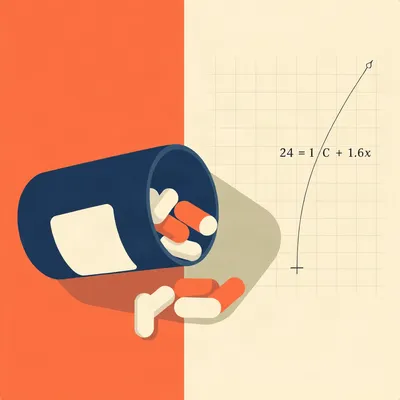
#4835: How Math Took Over Your Prescription Bottle
Dosing wasn't always science. Before 1937, it was guesswork. Here's how equations conquered medicine.
#4673: What "Feels Like" Really Means on Your Weather App
Heat index, wind chill, and why two apps can give different numbers on the same street. The science behind that little number.
#4468: What a Log Scale Actually Does to Your Sensor Data
Log scales don't smooth data — they change the ruler you're measuring with. Here's when to use them and when they'll break.

#4216: What Percentage of Reality Are We Missing?
Humans detect 0.0035% of light and 0.14% of sound. What else are we missing?

#4048: Can You Learn Reveille in 8 Weeks?
Why the bugle still matters, and how fast a motivated adult can actually learn to play Reveille.
#3975: Reading Concrete Cracks: What Your Building Is Telling You
Most cracks aren't emergencies. Here's how to tell which ones are — and why fixing them late costs 5x more.
#3930: Why Movers Are Stronger Than They Look
How movers and Olympic lifters build elite strength without big muscles — it's all in the nervous system.
#3879: What the Moon Actually Smells Like
Twelve humans have walked on the Moon. Here's what it actually felt, smelled, and sounded like—and why we stopped going.