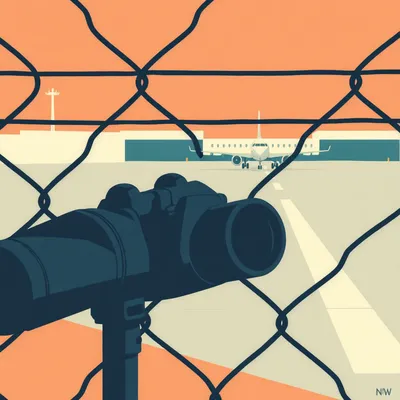
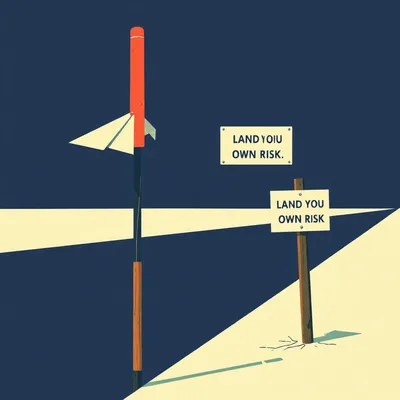
Picture this. Cork Airport on a wet Tuesday: the perimeter fence is patrolled, cameras sweep every angle, the fire service is out doing debris checks on the runway. It's a machine. Now picture another airfield, about an hour west. Same county, same regulatory authority, same sky overhead. And an elderly lady is walking her groceries straight down the center line while a Cessna circles overhead.
Daniel's been thinking about this moment ever since he saw it. He and a friend used to go plane spotting at Cork Airport's perimeter fence, and he says if anyone assumed smaller international airports were lax, Cork was the counterexample — tight, professional, patrolled. But then he went looking for the airfields of County Cork, drove down to one in Bantry, and walked into a scene that's stayed with him: a woman using the runway as a shortcut, a bystander running to warn her about an inbound plane. The airfield handled pharmaceutical deliveries, flight movements were rare, and locals treated it like any other stretch of asphalt.
He's asking three things. How many small airfields exist like this around the world, places that fade into the background of their communities? What does it mean when aviation is removed from the intense security that, for all its necessity, cuts people off from the machines they're fascinated by? And what's the balance between the charm of an open runway and the locked cockpit door of the modern world?
So today we're asking: what happens to the places that fall through the cracks of the aviation security state?

The thing is, aviation security is not a monolith. It never was. We tend to picture the international terminal — the scanners, the pat-downs, the armed patrols — and assume that's what an airport is. But that's the extreme end of a spectrum. At the other end you've got a windsock, a painted line in a field, and a pilot squinting out the windshield to check for sheep.
And the Bantry airfield Daniel saw — that sits somewhere in the middle. It had a real function. Pharmaceutical deliveries. That means scheduled or semi-scheduled freight flights, which means it was a licensed aerodrome, which means the Irish Aviation Authority had it on a list somewhere. But the traffic was so low that the security apparatus never materialized. There was no business case for a fence. The risk profile didn't justify it.
The risk profile being... a Cessna every few days and a woman with groceries.
Exactly the kind of thing that would be a catastrophic failure at Cork Airport. A pedestrian on the runway, an inbound aircraft — that's a near-miss that triggers an investigation, a report, probably a review of perimeter security. At Bantry, it was Tuesday.
And the woman probably didn't think she was doing anything unusual. She wasn't trespassing in her own mind. She was taking the shortcut she'd always taken.
Which tells you something about how the community had absorbed that runway. It wasn't a sterile zone. It was a piece of infrastructure that existed in the same mental map as the road to the shop. And that's not negligence — it's a different category of airfield entirely.
So let's get into the categories, because I think that's where Daniel's question actually lives. What is a place like Bantry, operationally speaking?
It's what's called an uncontrolled airfield. No control tower. No ground controller. No security staff. Pilots self-announce on a common frequency — in Ireland it's typically the CTAF, the Common Traffic Advisory Frequency. They broadcast their position, their intentions, and they listen for other traffic. The onus is entirely on the pilot to see and avoid. And that includes obstacles that aren't supposed to be there.
The runway itself — I don't know the exact surface at Bantry, but for a field handling freight flights it was likely a paved strip, maybe asphalt, maybe compacted gravel. Either way, the operational principle is the same: the pilot does a low pass or a flyover before landing to check the strip is clear. You don't get that at Heathrow.
You'd cause a diplomatic incident.
You'd cause several. But at an uncontrolled field, that flyover is standard procedure. You check for debris, for animals, for vehicles, for... pedestrians with shopping bags. And if something's there, you go around and try again, or you don't land.
So the system accounts for the grandmother. She's a known unknown.
In a sense. The safety model at these fields is fundamentally different from a controlled airport. At Cork, the system eliminates the hazard — the fence, the patrols, the cameras, the sterile zone. At Bantry, the system accepts the hazard and trains the pilot to manage it. Neither approach is wrong. They're calibrated to different levels of risk and different volumes of traffic.
And the Irish Aviation Authority is fine with this.
The IAA licenses these aerodromes and sets minimum requirements. For a low-traffic field, those requirements are... minimal. You need a defined runway, basic markings, a windsock, some kind of firefighting capability — which might just be an extinguisher in a shed. You don't need a fence. You don't need security patrols. The regulatory framework explicitly recognizes that a field with two movements a week is not Cork Airport and shouldn't be treated like one.
And this isn't unique to Ireland. The same principle applies across the EU, across the US, across most of the world. The FAA has thousands of general aviation airports, many of them uncontrolled, many with no fence worth mentioning. The risk-based approach is standard. It's just that most people never encounter it because most people only ever fly through the secured end of the spectrum.
So Daniel's question about how many of these exist — it's not dozens. It's thousands.
Thousands globally, easily. The US alone has over five thousand public-use airports, and the vast majority are general aviation fields. Most of them are uncontrolled. Most of them have no real security presence. A significant number are surrounded by farms or residential areas where the runway is just... there. You could walk onto it. People do.
And the pharmaceutical delivery detail is interesting because it tells you this wasn't recreational aviation. This was commercial. Goods moving through the supply chain, landing on a strip where the primary pedestrian deterrent is the pilot's eyesight.
Which is actually not that unusual for remote or rural logistics. There are airfields in the Scottish Highlands that serve whisky distilleries — we'll come back to that. There are strips in Alaska that are the only way to get supplies into villages. There are fields in the Australian outback that double as the town's main road. The Bantry model is not an anomaly. It's a whole category of aviation infrastructure that operates on trust and local knowledge rather than security theater.
Trust and local knowledge. That's the phrase. Because what Daniel described — the bystander running to warn the woman — that's the security system. That's the fence. It's a person who knows the schedule, knows the sound of an approaching engine, and knows who needs to be told.
And that works until it doesn't. Let's be clear-eyed about this. The Bantry scenario Daniel witnessed was a near-miss. If the bystander hadn't been there, if the woman hadn't heard, if the pilot hadn't seen her — that's a collision. The probability is low, but it's not zero. The risk-based approach accepts that low probability because the cost of eliminating it — fencing, staffing, patrols — would be disproportionate to the actual threat.
But it's worth naming the tradeoff plainly. The charm of Bantry is that it's not secured. The safety of Bantry depends on a calculation that nothing terrible will happen. Most of the time, the calculation holds. Occasionally, it doesn't.
Occasionally, a campervan on the threshold.
Or a deer. Or a drone. Or fog that rolls in faster than the pilot expected. The uncontrolled airfield model has failure modes that the secured airport model has engineered out. That's not a criticism. It's just the shape of the tradeoff.
Let's talk about the other side of that tradeoff. Cork Airport. Daniel cited it as the counterexample — and he's right. I've been through Cork. It's not a massive hub, but it's a serious operation. The perimeter is patrolled. The fire service does regular FOD checks — foreign object debris sweeps. They're looking for anything on the runway that could get ingested into an engine or damage a tire.
FOD patrols are one of those things that most passengers never see and never think about. At a major airport they happen multiple times a day. The fire service drives the runway in a vehicle, sometimes with a magnetic bar to pick up metal fragments, checking for anything that doesn't belong. It's methodical, it's boring, and it's one of the reasons commercial aviation is as safe as it is.
Cork also has all the other layers: the perimeter fence with intrusion detection, the CCTV coverage, the access control systems, the security patrols, the screening checkpoints. It's a secured environment in exactly the way Bantry is not. And the interesting thing is that Cork isn't even a large airport by international standards. It handles about two and a half million passengers a year. But the security posture is essentially the same as a major hub, because the threat model is the same.
The threat model being... people who want to bring down an aircraft, or get unauthorized access to one.
Or leave something on the runway. Or fly a drone into the approach path. The threat landscape for any airport handling commercial passenger flights is broad and serious enough that the baseline security posture is high everywhere. There's no such thing as a relaxed international airport anymore.
But that baseline — the fence, the cameras, the patrols — it creates a barrier. Not just a physical one. An experiential one. You used to be able to stand at the perimeter and watch the planes. Now you're herded through a terminal, scanned, watched, kept at a distance from the machines. The wonder is still there, but it's mediated.
Plane spotting as a hobby has been shaped by this shift. There are still designated spotting areas at some airports — viewing platforms, parking lots near the approach path. But the days of leaning on the fence with a camera are mostly gone. The fence is set back. The patrols will move you along. The security state doesn't distinguish between a teenager with binoculars and someone doing reconnaissance.
Which brings us to the psychological division Daniel's pointing at. The division between people's natural fascination with things that fly and the practicalities of keeping aviation safe.
And it's a real division. A kid who sees an aircraft up close — standing at the edge of a runway, feeling the prop wash, hearing the engine — that kid is changed. That's a core memory. That's how you make a pilot, or an engineer, or just someone who looks up when they hear an engine. But that experience is almost impossible to get at a secured airport now. You're behind glass. You're separated from the machine.
Small airfields like Bantry offer something that the security state has taken away: an unfiltered connection to aviation. You can stand at the threshold. You can feel the wind from a passing prop. You can see the rivets. And that's not nothing. That's genuinely valuable.
It's the difference between watching a nature documentary and standing in the forest.
And we've made the nature documentary the only option for most people.
So let's go wider. Daniel mentioned decommissioned airports, and specifically the one in Jerusalem. Atarot.
Atarot Airport. This is a fascinating case. It was Jerusalem's airport, located in the northern part of the city. It handled domestic flights and some international charters. Then the Second Intifada happened, the security situation deteriorated, and the airport closed. That was back in two thousand one, two thousand two. It's been sitting there ever since.
And what's happened to it is exactly what Daniel's describing. It's faded into the landscape. The runways are still there. The terminal building is still there, more or less. But there's no fence worth mentioning, no security, no active patrols. People go there. They walk on the runways. They explore the buildings. It's become a kind of accidental public space.
In a city that's not exactly short on contested spaces.
No, and that's part of why Atarot is complicated. The airport sits in an area that's been at the center of territorial disputes. There have been various proposals to reopen it, to redevelop it, to turn it into a settlement, to turn it into a Palestinian industrial zone. None of them have gone anywhere. So it just sits there, this ghost of an airport, slowly decaying, open to anyone who wants to walk in.
And that's a different category from Bantry. Bantry is operational but unsecured. Atarot is decommissioned and abandoned. The openness isn't a design choice — it's a vacuum.
Right. And the vacuum is political, not operational. If the political situation were different, Atarot might have been redeveloped years ago. Or it might have been secured and fenced off. The fact that it's open is almost an accident of history. Nobody decided to make it a public space. They just stopped maintaining the fence.
But the effect is the same. You get a place where aviation infrastructure is just... there. Accessible. Part of the landscape.
And this pattern repeats all over the world. Tempelhof in Berlin is the famous example — a massive airport in the middle of the city that closed and was deliberately turned into a public park. That one was intentional. But there are dozens of others where nobody made a choice. The base closed, the fence rusted, and people started walking their dogs on the runway.
There are strips in rural America where the local airfield is also the place where teenagers learn to drive, where the farmer stores equipment at the edge, where the community holds its Fourth of July barbecue. In Australia, there are outback stations where the airstrip is the only flat piece of ground for miles and it doubles as the cricket pitch. The boundaries blur.
The runway as cricket pitch. That's a security posture you don't see at JFK.
And it works because the traffic is so low that the probability of conflict is negligible. The cricket match is over before the weekly mail plane arrives. If the plane arrives early, someone waves and the players clear the strip. It's informal, it's trust-based, and it's utterly incompatible with the regulatory framework of commercial aviation.
Which is the tension Daniel's really getting at, I think. The charm of Bantry is that it's informal. It's human-scale. It's woven into daily life in a way that Cork Airport can never be. But that charm is also the thing that makes it vulnerable. You can't have the open fence and the locked cockpit door. You have to choose.
And we've chosen. As a society, we've chosen the locked cockpit door. And it's hard to argue with that choice. The threat is real. The consequences of a breach are catastrophic. The security state exists for a reason. But we should be honest about what we lose when the fences go up.
We lose the grandmother with her groceries. Not literally — she's still there, she's still taking her shortcut. But she's an anomaly now. A relic. The world she inhabits, where a runway is just a stretch of asphalt, is shrinking.
Is it shrinking, though? Or is it just invisible to most of us?
That's a fair pushback. It might be that the Bantrys of the world are still out there in large numbers, and we just don't see them because we're looking at the Cork Airports. The general aviation infrastructure is vast and largely unremarked upon. Thousands of strips, thousands of fields, thousands of communities that have absorbed an airfield into their geography without much fuss.
Daniel's question was how many exist. We've established it's thousands. But the more interesting question is whether they can survive. As drone technology expands, as urban air mobility becomes a thing, as the security state extends its reach — does the Bantry model have a future?
There's an argument that it does, and it comes from an unexpected direction. The drone revolution and the push toward urban air mobility are creating demand for exactly this kind of distributed, low-infrastructure landing site. You don't need a Cork Airport to land an electric vertical takeoff and landing aircraft. You need a pad, some charging infrastructure, and a clear approach path. The vision for UAM is hundreds or thousands of micro-airfields, many of them automated and unstaffed.
The question is whether those micro-airfields will be secured or open. Will they be fenced and camera-watched, little fortresses of the security state? Or will they be more like Bantry — integrated into the community, accessible, human-scale?
My guess is the security state wins that fight. The liability equation alone pushes toward fencing. If you're an operator running a network of drone landing pads, the last thing you want is a grandmother with groceries on your landing zone. The insurance alone would force the fence.
Probably. But there's a counter-pressure. The whole promise of urban air mobility is accessibility. Point-to-point travel, distributed infrastructure, aviation woven into the fabric of the city. If every landing pad is a secured fortress, you've lost something essential. You've recreated the airport experience at smaller scale, and the promise was to escape it.
So the Bantry model might be a blueprint, or it might be a museum piece. We won't know for another decade.
And in the meantime, there's something worth preserving. Not the lack of security — I'm not romanticizing the near-miss. But the connection. The ability to stand at the edge of a runway and feel the wind from a passing aircraft. The reminder that these machines are real, physical things, not abstractions behind glass.
The grandmother with her groceries, looking up.
Right. She's not a security failure. She's a reminder that aviation used to be closer to the ground.
And that's the thing about the Bantry story. It's funny, but it's also kind of beautiful. A woman walking her shopping down a runway while a Cessna circles overhead. It's a safety violation and a perfect symbol of something we're losing.
The fact that the bystander ran to warn her — that's the part that gets me. That's the community security system in action. No cameras, no patrols, no fence. Just a person who knew the schedule and cared enough to run.
A human FOD check.
And it worked. This time.
Let's talk about what happens when it doesn't work. Because there's a version of this story that ends differently, and we should sit with that for a moment.
The probability of a collision between a pedestrian and an aircraft at a low-traffic airfield is extremely low. We're talking about events so rare that they make the news when they happen. The more common risk at these fields is actually the pilot misjudging the approach, or hitting an obstacle on the runway, or a mechanical failure on takeoff. The pedestrian scenario is vivid because it's human and relatable, but it's not the primary safety concern.
That said, when it does go wrong, it goes catastrophically wrong. A Cessna hitting a person on the ground is fatal for the person and potentially fatal for the pilot. The aircraft is designed to survive bird strikes, not human strikes. The energy involved is enormous.
The risk is low probability, high consequence. Which is exactly the kind of risk that the secured airport model is designed to eliminate.
The Bantry model accepts. That's the tradeoff in its purest form. Low probability, high consequence, accepted because the cost of elimination is disproportionate. It's the same logic that lets us drive cars, or cross the street, or eat sushi. We accept risks every day that would be unacceptable if they happened at scale.
The difference is that aviation has trained us to expect zero risk. Commercial air travel is so safe that any failure feels like a systemic collapse. Bantry operates in a different psychological register. It's aviation on the same risk model as everything else in life.
Which is probably why Daniel found it so striking. He went from Cork Airport, where the safety culture is visible and absolute, to Bantry, where the safety culture is... a bystander with good instincts. The contrast is jarring.
It raises a question about what we want from aviation. Do we want zero risk everywhere, at every scale, for every kind of flight? Or is there room for a tiered system where some kinds of flying operate on a different risk model?
We already have a tiered system. That's what the regulatory categories are for. The FAA and the IAA and every other aviation authority already distinguish between commercial passenger operations and general aviation. The safety requirements are different. The security requirements are different. The tiered system exists. It's just that most people don't know about the lower tiers.
Because the lower tiers are invisible unless you go looking for them. Like Daniel did.
When you find them, they feel like a secret. A whole parallel aviation ecosystem operating on trust and local knowledge and informal agreements. It's easy to romanticize that. I think we should resist the romance a little, but we should also acknowledge that it's real and it works most of the time and it serves communities that would otherwise have no air access at all.
The pharmaceutical deliveries. That's not recreational. That's supply chain. Medicines moving through a strip in West Cork with no fence and no security patrol. And it works.
It works because the pilot knows the strip, the community knows the schedule, and everyone involved has an interest in keeping it functioning. That's not security theater. That's security through relationship. It doesn't scale, but it doesn't need to.
Which brings us back to the grandmother. She's not a threat. She's a neighbor. The security model at Bantry doesn't treat her as a threat because she isn't one. The security model at Cork treats everyone as a potential threat because at that scale, you have to.
That's the division Daniel's talking about. The division between a world where you can walk your groceries down a runway and a world where the runway is a sterile zone patrolled by armed guards. They're both rational responses to their contexts. But they produce very different relationships between people and the sky.
The sky as neighbor versus the sky as threat vector.
That's the phrase.
Where does this leave us? Daniel asked about the balance between charm and security. I don't think there's a clean answer. The balance is different at every airfield, and it shifts over time, and it's never going to be stable.
The balance is also political. Atarot is open because the politics failed. Bantry is open because the traffic never justified a fence. Cork is secured because the traffic demands it. None of these are pure engineering decisions. They're social, political, economic. The fence goes up when someone decides the risk is worth the cost, and that decision is never just about safety.
The fence comes down when someone stops paying for it. Atarot again. The ghost airport, slowly becoming a park, not because anyone planned it but because nobody stopped it.
There's something almost comforting about that. The infrastructure outlasts the purpose, and then the community reclaims it. The runway becomes a walking path. The terminal becomes a ruin. Aviation recedes and the ground comes back.
Until someone decides to reopen it. Which has been proposed for Atarot multiple times. The ghost could come back to life.
If it does, the fence goes up. The patrols start. The grandmother gets moved along. The cycle continues.
I keep coming back to that image. The elderly lady with her groceries, the Cessna overhead, the bystander running. It's a moment that couldn't happen at a secured airport and probably shouldn't happen anywhere, and yet there's something in it that feels worth holding onto.
It's the informality. The human scale. The sense that aviation doesn't have to be this distant, mediated thing. It can be close. It can be part of life. The cost is a certain amount of risk, and we've decided as a society that the risk isn't worth it at scale. But at the edges, in the Bantrys of the world, it still is.
For now.
Hilbert: Nineteen ninety-seven. I spent a summer clearing sheep off a runway in the Highlands.
...Go on.
Hilbert: The airstrip served a whisky distillery. Glen something. Weekly freight flight, Wednesday mornings. My job title was runway rabbit. I had a high-vis vest and a whistle.
Hilbert: No fence. There was a stile over the dry stone wall for hikers on the right-of-way. The postman left mailbags on the threshold for the pilot to collect. The pilot would taxi over, open the door, haul the bags in, and take off again. Took about four minutes on the ground.
The postman just... knew the schedule.
Hilbert: Everyone knew the schedule. The distillery manager, the postman, the farmer whose sheep kept getting onto the strip, the woman who ran the bed and breakfast half a mile down the road. She'd wave from her garden when the plane came over. It was the highlight of her week, she said.
Hilbert: One time a tourist in a campervan parked on the threshold. Thought it was a disused road. Pilot had to go around. I ran out waving my arms, got the van moved, pilot came back around and landed. He climbed out, walked over to the tourist, and gave him a bottle of twelve-year single malt. Said welcome to Scotland.
The pilot gave him a bottle of whisky.
Hilbert: The distillery paid me in product too. I had twelve bottles in the back of my car when I drove back south at the end of the summer. Customs officer at the border asked me what I was doing with a case of single malt. I told him I'd been chasing sheep off a runway for three months. He waved me through. Said he'd heard stranger things.
The currency of these places. It's not security protocols. It's whisky and local knowledge.
Hilbert: It's knowing the postman's name and which sheep belong to which farmer and what time the B and B lady puts her kettle on. The security system is just... everyone knowing what's supposed to be happening and noticing when it isn't. That campervan stood out because it wasn't supposed to be there. No camera needed.
Hilbert: The field's still there. Still no fence. Different pilot now, I'd imagine. Different postman. But the same arrangement, probably. These things don't change much unless someone makes them change.
Unless the security state arrives.
Hilbert: Nobody's going to secure a strip that handles one flight a week and a dozen bottles of whisky. The cost-benefit doesn't work. The security state only shows up when the traffic justifies the expense. That's the whole point of the risk-based approach. It leaves the small places alone.
Hilbert: Which is what you two have been saying for the last twenty minutes, essentially.
We got there eventually.
Hilbert: You did. The grandmother with the groceries — she's the B and B lady. She's the postman. She's part of the system whether she knows it or not. The system works because people like her have been walking that shortcut for thirty years and nothing bad has happened. If something bad happened, the fence would go up. The fact that it hasn't is why the fence isn't there.
The fence is absent because the catastrophe is absent.
Hilbert: The fence is a monument to a disaster that already happened somewhere else. Bantry hasn't had its disaster yet. Neither has the distillery strip. When they do, the fence goes up. Until then, the grandmother walks.
That's a bleaker way of putting it than I'd like, but it's accurate.
Hilbert: It's not bleak. It's just how risk works in practice. Nobody spends money on a fence until they have a reason. The reason is usually a body. No body, no fence.
The cutting room floor detail: Cork Airport's fire service doesn't just do FOD patrols. They also do wildlife management. Birds are a serious hazard, especially during migration season. They use distress calls, pyrotechnics, sometimes trained falcons. The contrast with Bantry, where the wildlife management is a guy with a whistle and a high-vis vest, is almost too neat.
The world is full of these gradients. The secured and the unsecured, the patrolled and the trusted, the falcon and the whistle. Aviation contains multitudes.
The open question, I think, is whether the Bantry model can survive the next twenty years. Not just the security pressure — the drone pressure, the liability pressure, the insurance pressure. The world is getting more risk-averse, not less. The fences are going up, not coming down. The grandmother with her groceries might be the last of her kind.
Or she might be the first of a new kind. If urban air mobility takes off the way some people expect, we're going to need thousands of landing sites that don't look anything like Cork Airport. The question is whether we build them like Bantry — open, integrated, human-scale — or whether we build miniature fortresses. The choice hasn't been made yet.
Thanks to our producer Hilbert Flumingtop, who apparently spent a summer as a runway rabbit and never mentioned it until now.
This has been My Weird Prompts. If you've got a story about an airfield that's faded into the landscape, we'd love to hear it — email the show at show at my weird prompts dot com.
We'll be back soon.