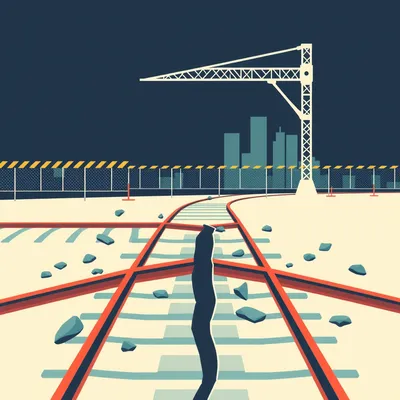
A listener wrote in with something that's been rattling around my head since I read it. He's lived in Israel about ten years, and he's noticed the country has always had two personalities — the startup nation on one hand, and the maddening bureaucracy on the other. But lately, he's started wondering if something's shifted. Let me read you what he sent.
He says, I've lived in Israel for about ten years, and like most people here, I've long accepted that the country has two personalities. On one hand, it's a global leader in technology, innovation, and resilience. On the other, it has a well-earned reputation for bureaucracy, administrative chaos, and the phrase many immigrants eventually learn: Welcome to Israel. It's usually said with affection and frustration in equal measure, acknowledging that the polished image of Israel doesn't always match the day-to-day reality.
Lately, though, I've started wondering whether something deeper is going on. Over the past few months, I've had a growing number of experiences that feel less like ordinary Israeli bureaucracy and more like systems beginning to break down. I'm currently trying to get authorization for a refill of Vyvanse, a tightly controlled prescription medication. I submitted the required paperwork a week before traveling, and it's still sitting as pending. When I call to follow up, the phone tree either doesn't offer an option that matches my situation or simply doesn't function properly. Today it announced that the office was open until eight p.m., but when I called at four p.m., it immediately played a message saying the office was closed. Even the automated system seems internally inconsistent.
This isn't an isolated experience. Paying municipal bills has become surprisingly difficult. Credit card issues go unresolved because no one seems available or empowered to fix them. Individually these are small annoyances, but together they create the feeling that a lot of ordinary systems are becoming less reliable.
Then today I witnessed something I'd never seen before in broad daylight here: a bus driver being physically attacked. A man got out of a van, forced his way onto the bus, and started throwing punches. Pedestrians rushed over to separate them. Of course, fights happen everywhere, but it struck me because it felt like another data point in a pattern of rising tension.
Israel has now been living under prolonged war and national stress for years. The country has shown incredible resilience, and when you read the news and then step outside, daily life often seems remarkably normal. Cafés are open, people go to work, children go to school, and life carries on. But I can't help wondering whether that normality is becoming increasingly surface-deep.
Is there historical or psychological evidence that societies under prolonged wartime pressure begin to accumulate hidden forms of dysfunction? Not dramatic collapse, but slower, subtler signs: public institutions becoming less responsive, bureaucracy becoming more dysfunctional, people becoming less patient and more prone to conflict, and the general feeling that the gears of society aren't meshing as smoothly as they once did.
I'm not trying to make a sweeping political argument or predict doom. My question is really about what prolonged national stress does to a society. Are these kinds of everyday frustrations and moments of public tension exactly what we'd expect to see after years of war, economic pressure, reserve duty, political turmoil, and collective trauma? Or am I simply noticing the ordinary frustrations of life more than I used to? In other words, how do you distinguish between confirmation bias and the genuine early signs of a society that's beginning to creak under sustained pressure?
That last line is the whole thing, isn't it. How do you tell the difference between a society creaking and your own perception shifting. Herman, where do we even start with this?

The phone tree. I want to start with the phone tree, because it's the most revealing detail in the whole letter.
The phone tree.
The phone tree that says the office is open until eight and then immediately tells you it's closed. That's not bad design. That's an internally contradictory system. A phone tree is a piece of technology that requires maintenance — someone has to update the hours, record the messages, make sure the routing logic matches reality. When that stops happening, you're not looking at garden-variety Israeli bureaucratic chaos. You're looking at an institution that can't keep its own automated systems internally consistent.
And the distinction matters because one is cultural, the other is a symptom.
Everyone who's lived in Israel knows the phrase Welcome to Israel — the shrug you give when the clerk tells you you're missing form seventeen dash B and you have to come back tomorrow. That's baseline friction. But a phone tree that contradicts itself mid-call — that's not friction, that's a system that's lost coherence. Somebody was supposed to update that recording and didn't. Somebody else was supposed to test the routing and didn't. Both of those somebodies might be on reserve duty, or covering for someone who is, or simply too overloaded to notice.
So the question the listener is really asking — beneath all the examples — is whether there's a documented mechanism by which prolonged national stress degrades the everyday machinery of life. Not the macro indicators, not GDP or military readiness, but the stuff you touch with your hands. The phone tree. The credit card dispute. The bus driver getting punched.
And the answer is yes. There are several mechanisms, and they stack. Let's walk through them.
Let's do it.
The first is allostatic load. Allostasis is the body's process of adapting to stressors — the system that keeps you stable through change. But allostatic load is the cumulative wear and tear on that system when it's activated too often or for too long. It's not the stress itself, it's the biological cost of being stressed continuously.
So you're not measuring the punch, you're measuring what the punching does to the body over time.
And here's why this matters. A Haaretz piece from May reported that the war has triggered clinical mental illness in millions of Israelis — diagnosable conditions like PTSD, anxiety disorders, depression — at a population scale. When millions of people operate with elevated allostatic load, their cognitive function degrades. Working memory gets worse. Impulse control weakens. The threshold for snapping gets lower.
Which means the guy who got out of the van and attacked a bus driver — that's not just a random act of violence. It's a data point in a population whose stress regulation systems are running hot.
And the bus driver himself is probably running hot too. So is the clerk handling the credit card dispute. So is the person who was supposed to update the phone tree recording. You've got a whole society where everyone's internal regulation is degraded simultaneously. That's not a collection of individual problems. That's an environmental condition.
But people have been stressed before. Wars have lasted longer than this. What makes allostatic load at a population scale different from just saying people are tired and cranky?
Because it compounds. The second mechanism is something military psychology calls the week three spike. In sustained combat operations, after about three weeks of continuous vigilance, performance drops measurably. Errors increase. Irritability spikes. Decision-making slows. The phenomenon is well-established in soldiers. But when an entire society has been in a state of heightened vigilance for years, not weeks, you're not looking at a spike anymore. You're looking at a new baseline.
A baseline of degraded function.
That's what the research suggests. And it's not just psychology. It's structural. Israel's economy is facing real worker shortages because of reserve duty call-ups. Government offices are understaffed. So you've got fewer workers handling the same or greater demand, and those workers are themselves operating with elevated allostatic load. The phone tree doesn't get updated because the person who updates it is either in uniform or covering three other desks.
That's the thing the listener might be sensing without being able to name. It's not that any single system is catastrophically broken. It's that the margin for error has disappeared across all of them simultaneously.
And that's exactly what history shows us. A Times of Israel report found that bureaucratic failures hamstrung social services in the wake of October seventh — specific delays in benefits and support. People who needed help couldn't get it because the systems designed to help them were themselves overwhelmed. That's documented institutional breakdown.
What about historical parallels? The listener asked whether other societies have shown these kinds of hidden dysfunction under prolonged pressure.
Two examples keep coming up. The first is the Ottoman Empire during World War One. The Ottomans had spent decades trying to modernize their bureaucracy through the Tanzimat reforms. But under the pressure of total war, those formal systems couldn't keep up. They didn't collapse dramatically. They just stopped working reliably. And what emerged in their place were informal networks — personal connections, favors, back channels. People found workarounds because the official channels had become too slow or too broken to use.
Which sounds familiar to anyone who's ever been told don't call the main number, call this guy directly.
The second example is the Soviet Union during World War Two, where the blat system emerged — a network of informal exchanges and favors that operated parallel to the official economy. If you needed something — a spare part, a medical appointment, a permit — you didn't go through the official process. You called someone who knew someone. The formal system had become so overloaded and unresponsive that the informal system became the real system.
And the key thing in both cases is that on the surface, society was still functioning. The Ottomans were still fighting a war. The Soviets were still producing tanks. The cafés were still open.
That's the normality paradox. Surface functioning can coexist with deep institutional dysfunction for a very long time. The cafés being open doesn't mean the systems underneath aren't fraying. It means the society has developed workarounds. But workarounds have a cost. They're less efficient. They're less equitable — not everyone has the right phone number to call. And they're fragile. When the person who knows the person retires or gets called up or burns out, the workaround disappears.
So the listener's credit card issue going unresolved because no one seems available or empowered to fix it — that's a classic workaround failure. The formal system is supposed to handle it, but the person who could handle it is either gone or overwhelmed, and the informal system hasn't filled the gap yet.
Or the informal system is there but the listener doesn't have access to it. He's calling the phone tree. The person with the direct line to the one competent person in the department is getting their problem solved. Everyone else is stuck in the queue.
Which creates its own feedback loop. If you can't get your problems solved through official channels, you get frustrated. If you're frustrated, you're more likely to be aggressive with the next frontline worker you encounter. If you're aggressive, that worker's stress load goes up, and they're less able to help the next person. And around it goes.
That's the knock-on effect the listener is picking up on. The bus attack isn't just a symptom of individual stress. It's part of a cycle. Public frustration rises. Trust in institutions drops. People lash out. Frontline workers — bus drivers, clerks, call center staff — bear the brunt of that aggression. They burn out faster, quit more often, or just stop trying. The systems get worse. Frustration rises further.
And all of this is happening while the country is also dealing with the direct costs of war. Reserve duty pulling people out of the workforce. Economic pressure. Political turmoil. It's not one thing. It's everything at once.
That's what makes this different from just saying Israeli bureaucracy has always been bad. The convergence of failures across multiple independent systems — healthcare authorization, municipal payments, credit card processing, public transportation safety — that's not baseline inefficiency. That's a pattern.
Which brings us to the listener's actual question. How do you distinguish between confirmation bias and genuine strain? Because he's right to ask. When you're stressed, your brain's negativity bias kicks in harder. You notice failures more. You remember them more vividly. The same number of annoyances feels like more.
And the answer is you need a framework. You can't just go by feeling, because feeling is exactly what confirmation bias exploits. So here's what I'd suggest. Four tests.
Walk me through them.
First test: convergence. Are multiple independent systems failing at the same time? The listener's examples span healthcare bureaucracy, municipal services, financial services, and public safety. Those are separate systems run by separate organizations with separate funding and separate personnel. If one of them is having a bad month, that's noise. If all of them are degrading simultaneously, that's signal.
Because there's no reason the credit card company's dysfunction should correlate with the health ministry's dysfunction unless something bigger is driving both.
The common factor isn't the systems themselves, it's the environment they're all operating in — an environment of worker shortages, elevated stress, and institutional overload.
Second test.
Acceleration. Is it getting worse over time? The listener has been in Israel for ten years. He knows what baseline Israeli bureaucracy feels like. And he's saying this feels different. That subjective judgment matters, especially when it comes from someone with a long baseline to compare against. But you can also look for objective markers — are wait times increasing? Are error rates going up? The trajectory matters more than the absolute level.
Third test.
Baseline comparison. Would these specific frustrations have happened in twenty nineteen? Not would you have been annoyed by something — would this exact phone tree contradiction, this exact credit card dead end, this exact bus attack have been equally likely before the current period of intensified stress? If the answer is no, or probably not, that's another point toward signal.
And the fourth test?
Correlation with known stressor timelines. Do the failures track with events that we know increase systemic load? Major reserve duty call-ups. Periods of heightened security alerts. Economic shocks. If bureaucratic dysfunction spikes after these events, that's evidence of a causal relationship, not just perception.
So you run these four tests on the listener's examples. Convergence across healthcare, municipal, financial, and public safety. Acceleration — he's saying it's gotten worse recently compared to his ten-year baseline. Baseline comparison — a phone tree that contradicts itself mid-call is not standard Israeli bureaucratic chaos, that's a system that's lost internal consistency. And stressor timeline — all of this is happening in the context of prolonged war, mass reserve duty, and documented institutional strain.
That comes out pretty strongly on the side of genuine signal. Not pure signal — confirmation bias is always part of how humans perceive the world. But the listener isn't imagining things. He's noticing something real.
There's a historical case that maps onto this framework really cleanly. The UK's winter of discontent in nineteen seventy-eight and seventy-nine.
That's a great parallel. Britain had been under prolonged economic stress — inflation, industrial decline, austerity. The surface was still functioning. People went to work. Shops were open. But underneath, the systems were accumulating dysfunction. Then it tipped. Strikes by public sector workers. Garbage piling up in the streets. The dead going unburied in some places. It wasn't a dramatic collapse. It was a slow accumulation of failures that eventually became visible all at once.
And the thing about the winter of discontent is that the individual failures had been building for years before they became a national story. The garbage collectors had been understaffed and overworked for a long time. The gravediggers had been making do with less. The system was creaking for years before anyone called it a crisis.
That's exactly what the listener is describing — the period before the visible crisis. The creaking phase. And the question is whether Israel is in that phase now, and whether it will tip or adapt.
One thing I want to pull on — you mentioned the Times of Israel report about bureaucratic failures in social services after October seventh. What specifically broke?
The report found that benefits and support services meant to help displaced families and affected communities were delayed by administrative bottlenecks. People who qualified for assistance couldn't get it because the paperwork couldn't be processed fast enough, or the right approvals couldn't be obtained, or the different agencies involved couldn't coordinate. These weren't policy failures — the policies existed. They were execution failures. The machinery of implementation had seized up.
Which is exactly what you'd expect if the people running that machinery were themselves affected by the same crisis they were supposed to be responding to.
The social services worker who's supposed to process benefits for displaced families might be displaced herself. Or her husband is on reserve duty and she's managing three kids alone. Or she's dealing with her own trauma. The system assumes fully functional operators. When the operators are themselves compromised, the system degrades.
And this connects to something the listener didn't say explicitly but is hovering around the edges of his letter. There's a gap between the official story of resilience and the lived experience of things not working. And that gap itself is stressful.
Cognitive dissonance. The narrative says Israel is strong, resilient, functioning. The phone tree says the office is open until eight. The recording says the office is closed. Which one do you believe? Living with that kind of constant contradiction between the official reality and your actual experience — that's its own form of cognitive load.
So what does someone do with this? The listener isn't asking for therapy, but he's clearly trying to figure out whether he should trust his own perception or talk himself out of it.
Three practical things. First, track it. Systematically. If you're wondering whether you're experiencing confirmation bias, build yourself a dataset. Note the date, the system, the specific failure, and the outcome. Do it for a month. At the end of the month, you're not relying on memory and feeling — you've got a record. Memory amplifies the most emotional experiences. A logbook gives you the base rate.
That's genuinely useful. Memory is a terrible statistician.
Second, reframe the individual failures. When you hit a bureaucratic dead end, the natural reaction is to blame the person in front of you — the clerk, the call center agent, the bus driver. But if you understand that what you're experiencing is probably systemic overload rather than personal incompetence, it changes how you respond. You escalate differently. You use written channels instead of phone calls because written channels create paper trails that are harder to lose. You ask for supervisors by name. You become a better advocate for yourself because you're not wasting energy being angry at the wrong target.
And the third thing?
For the listener specifically — run the four-test framework on your own stress levels too. Are you more stressed than you were in twenty nineteen? Is your patience lower? Is your threshold for frustration reduced? Because if your own allostatic load is elevated, you're going to experience the same bureaucratic friction as more painful than it used to be. That doesn't mean the friction isn't real. It means your perception of it is amplified. Both things can be true at once.
The systems are actually worse, and you're actually more sensitive to them being worse. Those aren't mutually exclusive.
They probably reinforce each other. Which is why the listener's question is so good — he's already doing the work of separating signal from noise by asking it.
There's one more piece of this I want to put on the table. The listener mentioned that daily life often seems remarkably normal. Cafés are open. People go to work. Children go to school. And he's right. That normality is real. But it might also be part of what's masking the strain.
The normality paradox again. And it's not unique to Israel. Societies under prolonged stress develop a kind of split consciousness. Part of you knows things aren't right. Part of you goes to the café anyway because what else are you going to do? The café isn't a lie. It's a coping mechanism. It's also a signal that the society hasn't tipped yet. When the cafés close, that's a different phase entirely.
The listener's examples are all from the phase where the cafés are still open but the phone tree doesn't work. That's the creaking phase. It's less dramatic than collapse, but it's the phase where interventions might actually prevent collapse.
Which brings us to what policymakers and managers should be doing. The military already knows about the week three spike and builds rotation schedules and rest periods around it. Civilian institutions don't do that. Nobody is stress-testing the municipal billing system. Nobody is simulating what happens to phone tree maintenance when twenty percent of the IT staff is on reserve duty. But they should be.
The Ottoman and Soviet examples suggest that when formal systems degrade, informal systems emerge to fill the gap. The question is whether that's already happening in Israel and we're just not naming it.
Almost certainly. The listener who can't get his Vyvanse refill authorized — someone else with the same problem called their cousin who knows someone in the health ministry and got it sorted in an hour. The blat system doesn't announce itself. It just operates. And the people who don't have access to it experience the system as broken.
Which creates an equity problem on top of everything else. The system works for the connected and fails for everyone else. That's corrosive to civic trust over time.
And civic trust is one of those things that's slow to build and fast to erode. Once people stop believing the official channels will work, they stop using them. They either find workarounds or they give up. Either way, the official system atrophies further because it's not being used and not being fixed. It's a death spiral for institutional legitimacy.
The listener didn't use the phrase civic trust, but the bus attack is a pretty vivid illustration of its absence. You don't punch a bus driver if you trust that the system will eventually address whatever made you angry.
The bus attack is the most extreme example in his letter, but it's on a continuum with the other frustrations. The person screaming at the credit card call center agent. The person shoving past someone in line at the municipal office. These are all expressions of the same underlying condition — a population whose stress regulation is maxed out and whose trust that things will work out is depleted.
So where does that leave us? The listener asked whether these everyday frustrations are exactly what we'd expect to see after years of war and national stress. Based on everything we've walked through, the answer seems to be yes. This is the textbook presentation of a society under prolonged strain.
The mechanisms are documented. The historical parallels exist. The specific examples he gave map onto the patterns. And the framework for distinguishing signal from noise — convergence, acceleration, baseline comparison, stressor correlation — points toward genuine systemic strain, not just perception.
But he also asked whether he's just noticing ordinary frustrations more. And the honest answer is probably both. The systems are degrading and his perception is heightened. Those two things don't cancel each other out. They amplify each other.
Which is why the practical advice matters. Track the data. Reframe the failures. Check your own stress levels. Those are things you can actually do. You can't fix the phone tree. You can change how you interact with it and how you interpret what it means.
I keep coming back to that phone tree. The office is open until eight. The office is closed. Both statements can't be true. Somewhere in that contradiction is the whole answer to his question.
The phone tree is a tiny thing. But tiny things are where big things become visible. You don't see societal strain in GDP numbers. You see it in the automated message that contradicts itself. You see it in the credit card dispute that nobody can resolve. You see it in the bus driver getting punched at four in the afternoon. These are the early warning indicators. The question is whether anyone is paying attention.
Before we wrap, I want to flag one detail from the research that didn't fit neatly into the discussion but is worth knowing. The PubMed literature on conflict-zone mental health shows that elevated rates of PTSD, anxiety, and depression don't just affect individuals — they correlate with measurable reductions in workplace performance and social patience at a population level. It's not just that millions of people feel worse. It's that millions of people perform worse, across every sector, simultaneously. That's the mechanism that turns individual suffering into institutional dysfunction. It's the bridge between the Haaretz mental health statistics and the broken phone tree.
That bridge is what the listener is walking across every day without necessarily knowing it's there.
The open question we're left with is whether this is a tipping point or a new normal. Societies do adapt to prolonged stress. The UK didn't collapse after the winter of discontent — it restructured. The Soviet blat system persisted for decades and became part of how the society actually functioned. Israel might be developing its own adaptations right now, and what looks like dysfunction might eventually become the new way things work.
Or it might tip. The winter of discontent led to a political realignment. The Ottoman bureaucratic decay contributed to the empire's eventual dissolution. The historical record goes both ways.
The listener's question, at its core, isn't really about whether the society is creaking. It's about whether we're listening to the right signals. And the answer to that depends on whether we're willing to take the small signals seriously before they become big ones.
Thanks to our producer Hilbert Flumingtop for keeping us on track.
This has been My Weird Prompts. If you want to send us your own question — about anything, not just societal stress — email the show at show at my weird prompts dot com.
We'll be back soon.