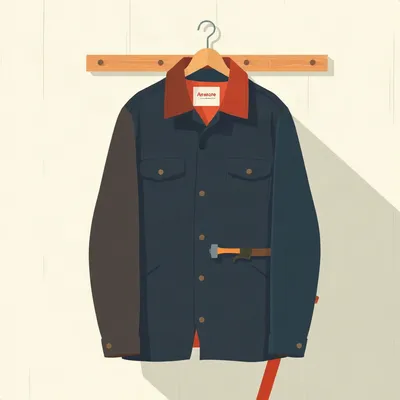
Daniel sent us this one from the middle of his apartment move — and I have to say, this is exactly the kind of question that only occurs to you when you're exhausted, surrounded by boxes, and holding a tool belt in one hand and a pair of scissors in the other.

The "will these scissors stab me through my own gear" moment. I've had that thought. I think everyone who's ever worn a tool belt has had that moment where you look down and realize the thing you're carrying could very easily turn against you.
He's grabbing for box cutters, scissors, measuring tape, all the moving-day essentials, and he picks up this tool belt and thinks: if I forget to close the scissors all the way and they sit point-down in the pouch, is this fabric actually going to stop them? And then the deeper question hits — how is that property even measured? What materials actually resist punctures and cuts, and are they the same materials?
He mentioned glass workers specifically — people for whom cut resistance isn't a nice-to-have, it's the difference between finishing a shift and a trip to the emergency room.
So this isn't just a moving-day curiosity. As DIY culture has exploded and more people are buying tool belts, aprons, cut-resistant gloves for home projects, understanding what "puncture proof" and "cut resistant" actually mean on a spec sheet becomes a real safety question. Not a theoretical one.
The answer is not as simple as "this fabric stops everything." The stuff that stops a scissor tip might not stop a glass shard, and vice versa. The tests are completely different. The materials are different. And most people reading those spec tags don't know which numbers actually matter.
Where do we even start with this? I feel like we need to back all the way up and define terms before we even touch a test standard.
So let's define the two things we're actually talking about here, because they get conflated constantly. Puncture resistance and cut resistance. Mechanically, they're completely different problems.
A scissor tip versus a glass shard.
Exactly the right split. Puncture resistance is about a blunt or semi-sharp object forcing its way through the material — think a scissor point, a nail, a screwdriver tip. The threat is perpendicular. It's trying to push fibers apart, stretch them until they fail, and break through. Cut resistance is a slicing action across the surface — a box cutter drawn along the fabric, a glass shard dragged sideways. The threat is parallel, or at least tangential. And the way a material fails in each case is totally different.
A material that laughs off a razor blade might surrender immediately to a screwdriver.
That's the thing. You can have a rubberized coating that's fantastic at stopping puncture — the probe just can't push through — but draw a sharp blade across it and it opens up like butter. Meanwhile, a tight weave of high-tenacity fibers stops a blade beautifully because the fibers are so hard to cut through, but a pointed probe can just spread those fibers apart and slip between them. The weave works against you.
Can we make that more concrete? Because I think people hear "the weave works against you" and it sounds counterintuitive.
Okay, picture a chain-link fence. If you take a knife and try to slice through one of those steel wires by dragging the blade along it, you're going to be there all day. The steel is hard, the wire is under tension, the blade can't get purchase. That's cut resistance. But now take a screwdriver and push it into one of the gaps in the fence. The wires don't break — they just spread apart. The screwdriver goes right through. That's exactly what happens with a tight weave of high-strength fibers under a sharp puncture load. The fibers themselves are nearly uncuttable, but the probe doesn't need to cut them. It finds the gaps.
The fence analogy actually maps perfectly. The same structure that defeats the slicing attack creates the vulnerability to the piercing attack.
Which means for Daniel's tool belt, we're asking two separate questions. One: if I drop closed scissors point-down into the pouch, does the fabric stop them? That's puncture. Two: if I'm working with glass or a box cutter and something sharp slides across the belt, does it slice open? That's cut. Same belt, two completely different threat profiles.
The way manufacturers answer those questions is not with a guy in a lab coat poking things with scissors.
No, although I'm sure someone has tried that. The real answer is standardized torture tests — specific machines, specific probe geometries, specific speeds. The numbers on the spec sheet come from tests that are, honestly, kind of brutal.
Before we get to which materials actually work, we need to understand how they're tested. Because if you don't know what the test is actually measuring, the number on the tag means nothing.
The two big ones are ASTM F1342 for puncture and ASTM F1790 for cut resistance. And the apparatus for each one tells you everything about why a single material rarely wins both.
Picture a hydraulic press with a steel probe mounted on it. The probe is four and a half millimeters in diameter — about the thickness of a nail — and it's driven straight down into a clamped sample of material at five hundred eight millimeters per minute. That speed is fixed regardless of whether you're testing a thin nylon pouch or a heavy leather tool belt. The machine records the peak force in Newtons required to punch through. That's your puncture resistance number.
The probe tip isn't just one shape.
Right, and this is where spec sheets get sneaky. The standard defines multiple probe geometries. You've got a blunt tip — flat or slightly rounded — designed to simulate something like a screwdriver or a pry bar. Then you've got a sharp tip, much more acute, simulating a needle or a scissor point. Same test, same speed, same clamping, but the numbers you get can be wildly different.
How different are we talking? Give me a sense of the spread.
It's not unusual to see a material post forty or fifty Newtons on a blunt probe and then fail at under ten Newtons on a sharp probe. Same test rig. The only variable is the tip geometry. And ten Newtons is not a lot of force — that's roughly the weight of a one-kilogram mass resting on the tip. A heavy pair of scissors in a pouch could easily exceed that just from the jostling of normal movement.
A manufacturer could test with a blunt probe, get a heroic number, and print "puncture resistant" on the tag — but if you drop closed scissors in there, you're looking at a sharp puncture event, and the fabric might fail at a fraction of that force.
And if the spec sheet doesn't tell you which probe type was used, the number is basically meaningless. You have to ask: resistant to what? A screwdriver or a syringe? The two threats demand totally different material responses.
Which brings us to the other half of Daniel's question — the slicing threat.
ASTM F1790, or its international equivalent ISO 13997. This one is visually very different. Instead of a probe punching down, you've got a straight blade — a fresh, standardized razor edge — drawn across the surface of the material. The test runs multiple passes under increasing loads until the blade cuts through a distance of twenty millimeters. The result is reported as the load, in grams or Newtons, required to achieve that twenty-millimeter cut.
It's not a single strike. It's a progressive failure.
That's the key mechanical difference. Puncture is instantaneous — the probe hits, the fibers either hold or they don't. Cut resistance is cumulative — the blade is working its way through, fiber by fiber. A material that's brilliant at one can be terrible at the other.
Walk me through why. I want to really understand the physics of the failure mode.
Take a tightly woven sheet of high-tenacity fibers — Kevlar, Dyneema, something like that. In a cut test, the blade has to sever each individual fiber, and those fibers are incredibly strong in tension. The blade is essentially trying to cut through thousands of tiny high-strength cables. That's why these fabrics score so well on F1790. But in a puncture test with a sharp probe, the tip isn't cutting fibers — it's wedging between them, spreading the weave apart. The fibers themselves might not break at all. They just get pushed aside.
The weave that stops the blade becomes a liability. The probe finds the gaps.
Now flip it. Take something with a thick rubberized or polyurethane coating. A sharp probe hits that and the material deforms, stretches, absorbs energy — it's like trying to puncture a tire with a nail. High puncture resistance. But draw a blade across that same coated surface? The rubber offers almost no resistance to slicing. It just parts.
If you had to summarize the fundamental tradeoff in one sentence — high-tensile fibers win on cut but lose on puncture because of the gaps, and coatings win on puncture but lose on cut because they can't stop a blade.
That's the entire dilemma in two clauses. And it means for Daniel's tool belt, the nightmare scenario is that it's optimized for one threat and he doesn't know which one. He's got a scissor tip — sharp puncture — sitting in a pouch that was tested with a blunt probe and rated for cut resistance. He's trusting a number that doesn't apply to the threat he's actually facing.
This is the core tradeoff in protective materials. You can engineer for one, or you can layer materials to handle both — but a single homogeneous fabric that excels at both puncture and cut resistance? That's the holy grail, and we're not there yet. Every product on the market is making a compromise. The question is whether the manufacturer is honest about which compromise they made.
Let's talk about the actual materials in the arena. The big three names you'll see on spec sheets are Kevlar, Dyneema, and Spectra. They're not interchangeable, and the differences explain a lot about why some gear costs more and protects differently.
Kevlar I've heard of. The other two sound like off-brand energy drinks.
Dyneema is an ultra-high-molecular-weight polyethylene — UHMWPE. Which is a mouthful, but the properties are remarkable. It's lighter than Kevlar, it floats on water, it's highly UV-stable, and its cut resistance is excellent. The tradeoff: it melts at around one hundred fifty degrees Celsius. So if you're working near heat, Kevlar's your friend — Kevlar doesn't melt, it degrades and chars at much higher temperatures.
Spectra is another UHMWPE fiber, chemically very similar to Dyneema, often used in composite layups. The differences between Spectra and Dyneema are more about the proprietary fiber-spinning processes than the base chemistry. Both give you that lightweight, high-cut-resistance profile. Both share the same melting-point vulnerability.
Kevlar's the heat-tolerant heavyweight, and the UHMWPE family is the lightweight floater that hates fire.
That's the headline. But then we layer on the puncture performance, and the picture gets messier. Kevlar's woven structure — those fibers we talked about that stop a blade beautifully — can be spread apart by a sharp probe. The tip finds the gaps between fibers and pushes through without cutting a single one. Dyneema, in certain tighter weaves, can actually outperform Kevlar on puncture because its fiber structure is more compact. But — and this is the sneaky part — Dyneema has a very low coefficient of friction. The fibers are slippery.
Under a puncture load, the layers can slide against each other instead of holding.
The probe doesn't have to break fibers, it just parts them like a curtain. Kevlar has more surface friction, so the fibers grip each other better under that same load. Neither one is a clean win.
It's almost like the material properties are playing a game of rock-paper-scissors with each other. Kevlar beats heat, Dyneema beats weight, but then the friction coefficient flips the puncture result.
This is why materials science is never just about picking the strongest fiber. It's about the system — the weave, the coating, the friction between layers, the direction of the threat. All of it matters.
Which is why the best tool belts and protective gear don't pick one material. They layer them.
The belt-and-suspenders approach, literally. You'll see a cut-resistant outer layer — often a Dyneema or Kevlar weave — bonded to a puncture-resistant inner layer. That inner layer might be a polyurethane coating, a nitrile rubber laminate, or in high-end gear, an actual stainless steel mesh. The outer weave stops the blade, the inner layer stops the probe. Each material covers the other's weakness.
Daniel's ideal tool belt would have a spec sheet listing both layers.
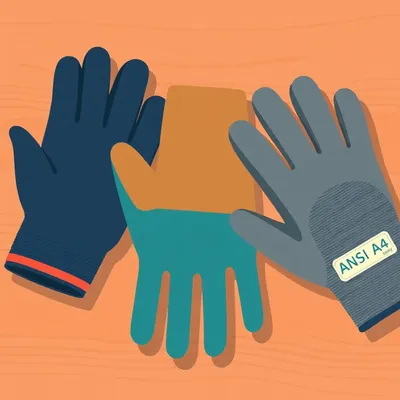
The numbers to match. Let's get concrete about what those numbers actually mean in the real world. For cut resistance, the standard most gear references is ANSI slash ISEA one-oh-five, which defines cut levels from A-one through A-nine. A-one is the lowest — it withstands about two hundred grams of cutting load before the blade gets through. A-nine is the highest, over six thousand grams. That's a thirtyfold difference.
Where do typical products land?
Most consumer tool belts and work aprons sit around A-three to A-five. That's roughly one thousand to twenty-two hundred grams of cut resistance. Fine for incidental contact with a box cutter. But if you're a glass worker handling sharp panes daily, you want A-seven to A-nine sleeves, which are rated above four thousand grams. And even A-nine isn't invincible — a sharp enough edge under enough force will still get through. The test measures the threshold, not invulnerability.
"cut resistant" never means "cut proof.
And the same applies to puncture. A material rated for, say, twenty-five Newtons on a sharp probe doesn't mean a scissor tip can't pierce it — it means the scissor tip needs to deliver more than twenty-five Newtons of force to do so. If you trip and fall onto those scissors, the force spikes well beyond that.
Which brings us back to reading the tag. What should Daniel actually look for? Let's give him a checklist.
Two numbers, minimum. ASTM F1342 puncture data with the probe type clearly stated — if it doesn't say "sharp probe" or specify the geometry, assume it was a blunt test and the real sharp-puncture number is lower. And ASTM F1790 or ANSI cut level. If the product only lists one, the manufacturer optimized for one threat and is hoping you don't ask about the other.
A tag that just says "Kevlar" with no test data is a red flag.
It's a material, not a performance guarantee. Kevlar can be woven loosely or tightly, coated or uncoated, layered or single-ply. The fiber alone doesn't tell you what the finished fabric will do. The spec sheet does.
If we're putting this into shopping advice for Daniel and anyone else staring at a wall of tool belts — what are the actual numbers to look for?
For DIY use — scissors, box cutters, the stuff Daniel's dealing with — I'd want to see a puncture rating of at least twenty Newtons on a sharp probe. That's not invincible, but it means a closed scissor tip resting in the pouch isn't going to push through under its own weight or normal jostling. Below that, and you're one bad lean away from a puncture.
For the glass workers he mentioned?
ANSI cut level A-five or higher. That's around twenty-two hundred grams of cutting load. A-five is the floor for anyone handling sharp panes regularly. Professionals should be looking at A-seven and above, which gets you past four thousand grams. The sleeves glass workers wear aren't just heavy fabric — they're engineered laminates rated for exactly this.
Which leads to the third thing. Layered beats single-material almost every time.
If you see a spec sheet that says Dyneema outer bonded to a polyurethane inner, or Kevlar with a nitrile coating, that's the belt-and-suspenders approach we talked about. Each layer covers the other's blind spot. A single-material pouch that just says "Kevlar" with no coating, no laminate — you're getting cut protection and hoping the weave is tight enough to handle puncture. That's a gamble.
"Kevlar" on the tag with no ASTM numbers at all — that's not a spec sheet, that's marketing.
It's like a food label that says "contains protein." Okay, how much? The fiber name is the starting point, not the conclusion. The test data is the conclusion.
The tool belt question Daniel asked — it's not trivial. It's this perfect little window into how material science either protects you or doesn't, based on whether someone did the testing honestly and whether you know how to read it.
The spec sheet is your friend. Two numbers — puncture and cut, with probe type and test standard clearly stated. If the manufacturer won't give you both, they're telling you something.
The story doesn't end with today's materials. There's work happening right now on composites that might finally crack the puncture-versus-cut dilemma in a single layer.
I've seen murmurs about graphene-infused polymers. Is that real or is that lab-press-release territory?
A bit of both. Graphene's tensile strength is absurd — something like a hundred thirty gigapascals — but the challenge has always been translating that into a fabric that's actually manufacturable. You can make a perfect graphene sheet in a lab the size of a postage stamp. Scaling that to a fabric that can be cut, sewn, and worn is a completely different problem. The more intriguing stuff, to me, is the bio-inspired work. Researchers are looking at pangolin scales — those overlapping keratin plates that are somehow both rigid against puncture and flexible against tearing. The geometry does the work, not just the material.
Instead of layering two different materials, you engineer one material with a structure that handles both threats. The pangolin doesn't have a Kevlar underlayer and a rubber overcoat — it's just keratin, arranged in a way that solves both problems at once.
That's the dream. And beyond that, there's a whole field emerging around smart protective fabrics — textiles with embedded sensors that can detect when the fabric's integrity has been compromised. Imagine a glove that alerts you the moment a cut breaches the outer layer, before you even feel it.
Turning passive protection into active safety. Your glove buzzes and you stop before the glass finds skin.
Which is a fundamentally different philosophy. Instead of just hoping the material holds, the fabric becomes a sentry. That's years out from consumer gear, but the prototypes exist.
For now, the spec sheet is still the sentry. Next time you pick up a tool belt or a pair of cut-resistant gloves, flip it over and read the tag. The numbers tell a story — if the manufacturer bothered to include them.
Now: Hilbert's daily fun fact.
Hilbert: In the late sixteen hundreds, glassmakers in Niger produced translucent cookware from a silica-rich sand that, when fired at specific temperatures, yielded pots with a faint opalescent sheen — an optical property caused by microscopic air bubbles trapped in the glass matrix.
I'll add that to the list of things I didn't know existed. And now I'm wondering about the puncture resistance of seventeenth-century Nigerien glass pots, which is probably a question for another episode.
I'm sure there's an ASTM standard for that somewhere. This has been My Weird Prompts. If you enjoyed this episode, leave us a review wherever you listen — it genuinely helps. Find us at my weird prompts dot com. I'm Herman Poppleberry.
I'm Corn. Read the tag.