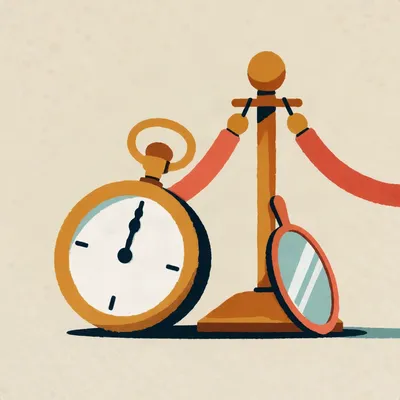
Ten minutes standing still can be half an hour. That's Daniel's opening move this week — same ten minutes, two experiences, and he wants to know why the queue version feels so much longer than the walking version. He also wants the field guide: what airports, theme parks, banks, call centres and buildings with slow lifts have actually done about it. The mirrors by the lifts. The suspiciously long walk to baggage claim. The snaking Disney lines. The hold music. What shortens a wait, what only dresses it up, and whether it's fair that so much effort goes into managing how a wait feels rather than cutting the wait itself.

And it's a good moment for it, because the honest answer is that a wait is not a duration. It's a psychological state. Two people can stand in the same line for the same eight minutes and have completely different experiences of it, and the entire service industry has spent forty years quietly engineering around that fact.
The gap between clock time and felt time is where the whole episode lives. And the first thing to get straight is that waiting isn't one experience — it's at least three mechanisms stacked on top of each other.
That's the frame I'd use. There's the neuroscience of subjective time, which explains why boredom stretches a minute into five. And then there's a completely separate literature — the applied psychology of waiting lines — which starts in the mid-eighties and is basically the service industry's playbook. Different fields, same question.
So which one answers the ten-minutes-walking thing?
The neuroscience, mostly. The walking-versus-queue puzzle is a perception question, not a queue-design question. But the moment you ask why the airport built the hallway that way, you're in the second literature.
And the tension underneath all of it: nearly every famous trick in the playbook — the mirrors, the walks, the music — changes how long the wait feels, not how long it is. And the people who wrote the playbook are completely open about that.
Candid about it, yes. David Maister, who more or less founded this field with an eight-page Harvard Business School note in nineteen eighty-five, says it flat out in the second paragraph: the topic is not how to make the waiting time shorter, but how to make it more acceptable or palatable to the person waiting.
Eight pages. The entire field rests on something the length of a lunch menu.
It's one of the most influential eight pages in service management, honestly. So — mechanism first, then playbook, then the fairness question. Three acts.
Start with the clock in your head. Why does it run fast when you're standing still?
The dominant model is called the attentional gate model, and the intuition is simple once you hear it. You've got an internal clock — think of it as a pacemaker emitting pulses — and a counter that accumulates them. More pulses counted, longer the interval feels. The gate is attention. When you're doing nothing, the gate is wide open, all your attentional resources flow to the clock, loads of pulses get counted, and the interval is judged longer. Give the person something to do and the gate narrows — resources go to the task, the clock gets starved, and time compresses.
So the queue isn't slow. My attention is unemployed and it's taken a job counting seconds.
And boredom is the paradigm case. The boredom literature has this lovely phrase for it, "low non-temporal processing load." Nothing to process, so the resources that would have gone to processing get reallocated to timing, and duration lengthens. The empty queue is the laboratory-grade version of that. Nothing to look at, nothing to do, no information coming in. The clock gets your full attention, which is the worst thing that could happen to you.
There's a cruelty in that phrasing, by the way. They named the state after what's absent.
It's accurate though. And boredom has a second layer that makes queues worse, which is where Marc Wittmann comes in. He's argued for years that we don't perceive time through a dedicated organ. No eyes for time, no ears for time. We perceive it through the sense of self. His line is that when we feel ourselves particularly intensively — in states of boredom, while waiting for something to happen — time stretches. And conversely, when we're focused on external information, we lose self-awareness and the passage of time accelerates.
Wait. Say the middle part again. The mechanism is the self?
The body, really. When there's nothing outside to attend to, your attention turns inward — you become aware of your body, your breathing, your feet hurting, and the body is effectively how you sense duration. Boredom makes you feel yourself existing, and existing is slow.
Standing in a queue is an hour-long encounter with the fact that you have a body.
That's the queue. And now run the walking case through all three levers. Walking is externally focused — the street, the route. It's goal-directed — you can see the destination getting closer, which is its own reward signal arriving the whole time. It's proprioceptively rich — your body is doing something, which paradoxically takes attention off the self because the movement is automatic. Walking is self-forgetting. The queue is self-confronting. Every lever points the same direction.
And it explains something the distraction story doesn't. A slow walk still feels fast. If the trick were speed, dawdling should feel like queuing. It doesn't, because the mechanism isn't speed — it's outward focus plus visible progress.
Right. There's a third lever, though, and it's the one people underestimate — arousal. Heightened arousal raises the pacemaker rate itself. The clock doesn't just get more attention, it ticks faster. Emotionally intense or threatening intervals feel prolonged. Which is why the anxious waits — hospitals, a delayed flight when you have a connection, waiting for a call with results — stretch beyond their clock time even when you're occupied.
So the anxious queue is the worst of both. Wide-open gate because there's nothing to do, and a pacemaker running hot because you're frightened.
All three levers at once, yes. And notice that two different people in the same line can be in different regimes — the bored one has the gate open, the anxious one has the gate open and the pacemaker fast. Same eight minutes, different experience. That's why the walking-versus-queue framing, though it's Daniel's cleanest example, is really the mild end of a spectrum.
Before we get to the people who exploit this — how solid is the model itself? Pacemakers, pulses, gates. It sounds like a metaphor wearing a lab coat.
Reasonable challenge. It's a functional model — the pulses aren't literally located anywhere agreed upon, and the neural version is still being argued about. But it predicts a lot: distraction shortens judged durations, boredom lengthens them, arousal lengthens them, and the effects combine roughly the way the model says. Zakay and Block formalized the attentional version in the mid-nineties, building on Church's animal timing work from eighty-four, and it's held up as the working model for thirty years. Nobody thinks it's the last word.
A model that predicts and survives. I'll take it over certainty.
Which takes us to nineteen eighty-five, because Maister read the room before the neuroscience matured. He opens his essay with a FedEx advertisement — "Waiting is frustrating, demoralizing, agonizing, aggravating, annoying, time consuming and incredibly expensive" — and then goes straight at the perception question. He proposed eight propositions, and he was careful to call them testable propositions, drawn from experience rather than experiment. Which is more honesty than the field's inheritors always preserve.
Give me the eight.
Unoccupied time feels longer than occupied time. Pre-process waits feel longer than in-process waits — people want to feel started. Anxiety makes waits seem longer. Uncertain waits are longer than known, finite waits. Unexplained waits are longer than explained ones. Unfair waits are longer than equitable ones. The more valuable the service, the longer the customer will wait. And solo waits feel longer than group waits.
Number four is the one every call centre violates by reflex. "Your call is important to us" is the absence of a number.
It's the most information-free sentence in commerce. Maister also gave us what he called his First Law of Service: satisfaction equals perception minus expectation. And he stresses, in his own text — both terms "are psychological phenomena. They are not the reality."
He put the disclaimer inside the equation.
Which is either very honest or very cynical depending on the reader. The Second Law is "it's hard to plan catch-up ball" — the early stages of an encounter dominate the overall judgment, so a wait that starts badly poisons everything after it.
Corn's own contribution to the law: the wait before the service is the service. You're already having the experience while you stand there. The encounter began when you joined the line.
That's actually consistent with the memory data — Carmon and Kahneman found that memories of a queuing experience are strongly influenced by the final moments, but the early stages color the whole read. A long wait that ends well gets remembered positively. A short one that ends badly gets remembered with cynicism.
The ending is doing disproportionate work. So a competent final sixty seconds is the cheapest goodwill in the building.
That's the psychology. Now here's what the people who make you wait have done with it.
Mirrors first. I want the mirrors.
The canonical story — Maister credits some earlier work for it, an unnamed hotel group getting complaints about elevator waits. They analysed how elevator service might be improved, and the recommendation that got implemented was: put mirrors near where guests waited. People's tendency to check their personal appearance substantially reduced complaints, although the actual wait was unchanged.
Zero elevators were improved in the making of that fix.
Richard Larson — MIT, the other giant of this field — tells it the same way. And I want to flag the caveat properly, because this story is everywhere: the hotel is unnamed, the wait time never changed, and nobody has ever run a controlled test of it. It's a case study from nineteen seventy-nine that got repeated into lore.
A mirror is a content generator, though. That's why I half believe it despite the paperwork. It's the one distraction that never runs out — you check, you re-check, you fix something. Forty seconds of employment.
The mechanism is plausible even if the evidence is anecdotal — it's the attentional gate, closed by vanity. The Houston airport story is the bigger one, because there the arithmetic is on record. Baggage claim complaints. The airport's first move was the obvious one — add handlers. Average wait fell to eight minutes, well within industry benchmarks.
And the complaints kept coming.
Kept coming. Someone finally studied what passengers were actually doing: one minute walking from the gate to the carousel, seven minutes standing there. Roughly eighty-eight percent of the passenger's time was unoccupied standing. The fix they shipped — instead of reducing wait times, the airport moved the arrival gates away from the main terminal and routed bags to the outermost carousel. Passengers now walked six times longer to reach their bags.
Total time went up.
Total elapsed time went up. Complaints dropped to near zero.
They solved the complaint by spending the passenger's legs instead of the airport's money.
That's the uncomfortable reading, and I think it's the correct one. They'd already proved they could shorten the wait — they hired the handlers and it worked and it didn't help. Then they chose the option that costs the airport nothing and costs the passenger minutes. Occupied time feels shorter, so make the walking longer. Maister's first proposition, executed at tarmac scale.
It's elegant, and I mean that as an accusation.
Well, before we get too deep into all that, we have a call from Corn's mother. Dorothy, you're on the line.
Hello dear, it's your mother, it's Dorothy's Kitchen. I thought we'd do buttered toast today, sweetheart. Two slices of bread, a good knob of butter, and that is all. That's the whole list.
Dorothy, it's Herman — wonderful to have you. Two slices. Go on.
Now the method. You put the bread in the toaster and you watch it, dear. You watch it the whole time. The bread will not tell you it's burning, it just goes quietly and then it's too late.
Mum runs a zero-tolerance unoccupied-time policy.
The butter, now. The butter can turn on you. Too cold and it tears the toast, too warm and it's a puddle. I've had it happen, I'd rather not say how, we don't talk about that.
Temperature window on the butter — noted. That's the part everyone gets wrong.
So you butter it the moment it comes up, and you don't answer the telephone, and you don't go looking for the good knife. Timing is everything, dear, it really is.
She says the same about the telephone every time, and she's right every time.
Anyway. Eat it while it's hot and put a plate under it, I don't want crumbs in the good chair. Give my love to your brother. Bye bye, sweetheart.
Back to the airport, because there's one more move in the playbook I want on the table — the serpentine queue. The single snaking line that feeds whichever counter opens next. One design writer called it probably the most significant design improvement the humble queue has ever received, and the interesting part is what it's for. It's not speed. A bank of parallel queues moves people at nearly the same rate.
It's fairness.
Strictly first-come-first-served. Nobody who arrived after you can possibly be served before you, because there's only one line. The serpentine queue is a justice device disguised as a throughput device. Whole Foods pioneered it among grocers and went as far as employing line managers. American Airlines, British Airways and Wendy's have all been credited with inventing it, which tells you how valuable it was — everyone wanted the patent story.
And the parallel-queue alternative — the supermarket model — has that particular misery where your line stalls and the one beside you surges.
There's research on exactly that asymmetry. In a multi-queue system, customers almost always fixate on the line they're losing to and rarely the one they're beating. And the surveys go further — many people say they'd wait twice as long for fast food from a single first-come-first-served queue than from multiple queues. Twice as long, voluntarily, for fairness.
People will pay in time for justice. That's not a perception trick — that's the opposite. That's people telling you what they actually value, and it isn't minutes.
Which is Larson's whole argument, and he earned the right to it. In his eighty-seven paper he wrote that attitudes to queues may be influenced more strongly by other factors than duration, and that customers may become infuriated by social injustice, defined as violation of first in, first out. He has a term for violations — slips and skips. His theorem number one: for every slip there's a skip, but it's not a zero-sum game psychologically. The person who skipped may not even be aware of it, but the anger and dismay of the victim of the slip can get up to a point of violence. Queue rage, he calls it.
He witnessed this personally, didn't he.
He lived it. A department store, sometime in the eighties. He waited about thirty-five minutes to collect a bicycle while later arrivals collected waffle irons and coffee makers in minutes. Separate counters, separate stock. He returned the bike unopened the following Saturday. Decades later, interviewed about queue design, he said he was still angry about it and had made a lifetime pledge never to patronize that store again.
Thirty-five minutes for a bicycle and the grudge is still under warranty.
And here's the detail that makes it more than an anecdote: a study of fans queuing for U2 tickets found people are just as upset by slips and skips occurring behind them — behind them, Corn, which don't lengthen their wait by one second — as by those in front. The anger isn't about your time. It's about the order of the world.
That kills the economic reading entirely. Nothing happened to you and you're furious.
Which reframes the whole playbook for me. The serpentine line works not because it closes the attentional gate but because it's legitimate. People can stand in a long line without distress if the line is fair and they know how long it is. Disney does the opposite in places — the Imagineers use queue chunking, wrapping the line around corners and walls so you can't see its true extent, and at Space Mountain they wall the queue off entirely so riders can't see how far they have to go. That works off Carmon and Kahneman's finding that we care more about how long a line looks than how fast it's moving — given a slow short line versus a fast long one, we often pick the short one even when the waits are identical.
Hiding the length of the line from the person standing in it. I want to see the internal memo where that got signed off as guest experience.
Disney also runs the inflated sign — deliberately overestimating the posted wait. Larson calls it a pure Machiavellian point of genius, admiringly. The sign says an hour, it's really about forty-five minutes, and you spend the whole line feeling fifteen minutes ahead of schedule.
Maister's equation, weaponised. Satisfaction equals perception minus expectation — so manufacture the expectation.
Engineered pleasant surprise. And it's the one perception trick I find hard to condemn, because the surprise is pleasant and the alternative — an accurate sign — makes the same wait feel worse. Where I get off the train is the labour end of it. Dan Ariely tells the story of locksmiths who deliberately take longer to pick a lock than the job needs. If a locksmith opens your door in seconds, you feel cheated by the fee, or you doubt the lock was ever secure. Visible effort raises perceived value, so the effort gets staged.
Corn's locksmith would be run out of business by an honest one. Unless the honest one can't get customers, because everyone feels robbed by competence.
That's the trap, yes. There's a critique building in the literature that this drifts into deception when artificial delays actively waste the customer's actual time — and the pandemic gave it a name borrowed from elsewhere, hygiene theater, visible effort staged for comfort rather than effect. VIP and priority queues get the same treatment: institutional violations of first-come-first-served, sometimes deliberately hidden from the regular customers so the violation stays invisible.
The hidden priority queue is the slip you're not allowed to see. Larson's rage, managed with a curtain.
Now — hold music, because the empirical record there is the messiest and most interesting part of this whole field. Maister was sceptical in eighty-five, before anyone measured it. The familiar Muzak, he wrote, is to many people an added annoyance rather than a benefit, largely because listening to music is totally unrelated to the service activity to come. His design rule for filler: it should offer benefit in and of itself, and be related in some way to the service encounter that's coming.
Both halves. Muzak fails both.
His best example is a sports team that played last week's game highlights to callers on hold — one caller was so engrossed he asked to be put back in the queue to hear the end. Since then the measurements came in, and they disagree. One call-centre study found longer announcements produced significantly shorter perceived hold times, while music choice improved satisfaction but didn't reduce the estimated duration at all. Another field study found music increased estimation error unless the callers chose the music themselves. A UK bank study found both music and wait-time updates reduced overestimation. And there's a Dutch study of a couple of hundred callers that found hold music made waits feel about seven percent shorter.
Seven percent. Hold music buys the company seven percent of your patience and they deploy it like infrastructure.
The stakes are real though — about half of callers placed on hold hang up before being answered, and of those only half ever call back. Half your abandoned customers are gone for good, over the experience of the wait. Meanwhile the boring intervention — telling people how long the wait is — reduces estimation error in study after study. Larson ran a version of this at a Bank of Boston branch back in the early nineties, a few hundred customers filmed: an electronic news board versus a plain clock telling each customer how long the wait would be. The clock did the work. The news board was the mirror; the clock was the truth.
Let me press on the other side, because we've been accepting the playbook's own scorecard. Has anyone actually tested the Disney-style stuff in the field?
Someone did, and the result is the best thing in this literature. A researcher named Ellen Daniels measured a hundred and twenty guests at Walt Disney World's Magic Kingdom over one full day — this would be 2015 data, published a couple of years later. She tested the themed, immersive, so-called suspended-reality queue design, the elaborately staged lines the Imagineers are famous for. No significant effect on perceived wait once she corrected for multiple comparisons. The scenery did nothing.
Nothing. The most expensive queue design on earth.
What did predict longer perceived waits was later time of day. Fatigue and crowding beat scenery. There's a companion finding — Jones and Hwang at Surrey, four hundred and fifty-five customers, found perceived waits exceeded actual ones but with no correlation to the service context at all. It doesn't seem to matter what kind of queue you're in. Being tired in it matters a great deal.
So the evening in the themed line is worse than the afternoon in the corridor. The Imagineers spent millions fighting the attentional gate and lost to bedtime.
Don Norman's read on all this is that the failure is attention, not trickery — there are places that invest heavily in this, like theme parks, but elsewhere he's surprised by the lack of it. His suspicion is that buildings get enormous design attention on interiors and almost none on how people actually move and wait inside them. Larson has his own version — he complains about a drugstore chain he uses where staff are added only when the line crosses some threshold, no floor markings, no stanchions. His word for it is accordion. A multibillion-dollar chain that won't spend on line design.
Which is my question back to you, Corn, because you keep defending the truth-telling option. If telling people the wait is twenty minutes makes the wait feel like twenty minutes, and a mirror makes it feel like ten — isn't the mirror the kinder choice?
It's the kinder choice once. The clock is the kinder choice every week. The mirror man still gets to the till after twenty minutes; the clock man left and came back at the right time, or reordered his day. Truth converts the wait into information, and information is the one thing you can spend elsewhere.
And there's the control finding — the study where music only helped when the callers chose it themselves. That's not about the music. That's about the choosing. Control and justice keep showing up as the real variables, more than minutes.
One more piece of housekeeping, since we're dismantling the field's furniture: the famous figure that people overestimate waits by about thirty-six percent — always credited to Larson — turns out Jones and Hwang trace it back to a nineteen eighty-four paper by Hornik instead. And nobody in the chain gives the original sample or the method.
Thirty-six percent, passed around for forty years like a family heirloom nobody can find the receipt for.
The overestimate itself is solid — people do report waits longer than they were, in most settings. The precise number is folklore with a footnote.

It was forty-five pounds, Herman, not fifty. The brass one.
Forty-five.
The clock above my door. I put it up in the late eighties, after a man who delivered photographic chemicals to the house had been left standing on my step more than once while I was in the cellar. He never complained, which is how I knew it was bad. Complaining takes energy; standing there quietly takes resentment.
So you bought a clock for the visitor.
A ship's bell clock, small, brass, mounted above the front door at an angle so a person standing on the step can see the face. That part took the time — I tested the angle with a spirit level and a piece of string from the centre of the doorstep before I drilled anything. A clock a person can't read is a decoration, and decorations don't answer questions. The idea was that if he could see how long he'd been there, the waiting would be governed, and governed waiting is a different animal. He seemed easier after it went up. He started bringing the invoices in a flat portfolio instead of loose.
The ship's bell version strikes the half-hour. Has anyone on your step ever heard it?
No, and I'll say that's the one disappointment of the arrangement. It strikes on the half-hour and I have never once heard it strike with somebody out there, because I always answer before then. I keep a notebook by the door as well — time they arrived, time I opened the door, been doing it since. Corn said earlier that people overestimate their waits. Not on my step they don't. My notebook has the numbers, and the numbers say most of my visitors were outside for under a minute and believed it was less.
Under a minute, and remembered as less.
The man with the chemicals, his name was Pearson. He moved to Whitby in about nineteen eighty-nine and I never found out whether the new address had a step you could see the clock from. That matters more than people think.
Hilbert runs the only doorstep in Jerusalem with an official timekeeping record.
Pearson under a minute and rated less — that lines up with the Jones and Hwang direction more than the folklore figure, honestly. Under a minute, occupied by the bell clock, primed to expect a short wait. Every lever in the queue's favor.
Cutting-room floor before we wrap. There's a number in the research I couldn't fit anywhere and it recontextualises the whole field: Americans spend on the order of thirty-seven billion hours a year waiting in line.
Billion. With a b.
Billion. Whole civilisations have existed for fewer hours. And the supermarket till alone generates around five and a half billion dollars of impulse buying annually, much of it from people standing captive at the checkout. The wait isn't a cost to the people who own it. Sometimes it's the revenue.
That's the fact I'd want every listener to sit with. The queue is a product.
So the open question I'd leave with Daniel: if the famous tricks are thinner than their confidence — unnamed hotels, null results at Disney, hold-music studies that contradict each other — why do they persist? My guess is they're cheap, visible and plausible, and they flatter the designer. Meanwhile the boring interventions — the real number on the sign, the single fair queue, the clock — keep winning the studies and keep losing the budget.
And the next decade decides it. Virtual queues and restaurant apps are already replacing the perception playbook with actual wait reduction — your phone tells you when the table's ready and you go somewhere else entirely. Or the wait just moves somewhere you can't see it, which would be the Houston airport trick at software scale.
Stone's closing line in the essay that made this field famous is still the best advice in it: we'll never eliminate lines altogether, but understanding the psychology of waiting can make the delays a touch more bearable. And when all else fails, bring a book. An occupied minute is a short one, even at gate thirty-four.
Thanks as always to our producer, Hilbert Flumingtop, at the desk. If you want more of this, try episode ninety-one, The Story Behind the Show; and episode eleven, How Does Fine Tuning Work Anyway. This has been My Weird Prompts — no question too obscure, no rabbit hole too deep. If you've got a spare minute today, a review on Spotify helps other people find the show.
We'll be back soon. See you then.