Two hundred and fifty tech insiders consulted on a sitcom by its third season. Six programmers, a startup lawyer and a chief technology officer, all working for a fictional compression company that never existed.

And the showrunners pitched that fictional company to real venture capitalists, who took the meeting seriously. That's the world we're in today.
Daniel sent us a prompt about a show he calls one of his favourites, HBO's Silicon Valley. He works in startups and tech himself, found it hilarious and, in his words, definitely plausible, and he wants the story underneath it. Who made it, how the characters were built, how much was lifted from real people, and how the actual industry took being laughed at by its own consultants.
And it's a good week for it, because Alec Berg gave an interview a few days ago where he said the show couldn't be made now, which is a whole other conversation.
Let's start with the fact that HBO never actually asked for a show about Silicon Valley.
Right — the premise of the show is that it's the show HBO didn't commission. They went to Mike Judge wanting a series about gamers, with Scott Rudin attached, and Judge basically said, I don't know the gaming world, but I worked as an engineer in Silicon Valley, let's do that instead. One meeting, pivot, and the whole thing exists because the creator admitted ignorance on one subject and claimed expertise on another.
Which is the most honest pitch meeting in television history.
It really might be. And the expertise was real, which is the part people skip. Judge graduated UC San Diego as a physics major, programmed electronic test systems for the F-18 fighter jet, then moved to Sunnyvale in nineteen eighty-seven as a test engineer at a startup. That's the material that became Office Space, twenty years before this show. So when HBO came calling, he wasn't a tourist. Amanda Crew, who played Monica, put it well: Mike's not just sharing an observation about a world he doesn't understand. He gets it.
He'd also been circling it for years before that. He told Deadline he'd thought about doing something about a tech billionaire, a Paul Allen type, back before the dotcom burst — but as a movie.
And the format itself came from John Altschuler, his King of the Hill collaborator. Altschuler's suggestion was something like Falcon Crest, but instead of wine and oil money, it would be tech money. Which sounds like a joke until you watch the show and realise it's a soap opera. Gavin and Richard are feuding families. The venture capital is the estate.
Six seasons, fifty-three episodes, April twenty fourteen to December twenty nineteen. Five consecutive Emmy nominations for Outstanding Comedy Series. And behind it, three creators — Mike Judge, John Altschuler, Dave Krinsky — plus a fourth man who arrived late and rebuilt the thing.
Alec Berg. He came in about a year before the premiere, when Judge was struggling with the pilot and wanted a second opinion. And here's what I love about his diagnosis — it wasn't about jokes at all. The pilot had a scene where Richard tries to buy a car he can't afford. Berg looked at that and said, no. This is not a guy who's materialistic. He's an artist.
A comedy script doctor whose first note is about the protagonist's soul.
That note reshaped everything. Berg took over the writers' room, became showrunner, and rewrote the pilot's opening. The original opening went out; what came in was a wild-but-lame party featuring Kid Rock, thrown by founders who'd just cashed out. The whole point of that scene is the contrast — Richard the ascetic engineer versus a culture obsessed with exits and three-comma fortunes. You can't have the satire until you establish what's worth less than the algorithm.
Berg's own summary of the series is the best one-liner anyone's produced about it: it was about how Richard had discovered fire, and was trying to keep it safe from all of these assholes.
Which is why the show never dated the way you'd expect a tech satire to date. The technology changes every season, but the premise is old. Fire, and men who want it.
So let's do the characters, because this is where Daniel's question gets interesting. How much of these people is real.
The honest answer is: less one-to-one than the internet believes, and more real than the show ever admitted. Start with Richard himself. Wired did the deepest mapping, and their conclusion is that Richard is one of the few characters whose persona is mostly derived not from a single person, but an entire cadre — their phrase is the on-the-spectrum Valley Boys who code their way to soylent and mana. Zuckerberg and Gates get what Wired called a sizable slice of the personality pie.
They also argue the Wozniak is strong in him.
They do, and the show feeds it deliberately. First episode, Richard says, Jobs was a poser. He didn't even write code. That's a Wozniak sentiment wearing a Hendricks hoodie.
Judge wrote the part with Thomas Middleditch in mind, by the way. Middleditch still had to audition like everybody else.
Which tells you something about Judge's priorities. His stated rule was that the cast be believable, highly intelligent, not just goofy caricatures. And Middleditch, when asked how he prepared to play fifteen years of relentless tech-industry social isolation, said all he did was suffer about fifteen years of relentless bullying. Pretty standard.
Casting by résumé.
Erlich Bachman is the character with the messiest provenance, because there are two competing claims and the show has confirmed neither. T.J. Miller said Erlich was based on the founder of Way.com, who had pestered Miller to be a spokesperson for his company. Miller's description is unprintable in half, but the printable half is: an arrogant blowhard with no coding skills, a fairly good salesman, who smoked marijuana a lot.
The other claim?
The Hustle did months of digging and identified Dave Grossblatt, owner of Founder's Dojo — a free incubator in downtown San Francisco that's given space to over two hundred early-stage founders since two thousand seven. Grossblatt's own description of his Dojo regulars is pure Erlich: talented non-conformist computer dudes on the verge of homelessness, vacillating between genius and madness.
An incubator owner describing his tenants as on the verge of homelessness. That's the most honest marketing copy in San Francisco.
Neither man has been confirmed by Judge or Berg, and honestly the twofer makes sense. Erlich is a type, and the type is everywhere — the guy who bought the house, hosted the hackers, and considers that a career.
Peter Gregory.
The consensus mapping is Peter Thiel, mostly because of the drop-out-of-college evangelism — Gregory funds a fellowship that pays students to leave university, which is a real Thiel programme almost beat for beat. But here's the wrinkle: Judge said the resemblance wasn't deliberate. He only noticed it after seeing footage of Thiel. And Wired floated Paul Graham as the model and then largely rejected it — their reasoning is that unlike Thiel, Graham actually believes in college, and he's not a member of the three-comma club.
So the show accidentally wrote Thiel twice.
Or Thiel is simply the fully realised version of a character the Valley already mass-produces.
Gavin Belson is the big one. Who's in him?
Everyone. Wired gives the largest pie portion to Marc Benioff — the meditation militancy, the promotional video about his vision for Hooli while saving children in Africa. BuzzFeed's Jonah Peretti said Belson was clearly patterned on Benioff. Then Larry Ellison supplies the litigiousness, and Sergey Brin and Larry Page are, in Wired's words, in sum the ultimate influence — Brin getting extra credit for the five-finger shoes.
And then there's the scene where the composite stops being a composite.
The Tom Perkins scene. Perkins, the venture capital cofounder, wrote a Wall Street Journal op-ed comparing the treatment of tech billionaires to Jews in Nazi Germany — a real op-ed, actually published, in the paper of record of American business. In the show, Belson recites the argument almost verbatim and then adds the punchline the real man presumably believed: one could argue that billionaires are actually treated worse, and we didn't even do anything wrong.
The writers' room contribution there was restraint. He had already written the joke himself.
They knew it, too — that scene works because they barely touch it. And the same thing happened with Russ Hanneman, except this time the source material was a bad meeting. The writers had conceived a sinister investor they called Bad Money. Mark Cuban, a Judge fan, invited them to the Shark Tank set — and kept them waiting an hour.
An hour.
Berg's account of walking out: we were supposed to have an audience with the king, and then he fucks us around for an hour. We were like, you know what? That motherfucker is Bad Money. So three-comma Russ was born, signature boast included — I put radio on the internet, which is Cuban's Broadcast.com sale to Yahoo, almost as a biography.
A fictional character built out of a grudge over scheduling.
Berg is at pains to say he bears no ill will to Cuban, and that he's not sure Cuban even knew they were there. Which is somehow worse.
Gilfoyle, Dinesh and Jared — my recollection is there's no confirmed model for any of the three.
Correct, and it's a genuine gap rather than a finding. The Wired mapping treats them as archetypes, and the creators have never publicly named individuals for them. Which, if you think about it, is the show's quiet thesis — the founders and billionaires get single sources because the industry insists on personalities, while the actual workers are types, because that's how the industry treats them too.
The characters are built. Now the part Daniel really wants — the research operation, because this is where the show stops being a sitcom.
Judge's preparation was hands-on. He toured Google's Mountain View campus with a Google programmer, visited a startup in SoMa, toured two LA incubators, and interviewed Eric Schmidt and Marc Andreessen personally. On the Google tour he counted the room — sixty engineers, maybe two were women — and that observation fed directly into the show's gender storyline, because the writers decided the honest thing was to depict the imbalance rather than fix it in casting.
One number, and a season of scripts out of it.
That's reported sitcom-making. And the technical backbone was Jonathan Dotan, a web entrepreneur and investor who became an associate producer on the show. Dotan assembled a team of six programmers, a designer, a startup lawyer and a chief technology officer — and here's the part I find staggering — he pitched Pied Piper's technology and business plan to real venture capitalists in Silicon Valley and Los Angeles.
To see if the fictional company would get funded.
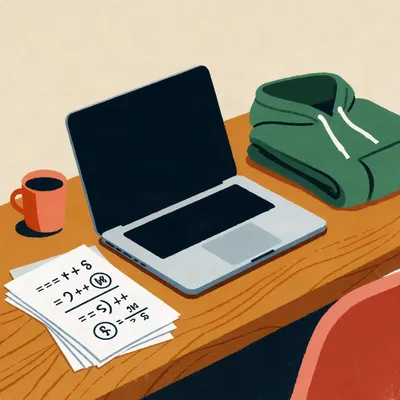
Real VCs, real pitch meetings, a company that did not exist. And the Stanford compression expert Tsachy Weissman consulted on the algorithm with his graduate student, Vinith Misra, who was twenty-seven at the time. Misra wrote actual mathematical formulas for the show — real equations, checked by a Stanford lab — to set up what Judge calls the most complicated and sophisticated joke about the male anatomy ever told.
The Disrupt finale. Mean jerk time.
The mean jerk time, dick-to-floor ratio sequence. Fully derived, mathematically sound, presented at a fake startup competition. Misra's own comment was that the kind of detail they were looking for was a little shocking. This is a man who went to Stanford to do information theory and spent his evenings optimising a joke about the male anatomy.
A rigorous field.
And it spilled out of the show. They invented the Weissman score as a fictional compression-efficiency metric — named after the real consultant — and Berg says computer scientists now actually use it. They put a fake unit into the literature.
Which, to be fair, is more than most real metrics achieve.

Hilbert's Mid-Show Haiku. Autumn frost stiffens the lawn. A founder ships code alone. The investors stay home.
The loneliest term sheet ever written.
And Disrupt itself entered the show by accident, which is my favourite detail in the whole research story. As they wrote season one, a Silicon Valley source mentioned that a crew like Pied Piper's would be angling for a Disrupt slot. The writers had never heard the words. Their reaction was, I've never heard those words before, but that sounds hilarious. What is that? They learned it was a kind of American Idol for startups, and it became the spine of season one.
The plot engine was a typo in someone else's calendar.
Better — the recreation was so accurate that when Michael Arrington visited the Culver City soundstage for his cameo in December twenty thirteen, he said he felt like he was walking into the conference he'd created. Dead on, he called it. Real startup CEOs who'd competed at Disrupt played themselves. Kara Swisher ad-libbed her lines.
Which raises the question of where you go for consultants after that.
You go to the top. Dick Costolo. The outgoing Twitter CEO, who left in June twenty fifteen — three days before the season two finale aired, the one where Richard gets fired by his own board. Costolo had breakfast with Kara Swisher, who offered to introduce him to Judge and Berg. At lunch in LA the two of them admitted they'd written themselves into a corner, and Berg said something wonderful: we just need someone who knows how these companies work, not someone who actually ran one of them.
So they hired the man who ran one of them.
Despite being overqualified, he got the job. And his routine was insane — every Monday for three and a half months he flew San Francisco to LA, took a car to Culver City, and spent Monday and Tuesday in a room with Berg, Judge and ten writers. He'd tell them a detail about something he'd observed, and they'd get this sparkle in their eye and say, that really happens?
Ten comedy writers treating a former Fortune-five-hundred CEO as a wonder cabinet.
His best anecdote is from a story-arc debate. Mike asked the room, didn't they face a problem like this in the Twitter book? What did they decide? And someone had to point out, Mike, one of the people from that book is in the room. Let's just ask him what happened.
Costolo's own summary was that it was interesting going from the CEO to the least experienced guy in the room.
By season three they'd consulted over two hundred and fifty tech insiders. And the writer Dan Lyons — the former Valleywag editor behind the Fake Steve Jobs persona — gave the whole operation its epitaph: the writers in that room are much more like journalists. We don't really have to make anything up. All we have to do is present what we see.
Which is either a compliment to the writers or an indictment of the industry, and it's both.
The blurring ran both directions, too. Kara Swisher, Eric Schmidt, Sheryl Sandberg, Evan Spiegel, Walt Mossberg, the Winklevoss twins — all of them have IMDb credits as themselves on the show. Meanwhile Big Head and Erlich, fictional characters, have real Crunchbase and LinkedIn profiles. The show's cast list and its subject's personnel files converged from both ends.
So the satire was built by the satirised. How did the satirised actually take it?
The split was immediate and personal. Marc Andreessen loves it. Elon Musk hates it. But it seems everyone in Silicon Valley had an opinion — that was the USA Today roundup within days of the premiere. Andreessen tweeted the day after launch a disclaimer that all the quotes he was tweeting that day were from Mike Judge's TV show and not from his own mouth, and Judge replied, so glad you liked it. Which is possibly the most Silicon Valley exchange ever conducted.
A venture capitalist clarifying that the obscene things he said were someone else's words, verbatim, from memory.
That's the telling part — he knew them well enough to quote. Musk's objections, meanwhile, were specific and, in their way, careful. At the Redwood City premiere he said it was like watching a bizarro version of your own reality. He also said he really felt Mike Judge had never been to Burning Man, which is Silicon Valley — if you haven't been, you just don't get it. And that most startups are a soap opera, but not that kind of soap opera, and none of those characters were software engineers.
His complaint was casting accuracy. Not the satire — the production values.
That's the second-order point, and it's the one I think is worth pausing on. The two poles of the reaction are both about authenticity, not offence. Nobody said it was cruel. Musk said it was inaccurate — no Burning Man, no real engineers. The enthusiasts said it was true — Wilson Sonsini's Selwyn Goldberg said it was no more unreal than real life there, that since the last bubble it's been complete insanity. Evan Spiegel reportedly called it basically a documentary. Both camps are arguing about fidelity, which means both camps conceded the premise.
The compliment Berg treasures most, though, is the nausea one.
Tech workers telling him they couldn't watch the show because it makes me nauseous. That's the review he holds above everything. And Costolo explained why the Valley mostly loved a show that mocked the Valley: a lot of people telling themselves, with varying levels of accuracy, they're satirizing those annoying tech people, not me.
With varying levels of accuracy doing all the load-bearing work in that sentence.
Every consultant in a co-working space in San Francisco decided the joke was about the desk next to his. And Berg's read on premiere night was equally dry — nobody would tell him to his face if they didn't like it. This is a pretty passive-aggressive place, he said. But I don't think they were lying when they were laughing.
And the show's own consultants said reality was worse than the scripts.
Roger McNamee, the venture capitalist, said real startups go through all of it you see on the show, as well as even crazier stuff — that if anything, the writers might have to leave out true things in order to seem more realistic. The satire had a realism ceiling imposed by credibility. Sam Biddle at Valleywag wrote that until the show, no one had adequately embarrassed Silicon Valley on TV — every prior attempt either embarrassed itself or fell just short — and called it the graceful slap across the face the industry deserved.
A graceful slap across the face. The industry framed the review and hung it in the lobby.
Which takes us to where the entire business lands now. The twenty nineteen finale — Pied Piper's AI turns out to be too dangerous to release, the team sabotages the launch and quietly walks away, and nobody ever tells the world why.
That ending was read at the time as a downbeat joke about responsibility.
Berg now says it reads as fantasy. Because in twenty twenty-six nobody walks away. His words from the interview a few days ago: it's just gotten fucking dark. I don't think the kind of fun that we had with it is doable now, in this era. And on a reboot: both of those shows were created in an era where it's, like, can you imagine if what was actually going on behind closed doors was this? And now it's not behind closed doors anymore.
The comedic premise wasn't that the Valley was absurd. It was that the absurdity was hidden.
Strip the secrecy and you don't have a sitcom — you have coverage. The show worked because there was a gap between what the industry said about itself and what happened in the building. Close the gap and the joke has nowhere to live.
That's the part everyone gets backwards about that show, by the way.
Backwards how?
The Weissman score. Herman said scientists use it now, like that's a cute footnote. It's not a footnote, it's the lot in miniature. A made-up number becomes a real number the moment enough people decide to use it. I watched that happen with my modem ratings.
Your modem ratings.
Early nineties, I had twenty-one modems on a shelf and no way to compare them, so I built a score. Throughput, warmth of the transformer, whether the LEDs said anything true. Wrote it all out on graph paper, one column per modem. I showed it to a man at a computer fair in San Jose and he asked if I was pitching a company.
Were you.
I took the meeting. Rented a blazer. Sat across from a fellow who listened to nine minutes on compression ratios and said the idea was not disruptive enough. Not wrong, mind. Not badly priced. I went home and fed the neighbour's goat, which I'd agreed to look after in exchange for their parking space, and thought about it for a while.
The goat was part of the arrangement?
The parking space was the arrangement, the goat came with the house. You'd know about arrangements like that, Herman, you've been breaking your own setups on this show for years. Anyway. The fellow who passed on my score went under in ninety-four, and the graph paper outlived him, and I've checked the math on that jerk-time scene and it holds up, which is more than I can say for most of what got funded that decade. The people who did the real work in that Valley — the ones soldering, the ones who knew what the transformer sounded like when it was honest — they were the only ones worth a damn then. Still are.
Graph paper survived the venture capital cycle.
The detail I can't get over is that he was nine minutes into compression ratios before the verdict.
Nine minutes is generous by that decade's standards. The misconception to kill before we go: the one everyone has is that Silicon Valley was Mike Judge's idea — that HBO commissioned a tech satire and he delivered it.
Backwards. HBO wanted a show about gamers, Scott Rudin attached. Judge said he didn't know that world, but he'd been an engineer in the Valley, and the whole series pivoted from that one admission. The second cousin of that misconception is that the characters are one-to-one portraits — most are composites, and the creators have never named models for Gilfoyle, Dinesh or Jared. And the third is that the industry hated it. The reaction was split between too real and not real enough, and both sides were arguments about accuracy. Nobody argued about the mockery.
Open question to leave you with: if the show's premise depended on the absurdity being behind closed doors, and it's all in the open now — what does the twenty twenty-six version even look like? A comedy with no discovery left in it, or something worse: a show that's already been made, and it's the news?
My money's on a drama. CBS already has one in the works about a Valley lawyer. The satire got cancelled by reality outbidding it.
Producer credit, as ever, to Hilbert Flumingtop, who has been at that desk the entire time and will deny the graph paper exists. If you enjoyed this one, try episode ninety-one, The Story Behind the Show; episode twelve, The AI Breakthrough; and episode thirteen, AI. This has been My Weird Prompts — if today's episode earned it, leave us a review wherever you get your podcasts. See you tomorrow.