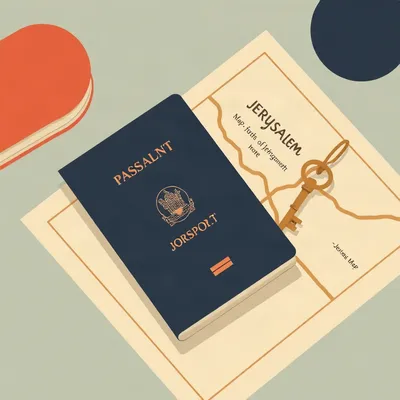
What does it actually mean for a city to be part of a country for nineteen years and still feel temporary? Daniel's question this week is about East Jerusalem between forty-eight and sixty-seven, when it sat on the Jordanian side of a border that ran through the middle of a city. He wants to know how that small territory functioned within Jordan during those years, whether it was integrating into a contiguous state or always had a provisional, transitory feel, and how deep the institutional and community ties had actually become by the time the border fell in June sixty-seven. So we went looking for what actually happened, and the answer is stranger than either option he offered.

The legal answer is that it was fully integrated. Jordan annexed the West Bank including East Jerusalem in April nineteen fifty, after the Jericho Conference where pro-Hashemite notables requested it. Full citizenship came with the nineteen fifty-four Nationality Law, which covered non-Jewish former Palestinian nationals residing in the kingdom. That is unlike every other Arab state hosting Palestinian refugees. They got passports, parliamentary representation, courts, currency, civil service appointments. On paper, East Jerusalem was Jordan.
And on the ground, Jordan was deliberately keeping it small.
That is the tension. Menachem Klein's work on this is blunt. He writes that the Hashemite regime consistently worked to strengthen Amman's political and economic status while keeping Jerusalem underdeveloped, fearing the rise of Palestinian national aspirations there. In nineteen fifty, Jordan began transferring central government departments out of Jerusalem to Amman. Local leaders protested. Klein says it was to no avail.
So the city that had been the administrative center of Mandate Palestine got demoted to a provincial town, and the people who lived there knew exactly what was happening. I want to pause on that for a second, because it's easy to say "they moved the government offices" and move on. But think about what that means in practice. Jerusalem under the Mandate had been the seat of the High Commissioner, the courts, the land registry, the education department. If you needed a document, a permit, a ruling, you went to Jerusalem. After nineteen fifty, you went to Amman. That's not just an administrative inconvenience. It's a message about where the center of gravity now sits, and who matters in the new arrangement. It's the difference between living in a capital and living in a satellite, and people feel that in their bones. Think about what it's like to live in a city where the institutions that govern your life are suddenly somewhere else. It's not just that you have to travel further. It's that your city stops being the place where decisions are made about your city. You become the object of someone else's administration rather than a participant in your own governance.
The comparative data makes it vivid. Jordanian Jerusalem's municipality was six and a half square kilometers with about sixty thousand people in nineteen sixty-one, and a budget of three point six million Israeli lira. Israeli Jerusalem across the line was thirty-eight square kilometers, about two hundred thousand people by sixty-five, with a sixty million lira budget. Per capita government expenditure was under a hundred and eight lira on the Jordanian side versus three seventy on the Israeli side.
That is not a gap. That is a policy.
Fifty-nine percent of Jordanian Jerusalem households lacked running water. Thirty percent lacked electricity. Three quarters had no refrigerator. Nine bank branches and three cinemas in the whole eastern half of the city. The Israeli side had fifty-eight banks and fourteen cinemas. Klein pulled these figures from Israeli surveys done in sixty-seven and sixty-eight, so there is an angle to be aware of, but the order of magnitude is not really in dispute.
Three cinemas. I keep coming back to that number. A city of sixty thousand people with three cinemas. That's not just underdevelopment, that's a statement about what kind of city this was supposed to be. Cinemas are where a city talks to itself, where the modern world gets projected onto a screen. Three of them means the regime wasn't interested in East Jerusalem having that kind of public life. It's like the difference between a town that has a library and a town that doesn't. A library says this is a place where people think, where ideas circulate, where civic life happens beyond the market and the mosque. Three cinemas says the same thing in the negative. This is a place where public life is supposed to be minimal, controlled, contained.
And yet Jordan called East Jerusalem its spiritual capital. It invested in tourism, religious sites, the airport at Qalandia. Six hundred thousand tourists in nineteen sixty-six, a hundred seventy-five thousand from Western countries. So the city was good enough to be a holy destination and not good enough to have running water for most of its residents.
That's the part that feels almost theatrical. You build an airport and a tourism industry for the pilgrims, but you don't lay water pipes for the people who live there. The city was a stage set for the Hashemite claim to Islamic legitimacy, and the actual residents were, what, extras? And I want to push on that, because it's not just a metaphor. Think about what a tourism economy does to a city. It creates jobs that are seasonal, low-wage, service-oriented. It creates infrastructure that serves visitors rather than residents. An airport brings people in and out, but it doesn't lay a single pipe to a single home. A hotel needs water, so the hotels get water, and the neighborhood next to the hotel doesn't. That's a very specific kind of development, and it tells you exactly who the city was being built for.
Klein makes the comparison directly. Both sides attached higher symbolic status to their half of Jerusalem than the city actually had. But where Jordan continued to present Jerusalem just as a holy city, Israel built its side into a national center. The symbolism was real on both sides. The investment followed on only one.
And the demographic engineering is the part that gets less attention. Jordan didn't just underfund Jerusalem. It changed who lived there.
The old Jerusalem elite, the established families with their clan networks and their property, had opposed annexation. So the regime encouraged pro-Hashemite Hebronites to move in. By sixty-seven, only about twenty-six thousand of roughly seventy thousand residents were original Jerusalemites. Sixty-seven percent of Old City residents came from Hebron. Ninety-five percent of Abu Tor.
Ninety-five percent of one neighborhood from a single city. That is not migration. That is replacement. And I want to understand the mechanism here. How do you encourage someone from Hebron to move to Jerusalem? What's the incentive structure?
It was access to state institutions and state-adjacent employment. The waqf, the Sharia courts, the Bureau of Commerce, the city council. These were positions with salaries and status, and they were distributed through patronage networks that favored Hebronites who had demonstrated loyalty to the regime. Hebronites came to dominate all of these institutions. Of eight Jerusalem district governors under Jordan, only one, Anwar Nusseibeh, was from the local elite. Hebronite ownership of East Jerusalem businesses rose from thirty-six percent in nineteen fifty to nearly forty-one percent by nineteen sixty. Meanwhile educated Jerusalemites were leaving for Amman, because the opportunities were drying up.
So the integration was real in the sense that the institutions were Jordanian, but the city itself was being hollowed out and repopulated with people loyal to the regime. That is a very specific kind of integration. It's almost like a corporate takeover. You keep the brand name, you keep the address, but you replace the staff with people who report to the new management. And the old staff either leaves or gets sidelined. The city keeps being called Jerusalem, but the people who made it Jerusalem are gone or going.
It is integration by substitution. The legal frame says one thing. The demographic record says another. And the identity question sits underneath both.
Before we get to identity, I want to sit with the physical reality for a moment, because the border itself was almost absurd. This was not a planned division. It was two officers with a wax pencil.
Moshe Dayan and Abdullah al-Tal drew the cease-fire line on a map in Musrara on the thirtieth of November nineteen forty-eight. Seven kilometers through the middle of a city. The thickness of their pencil lines created an accidental no-man's-land sixty to eighty meters wide. It stranded about a hundred and twenty-five homes and fifty-five fortified positions.
A cartographic error with military fortifications in it. And I want to really dwell on the wax pencil detail, because it matters. These were grease pencils, the kind you use to mark glass or acetate. They're not precision instruments. The line they drew was maybe a millimeter wide, and when you scale that millimeter up to the actual city, it becomes a zone of sixty to eighty meters. That's a whole street width. That's houses, shops, gardens, all of it suddenly in no-man's-land because two exhausted officers drew a line on a map in a hurry. Imagine your house being in that millimeter. Imagine your street being in that millimeter. The line didn't run between houses. It ran through them. People woke up one morning and their front door was in one country and their back garden was in another. That's not a border. That's an accident with consequences.
The only crossing was the Mandelbaum Gate, named for a Jewish family whose house stood there. It was restricted mainly to diplomats, UN staff, clergy, humanitarian convoys. Families separated by the line could see each other and not reach each other. The line cut through Musrara, Mamilla, Abu Tor, Beit Safafa was split in two, al-Walaja. A city that had always folded into itself became two separate urban realities pressed against each other but forbidden from touching. That phrasing is from Jerusalem Story, a photo essay published this June.
So when we ask whether East Jerusalem felt transitory within Jordan, part of the answer is that the entire city felt transitory, because the border was a wound that never closed. You lived next to a wall you could see but not cross. That shapes daily life in a way that no amount of citizenship paperwork can override. And I think we underrate how much of identity is spatial. You can have a passport that says Jordanian, but if your daily life is defined by a line you cannot cross, by a neighborhood you can see but not enter, by a family member you can wave to but not embrace, then the passport is a piece of paper and the line is the real thing. The line is what you feel.
And yet the scholarly record pushes back on the idea that East Jerusalem was just a stagnant backwater of loss and waiting. Haneen Naamneh's doctoral work at LSE frames Arab Jerusalem as a state of in-betweenness, a frontier city of refugees located at the border with its lost homeland. But she argues the municipality was a refugee-institution that lost its town hall in West Jerusalem in forty-eight and still actively built the city alongside residents, refugees, professional unions, local capital. Palestinians reclaimed their right to the city under Jordanian rule.
So the city was building itself even while Jordan was underbuilding it. And I think this is where the story gets interesting, because it would be easy to tell this as a simple tragedy. Jordan neglects the city, the people suffer, the end. But Naamneh is pointing at something else. The municipality kept functioning as a social institution even after it lost its physical home. That's not passivity. That's agency under constraint. It's like a family that loses its house in a fire and still manages to keep the family together, still manages to celebrate the holidays and raise the children and maintain the traditions. The house is gone, but the family isn't. The town hall was gone, but the municipality wasn't.
The municipality lost its physical town hall and its resources in the western half, and it kept functioning as a social institution. Jordan appointed the first post-war municipal council in November forty-eight, renewing a self-rule Jerusalem had lacked under the late Mandate. There was infrastructure work, tourism development, cultural production. Naamneh's point is that Palestinian identity was not suspended in forty-eight and frozen until the national movement revived in the mid-sixties. People were imagining, thinking, producing, struggling for the future the whole time.
Which complicates the clean story of Jordanian neglect. The regime neglected the city, but the city did not neglect itself. And that's a crucial distinction, because it means the story isn't just about what Jordan did to Jerusalem. It's also about what Jerusalem did despite Jordan. The municipality was building roads and promoting tourism and participating in regional conferences. The residents were opening businesses and publishing newspapers and sending their children to school. There was a whole civic life happening in the shadow of the neglect. That's not a city waiting for history to happen to it. That's a city making history happen.
And then there is the education system, which is where the loyalty project gets tested. Mustafa Abbasi studied this directly. Jordan used schools to build loyalty to the Hashemite regime, comprehensive changes to study programs and textbooks, the whole apparatus of Jordanization. The term Palestine was banned from official documents in May nineteen fifty. The curriculum promoted the unified kingdom as a little Arab homeland.
And it failed.
Abbasi's conclusion is that these efforts failed and Palestinian identity was preserved and even strengthened. You cannot overwrite identity through textbooks when the students live in a city cut in half, surrounded by refugees, with a border running through their neighborhood. The material conditions contradicted the pedagogy.
I want to unpack that failure, because it's not obvious why it failed. Jordan had the schools, the textbooks, the teachers, the curriculum. That's usually a pretty effective apparatus for shaping identity. Why didn't it work?
Because the students were living in a city that contradicted the textbook at every turn. The textbook said you are Jordanian, part of a united kingdom, but the border cut through their neighborhoods and they could see the other half of their own city across a line they couldn't cross. The textbook said the kingdom is your homeland, but their families were refugees from places that were now in Israel. The textbook said Amman is the center, but Amman was where the jobs were going while Jerusalem was left to decay. You can't teach away that kind of daily experience. A child can memorize a textbook, but they can also look out the window. And the window was telling a different story.
That's the thing about identity. It's not just what you're taught. It's what you live. You can teach a child that they're Jordanian, but if they grow up in a city cut in half, with a family history of displacement, with a neighborhood that used to be something else, then the lesson doesn't stick. The lesson bounces off. The lived experience is too strong.
The political limits showed up earlier than that. King Abdullah the First was assassinated in Jerusalem in nineteen fifty-one by a Palestinian nationalist. That is a fairly direct signal that annexation was not universally popular.
Then the nineteen fifty-five to fifty-seven unrest in the West Bank made Jerusalem a focal point of demonstrations. Jordan crushed them and imposed martial law in the city. In nineteen fifty-seven Amman appointed a new mayor who stayed until sixty-seven. So the political integration had a ceiling, and the ceiling was enforced.
The assassination of Abdullah is worth sitting with for a moment. He was killed at the Al-Aqsa Mosque, in the heart of the city he had annexed. The assassin was a Palestinian who saw the annexation as a betrayal of the Palestinian cause. So the man who brought East Jerusalem into Jordan was killed by someone from that very city who rejected the whole project. That's not a footnote. That's the entire tension of this period in one event.
And the response was not to reconsider the project. It was to double down on control. The martial law, the appointed mayors, the patronage networks. The regime understood that East Jerusalem was not loyal, and it responded by trying to make it loyal through force and favor. That's what integration by substitution really means. It's the logic of a government that knows it hasn't won hearts and minds, so it settles for controlling bodies and paychecks. You don't need people to love you if you can make them dependent on you. But dependence isn't loyalty, and the nineteen fifty-one assassination proved it. The man who pulled the trigger wasn't an outsider. He was from the city. He was from the very population Jordan was trying to absorb.
So by the time the border fell in June sixty-seven, what had Jordan actually built in East Jerusalem? Full legal integration, real institutional presence, a deliberately underdeveloped economy, a transformed population, and a local identity that had survived every attempt to overwrite it. That is not integration in any simple sense. That is a city held in tension.
The annexation was permanent in Jordanian law until nineteen eighty-eight. There was no legal provisionality. The transitory feel came from Palestinian identity and the frontier status of the city, not from any Jordanian legal framework that said this was temporary. That is the misconception worth naming. East Jerusalem was not a provisional territory within Jordan. It was a fully annexed province that was treated as a periphery and whose people never stopped being Palestinian.
When Israel captured it, the reunification was not clean either. The Green Line's logic endured after the barriers came down. Jerusalem Story argues the seam persisted as invisible structural separation in infrastructure, planning, and development disparities. Later it re-materialized as the Separation Wall. So the border drawn in wax pencil in nineteen forty-eight is still shaping the city.
The infrastructure gap from the Jordanian period did not disappear in sixty-seven. It became the baseline for the eastern half of the city. The planning disparities, the development lag, the different municipal systems, all of that carried forward. The wall later made physical again what the pencil line had created. And that's the part that feels almost eerie. The border was erased in a weekend of fighting, but the effects of the border were so deeply embedded that they couldn't be erased at all. You can take down the physical barrier, but you can't take down the decades of differential investment, the different legal systems, the different administrative histories. Those things don't disappear when the line does. They just become invisible.
Daniel's question about whether East Jerusalem was well integrated or always temporary, the answer is that it was both, and the tension between the two is the actual story. The institutions said Jordan. The identity said Palestine. The economy said periphery. The border said nowhere.
The people who lived there built a city anyway. That is the part that gets lost in the geopolitical framing. Naamneh documents the municipality participating in an Arab Town Organization conference in Kuwait weeks before the occupation. They were planning for the future of the city right up until the border fell.
Which makes you wonder what it was actually like to live in a city cut in half, to see your other half across a line you could not cross. To have the whole thing be an accident of two officers and a wax pencil.

The Mandelbaum Gate was the only crossing. I processed permits for it in the early seventies, working as a junior clerk at a British travel agency. I never went through it myself. But I handled hundreds of transit permits for pilgrims and journalists, and the paperwork told the story.
What did the permits actually say?
They were forms. Name, nationality, purpose of travel, duration. The categories were diplomats, UN staff, clergy, humanitarian convoys. If you were a family member separated by the line, you needed a special pass, and those were hard. People could stand at the crossing and see their relatives on the other side. The gate itself was named for a Jewish family's house that stood there, the Mandelbaum house. The border ran through a family home. That is the whole division in one detail.
The physical experience of the border is what the legal analysis misses. You can have full citizenship and still live in a city where the other half is a wall you cannot cross. The transitory feel was not just about Jordanian policy. It was about the daily fact of the line.
The agency files showed a spike in bookings in June sixty-seven. Pilgrims, journalists, people trying to get in before something happened. Then it stopped. The gate became irrelevant overnight. I kept one of the old transit permit forms. It is in a drawer somewhere.
A border that fell in a weekend, and its logic never went away.
The permit form is a relic of a specific moment. The border it documents stopped existing in June sixty-seven, but the separation it enforced is still there in the infrastructure, the planning, the disparities. The wall is just the most recent materialization.
The forms stopped being used. The drawer stayed full.
The Green Line was drawn in wax pencil by two military officers in a matter of minutes. Sixty years later, its logic still shapes the city. That is the thing I keep coming back to. A line that took minutes to draw has taken generations to erase, and it still isn't erased. It just changed form. The wall is the pencil line made concrete. The infrastructure gap is the pencil line made economic. The administrative divisions are the pencil line made bureaucratic. The line didn't go away. It just went underground.
The question Daniel asked, whether East Jerusalem was well integrated or always temporary, the answer is that integration and transitoriness were not opposites. They coexisted. The city was legally Jordanian and experientially Palestinian, economically peripheral and symbolically central. That tension did not resolve in sixty-seven. It transformed.
If Jordan's annexation was permanent in law until nineteen eighty-eight, and yet the city always felt provisional, what does that say about the limits of state-building in contested territory?
It says institutions can be real and still not produce belonging. Citizenship can be granted and still not be claimed. A state can build schools and courts and currency and still fail to build a people. The in-betweenness Naamneh describes in forty-eight to sixty-seven East Jerusalem is arguably the same condition that defines East Jerusalem today. Permanent residents who repudiate the state's legitimacy.
The nineteen sixty-seven reunification did not end the frontier logic. It just moved it inside the city. And that's the uncomfortable conclusion, isn't it? You can change borders, you can change regimes, you can change the legal status of a city. But the underlying condition, the in-betweenness, the sense of being caught between two claims and belonging fully to neither, that persists. It persisted under Jordan, it persisted under Israel, and it persists now. The wax pencil line was the beginning of something that still hasn't ended.
That is the open question we are left with. The border was an accident of pencil thickness. The separation it created was real. The reunification was supposed to erase it. Instead it became structural.
Thanks to Hilbert Flumingtop for producing, and for the transit permit in a drawer that says more than most of the scholarship.
This has been My Weird Prompts. If you want to send us a question like Daniel did, email us at show at my weird prompts dot com.
We'll be back soon.