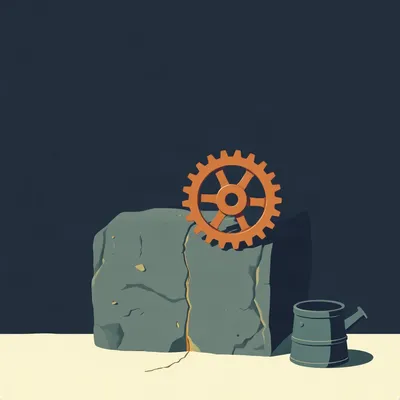
The familiar story says humanity invented farming, built cities, and kept climbing until somebody put a computer in the refrigerator. Hannah wants to know why that climb actually took so long, and when it suddenly became a sprint. Because the awkward part is that ancient people already had astonishing machines. Having clever engineers plainly wasn't enough.

The refrigerator wasn't the missing breakthrough.
Mine has not advanced civilization. We've usually approached technology from Daniel's side, looking at particular tools and what they can do. Hannah is pulling the camera back. Discoveries like Göbekli Tepe complicate the tidy agriculture first story, while Rome, Egypt, and the Islamic Golden Age complicate the idea that earlier societies were waiting for intelligence to arrive.
I'm Herman Poppleberry, and the date I'd put near the center of this is around seventeen sixty, in Britain. Not because everything changed that afternoon. Steam, coal, factories, scientific knowledge, and investment gradually began reinforcing each other. Electricity and computers came later, accelerating a process already underway.
The part that bothers me is what kept it underway. We have sophisticated societies lasting centuries without each generation expecting its grandchildren to inhabit another technological universe. Now we're asking whether our grandchildren will need jobs. Or whether they'll spend their leisure arguing with the refrigerator.
Ancient engineering makes that question harder, in a useful way. Rome had water powered production and enormous mining operations. The Greeks built an astronomical calculating device with intricate gearing. These weren't societies short of ingenuity.
Yet ingenuity arrived in islands. A mill complex here, an extraordinary instrument there. The usual ladder picture makes those look like early versions of us, all heading in the same direction. I doubt the people commissioning them thought they were working toward a laptop.
No, and they weren't guaranteed to get there. An alternative picture is a threshold. Improvements become cheap enough, reproducible enough, and profitable enough to generate further improvements. Better tools make better tools. More power helps obtain more power. Useful knowledge circulates beyond the workshop that produced it.
You're about to fall in love with a diagram containing arrows.
Only if the arrows explain something. You prefer a civilization that gives you six hundred years to finish a book.
I prefer knowing whether the arrow can afford coal.
That's a perfectly serious objection. Calling something a feedback loop doesn't tell us what pays for it, or who maintains it. We need energy, skills, markets, and reasons to replace the existing method. Those things don't automatically arrive together.
There's another awkwardness. We can have a vastly more capable industrial civilization and still struggle to recover exactly how someone made a particular ancient object. Roman concrete and the Antikythera mechanism are examples. Lost workshop knowledge doesn't return just because our computers are faster.
Although we should distinguish reproducing a function from reconstructing the historical method. We can calculate eclipses more accurately than the mechanism. We can make excellent concrete. Recovering the original recipe, tooling, and sequence of decisions is a different task.
History has misplaced the instruction leaflet.
Sometimes the whole supplier network. What looks like one artifact may depend on apprenticeships, specialist materials, and techniques nobody thought worth writing down. Corn, do you think losing that knowledge means progress is mostly an illusion?
No. It means progress has a selection policy. We preserve what people keep paying to do. Everything else can become archaeology, including something that worked beautifully.
That makes the beginning worth examining carefully. Göbekli Tepe was inhabited roughly between ninety-five hundred and eight thousand BC, before pottery became part of that local material culture. Its monumental stone enclosures are sitting on a rocky height, without clear evidence that cultivated agriculture was supporting the original project.
People organizing that much stonework before clear farming evidence rather spoils the textbook order. Grow grain, acquire surplus, hire somebody to make religion architectural. Apparently the committee could meet earlier.
The older interpretation leaned toward a sanctuary visited by mobile groups. Evidence discussed since twenty nineteen includes domestic buildings, extensive cereal processing, and water provision. That supports people actually living there. Processing cereals doesn't, by itself, establish that they cultivated domesticated crops.
They could gather wild grain, settle for substantial periods, and build things together without crossing every boundary in our definition of agriculture. That's the trap with the tidy sequence. We turn overlapping changes into separate boxes, then act surprised when a site occupies several.
Settlement could encourage cultivation, cultivation could support settlement, and ceremonial gatherings could encourage both. I'm not sure we'll ever get a universal ordering, because there may never have been one.
Civilization has declined to follow the syllabus.
Karahan Tepe, about forty-six kilometers east, adds another complication. Some proposed dates place occupation around ten thousand to ninety-five hundred BC. Claims that it is the earliest village need care, but it belongs to a broader landscape of early settlements and monumental construction.
Rather than one inexplicable hill.
The Taş Tepeler group contains roughly a dozen sites. At Göbekli Tepe, only about a tenth had been excavated as of twenty twenty-one. Geophysical work suggested at least twenty large enclosures. We're making interpretations while most of the place remains underground.
A tenth of a site is a bold foundation for a universal human itinerary. Still, none of this means agriculture was unimportant. Feeding dense populations, supporting specialists, storing food, taxing it... those are enormous changes. It means elaborate cooperation wasn't waiting for the first proper wheat field.
Egypt demonstrates the same distinction from another direction. Quarrying, surveying, moving stone, organizing food and labor, keeping construction aligned across years. Those are technological capabilities, even when the impressive part isn't a little mechanism on a museum plinth.
People say we couldn't build the pyramids today. We could. Getting a modern project to use precisely the ancient tools, workforce arrangements, and delivery schedule is a much stranger commission.
Ancient achievement doesn't require modern helplessness to remain impressive. Take Roman concrete. It was in use by roughly a hundred and fifty BC. The Pantheon's dome remains the largest unreinforced concrete dome. Its survival is an engineering accomplishment, not evidence that modern structural engineering went backward.
We do occasionally construct things whose chief historical achievement is opening late.
Roman volcanic ash mattered, but the little lumps of lime also matter. Work published in twenty twenty-three showed how lime rich inclusions can help seal cracks. Water enters, material dissolves and moves, and calcium compounds precipitate in the gap.
The lumps once dismissed as poor mixing could be doing useful work. I enjoy that. Somewhere an ancient contractor is finally winning a dispute.
Ordinary modern Portland cement concrete doesn't automatically have that same behavior. Although modern concrete can exhibit some self healing, and engineered self healing materials exist. Saying the Romans had magic concrete and we have forgotten concrete would be wrong.
They had a durable material for particular uses, with a manufacturing practice we needed to understand. That's enough. We don't have to pretend a Roman bridge could pass every modern motorway specification.
The Antikythera mechanism is an even sharper reconstruction problem. Built in the second century BC, recovered from a shipwreck in nineteen oh one, it contains surviving evidence of dozens of bronze gears. Reconstructions commonly involve thirty or more.
All hand cut. A fairly decisive answer to the claim that ancient people couldn't manage precision.
It modeled astronomical cycles, predicted eclipses, and included the four year cycle associated with the ancient games. Comparable surviving geared complexity doesn't reappear until medieval clockmaking. With a complete surviving machine, every intermediate tooth count would be straightforward to recover.
Complete being the expensive word there. We have damaged remains, missing pieces, inscriptions, and clever interpretations. A reconstruction can work without proving that's precisely what the original maker built.
Yes. Well... even complete, workmanship can make measurement awkward. The missing evidence is the much larger obstacle here.

Has your civilization plateaued? Listen to satisfied customer Mr. Edwin Parch, who writes, Dear Larry, before purchasing the Domestic Industrial Revolution, my household remained trapped in an organic energy economy. My wife would ask for toast and I would point to the sun. Within minutes of installing your patented Surplus Pillar, we had achieved urban settlement, an astronomical calendar, and a small but vigorous export sector in damp bronze. Edwin continues, or Edmund, as his family now calls him, the first evening our kitchen crossed the critical threshold, our coal scuttle developed useful knowledge independently and hired three apprentices. We haven't looked back, partly because the rear of the house is now a water powered factory. Your neighbors will marvel as your breakfast nook enters the Second Industrial Revolution while theirs remains dependent on seasonal tubers. Every kit includes one ceremonial enclosure, a wage pressure dial, and a self repairing crack, supplied separately from the wall. Order the family model and receive enough shadow acres to conceal an embarrassing conservatory. Mrs. Parch says it's the closest they've felt since the invention of settled life. Mr. Parch says she has never existed, but that is how successful the productivity gains have been.
Does the ceremonial enclosure come in a smaller size?
Corn, a smaller enclosure will not industrialize the kitchen. The Islamic Golden Age gives us actual examples of sophisticated devices embedded in sophisticated societies, without needing that outcome.
The Banu Musa brothers' Book of Ingenious Devices describes about a hundred mechanisms. Valves, fluid control, automatic behavior. That interests me more than the familiar hunt for somebody who invented a modern thing early.
Their work also included an effort to measure Earth's circumference using a measured ground distance and a change in stellar altitude. The important capability is coordinating geometry, observation, and field measurement. Knowledge doing practical work.
Al-Jazari's water clocks, pumps, and automata belong in that picture too. He died in twelve oh six, which helps stop us compressing all preindustrial engineering into one vaguely ancient afternoon.
His machines combine clever mechanisms with skilled manufacture. People call him a father of robotics, though I find that title less useful than looking at what his devices actually controlled. Flow, timing, motion, repeated actions. The craft was real.
No need to award him a startup.
Nor draw a straight line from one inventor to factories centuries later. Transmission matters, but industrialization required more than possessing ingenious mechanisms. Roman Barbegal had a substantial complex of water mills. Hydraulic mining moved water and rock on a huge scale.
Greek steam devices existed too, but an ingenious spinning demonstration doesn't supply an efficient engine, a boiler industry, and a customer who can afford the fuel. Ancient mass production of standardized goods also doesn't mean factories were about to acquire machine tools.
Corn, if you'd owned an ancient mill, would you have spent your profits developing an entirely new power source?
I'd first have bought another waterwheel. Known machinery, a customer for the flour, somebody nearby who can repair it. Developing a temperamental boiler would be a rather elaborate way to stop selling bread.
That answer gets us closer than saying people lacked imagination. Investment follows available opportunities. Land based energy from food, fodder, and wood put limits on expansion. Cheap coerced labor could also weaken particular incentives to mechanize, though slavery alone cannot explain the whole ancient economy.
There were wages, markets, inventions, and regional differences. Treating every ancient worker as free muscle for a rich man would flatten the evidence as badly as the ladder story.
A new, unreviewed preprint by Kriger calls industrial takeoff a critical transition. It describes an innovation reproduction number, rho. Above one, improvements generate enough further improvements for the process to sustain itself. Below it, exceptional projects can flourish without transforming the whole economy.
I like that as a question to ask. I'm less persuaded that giving history a Greek letter means we've measured it.
We haven't. It's a proposed model, not an established meter you can attach to Rome. Its useful suggestion is that energy returns, incentives to automate, and the production of useful knowledge must connect. A missing connection can prevent impressive local achievements from spreading.
Britain then gives us a place where those connections did strengthen. Around seventeen sixty is the conventional starting marker, not the date somebody invented change. By roughly eighteen forty, mechanized production was spreading through parts of Europe and the United States.
Water power remained important alongside steam. Textile machinery, machine tools, factories, transport, and mining interacted. The factory system also changed supervision, timing, and the organization of labor. A machine in an otherwise unchanged workshop wouldn't explain the transformation.
The worker got a new clock before he got leisure.
Often a much harsher relationship with it. Rising productive capacity and immediate improvements in ordinary life aren't the same event. Those benefits arrived unevenly, through wages, public health, infrastructure, and political fights as well as inventions.
Coal seems like the most convincing break to me. You're no longer asking this year's plants to provide most of the extra work. You can dig up stored energy. That doesn't tell us why Britain rather than every coalfield, but it explains how expansion escapes one old limit.
Wrigley's question was why industrialization didn't quickly end, not merely why it began. His answer emphasizes the move from organic to mineral energy. More output had previously competed for land with food, timber, and fodder. Coal loosened that constraint dramatically.
Steam then helps pump mines, mines supply fuel, and workshops improve engines. An actual sequence that feeds itself, rather than an arrow labeled progress.
Your coal arrow has been approved.
Provisionally. Show me the maintenance bill.
The rival emphasis is high wages and cheap energy. On that account, Britain offered a particularly attractive payoff for machinery that substituted fuel and capital for labor. An expensive invention can make economic sense in one place and fail to pay somewhere else.
Even when the engineers elsewhere understand it perfectly. That's important. We tell invention stories as if the person who had the idea has already done the difficult part. The machine also needs enough customers whose existing method is expensive.
Would you accept a slightly worse automatic system if it cost much less to operate?
For sorting gravel, probably. For prescribing medicine, no. And if the cheaper system requires me to become its unpaid supervisor, I would like that labor included in your calculation, Herman.
You have noticed my approach to installing household software.
Your automation keeps creating vacancies for me.
Some of those vacancies are temporary. Your point holds, though. Labor saving is a claim to test across the whole process, not just at the impressive step. Industrial machinery needed reliable inputs, repairs, training, and coordination.
Useful knowledge is the remaining candidate. Not just knowing a principle, but making it available to the person with a practical problem. Drawings, publications, skilled workers moving between shops, people comparing results.
The industrial enlightenment explanation emphasizes that culture of useful inquiry and circulation. A failure in one workshop can become information for another. Experiments connect to production. That helps explain why improvements might accumulate rather than die with one exceptional craftsperson.
None of these explanations cleanly eliminates the others. Cheap energy without machinery doesn't do much. High wages without capital don't purchase an engine. Circulating knowledge without a practical market can produce very interesting correspondence.
The disagreement over their relative weight remains real. Geography and global connections also matter. The Great Divergence argument places a major break around eighteen hundred, with northwest Europe pulling ahead of advanced regions of China and India.
Coal plus access to overseas land and products. The phrase shadow acres means land elsewhere supplying things your own economy would otherwise need to grow. Cotton and other imports affect how much domestic land has to carry.
Those connections included colonial coercion and slavery, alongside trade. Leaving that out would give us a falsely self contained Britain. Leaving out technical and commercial changes would give us a different incomplete story.
Several explanations can be necessary without all being sufficient. The phase transition idea is helpful there. I'm not prepared to announce which gate opened first across every industry.
Neither am I. The later acceleration adds more interacting systems. The Second Industrial Revolution is conventionally placed between eighteen seventy and nineteen fourteen. Electricity, chemicals, steel, and new production methods expand what industry can do.
Computers arrive much later. They accelerate design, communication, calculation, and control. They didn't initiate the escape from an agricultural energy budget. A spreadsheet cannot pull a plow unless something supplies power to the motor.
Electricity also changes the arrangement of production. You can distribute power differently, then redesign machinery and buildings around it. That takes time. The productivity gain comes partly from reorganizing the work, not merely replacing a power source.
That makes me suspicious of forecasts where installing AI immediately produces a different economy. People still have contracts, habits, responsibilities, and machinery that won't be replaced on the model release schedule.
AI's current visibility rests on long groundwork, as we discussed when we talked about AI not being an overnight success. The sudden public experience can conceal decades of underlying development. Corn, what would convince you the next five years had changed work, rather than merely its software?
Shorter queues for actual services. Less time spent repeating information. Products designed and manufactured more cheaply without becoming disposable rubbish. I'd also count whether workers can complete a day without a second shift correcting automated mistakes.
That's a much better set of tests than how many organizations announce adoption. My five year expectation is more uneven deployment of AI in existing workflows, rather than a uniform replacement of occupations. I'm making a judgment there, not citing a reliable countdown to general intelligence.
We don't have a dependable numerical AI timeline to offer Hannah. Precise dates would make this sound more scientific while adding very little knowledge.
Over ten years, I'd look for stronger connections between software and physical work. Robotics, medical development, industrial design, logistics. The Fourth Industrial Revolution label groups AI, gene editing, and robotics because information increasingly guides interventions in the physical and biological world.
A category, not a timetable.
Yes. Over fifty years, accumulated changes in energy, materials, health, and automation could make present assumptions about work look provincial. Over a hundred... I can name constraints and possibilities. I cannot honestly name the dominant industry.
Our grandparents didn't need to predict the smartphone to understand that cheap electricity would change domestic life. We can reason about abundant reliable energy or cheaper expert assistance without pretending we know what a grandchild carries in a pocket.
There are reasons to expect enormous gains. Better tools for discovering drugs, operating equipment, teaching specific skills, and designing infrastructure. Yet capability doesn't automatically become leisure. Who receives the income, what remains scarce, and whether institutions adapt all matter.
A society can automate a factory and still make housing expensive enough that everyone works longer. More output doesn't dictate how the day is divided.
Instability can come from success as well as stagnation. Rapid displacement can outrun retraining and local adjustment. Powerful biological or digital tools can spread damage faster than institutions respond. More capable systems also create harder questions about authorization and accountability.
Then there's the less cinematic danger. The useful improvements get harder to obtain. Energy systems become unreliable. Skills thin out. Maintenance slips. We keep announcing breakthroughs while the pipes deteriorate.
The criticality model would call that weakening the conditions that sustain further improvement. Declining net energy return, less productive knowledge creation, or weaker incentives to invest could slow the process. It doesn't follow that society suddenly becomes ancient Rome.
Different places could diverge too. One economy keeps building while another spends its capital preserving what it already has. No single global switch needs to click.
Right... no, I should narrow that. International networks make those places dependent on one another, so even a local loss of capability can travel. A missing specialist supplier can matter far beyond its size.

Herman, would you count a gear as fully surviving if the last tooth was only a stain? I'm asking about your complete machine remark. A complete object doesn't always give you a complete measurement. You corrected yourself, but the workshop drawings are what interested me. Not the prediction of eclipses. The man making the drawings can ruin a perfectly adequate Thursday.
Wear and corrosion would still leave judgment calls. A replica also tells you what its builder decided, rather than settling the ancient design.
Yes. I handled a replica gear train at Bellweather Precision, where I was a fitter in the mid eighties. Their drawing had one extra tooth on an intermediate wheel. Every copy pinned up in our workshop repeated it. Mr. Bellweather blamed the tide. He had moved the shop into a shipping container on a decommissioned ferry, which was still moored and still technically in service. The workshop had a waiting list of twelve. Eleven. I don't count a man who brings his own chair.
A chair suggests he expected delays.
He was the harbor dentist. He wanted a mechanism that showed when his brother was coming home. His brother refused to state a date. Bellweather said astronomy was the remaining avenue. We had the container across the passenger lounge, with the doors facing a painted sign for light refreshments. Customers had to enter through the emergency exit. The emergency exit had a receptionist. She issued return tickets even if you were collecting a washer.
A return ticket would at least establish that collection was expected to finish.
It established very little. Mine said Tuesday, weather permitting. Bellweather kept the ferry engine running to power the workshop. He said it was the only way to get clean enough power for gear cutting. There was a shore cable. He wouldn't use it because the electricity had passed the fish market. You heard Herman separate energy from knowledge earlier. Bellweather kept them separate with a padlock.
The fish market had contaminated the current.
That was his position. He put the fuel account under research, then appointed the purser head of astronomy. The purser was allowed to alter a drawing only while wearing his peaked cap. He couldn't fit under the container lamp with it on, so he approved everything through the window. We lost three days when a gull took the cap. Bellweather would not recognize the acting purser.
Your extra tooth was on the workshop drawing, then. Not a measurement you'd established on the ancient mechanism.
On our drawing. The original was not available for the Tuesday session. I cut the wheel from the corrected sheet. It turned properly. Bellweather put it in a velvet lined biscuit tin and made me carry it around the deck before installation. That was his sea trial. The dentist followed with a stopwatch and a bouquet, because he thought his brother might arrive during the test.
He was covering both possible outcomes.
His brother arrived by bus. This caused an argument about the warranty. The replica wasn't finished, but the dentist said it had correctly foretold an arrival and should be released. Bellweather said road transport was outside the instrument's competence. They brought in the purser, who had to borrow a cap from a boy selling lemonade. The boy required a written promise that no eclipses would occur while it was away.
A narrow lending agreement.
I finished the assembly while they negotiated. The actual cutting and fitting had taken four working days. It then sat awaiting collection because the ferry's departure board said delayed. Bellweather wouldn't hand over goods while a delay was posted. The receptionist eventually changed it to arrived. She had to stand on the dentist's chair. The lettering man charged six pounds to paint the new word.
Six pounds and a changed sign finally let somebody collect it. For our own future, I'd watch whether impressive capabilities keep becoming things people can actually obtain and use. If that connection weakened, would we recognize it as a technological slowdown, or keep admiring the demonstrations?
My answer to Hannah is that the decisive historical change was the industrial transition, with fossil energy, machinery, incentives, and circulating knowledge reinforcing each other. The later waves accelerated it. That history promises neither effortless prosperity nor inevitable collapse. Continuing gains depend on continuing work, and on conditions that can deteriorate.
The reproduction gap is worth remembering. We can exceed an ancient machine's performance and still struggle to recover the workshop that made it. Our own extraordinary industrial run is young beside the civilizations we've been discussing.
Thanks to our producer, Hilbert Flumingtop, for putting the show together.
If this was your kind of episode, go back for episode twelve, The AI Breakthrough; episode fifty-seven, From Lawyers in Limousines to Developers in Their PJs; and episode thirteen, AI. This has been My Weird Prompts, the human-AI collaboration podcast. If you're enjoying these conversations, leave us a review wherever you listen. It helps other people find the show.
I'm Herman Poppleberry.
And I'm Corn. See you tomorrow.