There's a book that sits in two different rooms of the same library, depending on who built the shelf. Open a Christian Bible and Daniel is right there with Isaiah, Jeremiah and Ezekiel, one of the four Major Prophets. Open a Tanakh and he's off with Psalms and Proverbs and Esther, in the third division, the Writings. Same text. Different room.

And the weird part is that the Talmud, having filed him there, then says flat out that Daniel wasn't a prophet at all — and in the same breath says he saw things the actual prophets standing next to him couldn't see.
That's the tangle Daniel sent us. He's asking as a Jewish reader who keeps bumping into the Christian framing — Daniel the great prophet, the seer of seers — and wants the Jewish vantage point instead. Why the Writings and not the Prophets. What "not a prophet" actually means when the rabbis say it. What the book is even for, and how the rabbis argued over it across a thousand years.
And argued they did. This is one of those topics where the argument is the tradition.
So let's start with the shelf itself — because the placement is the argument.
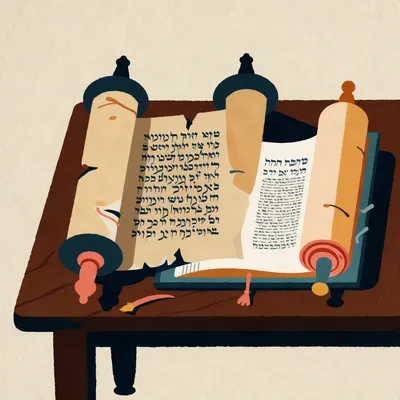
The Tanakh has three divisions: Torah, Nevi'im, the Prophets, and Ketuvim, the Writings. Daniel is in the third one. And the Talmud doesn't leave you guessing about the ordering — Bava Batra, folio fourteen through fifteen, lists the Writings as Ruth, Psalms, Job, Proverbs, Ecclesiastes, Song of Songs, Lamentations, Daniel, Esther, Ezra, Chronicles. Same passage says who wrote what: the Men of the Great Assembly are credited with writing Daniel, alongside Ezekiel, the Twelve, and Esther.
Lamentations on one side, Esther on the other. A book about empires falling, shelved between a scroll of grief and a scroll about a queen.
It's a strange neighbourhood, I'll grant you. But the passage is doing something deliberate — it's not just a table of contents, it's a claim about what kind of literature each of these is. Psalms and Proverbs and Job are wisdom and prayer. Daniel gets filed with the books you live by, not the books delivered by office.
Before we get to the office — the book itself is a strange object, isn't it. It's practically two books stapled together.
It really is. Chapters one through six are six court tales — Daniel in Babylon, refusing the king's food, interpreting dreams, the fiery furnace, the lions' den — and those are written mostly in Biblical Aramaic, which is unusual. Most of the Tanakh is Hebrew. Then chapters seven through twelve are four apocalyptic visions, and those are mainly in Late Biblical Hebrew. Two languages, two genres, one book.
And the Christian Bibles carry a fatter version.
The Septuagint, the ancient Greek translation, adds three sections that aren't in the Tanakh at all: the Prayer of Azariah and the Song of the Three — that's the extra bit inside the fiery furnace story — plus Susanna, a courtroom drama with Daniel as the young lawyer, and Bel and the Dragon, where Daniel demolishes a false god and gets another turn in the lions' den. Catholics and Orthodox keep those; the Jewish canon never had them.
So even "the same book" isn't the same book.
Right down to the shelf, the table of contents, and the text. And here's the twist I want to hold onto for the whole episode, because everything else hangs off it: when the Talmud says Daniel wasn't a prophet, it isn't demoting him. It's redefining prophecy — narrowly, precisely — and then handing Daniel a compliment on the way out.
The Talmud does backhanded compliments the way nobody else does.
It really is an art form. The load-bearing text is Megillah, folio three, side a. It starts from a verse in Daniel itself — chapter ten, verse seven: "And I, Daniel, alone saw the vision, for the men who were with me did not see the vision." The Gemara asks who those men were, and answers: Haggai, Zechariah and Malachi. The last prophets of the return to Zion.
The actual, credentialed prophets of the generation.
And then comes the line. "In certain ways they were greater than him, and in certain ways he was greater than them. They were greater than him, as they were prophets and he was not a prophet... In another way, however, he was greater than them, as he saw this vision, and they did not see this vision."
He out-saw the prophets. He just wasn't one.
That's the whole sugya in miniature. The criterion isn't visionary capacity — he wins that contest hands down. The criterion is something else entirely. Rashi on that passage explains it: Daniel "did not share his visions with the Jewish People as the prophets of his and earlier generations had done." A prophet, on this reading, is someone sent. Haggai, Zechariah and Malachi were dispatched to convey God's word to the people. Daniel received visions and kept them — or delivered them to kings, which is a different job.
Rashi derives the word itself, doesn't he.
He does, and it's a lovely piece of etymology. Navi, prophet, from niv — to speak. The word for prophet is built on speech. Not seeing. The title lives in the delivery, not the reception.
Which is either profound or a bit like defining a chef as someone who waits tables.
I'd push back — gently — because the distinction does real work. Megillah, folio fourteen, side a, gives the numbers behind the narrow definition. "Forty-eight prophets and seven prophetesses prophesied on behalf of the Jewish people, and they neither subtracted from nor added onto what is written in the Torah." On behalf of. That phrase is doing everything. The seven prophetesses are Sarah, Miriam, Deborah, Hannah, Abigail, Huldah and Esther.
Forty-eight men, seven women, and nobody else made the list?
The Gemara itself anticipates that. It says many prophets arose, "numbering double the number of Israelites who left Egypt" — so, on the traditional count, well over a million — "but only a portion of the prophecies were recorded, because only prophecy that was needed for future generations was written down."
Hold on. Double the number who left Egypt.
That's the text.
The desert was wall-to-wall prophets and nobody thought to mention it.
The point isn't the census. The point is the filter — prophecy as a common phenomenon, and scripture as the tiny residue of it that later generations actually needed. Which is the Talmud's answer to why Daniel's book is in the Bible at all, despite the man failing the job description. The book earns its place by usefulness, not by office. It was needed for the generations, so it was written down and kept.
And nobody fought about keeping it.
That's the part people get wrong, and Fred Blumenthal made it bluntly in the Jewish Bible Quarterly: "The Book of Daniel was canonized without any reported opposition. While the inclusion of some other books of the Hebrew Bible was contested, no such controversy seems to have existed about the Book of Daniel." Ecclesiastes, Song of Songs — those had defenders and doubters. Daniel sailed through. The fight was never whether to keep the book. It was which shelf it belongs on.
Which is a much better fight anyway. Shelves are where the real theology happens.
You joke, but I half believe it. The shelf encodes a claim about what kind of authority the book carries. Nevi'im means a message delivered to the people with divine warrant. Ketuvim means inspired, holy, enduring — but a different category of speech.
Let me test the criterion, though. Because there's an obvious objection — Daniel does interpret dreams for kings, he does announce things. He tells Nebuchadnezzar his empire falls. That looks a lot like delivery.
He delivers to emperors, not to Israel. And the content of his own visions — the apocalypse in the back half — he receives and records, and the text never says he stood in the street and proclaimed it. It's private revelation with a public record. Jeremiah is told to stand in the gate of the Temple and shout. Daniel is told to seal up the words.
And there's a structural echo the commentators lean on — Daniel reads like Joseph. Both of them in exile, outside the Land, in a foreign court. Both dream-interpreters, both rising in imperial service, both keeping their identity while serving the empire. And in neither book does the text ever say God appeared to them. God is present in both, constantly — through dreams, through rescue, through wisdom — but never in the face-to-face mode the prophets describe.
Joseph never got called a prophet either, and he ran half of Egypt.
Nobody in the tradition calls Joseph a navi in the formal sense. And Deuteronomy eighteen, fifteen, frames the whole thing: a prophet arises "amongst Am Yisrael" to communicate God's word to them. Amongst the people, to the people. Daniel and Joseph both live at one remove from that. It's the exile itself that puts them outside the category — the very condition the book of Daniel is about.
So the man who wrote the manual for exile is disqualified from the prophetic office by being in exile. There's a tidiness to that that I distrust.
Good instinct. Because the medievals didn't find it tidy at all. They fought about it for centuries, and the fight is where it gets rich. Rambam — Maimonides — comes down where the Talmud points: in the Guide of the Perplexed, part two, chapter forty-five, he says Daniel had ruach hakodesh, divine inspiration, holy spirit, but not the level of prophecy proper. And that's why the book sits in Ketuvim. A lower rung of the ladder, divinely real but not the top.
The Rambam had a whole ladder of the mind — he needed Daniel on one of the lower rungs.
He did, it's systematic with him. Ramban — Nachmanides — takes a different cut. Commenting on Genesis eighteen, he distinguishes seeing an angel as an angel from seeing an angel appearing as a person. The first, he says, isn't prophecy. Hagar saw an angel, as an angel, and nobody calls her a prophet. Daniel saw angels — chapter nine, chapter ten, Gabriel arriving at the evening sacrifice — and on the Ramban's reading that still doesn't make the cut.
That one feels like a distinction invented to exclude people politely.
It has that flavour. But then you get the dissenters, and they're not marginal. Ibn Ezra, on Daniel one, seventeen — "Daniel grasped all visions and dreams" — reads that verse as a straight assertion that Daniel is a navi. He doesn't hedge it.
And Abarbanel went much further.
Abarbanel — Don Isaac Abarbanel, fifteenth-century Spain — insisted at enormous length that Daniel was a prophet, full stop, and took the Rambam on directly. And here's the context that changes everything about the argument: Rabbi Chaim Jachter notes Abarbanel wrote his very long commentary on Daniel "to a great extent... to combat the Christian interpretation of Daniel." This was Spain, church-sponsored missionary pressure, Jews being challenged with their own scriptures. The Christians' case ran through Daniel — the seventy weeks, the son of man, the timeline to the messiah. A Jewish commentator conceding "well, technically he's not a prophet" handed the other side a talking point.
So the question wasn't academic. It was a border dispute with a church holding the book over your head.
And the modern Israeli commentary Da'at Mikra captures how unresolved the tradition really is — its introduction lists ten significant differences between Daniel and standard prophets like Isaiah, Ezekiel and Zechariah, and then, in the same discussion, cites midrashim arguing Daniel was a prophet. Both positions, side by side, in the introduction.
Ten differences. I want the list.
I don't have all ten in front of me and I won't invent them — but the shape of them is exactly what we've covered. No proclamation to the people, no sending, exile outside the Land, angels rather than the direct word, the list goes on.
Jachter's own landing, as I recall it, was that the whole categorization question is academic — God was clearly communicating with Joseph and Daniel either way.
His words are close to "purely academic," yes. Hashem communicates with them, or at minimum strongly influences them, and the label is the label. Which is a rabbi's way of saying the shelf matters less than the contents.

Hello dear, it's Dorothy with Dorothy's History of Toast.
In January nineteen forty-three, the United States government banned sliced bread, as a wartime economy measure.
People were so upset the ban was lifted within two months. It never works out, does it, love.
Anyway, I've got a nice bit of haddock for my tea. You have something warm, won't you. Bye now.
Mum, the haddock sounds lovely. Yes, someone has tried to organize a religion by decree before, with the bread, and it went exactly as well.
Governments banning nourishment. There's a theme in there somewhere.
Where were we — the shelf. Because there's one more Talmudic passage that turns the whole shelving question from furniture into theology. Megillah three, side a, again. It asks why the Writings were never translated into Aramaic, the way the Prophets were. Yonatan ben Uzziel, it says, sought to translate the Writings, and a Divine Voice came out and stopped him: "It is enough for you that you translated the Prophets."
A voice from heaven filing an injunction.
And the reason given: the Writings contain "a revelation of the end, when the Messiah will arrive. The end is foretold in a cryptic manner in the book of Daniel, and were the book of Daniel translated, the end would become manifestly revealed to all."
So they canonized it, denied it the prophetic shelf, and then refused to translate it — because the ending was too dangerous to make accessible.
It's the most striking thing in the whole discussion. Canon as containment. The rabbis treated Daniel's apocalypse as live ordnance — kept in the building, but behind a door. And you can see the whole difference between the traditions right there, because the Christian tradition did the exact opposite: it made Daniel the cornerstone of eschatology, the schedule of the end times, the book you read to find out when the story finishes.
One tradition put it on the schedule board. The other kept it in the locked cabinet.
And that's why Jews historically read Daniel liturgically and morally rather than as a timetable. The message the rabbis drew from the book isn't "here is the date." It's in the court tales — just as the God of Israel saved Daniel from his enemies, so he will save Israel in its present oppression. Resilience, not chronology.
Which connects to what the book is actually about. Because there's a reading where the shelving isn't incidental at all.
Blumenthal again — his thesis is that the book documents Judaism's conversion "from one that was directed and taught in the First Temple of Jerusalem to a creed that functioned after the destruction of the Temple and until this very day." From a state religion with a central sanctuary to something individuals carry in exile. And the details bear it out — prayer toward Jerusalem three times a day, keeping kashrut in a foreign palace, the whole apparatus of a portable Judaism. That's the book's technology.
He makes the comparison with the other exiles, doesn't he.
It's a lovely contrast. In Babylon, Ezekiel squelched any plan to build a replica Temple — no substitutes, the community waits. But the Jewish garrison at Elephantine in Egypt built one, and so did the community at Leontopolis. Different exiles made different choices about what could replace the centre. Daniel's book is the argument for the version that won: you don't rebuild the centre, you carry it.
Wisdom literature for diaspora life. Which, come to think of it, is exactly why it sits next to Proverbs and Job.
The shelf suddenly looks less like a demotion and more like a very considered editorial decision. The book that teaches you how to live without the Temple, filed among the books that teach you how to live.
There's the scholarly frame too, which we should state plainly because Daniel's asking what the sources say and this is part of the landscape. Mainstream academic scholarship dates the visions in chapters eight through twelve to between one sixty-seven and one sixty-four BCE — the persecution under Antiochusus Epiphanes —
Antiochus. Antiochus the Fourth.
Antiochus the Fourth, thank you — with the court tales older, third or early second century. Read as vaticinium ex eventu — prophecy written after the events it foretells, with the "predictions" running suspiciously accurate up until the actual present of the author, and then going vague.
Which is the classic signature of the genre. And the traditional attributions the rabbis worked with are much earlier — Daniel in the Babylonian court, sixth century. I hold both frames side by side without pretending they collapse into each other; the rabbis were reading a sixth-century exile, the academy reads a second-century persecution, and the book is strange enough to have fathered both readings.
The rabbis' own dating showed up in the canon list, remember — Bava Batra credits the Men of the Great Assembly with writing it, which is a post-exilic institution. Even the tradition's own account doesn't have Daniel writing it at the court of Nebuchadnezzar with his own pen.
Which fits the filter from Megillah fourteen — the book exists because the generations needed it, and it was preserved by the community that emerged from the return. Composition by preservation, not by dictation.
Forty-eight prophets, seven prophetesses, a million unrecorded ones, and one civil servant who saw more than all of them and got filed under Esther.

Only because they shelved him under Lamentations first, Corn, and the grief got the good side of him.
Careful, that's my shelf order you're defending.
I've got a Tanakh here with the shelf order drawn in the back. Hebrew-English, the binding's gone at Genesis, and somebody pencilled the three divisions on the flyleaf decades ago with arrows moving Daniel out of the Prophets and into the Writings. There's a note in the margin I've never fully made out. I read it as "not sent — but saw," and I've decided that's correct.
That's the sugya in three words, as far as I can tell.
My niece's boy wanted to see it. I'd already wrapped the thing in a tea towel in the drawer, so I had to say no, and he wrote me a letter about it. Twelve years old, typed, one page. My sister measures his letters, says this one came in under Katriel's, which was four hundred words and change. She keeps the count. I've never asked why and I don't intend to.
Why the tea towel? What did the book do?
It's too argumentative to leave on a shelf. I tried re-shelving my own books by the Talmud's ordering once, following the diagram, and Daniel sat between Lamentations and Esther for a fortnight before I decided the arrangement was asking for trouble. The pencil arrows, they were drawn by someone who'd thought about it, that's what I liked. I did some bookbinding work in the seventies and you learn to read a hand. Whoever it was pressed hard and changed their mind halfway through one of the arrows.
The diagram itself contains an argument about the diagram.
The niece's boy can have it when he's older and can read the note himself. I'll unwrap it for that. The tea towel comes back off — the note I'll leave exactly as it is.
He's deciding the hermeneutics of the flyleaf. That's very you, Hilbert.
Somebody has to keep track of what got moved and why, Herman. You two cover what got said.
The flyleaf is doing more scholarship than half the journals, if we're honest — a reader who moved the book, regretted it, and left the trace.
He left it visible. That's the part most people skip.
Before we wrap — the misconception. The one I'd most want to correct from all of this.
That "Daniel was not a prophet" is a put-down. It reads like a demotion, especially coming after a thousand years of Christian framing where he's the seer of seers. But Megillah three doesn't diminish the man — it defines the office narrowly, a message sent to the people, and then says outright he saw what Haggai, Zechariah and Malachi standing beside him could not. The demotion and the compliment arrive in the same sentence, and the rabbis meant both.
And the companion piece — people assume the Writings placement means the book was marginal, contested, nearly left out. Blumenthal's point stands: canonized without any reported opposition, while other books had to fight for their place. The rabbis argued about which shelf, never about whether the book belonged in the building.
The open question I keep circling — and I think it's the one the rabbis never settled, which is why it's still good. If the criterion for prophecy is dissemination, a message sent to the people, then what do you do with a book that was deliberately kept from translation because its ending was too dangerous to hand to everyone? A message the tradition itself decided not to send. Canonized without opposition, denied the prophetic title, locked in the Aramaic drawer — the rabbis wanted Daniel in the house, in the canon, needed for the generations, and precisely not democratized.
The argument is the tradition. A thousand years of Rashi, the Rambam, Ibn Ezra, Abarbanel, the Da'at Mikra, all still disagreeing — that's not a book the tradition finished with. That's a book it's still holding at arm's length, reading carefully.
Our thanks, as ever, to Hilbert Flumingtop, producing this whole operation from behind the desk. If you enjoyed this one, try episode ninety-one, The Story Behind the Show; episode fourteen oh eight, Israel Wartime Readiness Field Guide; and episode twenty-one, Is Your AI Secretly American. This has been My Weird Prompts — the human-AI collaboration podcast. If you enjoyed the episode, the review pitch writes itself: tell somebody which shelf you'd file us under. You can find everything at my weird prompts dot com.
We'll be back soon.
See you tomorrow.


 chatterbox-regular