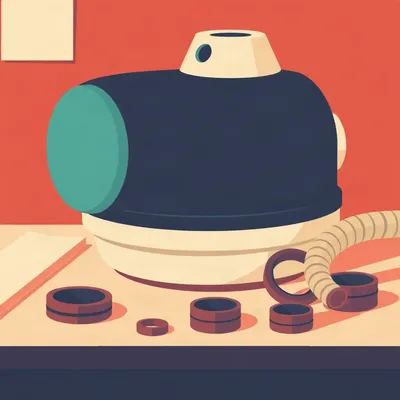
The thing about a toddler is that the floor stops being a surface and becomes a food supply. Daniel's got Ezra at fifteen months, which means everything goes in the mouth, which means the vacuum isn't a convenience anymore, it's infrastructure.

And he bought it fast. That's the part I want to sit with, because anybody who's had a small kid knows that feeling, you have one afternoon, the floor is a biohazard, and you go buy whatever the guy at the shop puts in your hands.
Daniel's words. His wife Hannah called this man the best appliance guy in Jerusalem, so they went, and they came home with a Bosch domestic device. And then he started looking at what Bosch's commercial line costs, and the dismay set in.
Specifically, that he could have had more power for less money. Which, on the surface, sounds like he got fleeced.
He doesn't think he got fleeced. He thinks he walked into the wrong shop. There's a whole paragraph in here about how people assume industrial means bigger and noisier, and how that's not necessarily true. Then the real hesitation, which is the one I'd have too. Bagged or bagless, what do the supplies cost, how hard are they to actually get, because a machine you can't buy bags for is a paperweight.
And he's using this thing daily. Weekly filter clean is on the calendar now.
He says he increasingly feels like he's maintaining a glorified toy. That's the line.
That's a great line.
He's not replacing it. Corn respects that. He says he'll run it until it stops being serviceable, and then he wants to buy what he actually wanted in the first place. Durable, powerful, maintainable, and, this is the bit he emphasizes, a nozzle with a standard diameter.
He got aftermarket heads for it and he says they made a real difference.
He calls the imagined upgrade nozzle nirvana. And then he says, and I quote, so let's talk about that also.
The 35mm thing.
So the question isn't really which vacuum Daniel should buy next. It's why the consumer version of a tool exists at all.
I want to plant a flag before we go anywhere else, because this reframes everything. The consumer vacuum is not a cheaper version of the industrial one. It's a different category of machine. Different standard, different channel, and in Europe, a different law.
Say more.
Bosch runs two entirely separate vacuum businesses. There's Bosch Home, the green and white stuff, sold in appliance shops, and there's Bosch Professional, the blue tools, sold to tradespeople through tool dealers. They don't overlap. Daniel's guy, the best appliance guy in Jerusalem, could not have sold him the professional line, because the professional line doesn't exist in that channel.
So he wasn't withholding anything.
He was operating in a channel where the other product is invisible.
But two Bosch universes, same company, same badge. That's a choice somebody made.
Completely separate distribution, completely separate engineering briefs. And there's a naming split that tells you everything. The professional machines aren't called vacuum cleaners. They're called dust extractors.
That sounds like marketing.
It's a regulatory classification. A dust extractor is commercial equipment, and that label is what exempts it from the rules that govern household appliances. Which is where the whole story actually starts.
So the question isn't which vacuum. It's why the consumer version exists at all. And the answer starts with a regulation.
Twenty fourteen. The EU capped consumer vacuum cleaner power at sixteen hundred watts. Then in twenty seventeen they dropped it again, to nine hundred.
Why would anybody cap the power of a vacuum?
The stated reason was energy consumption, motor efficiency. The idea was you shouldn't need two kilowatts to pick up a cornflake.
But you do need two kilowatts to pick up the cornflake that's been ground into a rug by a fifteen-month-old.
Right, and here's the crucial bit. The cap applies to household appliances. Commercial equipment is exempt. A dust extractor isn't regulated as a vacuum cleaner, so it isn't capped. It can pull whatever it can pull.
So Daniel's machine is legally limited in a way the blue one isn't.
Not by marketing, not by cost engineering. By statute. That's the single most important structural fact here. The consumer vacuum isn't a weaker machine because Bosch cut corners. It's a weaker machine because the law required it to be.
That reorders the whole thing in my head. I was assuming marketing decided this.
Marketing exploits it. The regulation created the tier, and then everybody built a product line to fit inside it.
And the professional line wasn't competing with the consumer line, it was just sitting on the other side of a wall.
Which means the appliance shop has no incentive to mention it, and the tool dealer has no incentive to advertise to homeowners. Two channels, two customer bases, two sets of rules. Daniel walked into one of them and got exactly what that channel sells.
So let's put numbers on the gap, because I want to know if more powerful for less is actually true.
It's true with an asterisk. Let's do it properly. Bosch's flagship corded extractor is the GAS 35 L SFC plus. Six hundred and fifty-nine pounds in the UK, with tax. That gets you a thirteen hundred and eighty watt turbine, two hundred and fifty-four millibars of vacuum pressure, seventy-four litres a second of airflow, thirty-five litres gross, twenty-three litres net, and it weighs eleven and a half kilos.
Two hundred and fifty-four millibars. Put that in a frame for me.
Most domestic canisters pull somewhere in the range of a hundred and fifty to two hundred. So this is in a different territory, and it's doing it through a filter surface of six thousand one hundred and fifty square centimetres, which is enormous.
And the consumer Bosch canister?
Two hundred to four hundred pounds for a top-end one. So there's the asterisk. The flagship is more expensive. Six hundred and fifty-nine is not less than four hundred.
So Daniel's more powerful for less claim is half right.
The real argument isn't sticker price, it's durability and serviceability per pound. That machine is built to run eight hours a day on a job site, hooked to a grinder, pulling concrete dust. It's a different expectation of lifespan.
Because nobody buys a dust extractor expecting to replace it in four years.
You buy it expecting to still be feeding it in fifteen. That's the calculation. But if you want the literal version of Daniel's claim, the cordless tier delivers it. The GAS 18V-10 L is a hundred and forty-six pounds, and it weighs four point seven kilos.
A hundred and forty-six pounds for a professional extractor.
Which undercuts a lot of consumer cordless vacuums. And the little handheld, the GAS 12V, is eighty-one pounds and weighs seven hundred grams.
Seven hundred grams.
That's a pint glass with a motor on it. That's smaller than the stick vacuum in most people's hall closets.
So the consumer assumption about which tier is expensive is just wrong at the bottom of the range.
The professional line spans from cheaper than consumer all the way up to expensive. What it doesn't have is the middle where the compromise lives. There's no machine in the blue range that exists because a regulation forced it to be weaker.
Which connects to something bigger. Because Daniel's instinct, that consumer products are inferior versions of industrial ones, that's not a vacuum story. That's a pattern.
It's basically the founding move of a lot of consumer product categories. The Dyson origin is the cleanest case. James Dyson took cyclonic separation, which is a technique from industrial saw mills, and adapted it for the home. The consumer product is a domesticated industrial technology.
He didn't invent the cyclone. He carried it across the wall.
He found a technology that industrial shops had been using for years, and he asked why your carpet doesn't get it. That's the whole story of the category. Somebody looks over the fence at what the trades are doing and shrinks it.
So Daniel is rediscovering a fence that was already there.
And then the interesting question is why the version that got carried over came back weaker. And in this case it's the regulation. The consumer line was deliberately capped. The domesticated version is a neutered version, and not always by accident.
So the why is regulation, distribution, and a wall between two channels. What's on the other side of the wall?
That's the part of Daniel's prompt I actually want to spend the most time on, because he buried a question in there that unlocks the entire professional world.
The hose.
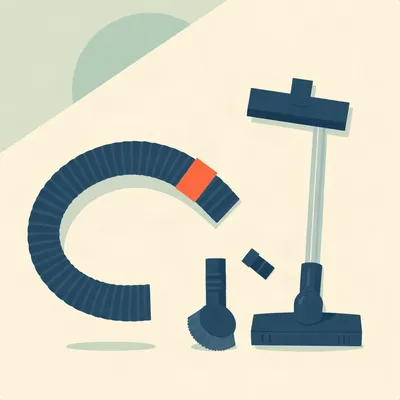
He calls his 35 millimetre hose only really a consumer standard.
He's wrong. He's so wrong.
That's the finding. The entire Bosch Professional dust extraction ecosystem is built on 35 millimetre. The GAS 35 ships with three half-metre chrome suction tubes, all 35mm. A three-metre 35mm hose with a power tool adapter. A 35mm floor nozzle set. A 35mm crevice nozzle.
So the diameter he's apologizing for is the standard he wants.
It's the same number. He owns the thread that leads into the professional world. He just doesn't own anything attached to the other side of it yet.
Which means nozzle nirvana isn't a fantasy, it's a shopping list.
And it's ridiculously granular. Floor nozzle, forty-nine pounds. Small floor nozzle, a hundred and thirty millimetres wide, eight pounds eighty-one. Rubber nozzle, eighteen forty-two. Small brush nozzle, eight forty-five. Crevice nozzle, five pounds and four pence.
Five pounds for a crevice nozzle.
Coarse dirt nozzle, thirteen twenty. A reduction adapter to take 35 down to 25, two pounds thirty-nine. And an adapter that mates it to the Click and Clean coupler at thirteen forty-five.
Every one of those is orderable individually.
That's the point. You don't buy a kit that bundles the three things you need with four you don't. You buy the nozzle.
The Click and Clean system is what does it, right? That's the coupling.
It's a standardized connector. Nozzles, hoses, tool adapters, all click into the same interface across the range. Which is the industrial answer to proprietary lock-in. It's a standard lens mount for a vacuum.
That's the part that makes it a system instead of a product.
And a system outlives any single machine. You buy a nozzle today and it still fits whatever Bosch sells in ten years, because the coupler is the contract.
Now let's get to Daniel's actual hesitations, because those are the practical ones. Bigger and noisier.
Size, it's mixed. The GAS 35 is eleven and a half kilos and thirty-five litres, that's a big machine. But the cordless line collapses that. Four point seven kilos for the 18V-10 L. Seven hundred grams for the 12V. So industrial equals huge is false across the bottom half of the range.
Noise.
Here's the interesting part. Bosch publishes noise and hand-arm vibration data for professional tools. That's a regulatory requirement. A consumer vacuum cleaner has no such obligation, so most of them simply don't publish a number you can compare.
So it's not that industrial is louder. It's that industrial has to tell you.
Industrial means documented, not necessarily loud. And that cuts both ways. Some blue extractors are quieter than you'd expect, and now you can actually check, because there's a datasheet.
So the assumption Daniel flagged is doing the work of keeping people out of the channel. People assume big, assume loud, assume expensive, and never walk into the tool dealer.
One of those assumptions is true at the top of the range and false at the bottom, and the other one isn't even reliably true at all. The assumption is doing more gatekeeping than the price tag is.
Then the bagged versus bagless question, which is his main hesitation.
Answered more cleanly than you'd expect. Bosch Professional explicitly markets what they call an ergonomic bagless design, and they say the reason is reducing plastic use and improving durability. So bagless is a design feature they're proud of.
They market bagless as the durable choice, which is the opposite of what people assume about pro gear.
But the flagship also supports bags. The GAS 35 ships with a disposal bag, part two six zero seven four three two zero four three, and a cellulose flat-pleated filter, part two six zero seven four three two zero three three. So it runs both ways. You pick.
So the hesitation was a false binary.
Then the supply cost fear, which I think is the most reasonable worry in the whole prompt. If you buy a machine and the bags are proprietary and vanish, you've bought a boat anchor.
What's the actual answer?
Bosch runs an online spare parts service, and a catalogue keyed to the ten-digit part number stamped on each tool. You type in the number, you get every part, and you can order it.
Indefinitely?
That's the design intent. Industrial supply chains are built for decades of service. The whole commercial model assumes the machine stays in use, because a job site can't have a dead extractor. Consumer supply chains are built for product cycles. The company assumes you'll replace the whole thing in four years, so there's no reason to stock the part in year six.
So the supply fear is real for consumer machines and backwards for professional ones.
The pro machine is the one where you can still get the part.
There's a counter example I want to put on the table, because it shows what happens when a commercial machine crosses into the home without getting worse.
Henry.
The Numatic Henry. Originally built to clean boiler interiors. It became a beloved domestic product, and it's the only mass-produced consumer vacuum still made in the United Kingdom. Uses big HEPA-FLO microfibre bags.
And keeps its hose fitting.
Two-inch oil-drum thread. An industrial standard it has retained for decades, because nobody saw a reason to change it. Henry is what Daniel actually wants. A commercial tool that crossed the wall and didn't get weaker on the way.
It didn't get regulated into a smaller motor, and it didn't get proprietary fittings to lock you into a supply chain. It just stayed a commercial machine that happened to live in a house.
Which is the test of the whole thesis. Henry shows the inferior consumer version isn't inevitable.
There's one more axis nobody thinks about. Dust class.
L, M, H.
EU standards. L-class is fine for household dust. M and H are for fine or hazardous dust, the stuff you shouldn't breathe. Bosch's flagship is L-class certified.
Certified to a standard the consumer machine doesn't carry.
It's a safety classification. It means the machine has been tested to contain a defined proportion of the dust it pulls in. A consumer vacuum has no equivalent rating, because nobody required it to have one.
So inferior isn't only about power. It's about what the machine is willing to guarantee.
Power, serviceability, accessories, and now certification. Four separate axes where the consumer version is a lesser thing, and only one of them is about the motor.
And the filter cleaning, which is Daniel's weekly chore. The 35 has semi-automatic filter cleaning. You tap a button, it knocks the dust off the filter into the container, one-handed.
The chore he's doing manually every week is a feature on the professional machine. That's the cleanest possible illustration of the gap. His maintenance burden is somebody else's solved problem.
So Daniel's weekly filter clean is the industrial feature he's performing by hand.
Because he bought the version where you do it yourself.
There's someone here who has actually handled this equipment, and he has been waiting to say something.
Hilbert: Two inch oil-drum thread.
The Henry fitting.
Hilbert: I spent a year working a parts counter for a janitorial supply house. And the thing nobody understands about that thread is that it's a pipe thread. It's not a vacuum part. It's plumbing.
Say that again.
Hilbert: It screws on the way a pipe screws into a fitting. Tapered, so it seals tighter the more you turn it. You can take a hose off a machine built in nineteen sixty and put it on one built last year, and it will not leak, because the thread didn't belong to Numatic. It belonged to the plumbing trade.
So the standard outlived the company that used it.
Hilbert: We had a shelf of adapters for it. People would come in with a hose their father had, and we'd sell them a two-pound adapter, and they'd walk out with a working machine.
That's the whole argument in one object.
Hilbert: There was a fella named Stefan, worked the loading dock. He'd take a broken machine home, strip it, keep the parts in coffee tins. Labeled in grease pencil. He could rebuild a whole vacuum out of those tins. Nobody taught him. He just hated throwing things away.
That's a specific kind of person.
Hilbert: The whole shop was that kind of person. It's why the parts catalogue existed. Somebody had to sit down and write every number in it, and that person did it because they knew Stefan would call.
The spare parts service isn't a nice-to-have. It's the actual product.
Hilbert: The machine is the thing you buy once. The catalogue is the thing you buy forever.
Which is the opposite of the consumer model, where the machine is the whole transaction.
Hilbert: We used to get people from the appliance stores coming in for hoses, because the hose on their machine had cracked and the store didn't stock it. We'd sell them a two-inch fitting and a clamp, and off they went. That was most of my Fridays.
The pro channel as the repair channel for the consumer channel.
Hilbert: Somebody has to keep the world running. It's usually not the person who sold you the thing.
That detail about the pipe thread reframes the whole thing. Because it means the standard was never the limitation. It was the thread that leads out.
Daniel's been apologizing for the one part of his machine that's actually professional.
If the standard is already there, if the 35 millimetre is the real one and there's a whole orderable ecosystem sitting on it, why does the consumer channel still sell a different, incompatible world?
Because the regulation forced a separate product category into existence, and separate categories grow separate fittings. The consumer machine had to be capped, so it was designed around the cap, and the design language followed.
The consumer channel sells a sealed box, because a sealed box is easier to sell, a sealed box has a warranty, and a sealed box doesn't need a parts counter and a man named Stefan.
The split isn't unique to vacuums. It's a pattern across tools. Same company, two channels, two standards, and a regulatory exemption deciding which customer gets the real one.
The misconception, then. The one everybody holds.
That the consumer vacuum is just a cheaper version of the industrial one. Same machine, less money.
It's a legally distinct category. Capped in power by law, sold through a non-overlapping channel, certified to no dust standard, and fitted with an incompatible hose.
Two different machines that happen to share a badge.
The thing I keep landing on is that Daniel's 35 millimetre hose was never the limitation he thought it was. He's already holding the thread. Everything on the other side of it is just a purchase order.
He's one adapter away from the catalogue.
Thanks to Hilbert Flumingtop for producing. This has been My Weird Prompts.
If you want to tell us about the standard hose fitting on your own machine, email us at show at my weird prompts dot com.
We'll be back soon.