Daniel's brief this time started with a workstation problem. He's collecting dictation data for speech models, looked at what the job actually needs, and found it needs almost nothing. A USB port, a small display, a few hotkeys. He could use a pared-down laptop. He could build a dedicated appliance. Then he went looking and fell into the world of the M5Stack Cardputer and everything around it, and now he wants the map. What is this category called, who lives in it, what does it cost, and why not just strap a battery to a Raspberry Pi and be done with it.

And the honest answer to the first question is that nobody has agreed on the name, which is the interesting part, because the naming mess is pointing at a real fork in the hardware underneath.
So let's start with the name, because that turns out to be half the story.
The community term is cyberdeck, borrowed from cyberpunk fiction, and the subreddit of the same name uses it for basically anything homemade and portable with a keyboard. But press and retail can't settle on it. You'll see handheld Linux computer, pocket computer, keyboard computer, all describing overlapping shelves of products. It's not a category the way laptop is a category. It's more like a mood.
A mood with a storefront.
Right, and the aesthetic does a lot of the selling. What actually matters, and what Daniel needs to hold onto for his decision, is the split underneath: microcontroller handhelds versus pocket Linux machines. One class is an ESP32 or a Pico-class chip running firmware, no operating system, no browser, nothing general. The other is a real ARM chip running full Linux. Same shelf, completely different animals.
And that split decides whether the device can run his data-collection interface at all.
A Cardputer cannot run a browser or a desktop app. It runs firmware you flash to it. In Daniel's setup it could be a hotkey pad sitting next to a real computer, or a standalone recorder with its own firmware. But it can never be the computer. The Linux-class ones can.
Well, before we get into the Cardputer and the rest of it, I believe we have a call from your mother. Dorothy, are you there?

Hello dear, it's your mother, with Dorothy's History of Toast. In nineteen forty-two, Britain brought in the National Loaf, to save wheat and shipping space.
It was a coarse grey wholemeal loaf, and most people disliked it. They didn't abolish it until nineteen fifty-six, so that's fourteen years of a loaf nobody wanted.
There we are, dear. Nothing works out, does it. Anyway, I've got a bit of washing to hang out, so I'll let you go. Bye bye now.
Fourteen years of unwanted bread. Thanks, Mum.
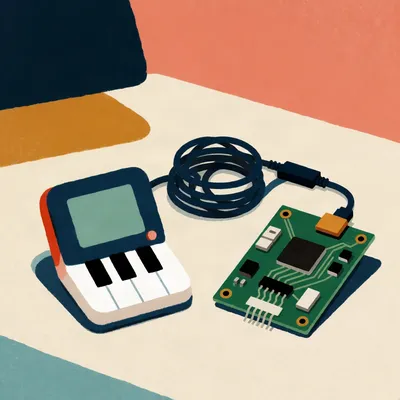
Cardputer, then. The one Daniel found is the ADV version, launched about a year ago, and the spec sheet reads like someone dared an engineer to fit a computer into a wallet. ESP32-S3 chip, half a megabyte of RAM, eight megabytes of flash, a 1.14-inch screen at 240 by 135, 56 keys, a 1750 milliamp-hour battery, a microSD slot, and a 14-pin expansion bus on the back for accessory modules.
Thirty dollars, I'm told.
Twenty-nine ninety-nine on M5Stack's own store. Resellers mark it up, so The Pi Hut in the UK charges the equivalent of a few pounds more. For thirty dollars. That price is doing a lot of the explaining for why these things have a following.
My calculator cost more and does less.
Here's the part that matters for Daniel, though. The audio chain on the ADV is real: a proper codec chip, a MEMS microphone, a one-watt speaker, even a headphone jack. But the microphone is wired to the board's internal audio bus. It is not a USB device. So the Cardputer records onto its microSD card, or streams audio over Wi-Fi, but it cannot simply present itself to a host computer as a USB microphone. There's one USB-C port, and it's shared with charging on top of that.
So the one thing Daniel's workstation needs, a mic into a USB port, is the one thing it can't be.
In that mode, yes. There's a related trick it can do, with a caveat that's easy to miss. The original Cardputer can act as a USB keyboard through the Arduino library, and the popular Bruce firmware has a whole BadUSB scripting mode for it. The catch is that when it's being a keyboard, it stops being programmable, because that same port is the programming connection. And that's all documented for the original model. Whether the ADV behaves identically is likely but not confirmed anywhere I've seen, so I'd treat it as probable rather than promised.
A keyboard that has to stop being a computer to be a keyboard.
It's a fair trade for thirty dollars. Now, the Cardputer is the cheapest of this class, but not the only one. LILYGO makes the T-Deck Plus, same ESP32-S3, but with a much bigger 2.8-inch display, a BlackBerry-style keyboard, an actual trackball, and then the extras that made it famous: a LoRa long-range radio and GPS, with a 2000 milliamp-hour battery. About seventy-one dollars direct from LILYGO, and considerably more once resellers get involved.
That's the one the off-grid messaging crowd uses.
The Meshtastic people love it, yes. Texting over LoRa with no infrastructure at all, which is about as far from Daniel's USB port as a device can get while still being the same chip. Then there's ClockworkPi, which has been in this niche for years. Their PicoCalc came out in March of last year, and it's charming: a Pico-class microcontroller, a 4-inch square IPS screen at 320 by 320, a backlit QWERTY keyboard, stereo speakers. Seventy-five dollars at launch, seventy-nine now.
For a kit.
For a kit, yes, you assemble it yourself, and the two 18650 battery cells are not included. Which is its own little tradition in this category. You can swap the Pico for a Pico 2W, and people do.
I want to notice something about all three of those, because it's the thing Daniel already sensed. Where there's a microphone at all, it's soldered to the board and wired to the chip, not offered up over USB, and the PicoCalc doesn't list a mic in the first place. They're appliances, not tiny computers with a port.
That's the clean way to put it, and it's why the category naming is such a mess. People call them pocket computers because they look like little computers, but architecturally they're closer to a smart thermostat that happens to have a keyboard. Firmware, one job, no general operating system. Wonderful if the job is the one they shipped with or one you enjoy writing. Useless if the job is running existing software.
Could Daniel write his own firmware and make the ADV the whole workstation? Recorder, hotkeys, screen for prompts, all in one thirty-dollar object?
He could, and people do exactly that, but he'd be writing the interface from scratch in Arduino-land, plus a way to offload the recordings. MicroSD cards fill up. He'd end up pulling the card out constantly, or fighting with Wi-Fi transfer. For collecting training data, where the recordings have to end up on a real machine eventually anyway, I think he'd be building a pipeline around the device's inconvenience rather than around his actual work. The collection side wants boring and standard.
So the microcontroller class is out as the computer, and possibly in as a hotkey pad.
Possibly in as the world's most over-qualified hotkey pad. Which, given what macro pads cost, is not even a stupid use of thirty dollars.
The microcontroller devices are cheap and hackable but can't run anything general. What happens when you insist on full Linux in your pocket?
The prices change shape. The interesting one right now is the CardputerZero, which is M5Stack building the Linux sibling of the card Daniel found. Raspberry Pi Compute Module Zero inside, quad-core Cortex-A53 at one gigahertz, half a gigabyte of RAM, a 1.9-inch screen, 46 keys, two USB-C ports and one full USB-A. That USB-A port is the detail I keep looking at, because it means a standard microphone just plugs in.
You're doing the thing where a port makes your week.
A full-size USB host port on a pocket device does, Corn, and I won't apologize for it. The funding story is the wrinkle. It went to Kickstarter this year, over ten thousand backers, pledges from about fifty-nine dollars for the Lite version up to one nineteen. Stated retail is a hundred and forty-nine, or ninety-nine for the Lite.
And delivery?
Planned for this month, actually. Campaign closed in July, and the last public update anyone can find is from the end of June. So whether it's actually shipping right now, as of today, is unconfirmed. Which is maddening, because it's exactly the device Daniel's use case wants.
Four and a half months of public silence from a campaign promising November delivery. That tracks.
Crowdfunding is a preorder with worse paperwork. Moving up the ladder, ClockworkPi's uConsole is the established option: 5-inch 720p screen, built-in keyboard and trackball, and the compute module is swappable, so it's designed to outlive its own chip. The 4-gigabyte kit is two hundred and fifteen dollars on the official store and currently out of stock. Cells not included, obviously. It launched back in twenty twenty-two from a hundred and thirty-nine.
Two hundred fifteen and out of stock is a strange flex.
Supply in this niche is always thin. Same story with the Hackberry Pi, from a maker called ZitaoTech: a Raspberry Pi in a handheld shell with a BlackBerry keyboard. The Zero 2 W version is about a hundred and twenty-six dollars on Tindie and is sold out more often than not. There's a Pi 5 version with a 3.95-inch square touchscreen and two 18650 cells, three to four hours of battery. And at the far end, the MNT Pocket Reform, which is open-hardware mini-laptop with swappable processor modules, beautiful machine, around thirteen hundred euros with a five or six month lead time.
Thirteen hundred euros. For that money it should take the dictation itself.
It's for people who want the philosophy, not the appliance. Even the Pi 500+, the keyboard-computer with sixteen gig of RAM and NVMe storage at two hundred dollars, is technically adjacent to this category, but it's a desktop, it needs a monitor. It shares the shelf and nothing else. And the shelf keeps getting new crowdfunded entries every year, a hundred and sixty here, a hundred and ninety there, mostly shells you supply a board for.
So the Linux class runs from maybe-ninety-nine-if-it-ships to thirteen-hundred-euros-and-wait-half-a-year. Which leads us to Daniel's actual question, the one I think he already suspects the answer to. Why not a bare Pi with a battery? Especially now.
Especially now, because the Pi pricing story got ugly this month. The sixteen gigabyte Pi 5 went up eighty dollars on the second of November, to three hundred and eighty-five. That's the fourth increase, against a launch price of a hundred and twenty. Memory shortage is the stated reason, and the one-gigabyte boards were left alone in the October round, which tells you exactly which component is the problem.
A board that costs as much as twelve Cardputers.
The Zero class is the cheap route left standing, and the battery side has answers. There's the PiSugar line, a battery and UPS board that clips onto a Pi Zero with power management and a clock, so you get graceful shutdowns instead of corrupted SD cards. That's the classic bare-Pi build: a Zero, a PiSugar, whatever screen and input you fancy.
But you keep circling something. Say the whole comparison.
The microphone, again. A bare Pi has no analog audio input at all. So the build needs a USB microphone or a USB sound card before it records anything. The integrated devices design the mic, the keyboard, the screen, the battery and the case as one object, and that's the actual product. That's what the two hundred dollars of a uConsole is buying, not the components.
So the difference isn't the battery. Anyone can buy a battery.
The difference is that the integrated device is a finished opinion. Somebody decided where the mic goes relative to your hand, how the screen tilts, what happens when you drop it. The bare Pi is no opinion at all, which is its own feature. Full-size USB host ports, so any mic in the drawer works. Any screen. Replace any part without grieving the whole object.
You know which side of this I'm on before I say it.
I do, and I want to hear it anyway, because your side has a point this time.
The Pi route wins on exactly the thing Daniel needs, which is USB flexibility, and loses on the thing he wants, which is a single object he picks up and uses. And I'm the one in that flat who has to use whatever Herman installs. I've reported back on too many of your builds to believe integration is free. When it works it's lovely. When one part dies, the whole opinion dies with it. The Pi fails in replaceable pieces.
That's the fair version of the argument, and I'll concede the replaceable-pieces point while keeping my affection for the finished object. For Daniel specifically, I'd say: the dictation station wants the Pi route, because the microphone and the interface are the whole job, and both want standard USB. The appliance feeling, the this-box-only-does-inventory feeling he loves, that's a mood you can give a Pi with a good case. It's not a purchase, it's a ritual.
I'd actually argue the affection people have for these devices is mostly about scope reduction. A laptop asks you things constantly. Which window, which tab, which notification. A single-purpose appliance stops asking. Daniel's inventory-input box and ASR terminal idea is the whole appeal stated plainly: a computer that has already decided what it's for.
A thirty-dollar object that's better than my laptop at not being my laptop.

You lose the programming port while it's in keyboard mode.
The ADV?
The original, which is the one I've got. You said it yourself earlier, then talked straight past it. Every time you want to change what the keys do, you flash it back, change it, flash it again. I found that out the inconvenient way, which I'm not going into. There's also no proper function row on that keyboard, so anything past the basics is a chord. I keep a spreadsheet of which chords you can reach with one thumb while holding it in the other hand. Most of the top row is fine. The ones where the thumb has to cross under the palm are a design crime and I've marked them as such.
Marked them how?
Colour-coded. Orange for reachable, red for a contortion, grey for ones I don't consider legitimate. Herman goes on about the F-thirteen-and-up trick for macro pads, and he's right, but the Cardputer makes you earn every one of them. Corn, you'd take to it, actually, you like anything with three buttons and no options. I've been carrying one in my coat pocket since the summer, keeping an inventory of what's in that pocket. Sixty-one entries so far. Herman, I'm cutting that cough on your last sentence before the export, it's sitting right on a word.
Please do. Sixty-one entries of coat pocket, though. The same pocket?
The same pocket, and the count's the interesting part, you'd be surprised what migrates in there over four months. That's the appliance doing its job, as far as I'm concerned. It's a good device. I've no argument with thirty dollars.
Sixty-one entries. That's a longitudinal study of a coat.
It's the only inventory in this building that updates itself. Leave it there.
Sixty-one things in one coat pocket. I'm not sure whether that's an argument for the device or against the coat.
It's an argument that scope reduction works even when nobody designed the scope. The most common wrong belief about this whole category, I think, is that cyberdeck is a settled thing you can shop for, one shelf, one kind of product. It's two entirely different kinds of hardware wearing the same aesthetic, and which one you're holding decides everything about what it can do for you. The second-most common is that a Cardputer can just be a USB microphone, which we've buried thoroughly. The mic is soldered to the board, not sitting behind a port.
A misconception the spec sheet actively encourages, to be fair. It has a mic and a USB port, and the gap between them is invisible until you need it.
And on the Pi side, the misconception is that a battery makes it equivalent. The battery is the easy tenth of the integration.
Before we go, the two live threads I'd watch. One is whether the CardputerZero actually ships this month. If it does, the Linux class gets a ninety-nine-dollar entry point with a full-size USB port, and Daniel's dictation station becomes a single purchase instead of a build. Months of silence on the campaign says wait, but it's the device that decides this question properly.
The other is the Pi price line. If memory costs keep climbing and the Zero class follows the Pi 5 upward, the economics of appliance versus build could flip the other way, and the integrated boxes become the frugal option, which would be a first.
Our producer is Hilbert Flumingtop, who keeps a spreadsheet of thumb reachability and would like you to know the red cells are non-negotiable. If you enjoyed this one, try episode two, Local STT For AMD GPU Owners; and episode eight, Building Your Own Whisper. This has been My Weird Prompts. If the show earns a spot in your rotation, a review wherever you listen helps other people find it, and everything lives at my weird prompts dot com.
We'll be back soon. See you then.