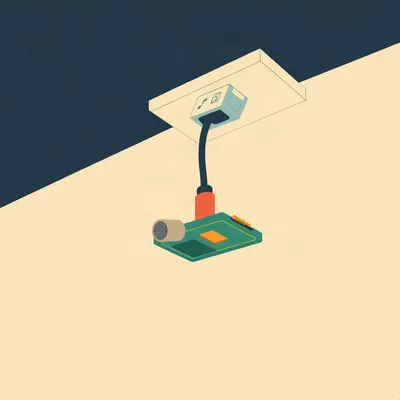
Daniel sent us this one — he's trying to solve a very specific domestic audio problem. He listens to podcasts while minding Ezra, moving from room to room in his apartment, and his Bluetooth speaker drops connection the moment he steps ten meters away into the next room, even though it's supposedly rated for thirty meters. He's wondering about a Bluetooth transmitter as an intermediate device — something with more range, maybe supporting multiple speakers, maybe even Auracast — so he can roam freely without losing audio. And he specifically asked: does Avantree make something that fits, and what is this category of product actually called?

Oh, this is a good one. And I know exactly why the thirty-meter rating is a lie in his apartment. Israeli construction — those walls are concrete and cinder block, often with steel reinforcement. Bluetooth's two-point-four gigahertz signal bounces off metal mesh in plaster, gets absorbed by dense materials, and the rated range is always measured in open air with line of sight. Put two walls between transmitter and receiver and that thirty meters becomes more like eight.
The rating isn't wrong, it's just...
It's the Bluetooth equivalent of a car's highway fuel economy number. Technically achievable under laboratory conditions, completely irrelevant to real life.
"Laboratory conditions" being a featureless void with no walls, no interference, and presumably a Bluetooth engineer holding their breath.
So the core problem here is that the phone is the transmitter, and phones have terrible Bluetooth antennas. They're optimized for near-body devices — earbuds, smartwatches — not for punching through walls to a speaker two rooms over. The solution is to decouple the transmitter from the phone entirely.
What he's describing — a dedicated Bluetooth transmitter that sits in a central location, connects to the phone, and then broadcasts to speakers — what is that product category?
It's usually called a Bluetooth audio transmitter, or sometimes a Bluetooth hub or broadcast adapter. But the specific thing he's after, where it can send to multiple speakers simultaneously and has extended range, sits in a category the industry calls "long-range Bluetooth transmitters for multi-room audio." Avantree is actually the dominant player here. Their flagship product in this space is the Avantree Oasis Plus.
Sounds like a bottled water brand that pivoted to audio.
It does, but it's genuinely the right tool for this problem. The Oasis Plus is a dedicated Bluetooth transmitter and receiver combo. In transmitter mode, it connects to your phone — or a TV, or a computer — and then broadcasts to up to two Bluetooth headphones or speakers simultaneously. The key spec is the range. Avantree claims up to a hundred meters in open air with their extended-range technology, but even in real-world conditions with walls, users report getting fifty to sixty feet reliably, which is about fifteen to eighteen meters through multiple rooms.
From ten meters with a phone to potentially eighteen meters through walls with a dedicated box. That's the difference between "music stops when I check the laundry" and "I forgot I was even carrying my phone around.
That's exactly the use case. And the Oasis Plus has an external antenna — a little physical nub — which makes a huge difference. Phones bury their Bluetooth antennas inside the chassis, surrounded by metal and glass and battery. A dedicated transmitter with an external antenna is simply a better radiator of RF energy.
Herman's in his element now.
But here's where it gets interesting for his specific multi-speaker question. The Oasis Plus supports dual-link — it can stream to two devices at once. So he could have a speaker in the living room and another in the kitchen, both receiving the same audio from the transmitter, and he moves between them seamlessly.
If he wants more than two?
That's where we get into the newer stuff. Avantree also makes something called the Avantree C81, which is a USB-C Bluetooth adapter designed more for computers, but it supports the newer Bluetooth five-point-three spec. And this is where Auracast enters the conversation.
The thing the prompt mentioned. I've seen this word floating around Bluetooth marketing for a couple of years now. What actually is it?
Auracast is the consumer-facing name for Bluetooth LE Audio's broadcast capability. Think of it as Bluetooth's answer to FM radio. A single transmitter broadcasts an audio stream, and an unlimited number of Auracast-compatible receivers can tune in. It's not a one-to-one or even one-to-two connection — it's one-to-many, like a tiny radio station in your house.
Instead of pairing devices, you're basically tuning in.
The transmitter creates an Auracast broadcast — it gets a name, like "Daniel's Podcast Feed" — and any Auracast-compatible speaker or earbud within range can join that broadcast just by selecting it. No pairing codes, no device limits. It's a paradigm shift for Bluetooth audio.
This exists now? I can buy it?
This is where the timeline gets a little awkward. Auracast was finalized as part of the Bluetooth five-point-two spec back in twenty twenty, and the branding was announced in twenty twenty-two. But adoption has been slow. As of mid twenty twenty-six, there are Auracast-compatible phones — recent Samsung Galaxy and Google Pixel models, iPhones from the fifteen onward — and there are Auracast-compatible earbuds and hearing aids. But dedicated Auracast transmitters for home audio, the kind of standalone box you plug in and it just broadcasts, are only just starting to appear.
The spec exists, the phones support it, but the thing you'd actually put on your shelf to run the show is still in that awkward "announced at CES but good luck finding it on Amazon" phase.
That's a fair characterization. There are some early options — a company called GN Hearing has Auracast transmitters aimed at hearing aid users in public venues, and Samsung has been pushing Auracast in their TV lineup. But the dedicated consumer-grade home audio broadcast box is still nascent.
Which means for Daniel's situation right now, Auracast is probably not the answer today. It's the answer next year, or the year after.
And I think that's important to say plainly. The prompt asks about Auracast, and it's absolutely the right long-term vision for this problem — but if you need something that works this week, you're looking at traditional Bluetooth transmitters with dual-link or multi-point capabilities, not Auracast.
Let's land on the concrete recommendation. Avantree Oasis Plus. What does it actually cost, what does it need to work, and what are the caveats?
The Oasis Plus retails for around sixty to seventy dollars. It connects to your phone via Bluetooth — so the phone pairs to the Oasis Plus as if it were a pair of headphones. Then the Oasis Plus transmits to your speakers or headphones. It supports aptX Low Latency and aptX HD codecs, which matters if you're also using it for video — no lip-sync issues — but for podcast listening, the standard SBC codec is fine. It has an optical audio input and output as well, so you can also connect it to a TV or a computer via a cable if you want.
The antenna — you mentioned it's external. Is it removable, adjustable?
It's a small fixed antenna, about an inch and a half long, and it swivels. You can angle it for better coverage. The device itself is small — maybe the size of a deck of cards. It sits near your audio source, or centrally in the home, and does its thing.
The setup is: phone pairs to Oasis Plus, Oasis Plus broadcasts to speakers placed wherever he wants them. Phone stays in his pocket, range is now measured from the Oasis Plus instead of from the phone.
That's the model. And the practical effect is that the transmitter sits in a fixed, central location — maybe on a shelf in the hallway, or in the living room where the apartment's rooms radiate from — and because it has a better antenna and more transmit power than a phone, the signal reaches further and penetrates walls more effectively.
There's something almost retro about this. The idea of a central broadcast unit in the home. We spent twenty years making everything portable and personal, and now the solution to whole-home audio is to put a stationary box back in the middle of the house.
It's the pendulum swinging. We decentralized everything to the phone, and then discovered that phones are terrible at being infrastructure. They're endpoints, not hubs. A phone's job is to be with you; a transmitter's job is to be where it can reach everything. Those are fundamentally different physical requirements.
"Phones are terrible at being infrastructure." That should be on a T-shirt sold to network engineers.
I'd wear it. But here's another layer — the prompt mentioned routing audio to multiple speakers or just one. The Oasis Plus can do dual-link, but it's a fixed setup. You pair two speakers, and it sends to both, always. If you want to dynamically choose which speaker is active, you're looking at something slightly different.
There's a category of products called Bluetooth transmitters with selective routing, or sometimes multi-point transmitters with per-channel control. Avantree makes a higher-end model called the Avantree Orbit Pro, which is actually designed for TV listening but works for music too. It has a dockable speaker setup — you have a base station that transmits, and when you pick up the portable speaker from the dock, the audio follows you. When you return it, it charges. It's a clever "grab and go" model.
It's a Bluetooth transmitter with a built-in handoff mechanism. You're not routing with an app — you're routing by physically picking up the speaker.
And that's actually more elegant than an app-based solution for his use case. He's carrying Ezra, doing things around the house — he doesn't want to open an app and tap a room name. He wants to grab a speaker and have it just work.
The physical world as interface. Pick it up, audio follows. Put it down, audio stops. No menus, no pairing, no "please update firmware to continue.
There is a certain beauty to it. The Orbit Pro uses Avantree's "Harmony" technology, which is their branding for seamless handoff between the docked speaker and any paired Bluetooth headphones. So he could have the dock speaker in the kitchen, and when he moves to the living room, he puts on a pair of Bluetooth headphones and the audio switches automatically.
He's minding a baby. I'm not sure sealed earbuds and infant supervision are a great combination.
That's an excellent point. Open-ear headphones exist — bone conduction, or something like the Shokz OpenRun, which leave your ears completely free. But that's a separate recommendation. For speakers, the principle holds: the Orbit Pro gives you one portable speaker that follows you, plus the option to expand.
Let me pull us back to the core question. He asked what this product is called. We've named specific models, but if he walks into an electronics store or searches online, what term gets him to the right shelf?
The most accurate search term is "long-range Bluetooth transmitter for multiple speakers." That will surface the Avantree Oasis Plus, the Orbit Pro, and competitors like the TaoTronics TT-BA09 or the Mpow BH390A. If he wants the multi-speaker broadcast capability specifically, "Bluetooth transmitter dual-link" or "Bluetooth broadcast hub" are good secondary searches. "Auracast transmitter" will become the right search eventually, but not yet.
If he wants to go deeper into the ecosystem, what's the difference between a transmitter and a transceiver?
A transmitter sends audio out. A transceiver can be either a transmitter or a receiver — there's usually a switch on the device. So the Oasis Plus in receiver mode can turn a wired speaker into a Bluetooth speaker. You plug your old hi-fi system into the Oasis Plus via the optical or aux port, set it to receiver mode, and now your phone can stream to those wired speakers. It's a two-way device.
Which is useful if he already owns decent speakers that aren't Bluetooth-enabled.
It lets you retrofit existing audio gear. And that's a much better environmental and financial decision than buying new Bluetooth speakers if you already own good passive or wired active speakers.
The sloth-approved approach: buy one box, keep the speakers you have, nap while the audio follows you around.
The sloth audio philosophy. Minimal effort, maximum coverage.
Let's do the summary for the specific ask. Avantree does make products that fit — the Oasis Plus is the closest match for a stationary central transmitter with dual-speaker support and extended range. The Orbit Pro adds a portable speaker with automatic handoff. The category name is "long-range Bluetooth transmitter" or "Bluetooth audio transmitter with multi-link." Auracast is the future but not the practical present.
I'd add one more option that's worth mentioning, which is the Avantree C81. It's a USB-C dongle, not a standalone box, but if he has an old Android phone or a Raspberry Pi sitting around, he could plug the C81 into that, install a Bluetooth audio server app, and turn that device into a dedicated transmitter with even more flexibility. It's the DIY route, but it's extremely cheap — the C81 is about thirty dollars.
A Raspberry Pi Bluetooth broadcast server. I can hear the Home Assistant community perking up their ears.
There's definitely overlap. And since we know he's into home automation, that might actually be the most fun solution for him. Set up a Pi with the C81, configure it as a Bluetooth audio bridge, and then control routing from his Home Assistant dashboard. But that's a project, not a product.
The prompt is asking for a product recommendation. So Oasis Plus is the off-the-shelf answer, C81 plus Pi is the enthusiast answer, Orbit Pro is the "I want a grab-and-go speaker" answer.
That's the menu.
I want to zoom out for a second, because there's something larger here about how Bluetooth has evolved. Ten years ago, Bluetooth audio was a joke. It was the thing you tolerated for phone calls. Now we're talking about whole-home audio distribution over Bluetooth, and it's actually viable.
The turning point was Bluetooth five, released in twenty sixteen. That doubled the data rate and quadrupled the range. Then Bluetooth five-point-two brought LE Audio and the LC3 codec, which is dramatically more efficient. The old SBC codec was designed in the early two-thousands and it's frankly terrible by modern standards. LC3 delivers better audio quality at less than half the bitrate, which means you can push the same quality further, or push higher quality the same distance.
The range improvement isn't just better antennas and more power — it's also that the data is more efficiently packed.
It's a multi-layered improvement. Better radios, better codecs, better error correction. Bluetooth in twenty twenty-six is not the Bluetooth of twenty sixteen. And LE Audio specifically was designed with broadcast in mind — Auracast is built on top of it. So the whole architecture has shifted from "connect two devices" to "create an audio broadcast domain.
An audio broadcast domain. That's a phrase that would have sounded like science fiction when we were teenagers plugging in RCA cables.
We're living in the future and it's mostly used to listen to podcasts while folding laundry.
The noblest application of advanced wireless technology.
Consumer audio has driven more wireless innovation than industrial applications in the past decade. The reason we have good Bluetooth chipsets is because hundreds of millions of people wanted to listen to music without wires. That volume funded the R and D.
Daniel's frustration with his apartment walls is, in a roundabout way, part of the same market force that's pushing Bluetooth toward broadcast-native architecture. His problem is the problem.
It's a problem that's especially acute in regions with concrete construction. Israel, much of Europe, parts of Asia — dense materials everywhere. North American wood-frame construction is much more forgiving to RF signals. So a lot of audio products tested in American homes perform worse in Israeli or European apartments, and the manufacturers don't always account for that in their marketing.
Which is why user reviews from people in similar construction types are more valuable than spec sheets. The thirty-meter rating is meaningless if it was measured in a California open-plan house and you live in a Jerusalem apartment with walls you could use as a bomb shelter.
That's the real-world testing that matters. And from what I've read in user reports, the Oasis Plus does hold up well in European-style concrete construction. The external antenna makes a measurable difference there.
Let's talk about the multi-speaker aspect specifically. He mentioned wanting the option to route to multiple speakers or just one. With the Oasis Plus in dual-link mode, both speakers play simultaneously, always. What if he wants to switch between them?
Then he'd need either a transmitter with app-based routing — and there are some, like the Auris Blume Pro, which has a mobile app that lets you select which paired speaker is active — or he'd need to move to a Wi-Fi based multi-room system like Sonos or Apple AirPlay, which is a completely different architecture.
Wi-Fi multi-room introduces its own problems. Latency, network congestion, the fact that you're now dependent on your router not having a bad day.
That's the tradeoff. Bluetooth is point-to-point, low latency, simple pairing, doesn't touch your home network. Wi-Fi multi-room gives you unlimited speakers, independent volume control, synchronized playback across rooms, but it's more complex and more fragile. For a single listener moving through an apartment with one or two speakers, Bluetooth is actually the more robust choice.
There's a minimalist elegance to it. You're not building a whole-home audio infrastructure. You're solving a specific problem: I want the podcast to follow me. That's a Bluetooth problem, not a Sonos problem.
It's cheaper. A sixty-dollar transmitter plus a couple of Bluetooth speakers versus a multi-room Wi-Fi setup that can easily run into the hundreds. For a podcast-listening use case — where stereo separation and high-bitrate fidelity don't matter — Bluetooth is perfectly adequate.
The recommendation isn't just "buy this box." It's "Bluetooth is actually the right technology for this specific problem, and here's the box that does it best.
And I think that's worth emphasizing because there's a tendency in tech recommendations to always push people toward the more complex, more expensive solution. "Oh, you want audio in multiple rooms? You need a Sonos system with a five-hundred-dollar soundbar and a mesh Wi-Fi network.He wants to listen to a podcast while carrying a baby. A sixty-dollar Bluetooth transmitter solves that.
The tech industry's answer to every audio question is "buy more speakers." The correct answer is often "buy one smarter box.
That's the episode title right there.
Let's address one more thing from the prompt. He mentioned Avantree specifically — he knows they have a good name for Bluetooth. Is that reputation deserved?
Avantree has been focused exclusively on Bluetooth audio for over a decade. They're not a general electronics company that also makes a Bluetooth dongle. Their entire product line is transmitters, receivers, adapters, and headphones. They've built a reputation specifically around range and reliability. Their extended-range technology uses a combination of a Class One Bluetooth radio — which is the highest power class allowed for consumer devices — plus tuned antennas and proprietary packet scheduling to maintain connections at distances where other devices drop.
Class One Bluetooth. What does that mean in practice?
Bluetooth devices are classified by transmit power. Class Two is the most common — that's what's in your phone, your earbuds, your laptop. It has a maximum output of two point five milliwatts and a typical range of about ten meters. Class One devices can output up to a hundred milliwatts and reach a hundred meters in open air. The Oasis Plus is a Class One device. That's the fundamental reason it outperforms a phone.
It's not magic, it's just...
More watts, better antenna, and a radio chipset that's optimized for transmission rather than for power efficiency. Phones throttle Bluetooth transmit power aggressively to preserve battery. A plugged-in transmitter doesn't care about battery life, so it can run at full power constantly.
There's something satisfying about that. The phone is compromised by design — it has to be a camera and a computer and a phone and a Bluetooth radio, all on a battery. The transmitter does one thing, plugged into the wall, and it does it at full power.
Specialization almost always wins. The Swiss Army knife is a mediocre knife and a mediocre pair of scissors. The dedicated tool outperforms every time.
Unless you're a sloth, in which case the Swiss Army knife is just a heavy thing you'd rather not carry.
You'd delegate the carrying entirely.
I'd find a nice branch and let the audio come to me.
That is, in essence, what this whole setup achieves. The audio comes to you. You don't go to the audio.
So we've covered the product category, the specific Avantree models, the Auracast future, and the underlying physics of why his phone fails in a concrete apartment. Is there anything else he should know before buying?
A few practical notes. First, the Oasis Plus needs power — it plugs into a wall outlet via USB, so placement needs to be near an outlet. Second, it supports both optical and aux input, so if he wants to also use it as a TV audio transmitter, he can. Third, when using dual-link mode, both receiving speakers need to support the same codec. If one speaker only does SBC and the other does aptX, the transmitter will fall back to SBC for both. That's usually fine for podcasts, but worth knowing.
The pairing process? Is this a "set it once and forget it" situation?
You pair the Oasis Plus with your phone once, and it reconnects automatically when powered on. You pair the speakers to the Oasis Plus once, and they reconnect automatically. The only friction is if you want to switch which speakers are paired, which requires re-entering pairing mode. But for a fixed setup — these two speakers, always these two — it's set and forget.
That's the dream. Technology that disappears after setup.
The highest praise for home technology: I forgot it was there.
Which brings us to the philosophical core of this whole prompt. He's trying to make the technology invisible. He wants to be present with Ezra, moving through the home, doing tasks, and the audio should just be there — no dropped connections, no fiddling with pairing, no conscious thought about the infrastructure. The ideal home audio system is the one you never think about.
That's the design principle that separates good home tech from bad. Bad tech demands your attention. Good tech fades into the background. The Oasis Plus isn't exciting. It's a small black box with a blinking light. You plug it in, you pair it, and then you forget it exists. That's the point.
The beige wallpaper of home audio. Unnoticeable by design.
And for a parent with an infant, unnoticeable technology is the only kind that survives. Everything else gets abandoned because you simply don't have the cognitive bandwidth to troubleshoot Bluetooth pairing while holding a fussy baby.
The parenting filter for technology: if it requires two hands and focused attention, it fails.
The Ezra test. Does it work with one hand while you're bouncing a baby on your hip? If not, it's not a home audio solution, it's a hobby project.
To wrap the recommendation: Avantree Oasis Plus, about sixty to seventy dollars, Class One Bluetooth with external antenna, dual-link to two speakers, set it centrally and forget it. If he wants the grab-and-go portable speaker option, the Orbit Pro. If he wants to build something more flexible with a Raspberry Pi, the C81 dongle. And Auracast is coming, but not yet the practical answer.
That's the summary. And I'll add: the category to search is "long-range Bluetooth transmitter." Those four words will get him where he needs to go.
I do wonder, though — when Auracast finally arrives properly in home audio, does this whole product category disappear? Does the dedicated Bluetooth transmitter become a transitional technology?
I think it splits. Auracast solves the broadcast-to-many problem elegantly, but there will always be use cases for a dedicated high-power transmitter — especially for TV audio, where latency matters and Auracast's broadcast model doesn't inherently solve lip-sync. Plus, Auracast requires new speakers or adapters. The Oasis Plus works with any Bluetooth speaker made in the past decade. The installed base argument is strong.
The long-range transmitter isn't a bridge technology. It's a parallel track that'll coexist with Auracast for years.
Like how FM radio didn't disappear when streaming arrived. Different tools for different needs.
For Daniel's specific need — podcasts, moving through a concrete apartment, baby in arm — the Oasis Plus is the tool that exists today, works today, and doesn't ask him to replace his speakers or wait for the future.
That's the recommendation. Buy it, plug it in, pair it, forget it, enjoy the podcast.
And now: Hilbert's daily fun fact.
Hilbert: In the nineteen fifties, scientists at a U.Army research station in Greenland measured the chemical composition of ancient air trapped in glacial ice and discovered that the carbon dioxide concentration during the last ice age was roughly thirty percent lower than pre-industrial levels.
The ice remembers how we used to breathe.
This has been My Weird Prompts. Thanks to our producer Hilbert Flumingtop for another fact that'll sit in my brain for the rest of the day. If you enjoyed this episode, leave us a review wherever you get your podcasts — it helps other people find the show. Find more at myweirdprompts dot com. I'm Herman Poppleberry.
I'm Corn. Go solve your audio problems.