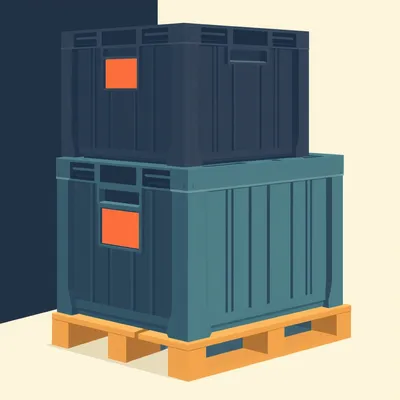
Daniel's last apartment move broke him open, literally — his IKEA bins shattered under five kilos of hardware, plastic chipping like old paint. That sent him down the industrial storage rabbit hole: Euro boxes, boltless shelving, and then the thing that happens to everyone who goes down that hole. You find one modular system that actually works, and suddenly you're looking at everything in your house wondering why it isn't in a bin that clicks together. For Daniel, the company that answered that question was Akro Mills. He wants to know who they are, how they came to define the parts bin category, what makes their plastics genuinely best in class versus the Grainger and Uline knock-offs, and why a company this good stays mostly B2B when it clearly has fans beyond warehouse managers.

So today we're going to open the catalog, and I mean really open it, on Akro Mills. And I should say, I get why Daniel went down this path. I went through the same thing setting up my archery workshop. You start with one bin, then you need three more, then you're standing in the garage at eleven at night rearranging fasteners by thread pitch and wondering where the evening went.
That's the gateway drug of modular storage. One parts bin and you're lost.
The thing is, what we're really talking about here isn't just a brand. Akro Mills didn't invent the parts bin. Small-parts storage has existed as long as people have had small parts to store. But they standardized the form factor and the material spec in a way that made everything else look like a prototype. Their core product, the AkroBin, is the Toyota Camry of industrial storage. Ubiquitous, unremarkable, and quietly excellent for forty years straight.
Unremarkable is the compliment here. Nobody writes love letters to a Camry, but it's what you buy when you want the thing to just work until your kids inherit it.
And the scope of their catalog is absurd. Shelf bins, hanging bins, cross-bins, bin racks, mobile trolleys, fixed shelving, drawer cabinets — over a thousand SKUs in the parts bin category alone. For people who care about this stuff, and Daniel is not alone, arranging these bins on a trolley is what he calls industrial poetry. That phrase is worth sitting with for a second. What does it mean to find aesthetic satisfaction in a system designed for forklifts and assembly lines?
It means the thing is doing exactly what it was designed to do and nothing else. There's no design flourish, no marketing story, no Scandinavian name that means "shelf" in Swedish. It's just a bin that holds parts and stacks perfectly with the bin next to it. That's the poetry — the absence of anything extra.
So let's get into the history, because it explains a lot about why the products feel the way they do. Akro Mills was founded in Akron, Ohio. The name is a portmanteau — Akron plus mills, referencing the manufacturing heritage of the region. This was the nineteen forties, and Akron was the heart of the American rubber and automotive supply chain. The company started out making metal bins and shelving for the factories and aerospace shops that dominated the Midwest.
Metal bins. So they were heavy, they rusted, and they made a terrible noise when you dropped one.
And they dented. The shift to injection-molded plastics happened in the nineteen sixties and seventies as the material science matured enough to hold dimensional tolerances. That timing matters. Akro Mills wasn't chasing a trend — they were early enough that they got to define what a plastic parts bin should be before anyone else had shipped one at scale.
So they wrote the spec that everyone else had to copy.
And the defining innovation was the interlocking bin system. Before Akro Mills standardized the footprint and stacking interface, every shop floor had a hodgepodge. Bins from different manufacturers that didn't stack, didn't fit standard shelving, didn't survive drops. You'd have a shelf full of mismatched containers leaning at different angles, and half of them would slide off if you bumped the rack. Akro Mills introduced a fixed-width system — the six-inch and twelve-inch modules that persist today — with a positive-lock stacking mechanism. The bins click together. They don't just sit on top of each other, they engage.
That's the sound Daniel's talking about. The click.
The click. And this was essentially the VDA 4500 standard before VDA 4500 existed, though Akro Mills' system predates the German standard by about a decade. They solved the same problem — modularity, interoperability, dimensional consistency — but they did it for American factory floors rather than European automotive supply chains.
So that's the company. But what actually makes the plastic different? Daniel says he's used both and the Akro Mills bins are best in class. What's happening at the material level?
This is where it gets interesting. Akro Mills uses a high-density polyethylene compound — HDPE — with a specific molecular weight and a UV stabilizer package that the knock-offs don't replicate. The knock-offs, the ones sold under Grainger's house brand or Uline's label, typically use cheaper polypropylene or recycled HDPE. And the difference in performance is dramatic.
How dramatic?
Real-world test. Drop an Akro Mills bin from eight feet onto concrete and it bounces. Drop a knock-off from the same height and it cracks. I've seen this demonstrated. The Akro Mills bin hits the floor and you hear a solid thump, and it's fine. The knock-off sounds different — more of a clatter — and you'll see a hairline fracture at the corner.
Eight feet is a real drop. That's someone on a ladder knocking a bin off a top shelf.
And in a warehouse or a maintenance bay, that happens constantly. The material formulation is the difference, not the mold design. The knock-offs look identical because they're cast from molds that are visually similar, but the plastic itself is a different recipe. Polypropylene gets brittle at low temperatures — leave a knock-off bin in an unheated garage in a Minnesota winter and it'll shatter if you look at it wrong. HDPE with the right molecular weight stays tough across a much wider temperature range.
And the UV stabilizers matter because a lot of these bins live near loading dock doors or in unconditioned spaces where they're getting sun.
Right. Without UV stabilizers, HDPE degrades. It gets chalky, it loses flexibility, it eventually cracks. Akro Mills bins are rated for outdoor use and direct sunlight in a way the knock-offs aren't. The company also uses a textured finish that does two things: it hides scuffs so the bins don't look beat up after six months of use, and it provides grip so they don't slide around on shelving. The knock-offs are smooth. They show every scratch, and they're slippery.
So the knock-off looks new for about a week and then looks terrible for the rest of its life. The Akro Mills bin looks the same at year five as it did at month two.
And that's the buy-it-for-life quality Daniel was after. Now, the copycat ecosystem is worth understanding because it's not just about cheaper materials. Grainger, Uline, McMaster-Carr — they all sell bins that look identical to Akro Mills products at twenty to forty percent lower prices. But the dimensions are subtly different. A knock-off standard bin might be an eighth of an inch narrower than the genuine article.
An eighth of an inch.
Which is enough that it doesn't interlock properly with genuine Akro Mills bins. Or it fits loosely on the same shelving, so it wobbles. This is intentional. The knock-offs are designed to be just incompatible enough to lock you into their ecosystem once you buy in. You buy a dozen Uline bins because they're cheaper, and six months later you need more, and now you're stuck buying Uline bins forever because nothing else fits your rack the same way.
That's... almost elegant. It's not a defect, it's a business model. They're selling you a cheaper bin and a lifetime subscription to their ecosystem.
And most buyers don't notice until it's too late. They see a bin that looks the same and costs thirty percent less, and they don't think to measure the interlocking lip with calipers.
Who measures an interlocking lip with calipers?
Daniel might. But the average maintenance supervisor doesn't, and that's who Grainger and Uline are counting on.
So Akro Mills built a standard that's so good it spawned an entire industry of near-copies, and the near-copies are just close enough to confuse people and just different enough to trap them.
That's the game. And Akro Mills has been playing it since the seventies. Now, the other thing that makes their bins distinct is the hopper front. The scoop-shaped opening at the front of the bin where you reach in to grab parts. Akro Mills figured out the exact angle — roughly forty-five degrees — where small parts slide right out without getting stuck. The knock-offs use a steeper angle because Akro Mills patented their hopper design in nineteen seventy-two, and the knock-offs can't copy it without infringing.
So your washers get stuck in the knock-off bin. That's the kind of detail that drives someone insane after the fortieth time they have to dig a washer out with their fingernail.
It's the kind of detail that makes someone a customer for life once they've used the real thing. The bin does what it's supposed to do, every time, without friction. Literally.
Let's talk about how this one company's design decisions ended up shaping how entire industries organize their stuff. Because it's not just auto parts warehouses.
It's everywhere. Walk into any auto parts warehouse, any electronics assembly line, any aerospace maintenance facility, and you will see Akro Mills bins or their clones. The fixed dimensions and interlocking footprint mean that a bin system designed in nineteen seventy still works with shelving bought this year. That kind of backward compatibility is rare in any industry. In physical products, it's almost unheard of.
Fifty-plus years of interoperability. Most software companies can't manage five.
It extends well beyond manufacturing. Hospitals use Akro Mills bins for organizing surgical supplies. Schools use them for art supplies. The military uses them for ammunition and tool storage. The same bin that holds carburetor jets in a Detroit repair shop is holding sutures in a Chicago operating room. That's the power of a standard that doesn't care what you put in it.
The bin is agnostic. It doesn't know what a carburetor is. It just knows it's three inches long and fits in a six-inch-wide compartment.
That agnosticism is the whole value proposition. Akro Mills doesn't sell you a solution for organizing screws. They sell you a solution for organizing anything that fits in a bin. The customer brings the use case.
Which brings us to Daniel's bigger question. This company is clearly excellent. Their products have a cult following among people who care about organization. Why do they stay mostly B2B? Why isn't Akro Mills a household name?
The short answer is that they have no incentive to become one. Akro Mills sells through industrial distributors — Grainger, McMaster-Carr, MSC Industrial — because that's where their customers are. Those distributors handle logistics, credit, customer service, and returns for a fraction of what it would cost Akro Mills to build that infrastructure themselves. The company's margins depend on high-volume, low-touch B2B sales. A pallet of bins goes to a warehouse, the warehouse distributes them, and nobody at Akro Mills ever talks to the end user.
The moment you go direct-to-consumer, you need smaller packaging, different pricing, a marketing budget, a customer support team. All the things they've never needed to build.
The Amazon presence is minimal. It exists, and you can buy Akro Mills bins on Amazon, but it reads as a concession to hobbyists rather than a strategic channel. The pricing isn't competitive with what you'd pay through an industrial distributor if you have an account. The selection is limited. It's there so that when someone like Daniel goes looking, they can find it, but Akro Mills is not optimizing for that customer.
Which is almost frustrating, because you can see the product that could exist. A well-designed DTC storefront, bins sold in curated sets for home workshops and garages, maybe a configurator tool where you design your own trolley layout. It would print money among the Garage Journal crowd.
It would, but it would also be a completely different company. The margins in B2B industrial supply are healthy and predictable. The margins in DTC consumer goods are thinner and require constant marketing spend to maintain. Akro Mills has spent eighty years building a business that doesn't need to advertise, doesn't need to trend, and doesn't need to care whether anyone on Instagram is posting photos of their parts bins.
Yet people are posting photos of their parts bins on Instagram.
They are. The forums are active — Garage Journal, the workshops subreddit, the tool organization threads. People share photos of their Akro Mills setups, and the comments are always the same mix of admiration and envy. Someone posts a wall of perfectly arranged bins labeled with a Brother P-Touch, and fifty people reply asking where to buy the bins and whether the knock-offs are just as good.
The answer to that second question is always no, and the thread becomes a support group for people who bought the knock-offs and regret it.
The appeal is the same as the Euro box community Daniel found first. It's the satisfaction of a system where everything fits, everything stacks, and nothing wobbles. For people who find joy in order, Akro Mills offers a kind of visual and tactile pleasure that IKEA can't match. The bins are heavy. They click together with authority. They survive moves. That's the industrial poetry — it's the feeling of using a tool that was designed for a purpose and executes it perfectly, even if that purpose is just holding screws.
There's something almost meditative about it. You're standing in your garage, and every fastener you own has a designated place, and that place is clearly labeled, and the bin that holds it will still be holding it in twenty years. In a world where everything else is disposable and poorly made, that's satisfying.
It's the opposite of planned obsolescence. Akro Mills bins are designed to outlast the person who bought them. And that's not a marketing claim — it's just what happens when you make something out of the right materials to the right tolerances and sell it to people who use it hard. The bin doesn't know it's supposed to fail after three years. Nobody told the HDPE.
The HDPE was not briefed on the business model.
Right. So the question of whether Akro Mills could enjoy broader popularity — I think the answer is that it already does, just not in a way the company measures. The people who know about Akro Mills really know about Akro Mills. They're evangelists. They tell their friends. They post on forums. They leave reviews that read like love letters. The company has a brand that most consumer companies would kill for, and they built it without a marketing department.
The brand is the product. You don't need a slogan when the bin bounces.
I think that's the real lesson here. The best products are the ones you never think about until you need them, and when you need them, they work exactly the way you expect. Akro Mills has been doing that for eighty years, and they'll probably do it for eighty more, and most people will never know their name.
Before we move on, I want to circle back to something you mentioned earlier. The hopper front angle. Forty-five degrees, patented in nineteen seventy-two.
Roughly forty-five degrees. I'd need to check the exact patent filing, but that's the ballpark.
Hilbert: It's forty-seven degrees.
Hilbert.
Hilbert: The patent is US three six nine eight five six three. Filed March nineteen seventy-one, granted October nineteen seventy-two. The hopper angle is forty-seven degrees from horizontal. I know this because I spent six months in nineteen ninety-eight restocking Akro Mills bins at a Grainger distribution center in Elk Grove Village, Illinois. My job title was bin merchandiser, which is not a real job title, but it paid nine fifty an hour and I could lift forty pounds without thinking about it. Eight hours a day handling those bins, stacking them, watching customers pick them up. Mostly mechanics and maintenance supervisors. They'd walk in, grab a bin off the shelf, set it on the concrete floor to test it. The Akro Mills bins made a sound — a solid thump. The knock-offs made a hollow clatter. You could tell blindfolded.
Forty-seven degrees. I was close.
Hilbert: Two degrees matters. The knock-offs use fifty-two or fifty-five degrees because they can't touch forty-seven without a lawsuit. At fifty-five degrees, small flat washers don't slide. They catch. You have to shake the bin or dig them out. It's the difference between reaching in and just working, and reaching in and being annoyed every single time for the rest of your life. Akro Mills figured that out in nineteen seventy-one and locked it down. The plastic matters, sure, but the geometry is the thing nobody talks about.
You know this because you spent six months watching people shake washers out of knock-off bins.
Hilbert: I know this because I have about forty Akro Mills bins in my garage right now, organized by fastener type, and my wife has threatened to leave me over the labeling system.
What's the labeling system?
Hilbert: Brother P-Touch, twelve-point Helvetica, all caps. She says it looks like a serial killer's evidence locker. I told her a serial killer wouldn't use Helvetica. That's the whole point of Helvetica — it's neutral. It doesn't judge. She didn't find that reassuring.
Forty bins is a commitment.
Hilbert: You start with six. Then you realize you need a separate bin for M five washers and M six washers because mixing them is chaos. Then you need a bin for the M five lock washers, which are different from the flat washers. Then you're standing in the garage at midnight with a label maker and you've crossed a line you can't come back from. The bins are great. I don't regret the bins. I regret nothing.
The forty-seven degrees is going to stick with me. That's the kind of detail that makes you look at a bin differently.
Hilbert: It's the kind of detail that cost someone at Akro Mills six months of testing in nineteen seventy. They probably tried forty-three, forty-five, forty-eight, fifty. They watched washers slide and catch and slide and catch until they found the angle where nothing catches. Then they wrote it down and filed a patent and nobody thought about it again except the guy whose job it was to copy it and couldn't.
Now we're talking about it on a podcast.
Hilbert: Now we're talking about it on a podcast. That's the thing about industrial design. The best decisions are invisible. You only notice them when someone gets them wrong.
The invisible infrastructure of everyday life. That's what Akro Mills is, really. Eighty years of making bins that work, and most people will never know their name, and the people who do know their name will never shut up about them.
The question Daniel's left us with is whether that's enough. Akro Mills has been quietly defining industrial storage for eight decades. As the maker movement and home workshop culture grow, will the company ever acknowledge its consumer fanbase, or is it content to remain the invisible infrastructure behind every organized workspace?
I think the rise of 3D printing and custom storage solutions could challenge the one-size-fits-all model eventually. But there's something to be said for a standard that just works, and has worked for half a century. The best products are the ones you never think about until you need them. And when you need them, they bounce.
Thanks to our producer Hilbert Flumingtop for keeping us honest on hopper angles and for the Helvetica confession.
If you have a weird prompt — something you've been wondering about, something niche, something that keeps you up at night — email the show at show at my weird prompts dot com. We'll do the research, we'll find the story, and we'll tell it.
This has been My Weird Prompts. I'm Herman Poppleberry.
I'm Corn. We'll be back soon.