Daniel's been staring out an airport window watching the organized chaos on the ramp and wants to know how any of it works. Who's coordinating the luggage carts, the catering trucks, the fuel bowsers, the buses ferrying passengers around? Do the people driving those vehicles go through security every single shift? Who has legal jurisdiction over the miles of roads inside an airport? And the question I genuinely want answered — can you get a speeding ticket on a luggage cart, and who writes it?

The speeding ticket question is better than it sounds, because the answer is yes, and it's not a joke. But start with the coordination, because that's the part that looks like chaos and isn't.
It looks like a ballet where half the dancers are trying to hit each other and somehow never do.
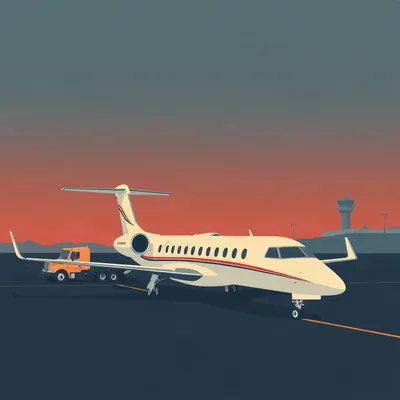
That's actually the right image. The ramp — or the apron, if you want the technical term — is this liminal zone between the terminal and the taxiway. It's not the runway, it's not the public road, it's this in-between space where aircraft park and everything that needs to reach an aircraft converges at once. At a major hub like Atlanta or O'Hare, you're looking at miles of internal roads, dozens of gates, and hundreds of vehicles moving simultaneously. It's a miniature city with its own traffic patterns, except the pedestrians weigh four hundred thousand pounds and cost three hundred million dollars.
And the guy in the luggage cart is making seventeen dollars an hour.
Probably not wrong. But here's what most people don't realize — the person coordinating all of this is not air traffic control. The tower handles aircraft on the taxiways and runways. The ramp has its own controller. It's called apron control or ramp control, and it's a completely separate function.
Separate how? Different frequency, different room, different people?
Different everything. At some airports it's a dedicated ramp control tower — you'll see a smaller tower positioned between terminals, lower than the main ATC tower. At others it's a desk in the operations center with a bank of screens. The ramp controller is managing vehicle movements, gate assignments, and ground crew operations, and they're doing it on a dedicated radio frequency that the pilots don't hear. They're talking to the tug drivers, the baggage supervisors, the catering dispatchers.
So the pilot lands, gets handed off from tower to ground control for the taxi, and then at some point gets handed off again to ramp control for the final approach to the gate?
The handoff point is usually a painted line on the taxiway — the non-movement area boundary. Once the aircraft crosses that line, it's in ramp territory, and the ramp controller takes over. That's the person who tells the pilot which gate, which lead-in line to follow, and whether there's a baggage cart that hasn't cleared the zone yet.
And meanwhile that same controller is also telling the catering truck to hold at gate B-twelve because the fuel truck hasn't disconnected yet.
That's the job. You're holding a mental model of maybe forty vehicles and six aircraft all moving through the same tight space, and your job is to make sure none of them occupy the same square of concrete at the same moment.
How many people are we talking about for a single widebody turnaround?
A widebody — say a triple seven or a three-fifty — you're looking at fifteen-plus vehicles and twenty-plus ground crew, all converging on one aircraft for a window of about forty-five to ninety minutes. You've got the marshaller guiding the plane in, the jet bridge operator connecting the passenger door, baggage handlers on the forward and aft cargo holds, a fuel truck connecting to the wing, a catering truck lifting to the galley door, a lavatory service truck, a potable water truck, sometimes a cabin cleaning crew, and then the pushback tug at the end to push the aircraft back out. Every one of those vehicles has a specific position and a specific sequence, and if the catering truck arrives before the fuel truck disconnects, you've got a problem.
And all of this is choreographed by one ramp controller?
One controller per zone, typically. At a big airport the ramp is divided into sectors, each with its own controller. But within that sector, yes, one person is sequencing all of it. They're working off a schedule that's measured in minutes — the airline's ground handler has a turnaround plan that says baggage unload starts at plus-three minutes, catering connects at plus-fifteen, fueling completes by plus-thirty. The ramp controller is the referee making sure those plans don't collide with each other across different aircraft.
You mentioned ground handlers. Who actually employs the guy driving the luggage cart?
This is where it gets fragmented. Airlines contract with ground handling companies — the big ones are Swissport, Menzies, Dnata, Worldwide Flight Services. These companies provide the baggage carts, the catering trucks, the pushback tugs, and the people who operate them. Each ground handler has its own dispatcher and its own radio channel, so there's a layer of coordination below the ramp controller. The handler's dispatcher is telling their drivers where to go, and the ramp controller is integrating all the different handlers' movements into one coherent picture.
So you've got multiple companies operating on the same ramp, each with their own radio net, and one controller trying to keep them from hitting each other.
And the aircraft. That's the part that concentrates the mind. A baggage cart hitting a seven-three-seven's engine cowling is a million-dollar repair and an aircraft out of service for days. The ramp speed limits exist because the cost of a collision is astronomical.
Which brings us to Daniel's speeding ticket question.
I want to get there, but let me finish the coordination layer first, because there's a technology dimension that's changed things. Most major airports now run digital ramp management systems — these are platforms that track vehicle positions via GPS or RFID tags, giving the ramp controller a live map of every vehicle on the ramp. Think of it like a dispatcher's screen at a logistics company, but the icons moving around are fuel trucks and baggage carts and the stationary objects are hundred-million-dollar aircraft.
Does that replace the radio, or just supplement it?
Supplements it. The radio is still the backbone. You can see on the screen that catering truck fourteen is approaching gate B-seventeen, but you still get on the radio and tell them to hold short because the fuel truck hasn't cleared. The digital system gives you situational awareness, but the coordination is still human-to-human voice communication. And honestly, that's partly because the ramp is a noisy, fast-moving environment where looking at a screen isn't always practical when you're driving.
What happens when the digital system goes down?
The ramp doesn't stop. Controllers revert to radio-only coordination and paper gate assignment sheets. It's slower, but it works. Airports ran this way for decades before GPS tracking existed. The technology is a force multiplier, not a dependency.
Alright, so we've got this intricate choreography of vehicles and people. How does anyone actually get out there to do the dancing? Daniel's second question — do these workers go through security every shift?
They do, but not the way passengers do. This is one of the biggest misconceptions about airport work. The airside worker is not standing in the TSA line at five in the morning behind a family going to Orlando. They use a completely different system.
Which is?
The SIDA badge. Security Identification Display Area. Every airside worker must hold one. To get it, you pass a background check — criminal history, immigration status, the works — and then you receive a badge that's programmed with specific access zones. Your badge might open doors in Terminal B but not Terminal C, or let you onto the ramp but not into the baggage handling area. The badge is the credential. The background check is the gate.
So the daily routine is what — swipe in and you're through?
Swipe in at a dedicated staff entrance, and you're subject to random screening. The key word is random. You might go weeks without being pulled aside, or you might get screened three days in a row. But it's not the full passenger experience — no taking off your shoes, no liquids bag, no body scanner unless you're randomly selected for enhanced screening. The TSA calls this the Known Crewmember program for flight crews, but ground workers have a parallel system under the SIDA framework.
So the security is in the credentialing, not the daily checkpoint.
Right. The theory is that someone who's passed a federal background check and holds a SIDA badge is a known quantity. The random screening is a deterrent and a spot-check, not the primary security layer. The primary layer is the vetting.
Does that actually work?
It's worked well enough that there hasn't been a major airside security incident from a badged worker in the US in decades. The vulnerabilities tend to be in things like badge sharing or tailgating through access doors, not in the vetting process itself. Airports have gotten much stricter about those in the last ten years — you'll see mantraps and anti-tailgating gates at most staff entrances now.
Mantraps. That's the thing where you walk into a glass box and the door behind you has to close before the door in front opens.
One person per badge, no exceptions. If you try to follow someone through, the system alarms and security responds. It's a physical enforcement of the one-badge-one-person rule.
Alright, so you're badged, you're through the mantrap, you're on the ramp. You're now in a weird legal space. Daniel's third question — who has jurisdiction over the roads?
This is where it gets interesting. Airport roads are a patchwork. The public roads — the terminal loop roads, the access roads from the highway, the parking garages — those are typically under local or state jurisdiction. If you speed on the terminal approach road, a city cop or a state trooper writes you a standard traffic ticket under state vehicle code.
But once you cross onto the ramp?
Different world. The ramp is a private, federally-regulated space. It's owned by the airport authority, which is usually a municipal or regional government entity, but it operates under federal aviation regulations. The roads on the ramp are not public thoroughfares. They're service roads within a secured area, and the rules that govern them are airport ordinances, not state traffic laws.
So the airport has its own police force?
Most large airports do. Airport police are sworn law enforcement officers with full arrest powers, but their jurisdiction is the airport. They enforce airport-specific traffic codes on the ramp. If you're doing twenty-five miles an hour in a ten-mile-an-hour zone on the ramp, you're not getting a state speeding ticket — you're getting an airport authority citation, issued by airport police or a ramp safety officer, under the airport's own traffic ordinance.
And the consequences?
Real ones. A ramp speeding violation can mean a fine, mandatory safety retraining, and in serious cases, badge suspension or revocation. Lose your badge, lose your job. The enforcement is strict because the stakes are high — a vehicle-aircraft collision can cause millions in damage and potentially injure people. Ramp speed limits are typically five to fifteen miles per hour near gates, and they're enforced with speed guns just like on a public road.
I'm now picturing an airport cop with a radar gun hiding behind a fuel truck.
I'm told they don't hide, but they absolutely do use radar. And the citations are real legal documents. There was a case a few years ago — a baggage handler at a major US hub was clocked at twenty-five miles an hour in a ten-mile-an-hour zone on the ramp. Airport police issued a citation under the airport's traffic code. He faced a three-hundred-dollar fine plus a mandatory safety review, and his badge was suspended for a week. That's a week of no pay.
So the answer to Daniel's question is yes, you can get a speeding ticket on a luggage cart, and it's the airport police who write it.
And it's not a joke ticket. It's a real citation with real consequences. The airport authority has the legal power to enforce these rules because the ramp is not a public road. It's a secured operational area, and the FAA delegates enforcement authority to the airport operator under Part 139 of the federal aviation regulations.
What about the gray zone — the roads that are sort of public but sort of not? The service roads that run around the perimeter?
That's where it gets murky. Some perimeter roads are public and patrolled by local police. Some are airport authority property but open to certain vehicles. The jurisdictional line is literally painted on the ground in some places — there will be a sign that says "Entering Secured Area — Airport Authority Jurisdiction" and once you cross it, the rules change. If you're on the wrong side of that sign and you get pulled over, which agency writes the ticket depends on which side of the line you're on.
Has anyone ever fought one of these in court? Argued that the airport doesn't have the authority to issue traffic citations?
It's been challenged, but generally the courts have upheld airport authority jurisdiction on the ramp. The reasoning is that the ramp is not a public right-of-way — it's a restricted operational area where the airport operator has a federal obligation to maintain safety. The traffic rules are part of that safety obligation, and the enforcement authority flows from it.
So the ramp is basically a company town with its own laws and its own cops.
That's... not a bad analogy, actually. The airport authority is the company, the ramp is the town, and the airport police are the sheriff. Except the company town is regulated by the FAA and the sheriff has federal security obligations.
And the speed limit is ten miles an hour.
Five in some zones. Near active gates, near fueling operations, anywhere with limited visibility. The rule of thumb is that if you can't stop before hitting an aircraft, you're going too fast.
Which brings up the question of what happens when there's no driver at all. Airports are starting to test autonomous baggage carts and autonomous pushback tugs. Who gets the ticket when the robot speeds?
That's unsettled. The current framework assumes a human operator. The citation goes to the driver, and the driver's employer bears the administrative consequences. With an autonomous vehicle, the operator is the company that deployed it, but the liability question hasn't been fully tested. Does the airport cite the ground handler? The software vendor?
Somebody's going to be the first test case.
And the lawyers are already salivating. There's also the question of whether an autonomous cart can even be "pulled over" in the traditional sense. If there's no driver to flash the lights at, does the ramp controller just... radio the dispatcher and tell them their robot is speeding?
Remote shutdown, probably. The controller or the safety officer sends a stop command and the vehicle pulls over autonomously. Which is somehow more humiliating than getting pulled over by a cop.
The cart tattles on itself. The telemetry data will show exactly how fast it was going, exactly where, and for exactly how long. There's no arguing with the radar gun when the vehicle's own logs confirm it.
You know who I want to hear from on this? Hilbert. He's been sitting there making faces for the last twenty minutes.
I noticed that. Hilbert, you've got a look.
Hilbert: Summer of ninety-four. I drove a baggage cart at Bradley International for three months. The ramp controller was a man named Gus who had been there since the airport opened and communicated exclusively by yelling.
What did Gus yell at you about?
Hilbert: I cut across a taxiway line. I didn't know what the yellow lines meant. Gus explained it to me at a volume that suggested I had personally endangered the republic.
Did you get cited?
Hilbert: Written warning. Twelve miles an hour in a five-mile-an-hour zone near Gate twelve. I still think it wasn't my fault — the cart had a bad speedometer. The needle bounced between zero and twenty if you hit a seam in the concrete. I told the safety officer this and he said the speed limit was five and I was going faster than five and the condition of the speedometer was not his problem.
That's the most Hilbert sentence I've ever heard.
Hilbert: The thing about the coordination question — you're making it sound organized. It's not organized. The radio is just people yelling at each other. Gus would yell at the catering dispatcher, the catering dispatcher would yell at his drivers, the drivers would yell back that they were already at the gate, and Gus would yell that no they weren't because he was looking at the gate and there was no truck there. Turned out the driver was at the wrong gate. Happened twice a shift.
So the digital tracking systems solved a real problem.
Hilbert: They solved the wrong-gate problem. They didn't solve the yelling. The yelling is cultural.
What about security? You had a badge in ninety-four?
Hilbert: Paper card with a photo laminated on it. They took the photo in a closet next to the baggage claim office. I never once went through a metal detector or any kind of screening. I just held up the card at the door and the security guard waved me through. The guard's name was Walter and he read the newspaper all shift.
That's... a very different security posture than today.
Hilbert: Different world. The badge didn't even have a barcode. It was just a piece of paper in plastic. I think I still have it in a box somewhere.
You kept your expired airport badge from nineteen ninety-four.
Hilbert: It's a memento.
Does it still get you through any doors?
Hilbert: It wouldn't get me through the door of the Denny's that used to be next to the airport. But it's a nice memory. Walter was a good guy. He'd save me the sports section.
The contrast between that and today's mantraps and biometric scanners is pretty stark.
Hilbert: The mantrap wouldn't have worked on Walter. He'd have propped the door open with a trash can because the air conditioning was better in the hallway. That was the security culture. Nobody thought about it.
Hilbert, you've just described a security environment that would give a modern airport administrator a heart attack.
Hilbert: It was fine. Nothing happened. Gus yelled at everyone, Walter read the paper, I drove a cart with a broken speedometer, and the planes all took off on time. I don't know what that says about security, but it says something.
It says that a lot of airport security is theater layered on top of a system that mostly works because the people in it are professionals who don't want to crash into things.
Hilbert: The speedometer was still broken. That wasn't theater. That was a maintenance budget problem.
And you're still annoyed about the written warning.
Hilbert: Thirty-two years. I'm still annoyed.
The future of ramp coordination is probably going to make Hilbert's experience seem quaint. Airports are already testing autonomous baggage carts at a few hubs — Singapore Changi has been running trials, and Frankfurt is looking at autonomous pushback tugs. The coordination problem shifts from managing drivers to managing fleets of robots that talk to each other directly.
Does that make the ramp controller's job easier or harder?
Both. Easier because autonomous vehicles follow rules perfectly — they don't cut across taxiway lines, they don't speed, they don't go to the wrong gate. Harder because now you're managing a mixed fleet of autonomous and human-driven vehicles, and the humans are unpredictable in ways the robots aren't programmed to handle.
The robot expects everyone to follow the rules, and the human in the catering truck is running late and takes a shortcut.
That's exactly the failure mode. The autonomous cart stops because its sensors detect an obstacle, and now you've got a traffic jam on the ramp because a human broke the pattern. The ramp controller has to untangle it over the radio, except the robot doesn't have a radio — it has a telemetry link to a control center somewhere.
And when the autonomous cart does something wrong, who gets the citation?
That's the open question. The current framework doesn't have an answer. The FAA is working on regulations for autonomous ground vehicles at airports, but they're not final yet. The liability chain is going to be complicated — the ground handler deployed the vehicle, the manufacturer built it, the software vendor wrote the navigation code. When a robot speeds, the ticket has to go to a legal entity, and nobody's decided which one.
The software vendor getting a court summons for a speeding robot is a very twenty-first-century legal problem.
The court won't know what to do with it. "Your Honor, my client, the autonomous baggage cart serial number four-seven-two, pleads not guilty on the grounds that its lidar calibration was within spec."
I'd watch that trial.
You'd nap through it.
Fair. But the larger point stands — the ramp is this hidden city with its own traffic laws, its own police force, its own rush hour, and its own emerging technology problems. Most passengers never think about it. They board the plane through a jet bridge that blocks the view of everything happening below.
The ramp is deliberately hidden. The terminal is designed to give passengers a clean, climate-controlled experience. You're not supposed to see the fuel truck or the lavatory service cart or the baggage handler throwing your suitcase. The chaos is backstage, and the backstage has its own rules.
And its own cops.
And its own speeding tickets.
This has been My Weird Prompts. Thanks to our producer Hilbert Flumingtop, who apparently still has a paper airport badge from the Clinton administration.
I want to see that badge sometime.
We'll do a show-and-tell episode. Find us at my weird prompts dot com, or email the show at show at my weird prompts dot com. We'll be back soon.