Ezra asleep by eight, office off limits, and a noise floor that only gets acceptable once the air conditioning dies. That's the situation Daniel's working with, and his question is the one every small-flat voice person eventually hits: how do you build a recording position that assembles in minutes, packs away in minutes, and doesn't assume you own a room.

And the honest version, Corn, is that nobody in the voiceover world owns a room. The whole trade runs on hotel rooms, closets, back seats and things draped over chairs.
He's asking about two configurations of one rig. Daytime, the desk with the three monitors at table height. Night-time, a laptop somewhere quieter in the flat, because that's when he can actually record. Closet booths, blanket forts, the commercial portable things, and the one he's skeptical about, the parked car, which he's heard is surprisingly dead acoustically. He wants to know if that's real, and how you'd do it well.
It's real. But the answer to all of it starts with one distinction, and if you get this wrong you buy the wrong product and are disappointed by it.
Treatment versus isolation.
Treatment is killing the reflections inside your space, with soft absorptive material. Isolation is keeping outside noise out, and that takes dense, heavy, decoupled mass, walls that don't touch other walls. The Violet Recording guide on home booths makes the point that for most voiceover work, reflections are the thing to fix first, because isolation is much harder and much more expensive. Here's the uncomfortable corollary.
A blanket fort doesn't stop the neighbour's dog.
Nothing portable stops the neighbour's dog. A closet full of coats, a blanket fort, a two-hundred-dollar foam ball around your mic, these are all treatment devices. They change how the room sounds. They do not change what gets in.
So if Daniel's problem at midnight is a truck on the street, the answer isn't a better booth.
The answer is record at eleven instead of twelve. That's why most home-booth purchases disappoint. People buy a treatment device hoping it's an isolation device, and then blame the device.
Eighty-five dollars of disappointment, usually.
Less than that, actually, and this is the good news. Bob Gatchel, who writes the Advice For Actors newsletter, has a line I'd put on the wall: if your sound is bad before it reaches the mic, no amount of expensive gear will rescue it. His version of the price point is that a thousand-dollar microphone in a bare room sounds worse than a hundred-dollar mic in a treated corner. And Topher Keene says the same thing as a rule: don't let the tech outrun the space. A level two microphone in a level zero room sounds worse than a level one microphone in a treated one.
The sloth position on this is well documented. Placement is free, gear is not.
You've said that before and it holds up. The cheapest treatment that actually works is the moving blanket. The thick kind movers use on furniture. Keene's numbers: fifty to a hundred dollars for a handful of them, and they do most of the work. Proper acoustic panels cost roughly three times as much and are only marginally better.
The blanket fort beats the bare closet, I assume.
Gatchel's exact words. "The blanket fort beats the bare closet. Every time." Because the closet advice is half right. A closet with dense clothing hung on at least two opposing walls absorbs, coats are honestly good absorber. An empty closet is a trap, his word. Hard surfaces on all sides that will hurt your vocals more than help them. StudioBricks adds the other problem with closets, they're cramped, so mic positioning and posture go out the window.
A tiny untreated box you also can't move in.
You can hear a self-taped audition recorded in a bathroom, by the way. Gatchel's first casting note ever was exactly that, sounds like you're in a bathroom. He was, and the microphone heard every bounce.
The build he cites, the one that keeps getting shared around. What's actually in it?
Three moving blankets, a grommet kit, eight command hooks, four drywall anchors, four screw-eye hooks, four carabiners. Under forty-five minutes to assemble, under eighty-five dollars total, and if you split a twelve-pack of blankets with friends it's about forty dollars a person. The detail that matters for Daniel is at the end. The whole rig disassembles. Blankets down, folded, back in the closet. Well. Back in a different closet.
He lives in a small flat with a toddler. The disassembly is the feature, not a bonus.
Right. And two cautions stop that build from being the whole answer. One, cheap thin foam and thin blankets barely touch the low-mids where the voice actually lives, so density is the whole game. Two, you don't blanket the entire room. Gatchel's guidance is to treat only the surfaces that reflect directly back at the mic, the wall behind you and either side of your mouth, then the corners as bass traps, covering maybe twenty to thirty percent of your wall space at the key reflection points. A full wall is wasted money unless the room is a cube.
Which a PVC frame then buys you.
Keene's mid-tier suggestion. A pipe frame about the size of a changing room, draped in moving blankets, two or three layers if you want. It treats echo well. It isolates almost nothing, which is the theme of the whole first half of this episode. And every small enclosure carries the same warning, ventilation. DG Floors flags it, and it matters for anyone sealed in a fort for an hour, and it matters double for Daniel, who is considering recording at night with the air off.
He's already solving that by location. Somewhere with a window, I'd guess.
Now the commercial booths, because this is where the money goes and the testing gets thin. Sound On Sound did a group test in twenty fourteen with Professor Trevor Cox, in the anechoic chamber at Salford, and the reason that test exists is damning. By then there were hundreds of thousands of portable vocal booths in homes and studios, a category SE Electronics created with the Reflexion Filter back in two thousand six, and SOS's finding was that there was no reliable information in the public domain on their effectiveness. None had ever been rigorously tested.
Hundreds of thousands sold, one test.
One test. And the results were bracing. The booth that screened best against reflections did so mainly because of its size, the Real Traps one. The Kaotica Eyeball, which almost completely encloses the microphone, they found was only effective above around one kilohertz, because of its lack of mass. And SOS's overall verdict was that the differences are subtle, and sometimes it's hard to say whether the sound with the screen in place is better or worse.
A two-hundred-dollar ball that works on the sibilance and nothing else.
At the top end it gets stranger. The IsoVox Two is eleven hundred dollars, twenty-six pounds, does three-hundred-sixty-degree treatment, but only works with vertically mounted side-address mics, and reviewers call it boxy and boomy. Box-iness is the recurring complaint across the whole category. The Porta-Booth Pro is the famous one, seven pounds, assembles in seconds by closing two zippers, foam inside rated at seventy percent absorption. Its origin story is the best part. Harlan Hogan invented it because, travelling for voice work, he kept, quote, building pillow forts and trying to use comforters as acoustic reinforcement in hotel rooms. The product is an industrialised pillow fort.
So the pros do the same thing Daniel's about to do, they just pay for it.
They pay for convenience and consistency. The VocalBoothToGo comparison table, vendor table so read it with care, ranks these things by internal space, and that ranking is quietly the most honest thing in the industry. The VOMO, biggest, fits a paper script, tablet or laptop. The IsoVox, not large enough for a laptop. The Porta-Booth, no space for a script. The Kaotica, no internal recording space at all, the eyeball only surrounds the microphone.
The spec sheet is a list of what you can't bring.
And that's the underreported angle on the whole category. Ergonomics. Closets are cramped, small booths have no room for a script, sealed enclosures get hot. The best-sounding setup may be the one you can't read in for forty minutes, and Daniel needs to read in at night. That's the tension nobody's comparison table captures.
We did an episode once on who actually uses voice technology, and the whole answer was people in improvised situations. This is the physical version of the same story.
The room, not the software.
So a blanket fort is a treatment device, not an isolation device, and that distinction is the whole episode so far.
It is, and I stand by it.
Which is apparently an invitation. Opal's on the line.
Opal: Sorry, I've been nodding along for months and I think I've missed step one. When you say a blanket fort kills reflections, what is a reflection, is it like an echo I can hear, or is it the room being a bit echoey even when I don't notice? And is isolating the same as soundproofing, like putting something over the door so the neighbour's dog stops coming in?
Opal, think of it like this. A reflection is your voice bouncing off a hard surface and arriving at the mic a fraction of a second late, like shouting across a valley, only the valley is your wall and the echo is a few milliseconds behind your words. You may not consciously notice it, but it makes you sound like you're recording in a room rather than nowhere at all. Isolating is a different job entirely, that's keeping the dog out, and it takes heavy sealed mass, not fabric.
We spent forty minutes getting there. He did it with a valley.
That's the treatment side. The isolation side is where the parked car comes in, and the car is the fun one, because it's the only booth on the list that is also a machine for making noise.
RØDE says it plainly, doesn't it.
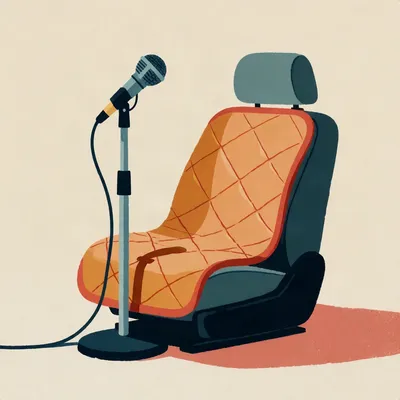
Flat out. Cars are excellent DIY sound booths, probably the best most do-it-yourself filmmakers will have access to. Their mechanism is the carpeted floor, the plush seats, and the airtight seals on the doors and windows. Recording Hacks adds the parts I find more interesting. The cabin is a small space lined about sixty percent with sound-absorbent foam and fabric, it has no parallel surfaces that could set up standing waves, and the whole thing is effectively shockmounted from the road. Their preferences are hardtops and cloth seats.
No parallel surfaces. That's the part the blanket fort can't copy.
Jason Bermingham, who wrote the session notes piece for Sound On Sound about recording voiceover on the road, documented doing it in rental cars on tour with an Apogee MiC into Twisted Wave on an iPhone, and he quotes the old adage, when all else fails, the back seat of an automobile makes a good recording studio. There's a counter-voice, though. Jason McCoy at Voice Acting 101 tried it on vacation and found his car recordings too boxy, and went back to pillows and a blanket. Small cars especially.
A sedan is a box that ate some foam.
A box with a lot of engineering budget spent on not rattling. But here's the catch under the endorsement, and it's the reason the car needs its own discipline. The fan. Even the lowest HVAC setting produces forty to fifty decibels SPL of broadband noise in the speech range, that's location-sound guidance from Soundrolling, and the blower hiss sits around one to four kilohertz, which overlaps exactly with the consonants that make speech intelligible. The engine adds low rumble below two hundred hertz. So the car is a great room attached to a noise factory, and you're not fighting the room, you're fighting the vehicle.
How would you actually do it, then. Say Daniel drives somewhere and parks at ten at night.
He wouldn't. He's got a sleeping toddler and a flat. But play it out.
Deaden the space first. RØDE's recipe is towels and blankets over the dash and the windows, then a Joby-style mount, mic in the cold-shoe connector, angled at your face. Their preferred seat is the middle of the back seat, which keeps you as far as possible from any reflective surface, and gives you the centre console to rest a laptop on. The alternative is the front seat with the mic clamped to the steering wheel.
The console is the answer to where the script goes, which is Daniel's actual question.
It's the only answer in a car. The script lives on the console or a tablet, never taped to the mic. SCHOEPS, who write about miking cars from the high-end side, list the standard positions, from below off the centre console, from above on the sun visors or the rear-view mirror, from in front on suction-cup holders on the windshield. For a parked car they say the distance can be somewhat greater than you'd expect, and their governing principle is the one to keep, the ratio of speech to noise must be as great as possible, with the mic near the mouth.
And the engine and fan?
Off. Completely off for the take. Soundrolling's summer workaround is the professional version of suffering. Run the AC between takes to cool the cabin, kill it for the take, budget recovery time, engine off between takes. Videomaker's low-tech version is a fan for circulation between takes if the space isn't air conditioned. And where you park matters as much as how you sit in it. A garage is best, otherwise somewhere with minimal traffic, away from flight paths and construction.
A booth you have to commute to.
Now, how do you know whether any of this worked. That's the measurement discipline, and it's the part Daniel asked about directly, because he's already doing a crude version of it every night when he kills the air conditioning.
The noise-floor check.
Jay Myers' procedure. Set your recording levels so peaks land at minus twelve to minus six. Hit record, then leave the space. Try not to walk, talk, or even breathe loudly. Record thirty seconds to a minute of room tone, trim off your entrance and exit, then look at where the meter spends the majority of its time. That's roughly your noise floor. Adobe Audition's loudness tab gives you the average figure, YouLean is a free alternative if you don't own Audition. Myers' own words on precision, you don't need to be exact, just confident it's averaging below a certain level.
What are the tiers?
His scale. Minus sixty-five or lower, professional. Minus sixty, darn good. Minus fifty-five, good, and that's the line for most home studios. Minus fifty, could be better, and above that you start running into issues. Then there's the published spec side. The ACX requirement for audiobooks submitted to Audible is room tone at minus sixty, RMS between minus twenty-three and minus eighteen, peaks at minus three.
And Daniel should chase that minus sixty.
Minus sixty, yes. What he should not chase is the minus seventy requests that circulate. Chris Radley is blunt about those. Most voice talent with home studios, using many of the booths currently on the market, even with a reasonable mic, would be unable to meet a minus seventy specification. His own booth is a proper Esmono in a basement with thick walls, achieves minus sixty without a problem, just about minus seventy, and only with a bass roll-off below a hundred hertz because sub-bass from traffic is unavoidable in a town.
One caveat on all these numbers, though. They're not what they sound like.
They're not SPL. They're dBFS or RMS, relative to digital full scale, so a minus sixty noise floor is a statement about your gain staging and your whole recording chain as much as about the room. Same room, different preamp gain, different number. Which is why the procedure fixes your peaks first, so the floor reading means something.
What actually makes up the floor in a flat like his?
Myers' list. Ambient noise, the fridge through the shared wall, plumbing, traffic, the furnace. Mic self-noise, and his rough line is that anything above minus sixteen self-noise might not be the best bet for voiceover, though the Neumann U87, the most prevalent VO mic there is, is minus twelve, so the rule bends for good mics. Cable interference, never lay a power cable across an XLR, keep it away from USB runs and the phone. Preamp hiss.
The fixes that don't cost money.
High-pass filter, fifty to eighty hertz for lower voices, up to a hundred or hundred-twenty for higher ones. Move the recording spot away from the wall shared with the fridge. Turn off anything that hums. And the one I'd underline for Daniel, use the polar pattern. Point the mic's dead zone at the noisiest point in the room, the door, the wall with the pipe, the side the street is on. A cardioid's null is a real physical resource. On noise-reduction plugins, Myers says it's always, always better to improve the audio at the source, and he's right.
So for the two-configuration problem, night-time Daniel carries the mic, the laptop stays on longer cables, the air goes off for the take, and thicker padding on the floor if there's rumble from below. Keene's list, and it maps onto this exactly.
With the desk version of that advice being, keep the computer and its fans outside the blanketed zone. Which, with three monitors on the table, is its own project.
The iterative method costs nothing, though.
Gatchel calls it the pro method. Record the empty space, listen, bring in one piece of treatment, re-record, repeat until the room cuts reflections evenly. Your ears are the cheapest analyzer you own. And Bermingham's hotel version is the sanction for overdoing it, his home studio aims at a principle of thirds, absorption, diffusion, reflection, but on the road with pillows and blankets he ends up two-thirds absorption. Over-absorbing a temporary setup is fine.

It isn't the carpet.
The car?
The reason it works. Everyone says carpet and plush seats, RØDE included. It's the shape, Herman. The glass is curved, the headliner is curved, no panel faces another squarely. Nineteen seventy-nine, a Hillman Avenger, my brother-in-law's. I sat in it four evenings running, outside the records office on Wickham Street, waiting on a clerk called Mr. Fenwick who had a file of mine and kept saying come back Thursday. I'd read my letters into a cassette machine before posting them, to hear where they went wrong. Sounded better than the front room ever did. I took the rear-view mirror off before each take and carried it in my pocket.
The mirror came off for the recording?
Reflections.
You sat in a parked car on a public street, dictating appeals, with the mirror in your pocket.
Two parking fines, three pounds ten each. The council sent the second one to the car. Fenwick kept the file eleven weeks, then retired in the March, and his replacement found it in a drawer in a day. Also, your moving-blanket arithmetic is sound. I have eleven of them.
Eleven.
The grommet kit is the part people skimp on.
I have a feeling Daniel's night-time floor just got its answer. The car stays theoretical in his case, but the reason it works applies to his flat too, the curve of the room is fixed, the reflections are not, and the blanket count is a budget question, not a physics one.
And the measurement question is still live, which is where I'd leave the practical part. The spread between minus fifty-five and minus seventy is the real argument in this field right now. Myers says minus sixty-five is the professional bar and minus fifty-five is fine for most home studios. Radley says minus seventy is effectively unachievable in a home booth. The ACX audiobook spec sits at minus sixty, commercial voiceover is looser. Those numbers describe different buyers, and nobody announcing the standard seems to agree on which buyer they're talking to.
For someone recording at night in a flat with the air off, the right bar is the one the deliverable asks for, and the noise-floor check is how you find out you've reached it. That's the thirty-second habit, not the purchase. The pro method costs nothing, record, listen, add a blanket, record again. Your ears are the meter you already own.
Producer credit as always goes to Hilbert Flumingtop, who has been at the desk longer than the mic has.
If this was your kind of episode, go back for episode fifty-seven, From Lawyers in Limousines to Developers in Their PJs. This has been My Weird Prompts, where no question is too obscure. If the show earns a review from you, it goes a long way. Rate us wherever you listen.
We'll be back soon. See you then.


 chatterbox-regular