Last time we went near this, the answer to recording at home was a blanket fort, a parked car, and the general principle that embarrassment is cheaper than foam. Daniel has decided that was the entry level. His new prompt is about furniture.

Finally, a topic with a flat-pack angle.
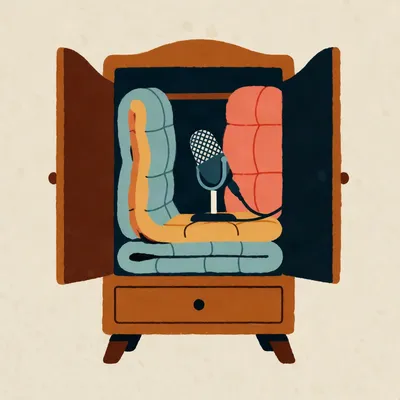
He lives in a small rental, no spare room, and he says he joked about pitching a tent in the living room — which, as we'll see, is less of a joke than he thinks. What he actually wants to know is what people have built out of a wardrobe, a cabinet, a spare cupboard already in the house, turned into a semi-permanent recording booth. What's out there, and which of these builds work.
And this is a good question because the answer is not "none of them work." Some of them work. The interesting part is why some don't.
Before we get into the builds, I want to set the bar. When someone says a booth "works," what's the test? Because I assume the person in the wardrobe and the person paying two grand for a purpose-built booth are not grading on the same curve.
They're really not. The professional curve is "does it match the treated room at the studio." The home curve is "does it sound better than the kitchen." And almost everything we're about to discuss clears the second bar and is silent on the first, which is worth keeping in your head the whole way through, because it explains a lot of the contradictions later.
So let's start with the documented ones. These exist — real people, photos, prices.
The one I'd lead with is Andy Chevalier, a UK voiceover artist who converted a cupboard in his living room. Forty-six centimetres wide, a hundred and seventy-two high, eighty-seven deep. Moving blankets on the walls and ceiling, old carpet on the floor, foam on the corners by the door, a cut-down IKEA shelf on brackets as the desk, IKEA stool, and an iPad wall-mounted for scripts.
A thousand pounds of gear to record inside a cupboard the cupboard came free with.
About a thousand pounds excluding the iPad and laptop, closer to two and a half thousand with them. He reports improved recording quality — no measurements, just his ears and presumably his clients' non-complaints.
Forty-six by eighty-seven. I want people to hold that footprint in their heads, because it comes back later and it comes back badly.
Noted, and I'll hold it. The detail I like is the laptop cooling pad — he specifically set it up so the laptop fans wouldn't kick in mid-take. That's a man who learned that lesson once, at volume, in a quiet cupboard.
The cupboard amplifies everything, including the machine you brought to fix the cupboard. That's the whole genre in one sentence.
It really is. And there's a second-order version of the same trap, which is that once you've put the machine outside the cupboard to keep it quiet, you've got cables through the door gap, and a cable through a gap is a gap with a cable in it. Everything in a small booth trades against everything else. You fix the fan and you've bought a leak.
Which presumably also applies to light. If you wall-mount an iPad for scripts, that's another device breathing in there.
Another device, another heat source, another thing with a screen that wants to update itself. The build blogs never mention the moment twenty minutes into a session when the tablet decides it's tired and needs to restart. But that's the difference between a build log and a diary — the log is written on day one.
Second build.
And this is where Daniel's tent joke stops being a joke — the grow-tent booth. Somebody took a forty-eight by forty-eight by eighty inch hydroponics frame, the skeleton gardeners use for tomatoes, and hung four eighty-by-eighty-inch acoustic blankets on it. Three walls with grommets and velcro, one on the ceiling. Total spend was about a thousand and fifty dollars in twenty twenty, though that included other gear, so the tent itself is less.
So the tent-in-the-living-room idea is real. It just has a product category and a price tag.
It's a real approach, and it's cleverer than it sounds, because the walls are fabric under tension rather than hard panels. Hold that thought too. What's frustrating is that the writeup says nothing about sound, nothing about heat, nothing about whether the fan assembly that comes with grow tents is usable. Used it for podcasting, that's the whole evaluation.
The tomatoes, presumably, recorded beautifully.
Crisp. And to be fair to the builder, the grow tent has one genuine structural advantage over the wardrobe that I don't think he even intended: it's a frame you assemble from poles, which means it disassembles. For a renter, a booth that packs into a bag when the landlord visits is not a small thing. Every wardrobe build we're discussing is a wardrobe you have committed to.
That's the rental calculus in general, isn't it. The question isn't just "does it work," it's "what does the flat look like when you're not recording."
Which is why so many of these builds end up semi-permanent in name only. The blankets go up, the blankets come down, and by month three the booth is a cupboard with a microphone in it and a cardigan on the floor.
Third one.
Randye Kaye, a voiceover artist in New England, took the opposite route. She had a five-foot wardrobe screen draped with quilts, and she replaced it with fourteen feet of ceiling track, moving blankets hung off it with grommets and S-hooks. It's a booth you can push along the track, open and close like a curtain wall.
Fourteen feet of ceiling track in a house. In a rental that's a deposit conversation.
It's not fully non-destructive, no. Her verdict is the useful part: passing airplanes intrude less than before. Leaf blowers and snowblowers still get through. Which is the whole physics of the thing in two sentences — she got treatment, she didn't get isolation.
The leaf blower is the honest test of any home booth. Planes are far away and low-frequency enough that you can mostly ride them. The leaf blower is a two-stroke engine operated by a man who has chosen your wall as his workplace.
And the snowblower is the same man in winter, so New England gives her the test in both seasons. That's diligence the climate provides for free.
Then there's the forum thread side.
People in the voice-acting communities describe the classic version: a closet, a small table, twelve-inch foam squares. One person who did exactly that later upgraded to a purpose-built booth and said it sounded noticeably better — which is the closest thing to an A/B test any of these builds has.
Notably better than a closet of clothes. Not necessarily better than nothing.
Fair distinction. The other thread staple is "staple moving blankets inside a wardrobe box," which is the zero-dollar version of everything we've just described. And then the IKEA-specific advice, which is the part closest to Daniel's question. The word on a PAX wardrobe full of hanging clothes is that it's one of the more effective budget booths — foam on the back wall and ceiling — with one caveat that tells you the whole story: you record with the door slightly open, because fully closed it has a small boxy resonance.
The IKEA hack is to leave the IKEA open.
It is, a bit. And I'll be honest about the limits of the evidence here — that's generic tutorial advice. I haven't found an actual documented PAX build log with dimensions and results. It's the advice that's real; the builds are asserted rather than photographed.
So it's folklore with a product name attached.
The folklore also has a retail endpoint, which I find charming. Primacoustic sells a thing called the FlexiBooth — a wall-mounted panel, twenty-four by forty-eight inches, that swings open like a cupboard and gives you roughly sixteen cubic feet of treated recording space. So the industry looked at "person records inside furniture" and productized it.
Sixteen cubic feet. That's a cupboard you hang on the wall and step into with your mouth.
With your mouth and a handheld mic, basically. And the fact that it's a product at all tells you the demand is real — enough people were recording in wardrobes that somebody tooled up a factory. You don't injection-mould a solution to a problem nobody has.
Although I notice the panel is twenty-four by forty-eight inches. Two feet by four. Which sounds suspiciously close to the three-to-five-foot zone you're about to tell me about.
We'll get there, and yes, and the fact that you can see the punchline coming from the product dimensions is exactly why the physics section exists. And the expert opinion splits on the wardrobe itself. Some studios call a clothes-filled wardrobe the classic free booth — the clothes are the absorber, it costs nothing. Others call a closet a last resort with minimal absorption. Both are looking at the same closet.
Two experts, one closet, opposite verdicts. That's usually a sign the question is being asked at the wrong level.
Yes, and the level it should be asked at is physics. The survey is done — none of these people published a frequency response, none of them mention heat or air, and two of the fully documented ones landed around a thousand pounds or dollars with gear included. Now the interesting question: why do some of these work and some just make you sound like you're in a box?
Because some of them are boxes.
Because they are all boxes, and boxes have rules. Here's the core one. Any room dimension between three and five feet resonates somewhere in the two hundred to four hundred hertz region — which is not some forgettable corner of the spectrum, that is the vocal range. That's the chest of your voice, the warmth, the thing that makes you sound like a person.
So a booth whose dimensions are wrong is a machine tuned to amplify the part of you that talks.
A machine tuned to resonate the part of you that talks, sitting exactly where the mic is. Typical booths throw standing waves in the one-fifty to three-fifty hertz region — a six-foot dimension resonates around a hundred and eighty-eight hertz. That's the boxy sound everyone describes. It's not a metaphor. It's the room singing along with you, quietly, in the wrong key.
And for the person at home — can you actually hear this? Or is it one of those things you need an analyser for?
You can hear it, you just don't name it. The classic tell is that your voice sounds fine while you're recording and then thin and hollow when you hear it back on phone speakers, or in the car. The boxy region is exactly the region small speakers reproduce worst, so your recording goes out into the world wearing its worst possible costume.
Now bring back Chevalier's cupboard.
Forty-six by eighty-seven centimetres. That's roughly a foot and a half by just under three feet, which is actually smaller than the danger zone, and smaller pushes the resonances up, not out. Do the arithmetic and the eighty-seven-centimetre depth rings at about two hundred hertz, and the forty-six-centimetre width at roughly three hundred and seventy. Both land squarely in the voice. Physics predicts boxiness with real confidence.
And he says it sounds good.
And he published no measurements, and I can't tell you he's wrong. That's the gap this whole topic lives in — build blogs that report satisfaction, and acoustic advice that predicts failure, and almost no overlap where someone measured.
And now it's time for another of our regular segments. Mum, you're on.

Hello dear, it's your mother. It's time for Dorothy's History of Toast.
In nineteen ninety five the physicist Robert Matthews published a paper explaining why toast really does tend to land butter side down, mostly because of the height of the table.
And it won him an Ig Nobel Prize the next year. So there you are, dear. Even the butter has made up its mind against you.
Anyway. I've got a bit of toast on the go myself, so I'll ring off. Mind how you go.
Ig Nobel for toast physics. Somewhere a wardrobe booth owner is nodding.
Tables and cupboards, both against us. Where were we.
The second half of the physics — why the treatment everyone actually installs doesn't fix it. Standard two-inch foam only works down to about four hundred hertz. Three-inch panels get you to about two hundred. The low mids — the exact region the box is resonating in — pass through thin foam like it isn't there.
So the foam takes away the hiss and leaves the honk.
You remove the highs and you keep the boxiness, and what's left is a recording that sounds dead on top and cardboard underneath, which people describe as "boxy" without realizing they're being literal. Paul White at Sound On Sound put numbers on this years ago: don't go below roughly a four-by-five-foot floor, use high-density mineral wool at least thirty millimetres thick, and — this is the part everyone skips — space it two to four inches off the wall. The air gap is what buys you the low-mid absorption. Thin panels glued flat to a surface control the highs and do almost nothing below that.
The gap is the treatment. Everyone buys the foam and throws away the gap.
And the reason they throw it away is that the gap is invisible. You spend forty pounds on foam tiles, you want to see forty pounds of foam tiles, not forty pounds of foam tiles hovering two inches off the wall on battens you also had to buy. The effective part of the product is the part you can't photograph.
Which is brutal for a genre that runs on photographs. The build blogs show foam-flat-on-plywood because foam-floating-on-battens looks like unfinished DIY.
And he's backed up by the actual case. The Studio SOS team got called to a five-foot by five-foot-six booth — barely over the floor — that sounded boxy. The fix was a six-by-four-foot rear trap six inches deep, mineral wool with barrier mat and felt underlay, four-inch ceiling foam, three-inch side panels. Two hundred and fifty to three hundred pounds. And the booth lost the boxiness without going dead.
Three hundred pounds to fix a booth that was nearly big enough. Chevalier spent a thousand to build one that isn't.
That comparison is the whole economics of the genre, honestly. The two fully documented furniture builds both landed near the thousand mark with gear included — that's portable-booth money, or at least the respectable corner of it. The wardrobe route is supposed to be the cheap route.
The cheap route costs a thousand pounds because the wardrobe was never the expensive part.
Moving blankets deserve their own line, because they're in every single build. They help the mids and highs. They do very little for bass — that's the vendor's own claim, and the vendor sells blankets, so if anything they're being generous to themselves. And low-density inch-or-two foam is ineffective below about five hundred hertz, which means the blanket-and-foam wardrobe is treating everything except the region the wardrobe itself is resonating in.
The treatment is aimed one octave above the problem.
Consistently. The grow tent is the interesting exception, and it's why I made you hold that thought — its dimensions put it in the danger zone, but the walls are fabric under light tension, not rigid panels. Fabric walls don't support the same clean standing waves a plywood box does. So the build that looks the most absurd is the one that accidentally sidesteps the main problem.
The tomato frame outperforms the furniture on acoustics. The furniture is winning on looks alone.
Which leads us to what a furniture booth actually is, versus what people hope it is. There are two jobs. Absorb sound inside so it doesn't bounce back into the mic. Block sound outside so it doesn't get in. Every one of these builds does some of the first and almost none of the second — Randye Kaye's leaf blower is the proof. Blankets absorb. They barely isolate. Isolation needs mass, sealed gaps, decoupling. A wardrobe door with a gap in it, in a rented flat with a shared wall, is a suggestion of a wall, not a wall.
So the honest pitch is: it'll make you sound less like a bathroom, and it will not stop the neighbour's television.
Or the lift, or the street. And that matters for anyone doing voice work in a flat, where a passing bus ruins a take far more than a bit of room tone does. If your goal is clean voice work, the outside world is the enemy, and the outside world is exactly what these builds don't touch.
Is there anything at the furniture scale that does block sound, or is mass just non-negotiable?
Mass is non-negotiable, but there's a furniture-shaped compromise people land on: don't try to block the whole room, deal with the one wall that matters. A tall bookcase packed with books against the shared wall. I wouldn't promise much isolation from it, honestly; a bookcase isn't sealed, so it's more a big diffuser and absorber than a barrier. But it's weight and depth exactly where the problem comes in, and it costs you nothing you didn't already own.
The library as passive acoustic treatment. The books were already bought. Same argument as the clothes in the wardrobe.
Same argument, and it's the argument the whole genre keeps rediscovering in different outfits: the stuff you already own is the absorber. Clothes, books, carpets, duvets. The purchases are almost decorative.
There's a third job nobody blogs about. Breathing.
Ventilation, yes. Any duct through a booth wall leaks sound unless it's baffled, and the standard answer is an inline fan around a hundred cubic feet per minute for long sessions — except people who've tried ordinary inline fans report they're loud, so now you've installed an appliance inside your acoustic space.
The fan that saves you from carbon dioxide introduces himself on the recording.
Paul White's advice on this is almost comically honest: open the door between takes. There is no cheap way to get quiet airflow while keeping isolation. And nobody — nobody — has published temperature or carbon dioxide numbers for a small furniture booth. A person in a sealed wardrobe with a laptop, a cooling pad, and a microphone is running an uncontrolled experiment on themselves.
A laptop, a cooling pad, and a human, in forty-six by eighty-seven centimetres, with the door closed. Except the PAX people say record with the door open, so the experiment is mercifully cancelled.
The door-open thing is interesting though, because it's the one piece of folklore that tracks the physics exactly. Close the box, you get the standing waves. Open it, you leak the resonance out and your acoustic space becomes the wardrobe plus half the room behind it.
So the fix for a bad box is to make it not a box.
And the fix costs nothing, which is why it survived in folklore while the mineral-wool depth chart didn't. Folklore is a compression algorithm for advice — it keeps whatever's cheap and memorable and silently drops the rest. "Leave the door open" survives. "Thirty millimetres of high-density mineral wool spaced two to four inches off the wall" does not.
Here's the thing I keep snagging on, Herman. The rule says Chevalier's cupboard should sound like a shoebox. He says it sounds good. One of them is wrong and nobody has ever checked.
Right, that's the... no, wait. Let me think about what the reconciliation might be, because I don't actually think he's lying. Three possibilities. One, he's used to worse — his before was a bare living room, and the cupboard is a massive relative improvement even if it's not objectively flat. Two, the mic — a directional mic close to the mouth in a heavily blanketed space hears very little room at all; the blankets have killed the reflections that would carry the boxiness to the capsule.
Three, he can't hear it because it's his own voice and his own box.
That one's real. Voiceover coaches say it all the time: you stop hearing your own room. Your brain files the colouration under 'normal' and moves on, and the only one who notices is the client on the other end.
So "works for me" is doing a lot of load-bearing in these build blogs.
Massive load-bearing. And it cuts the other way too — the purpose-built booth beating the closet in that forum thread is one data point from one person who owned the purpose-built booth. Everyone in this genre is comparing their current thing to their last thing, and nobody's comparing to the same reference.
That's the actual answer to "which of these work," isn't it. Nobody knows, and everybody's confident.

That's true, both of you.
I had one of these. Late seventies. A wardrobe, a heavy one, in a flat on Crane Lane with a shared wall to a laundry room where the boiler hummed in E. The council sent a man out about the boiler — Mr. Peascod, environmental health, a clipboard, a form in triplicate — and the dealing ran eleven months, so I stopped waiting for the council and dealt with the wall myself. Hung moving blankets inside the wardrobe, doubled over, on the sides, single layer on the door. Recorded in there sitting on a kitchen chair with the door open a hand's width. Corn will like the width — I measured it with a spanner, a quarter-inch Whitworth laid across the gap, and the card I wrote it on is still taped inside my head.
Sorry — Herman, you've got a level sitting on the desk there, it's been riding red since the cupboard talk.
Anyway. The blankets doubled over did more than the single layers did, that I could hear plainly. You said earlier they do nothing below the mids, and single ones, no. Doubled, folded in half so you've got four thicknesses, they pull down further than you'd credit. I don't know the hertz of it. I know the hum came down to a thing I could live with and Mr. Peascod's file stayed open anyway.
Sold the wardrobe when I moved. Man from two streets over gave me six pounds for it, blankets included. He wanted it for coats.
Eleven months, that boiler. Peascod retired before it was fixed. Good man, though. Filled the form in properly, all three copies.
A Whitworth spanner as a calibration instrument. The man measures a door gap with a tool for nuts and gets a repeatable number.
Four thicknesses of blanket. That's the bit I'm keeping — everyone else hangs them flat, and the one person who folded them got a result he could hear.
It's consistent with the physics, too, in a rough way. Double the thickness, halve the effective cutoff — four layers of blanket is approaching panel territory, not fabric. Not mineral wool, but it's not nothing.
And there's something else in there, which is that he was solving a different problem. The boiler hum in E — that's a low-frequency intrusion, the leaf-blower class of problem, the one we said blankets can't touch. And he says it came down to something he could live with.
Which is the phrase doing the work. "Could live with" is not "eliminated." The hum was still on the recording, quieter, and a man in nineteen seventy-something had no noise gate and no expectations, and the council form was in triplicate. His standard was livable, and by his standard he succeeded. It's Chevalier's cupboard again — the ear inside the box makes the final ruling.
And the council took eleven months to do what four folded blankets did overnight. That's also physics, of a kind.
The bureaucratic kind. Which takes us to where this leaves Daniel, I think.
Cutting-room floor first. There was one build in the pile we never got to — people filling IKEA bookcases with rigid insulation and using them as movable sound panels, gobos you wheel around the mic position. Same furniture, opposite philosophy: don't get inside the box, put the box around the mic.
And somebody on Hackaday built a mic isolation shield out of IKEA parts. So the full spectrum exists — from "climb inside the wardrobe" to "the wardrobe is now two feet of foam in front of your face." For a small rental, the gobo route is honestly the more renter-friendly half of the genre.
Nothing above your head, nothing in your walls, and when you move house it's a bookcase again.
And it composes with the door-open trick, which is the part I like. If the PAX advice is "leave the door open because the closed box resonates," the gobo is the same insight with the furniture repositioned — you get the absorption where the mic needs it and the "room" behind you is the actual room, which is at least dimensionally out of the danger zone. You've replaced a tuned box with an untuned corner.
Plus you can still hang coats on it between takes, which is more than the FlexiBooth offers.
The FlexiBooth does not have a coat hook, no. Missed market.
The open question I'd leave Daniel with —
Go on.
If the builds that violate every acoustic rule still make their owners happy — and they do, year after year — then "works" is being judged by ear, and the ear in question is inside the box. Whether anyone ever puts a measurement rig inside one of these things, and publishes the temperature and the frequency response of a person in a wardrobe, I'd like to know. That's the missing episode, and nobody's written it.
Measure the cupboard, publish the number, and find out whether a thousand pounds bought acoustics or just confidence. My guess is some of both, and that the confidence records better takes.
That might be the quiet truth of the whole genre, actually. Thanks as always to Hilbert Flumingtop at the desk — the man keeps a Whitworth calibration somewhere.
And a spanner we will never be allowed to forget.
If you want more of this, try episode seven, Building Custom ASR Tools; episode eight, Building Your Own Whisper; and episode sixty-five oh five, Why Blanket Forts Beat Expensive Portable Vocal Booths. This has been My Weird Prompts. If you enjoyed this one, the review button is right there on your app, and it takes four seconds.
Rate us like you mean it, and we'll be back soon. See you tomorrow, brother.
Tomorrow.