
Emergency Supplies
61 episodes · Page 2 of 3
#3678: Is Gas in Our Homes a Needless Risk?
A near-fatal gas explosion in Jerusalem raises hard questions about the safety of gas in our homes and apartments.
#3603: How to Salvage Construction Dumpster Lumber Safely
Know your lumber, your rights, and your timing before you grab that "free" two-by-four.
#3541: When Police Escort Civilians to Hospitals: The Real Calculus
Police escorts for civilians are officially discouraged but happen more than protocols admit. Here's the real math behind the decision.
#3477: What Belongs in Your Car Emergency Kit
LED flares, tourniquets, and tire plug kits — the gear that actually makes a difference between inconvenience and danger.
#3474: How to Actually Use a Tourniquet
Most people own a tourniquet but couldn't use one effectively under pressure. Here's what you need to know.
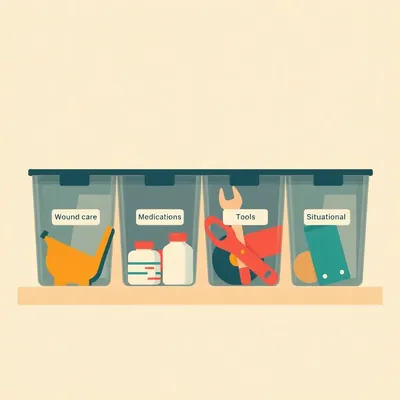
#3473: Organize Your First Aid Kit Like a Pro
A pediatrician explains the four-zone system for organizing your home first aid kit so you can find what you need in an emergency.
#3325: How to Move Heavy Furniture Without Hurting Yourself
Track-based dollies, sliders, and wheeled bases — the gear that pays for itself in two moves.
#3311: What Ambulance Bays Teach About Home Organization
Four design principles from hospital vending machines that can transform your workbench into a lean, restocking machine.
#3276: Pocket Signal Lights for War Zones
Dedicated signal lights explained: what they are, why the market is fragmented, and what actually works at 100 meters.
#3058: How to Get 15 Hours of Light From Your UPS
Turn your UPS into an emergency light source with the right LED bulb, NUT, and Home Assistant automation.
#2756: Protein Bars as Frontal Lobe Jumper Cables
Building a tiered food system for when your brain can't make decisions about food.
#2635: How to Upgrade Your Readiness Without the Anxiety
A practical walkthrough on situational awareness, news consumption protocols, and go-bag checks for ambiguous threat periods.
#2238: What Jerusalem Actually Needs to Survive
Forget the faraday cages. Two hosts design a real emergency syllabus for a city that's lived through actual crises.
#2124: The Flashlight You Actually Need
Most cheap flashlights fail when you need them most. Here’s what to buy instead.
#2117: The Disciplined Engineering of Urban Search and Rescue
How search and rescue teams use engineering, radar, and sound to find survivors in collapsed buildings.

#1692: The 60sqm Handoff: Parenting Without Childcare
How to survive a high-stakes work-from-home setup when your office is also the nursery.
#1457: The 90-Second Window: Sustained Survival in a War Zone
When the siren sounds, you have 90 seconds. Learn the tactical habits and "PAWS BED" protocols essential for life in a constant alert zone.

#1455: The 90-Second Sprint: Rethinking Home Defense
From the "90-second sprint" to the BRACED test, learn how to engineer your home and gear for 72 hours of total self-sufficiency.

#1408: Israel Wartime Readiness Field Guide — Audiobook
The complete Israel Wartime Readiness Field Guide read by Corn and Herman — 90 minutes of practical civilian preparedness guidance based on Home Front Command protocols.
#1355: Open-Source Emergency SOPs: Aviation Checklists for Your Home
Learn how to apply aviation-style checklists to survive a high-stress emergency in under 90 seconds using tactical systems engineering.

#1118: Sustaining Readiness When the Sirens Never Stop
When the siren wails at 3 AM, you have 90 seconds to reach safety. Learn to bridge the gap between civilian chaos and professional readiness.
#935: How Do You Move 2,000 Patients Out of a Parking Garage?
When the sirens stop, the work begins. Explore the complex "failback" process of moving an entire hospital from a bunker back to the surface.
#921: When Your Power Bank Lies: Urban Survival and Real Capacity
When seconds count, your gear can't fail. Learn the technical truth about power bank capacity, efficiency, and urban survival reliability.

#911: Sound as a Shield: Reclaiming Calm in High-Stress Zones
Learn how to use soundscapes, brown noise, and AI to protect your nervous system and reclaim calm during times of high-stress and sensory overload.