
Sunday, 8 November 2026
20 episodes · 6596 in all
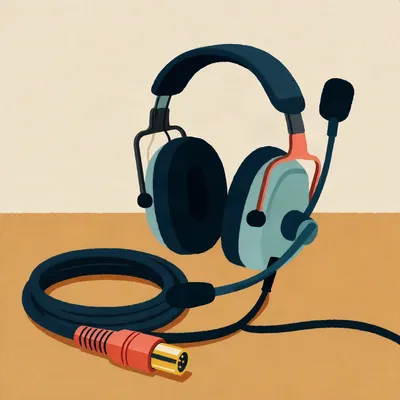
#6507: Why Broadcast Headsets Fit Commentators but Not Voiceover
Classic broadcast headsets avoid room noise at close range, but almost none use native USB or fit long studio voiceover sessions.
#6506: Why Generative Audio Restoration Hallucinates Highs
Hardware bandwidth limits force modern neural denoisers to hallucinate missing high frequencies from scratch rather than clean real audio.
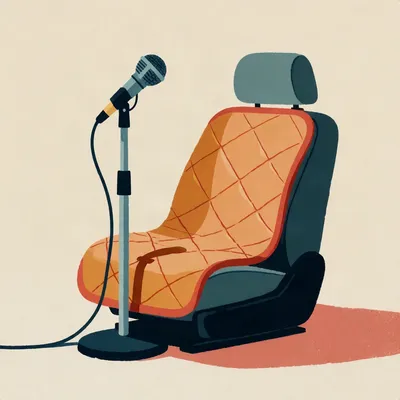
#6505: Why Blanket Forts Beat Expensive Portable Vocal Booths
A blanket fort dampens room reflections for under eighty-five dollars, but no portable fabric rig can stop outside noise from entering.
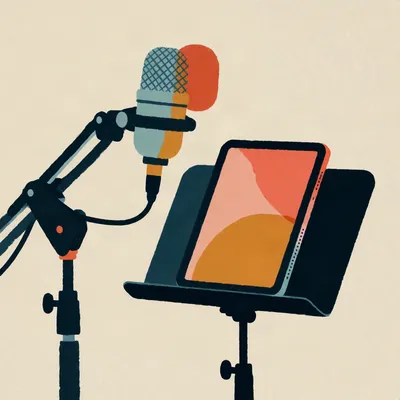
#6504: How Voiceover Pros Set Up Their Mic Stations
A professional narration station is optimized for acoustic consistency between takes, not abstract sound quality.

#6503: How BPE Builds a Vocabulary, Merge by Merge
Inference-optimal vocabulary size shifts sixteen-fold depending on serving batch size, from 32,000 at batch one to 524,000 at batch sixty-four.
#6502: What a Cross-Entropy Loss of 1.8 Actually Means
A cross-entropy loss of 1.8 nats means a language model is about as uncertain as choosing uniformly among six equally likely tokens.
#6501: Splitting Frontier AI Across Thousands of GPUs
A 405-billion-parameter model requires 810 gigabytes just for weights, yet an H100 GPU holds only 80.

#6500: Why LLM Leaderboards Need Psychometrics
Applying item response theory to AI benchmarks reveals up to 31 percent of leaderboard positions shift when raw accuracy is adjusted for difficulty.
#6499: How RL with Verifiable Rewards Works
DeepSeek R1-Zero boosted AIME accuracy from 15.6% to 77.9% using only two deterministic checks and no learned critic.

#6498: Why You Must Read AI Traces Before Writing Evals
Reading just thirty real interaction traces by hand reveals failure modes that generic automated evaluation metrics consistently obscure.

#6497: Why Speech Recognition Confidence Scores Lie
Cross-entropy loss rewards saturation, leaving speech recognition models to assign winning tokens over 0.9 probability even when they are guessing.
#6496: How Speech Models See Audio as an Image
Modern speech recognition models like Whisper never hear raw audio; they inspect an eighty-pixel-tall grayscale image of the sound.

#6495: Teaching Speech Models to Choose Their Own Audio
Selecting the most uncertain speech recordings often just surfaces silence, clipping, and abandoned half-sentences.
#6494: Where Speech Models Actually Learn
Just three self-attention heads out of twenty in Whisper's decoder trigger over 75 percent of hallucinations on non-speech audio.
#6493: Why Speech Models Forget Other Voices When Tuned on Yours
Adapting Whisper to one person's voice can trigger catastrophic forgetting, stripping away timestamps, segmentation, and accuracy on other speakers.

#6492: What Audio Models Learn Before Fine-Tuning
With just ten minutes of labeled audio on top of unlabeled pretraining, wav2vec 2.0 achieves a 4.8 word error rate on clean speech.
#6491: Agent Skills Break When Secrets Leave Your Laptop
Cloud environments deliberately strip uncommitted dot-env files during session uploads, leaving agent skills without working credentials.

#6490: What the Evidence on Daylight Saving Actually Shows
A foundational claim about permanent sleep debt from springing forward traces back to a study of just nine adults in Finland tracked for one week.
#6489: Why Governments Move Time Zones Off the Grid
China stretches across five geographic time zones under a single clock, causing winter sunrises in its far west to happen past 10 a.m.

#6488: Why Australian Suburbs Resemble American Ones
In 1907, an ad for Malthoid roofing kicked off Australia's obsession with American Craftsman bungalows, transforming inner-ring suburbs.