Daniel's prompt this week is about something that probably cost him an hour of his life before he even wrote it. The universal ritual of patting every pocket, scanning the counter, walking back to the car. He says he'd love a dollar for every time he's been held up leaving the house because he couldn't find his keys or wallet, or had that nagging sense he was forgetting something without being able to name it. He knows it's common with ADHD, which he has, and he suspects the cumulative time people spend retrieving their own possessions is shocking. But here's the thing he's actually poking at: he always thought memory aids were for people with failing memories. That's why he was reluctant to use them. He loves checklists, but he's honest that he doesn't pull one out every time he leaves the house. So he's asking whether some mix of methods would work better, and how to use them effectively when you're prone to getting absorbed in whatever you're doing and need a quick external validation before running out the door or stepping out of the car.

He's not asking how to remember better. He's asking how to know, fast, that nothing fell through the cracks.
Right. And that's a different problem than most memory advice pretends to solve.
Completely different. Most memory advice is retrospective. It's about remembering things that already happened, facts, names, where you put something. Daniel's problem is prospective. It's remembering to do something in the future, at the right moment, while your attention is somewhere else entirely.
So why does a tool everyone uses feel like something only failing minds need? Everyone writes notes. Everyone sets alarms. Nobody thinks twice about it. But the moment it's framed as a memory aid, as something for people with memory problems, suddenly it's a crutch.
And the data says that framing is just wrong. A study in Nature a couple years back looked at external memory aid use across a huge sample, different ages, different cognitive statuses. The finding was that basically everyone uses them. Not just people worried about decline. Not just the elderly. Everyone. Writing things down, setting reminders, taking photos of parking spaces. It's universal human behavior.
So the stigma isn't empirical. It's cultural.
It's cultural, and it's built on this assumption that memory is a fixed trait. You either have a good memory or you don't. And if you use a tool, you're admitting yours is bad.
Which is strange, because we don't think that about any other tool. Nobody says using a calculator means you're bad at arithmetic. Well, some people did say that in the eighties, actually.
They did, and they lost. Because the calculator doesn't replace the skill, it offloads the computation so you can do something else with your attention. That's the whole concept here. Cognitive offloading. The brain is designed to do this.
Designed to outsource.
Yes. The brain treats the environment as part of the cognitive system. This isn't some modern hack. It's how the brain has always worked. We offload to paper, to other people, to physical spaces. The cup of coffee by the door so you don't forget to take it. That's offloading. The note on your hand. The alarm on your phone. The brain doesn't care whether the information lives in your neurons or in the world. It just needs to be retrievable at the right moment.
So when Daniel says he thought memory aids were for people with failing memories, he's describing a stigma that contradicts how he already lives. He uses checklists. He sets reminders. He's been offloading for years. The only thing that changed is what he called it.
Once you strip away the stigma, the real question is how these tools work differently, and why some of them fail exactly when you need them.
Let's talk about the ADHD mechanism for a minute, because Daniel named it and it matters. What's actually happening when he's absorbed in a task and forgets to grab his wallet?
Working memory overload. Working memory is the small, temporary holding space where the brain keeps things it needs right now. In ADHD, that space is smaller, or it gets disrupted more easily. When you're deeply absorbed in something, the task fills the entire working memory capacity. The thought of I need to grab my wallet before I leave was in there, but it got pushed out. Not because he forgot it in the long-term sense. It was a prospective intention, an item in working memory, and working memory ran out of room.
So it's not a retrieval failure from long-term storage. It's a failure at the moment of encoding into action.
The intention never made it into the system that would carry it out. And this is why the standard advice, just try harder to remember, is useless. Trying harder doesn't expand working memory capacity. It just adds more load.
Which brings us to the two big approaches. Checklists, which Daniel already uses, and the older, weirder ones like the method of loci, the memory palace.
And they work through completely different mechanisms. A checklist is external. The information lives in the world. You don't have to hold it in your head at all. You just have to remember to look at the checklist.
Which is the catch.
Which is the catch. The method of loci works internally. You anchor information to a familiar spatial layout, a house you know well, a route you walk every day. You place the items you need to remember at specific locations along that route. Then when you need to recall, you mentally walk the route and pick up each item.
And this has nothing to do with dementia patients. This goes back to ancient Greece. Orators used it to memorize speeches.
Cicero wrote about it. The story goes that a poet named Simonides was at a banquet, the roof collapsed, and he was the only survivor. He could identify the bodies because he remembered where everyone was sitting. That spatial memory became the foundation of the technique. Orators would mentally walk through a building and place the points of their speech in different rooms.
So it was a performance enhancement technique for people who needed to deliver hours of argument from memory. Not a clinical intervention.
Right. And that's worth sitting with, because it reframes the whole category. The most famous memory technique in history was invented by and for people with exceptional cognitive demands. It was never about compensation for decline. It was about extending capacity.
So how does a memory palace actually help someone like Daniel, who's trying to remember to grab his keys and wallet and phone before leaving the house?
This is where it gets interesting. The method of loci is traditionally for retrospective memory. For memorizing lists, speeches, facts. But you can adapt it for prospective tasks. You create a small, fixed route, maybe three or four locations, and at each location you place a vivid image of the thing you need to check. The front door, then the car door, then the car seat. At each spot, you mentally place the items you need to verify before moving on.
And because spatial memory is extremely robust, the route becomes automatic. You don't have to remember to remember. The route itself is the reminder.
That's the key difference from a checklist. A checklist requires a separate act of initiation. You have to remember to consult it. A memory palace, once established, gets triggered by the context itself. You walk to the door, your brain pulls up the route, and you run through it.
But there's an upfront cost. Building the palace, placing the images, practicing the route. That's real work before it becomes automatic.
It is. And for someone with ADHD, that upfront investment can be a barrier. The checklist is zero cost to learn. You just write it and use it. The problem is the discipline to consult it. The memory palace requires more setup, but once it's established, it runs on automatic pilot through spatial memory, which is one of the most reliable systems the brain has.
So the checklist is cheap to install but costs you every time you use it. The memory palace is expensive to install but free to run.
That's a clean way to put it. And the ADHD brain that needs the checklist is the same brain that forgets to look at the checklist. That's the trap.
Daniel said exactly that. He loves checklists, but he doesn't pull one out every time he leaves the house. Which means the checklist, as implemented, isn't actually catching the failures.
The solution isn't more checklists. It's placing the checklist in the path of action. By the door. On the car seat. On the back of the front door where your hand touches it as you leave. The reminder has to interrupt the moment of absorption, not exist as an abstract tool that you have to remember to use.
So the design principle is: the aid has to be where the failure happens, not where you go when you're already in checklist mode.
And this connects to something Daniel mentioned about failover. He's a big believer in failover, and he's right. Memory aids are a redundant system. The primary system, your working memory, is going to drop things. That's not a bug. It's a known failure mode. The question is how you design the redundancy so it catches what the primary system drops.
And a good failover system doesn't require the primary system to be healthy in order to activate. If the backup only works when the primary system is working, it's not a backup.
Which is why the checklist on the phone fails. You have to remember to open the phone, find the app, open the checklist. All of those steps use the same working memory that's already overloaded. The backup is dependent on the system it's backing up.
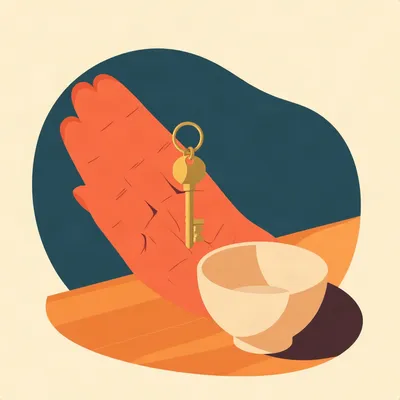
Whereas the bowl by the door is independent. The keys are either in the bowl or they're not. You don't have to remember anything to check. You just look.
And that's the location-based anchoring. The fixed-location bowl technique. Always put keys in the same bowl. Always. No exceptions. What that does is convert a prospective memory task into a retrospective one.
Explain that conversion.
A prospective task is: remember to grab your keys before you leave. That requires holding the intention in working memory until the moment of action. A retrospective task is: where are my keys? That's a fact that's stored in long-term memory. If the keys are always in the bowl, the answer to where are my keys is always the same. The bowl. You don't need to remember to grab them. You just need to know where they are, and the fixed location removes the retrieval step entirely.
So the bowl doesn't help you remember to take the keys. It makes the question of where the keys are so trivial that you don't need prospective memory at all.
Right. You've eliminated the failure point rather than trying to strengthen the system at the failure point.
Daniel mentioned two specific transition points. Leaving the house and leaving the car. Those are different failure pattern.
They are, and this is a subtle point that most advice misses. Context transitions reset attention. When you move from one environment to another, house to car, car to destination, your brain has to reorient. New environment, new set of relevant information. And at that moment of transition, whatever was in working memory from the previous context gets wiped.
So leaving the house is one reset. Leaving the car is a second reset. And the things you need to remember are different in each context.
At the house, you need keys, wallet, phone, maybe a bag, maybe something you were supposed to bring. At the car, you need to check that you turned off the engine, took the keys out, didn't leave your phone in the cup holder, remembered the thing on the passenger seat. Different items, different context, different failure pattern.
Which means a universal checklist doesn't work well. You need context-specific aids.
Context-specific, and placed at the point of transition. The aid for leaving the house goes by the door. The aid for leaving the car goes on the dashboard, or somewhere that's in your visual field as you're getting out.
There's a deeper insight here that I think is the actual answer to Daniel's question. People with ADHD aren't bad at remembering. They're bad at remembering at the right moment.
That's exactly right.
The information is in there. Daniel knows he has keys. He knows he needs them. The failure is that the knowledge doesn't surface at the moment when it's actionable. It surfaces two blocks later, or when he's already locked the door and is reaching for his pocket.
And external aids work when they interrupt the moment of absorption. The note on the door isn't there to teach you anything. It's there to break the flow of whatever you were thinking about and inject the reminder at the exact moment you need it.
So the aid isn't a memory substitute. It's an interruption device.
A well-designed one is. And that's why the stigma is so counterproductive. If using an aid feels like admitting defeat, you're less likely to place the interruption where it needs to go. You'll keep the checklist in a drawer, or in an app, and it won't catch you at the door. The stigma doesn't just make you feel bad. It makes the aid less effective, because you hide it away.
And the cost isn't just emotional. Daniel mentioned the cumulative time. If the average person loses even a few minutes a day to object retrieval, patting pockets, scanning counters, walking back to the car, that adds up. Over a lifetime, that's weeks. Months, maybe.
There was an estimate floating around a while back that the average person spends something like six months of their life looking for misplaced items. I'm not certain of the exact figure, but the order of magnitude is right. It's not trivial.
Six months of standing in the living room saying where did I put the thing.
And for someone with ADHD, the number is probably higher, because the retrieval failures happen more often and take longer to resolve. The reluctance to use memory aids because of stigma is itself a tax on productivity. It's paying a cost to avoid feeling a certain way.
Which is a strange trade when you spell it out.
It is. And the Nature study makes it stranger. Because the people who use these tools most effectively aren't the ones with the worst memories. They're the ones who are most organized. They've externalized the load so thoroughly that their internal memory is freed up for actual thinking.
So the aid isn't a sign of weakness. It's a sign of system design.
The brain is designed to offload. It's not cheating. It's extended cognition. The philosopher Andy Clark has been arguing this for decades. The mind doesn't stop at the skull. It extends into the tools and the environment. Your phone is part of your cognitive system. The bowl by the door is part of your cognitive system. Treating the unaided brain as the real one is just a category error.
Let me push on something. Daniel asked about a mix of methods. He likes checklists, but he's honest that he doesn't use them every time. He's asking what the practical integration looks like. What's the actual system?
I'd say the system has three layers. First, the fixed-location layer. Keys, wallet, phone, anything you need every single time, goes in the same place every single time. No exceptions. This eliminates the most frequent retrieval failures entirely.
And that's not a memory aid in the traditional sense. It's just a habit.
It's a habit that functions as a memory aid. Second, the interruption layer. The note on the door, the checklist on the car seat, the reminder that's in your visual field at the exact point of transition. These catch the one-off items, the thing you were supposed to bring, the errand you need to run.
And third?
Third, the internal layer. The memory palace, or some other mnemonic, for the things that don't have a fixed location and can't be placed in your path. Things you need to remember for a specific event, or a sequence of tasks.
So the mix is: fixed locations for the daily items, interruptions for the context-specific items, and mnemonics for the sequences and one-offs.
And the key is that each layer is designed for a different failure pattern. The fixed locations handle the most frequent failures. The interruptions handle the transition failures. The mnemonics handle the complex sequences. You're not relying on any single system.
Which is the failover Daniel was talking about. Redundancy across different mechanisms, so when one drops something, another one catches it.
And the redundancy isn't just about having multiple aids. It's about having aids that work through different cognitive channels. The bowl works through habit and spatial memory. The note works through visual interruption. The memory palace works through spatial narrative. If one channel is compromised, the others are still running.
Let's talk about the memory palace for a minute, because it's the one that sounds the most intimidating, and I think it's actually the most useful for Daniel's specific problem.
The absorbed-in-a-task problem.
Right. He gets caught up in whatever he's doing, and the intention to grab his wallet just evaporates. A checklist doesn't help, because he won't remember to look at it. A note on the door helps, but only if he's leaving the house. What about the moment before he leaves his desk, or before he gets out of the car?
This is where a small, fixed memory palace can be surprisingly effective. You build a route of, say, three locations. The desk, the door, the car. At each location, you place a vivid image that represents the checks you need to do. At the desk, you picture a giant key sitting on your keyboard. At the door, you picture a wallet hanging from the handle. At the car, you picture a phone glowing on the seat.
And because the route is tied to the physical locations you actually pass through, the context itself triggers the recall.
You stand up from the desk, your brain pulls up the image of the key on the keyboard, and you check. You walk to the door, the image of the wallet on the handle surfaces, and you check. You get out of the car, the image of the phone on the seat appears, and you check.
The images have to be vivid, though. A boring image doesn't stick.
The more absurd the better. A key the size of a surfboard. A wallet that's on fire. A phone that's screaming. The brain remembers the weird, the emotional, the exaggerated. The ancient Greeks knew this. The more vivid the image, the more reliably it surfaces.
So the method of loci works because it hijacks spatial memory, which is extremely robust, and emotional memory, which is extremely sticky.
It works automatically, once the route is established. That's the crucial difference from a checklist. The checklist requires an act of will. The memory palace runs on the same automatic system that lets you walk through your house in the dark without thinking about where the furniture is.
How long does it take to establish?
For a simple three-location route, maybe twenty minutes of deliberate practice. You walk the route a few times, you place the images, you test yourself. After a few days of using it, it becomes automatic. The upfront cost is real, but it's small compared to the cost of the failures it prevents.
The cost of the failures is what Daniel opened with. The dollars for every time he's been held up. The cumulative time.
If you spend five minutes a day looking for things, that's over thirty hours a year. Over a working lifetime, that's months. And that's just the retrieval time. It doesn't count the stress, the frustration, the missed buses, the late arrivals.
The stigma is literally costing people time. Not just the time spent looking, but the time spent avoiding the tools that would prevent the looking.
The stigma is manufactured. That's what I keep coming back to. The Nature study shows everyone uses these tools. The ancient Greeks used the memory palace as a performance enhancer. The idea that memory aids are for people with failing memories is a modern cultural artifact. It's not based on anything real.
Where does it come from, do you think?
Partly from the way we've romanticized the unaided mind. The genius who remembers everything without notes. The prodigy who never writes anything down. It's a myth, but it's a powerful one. And partly from the way memory decline is stigmatized. If memory aids are associated with dementia, then using them feels like admitting you're on that path.
The stigma is a collision of two anxieties. The anxiety about not being naturally brilliant, and the anxiety about cognitive decline.
Both anxieties are misplaced. The naturally brilliant people use memory aids constantly. They just don't call them that. They call them systems, or habits, or routines. And cognitive decline is not the same thing as using a tool to manage a heavy cognitive load.
Let's go back to Daniel's specific ask. He wants a quick external validation before leaving the house or the car. What does that actually look like?
I think the most practical version is a combination of the fixed-location layer and a very short, very specific interruption. The keys, wallet, phone always go in the same place. That handles the daily items. Then, for the one-off items, a single note by the door that says something like: check the stove, grab the thing for Hannah, take the package.
But the note has to change. Otherwise it becomes background noise.
That's the challenge. A static note gets ignored after a few days. The brain stops seeing it. So you need either a dynamic note that you update, or a ritual that forces you to actually look at it.
The ritual is the key. The note is just a prop. The ritual is what makes it work.
The ritual can be very short. Before you touch the door handle, you pause for two seconds and run through a fixed sequence. Phone, wallet, keys, bag. That's it. Two seconds. The pause is the interruption. It breaks the flow of whatever you were thinking about and forces the check.
The ritual is the memory aid, not the note. The note just reminds you to do the ritual.
Once the ritual is automatic, you don't need the note. The door handle itself becomes the trigger. You reach for it, and the sequence runs.
That's the failover. The primary system, your working memory, is going to drop things. The ritual is the redundant system that catches them. And the ritual is triggered by the context, not by an act of will.
For the car, same thing. Before you get out, you touch the door handle and run the sequence. Engine off, keys in hand, phone in pocket, nothing on the seat. Two seconds. It becomes automatic.
The answer to Daniel's question is: the mix is fixed locations for the daily items, a two-second ritual at each transition point, and a memory palace for anything more complex. And the whole thing works because it's designed for the failure pattern, not for the ideal case.
The ideal case is a trap. If you design your system for the day when you're well-rested, focused, and unhurried, it will fail on every other day. You have to design for the worst case. The distracted day. The rushing day. The day when your working memory is full of something else entirely.
Which is every day, for most people.
Which is every day.
There's a story about the business of selling memory aids that I think cuts right to the heart of this.

I was in that business.
Go on.
Nineteen ninety-eight. Six months. A startup in Mountain View. They sold mnemonic training courses to executives. Memory palaces, peg systems, the whole package. The pitch was that these techniques were for winners who wanted an edge. Never for people with problems.
They sold the exact same techniques, but rebranded them as performance enhancement.
That was the whole business model. Same method of loci the Greeks used. Same peg systems. But the marketing said: elite performers use this to get ahead. It was a status product. The word memory aid never appeared in any of the materials. It was cognitive optimization. Peak mental performance.
The stigma was part of the pitch. You're not compensating for anything. You're enhancing.
The customers paid three thousand dollars for a weekend seminar. They'd have paid nothing for a memory aid. They paid for the story that they were already good and getting better.
What happened to the company?
The CEO forgot his password to the flagship product. The demo crashed in front of a room full of investors. He couldn't get back in. They fired me the next week.
They fired you for the CEO's password.
I was the memory consultant. Apparently that made it my job.
That's a remarkable story.
The password was on a sticky note on his monitor. He'd written it down. But he'd also written down three other passwords, and he couldn't remember which one was which. So he tried all four, locked himself out, and blamed the mnemonic training.
The man selling memory palaces was using a sticky note.
Everyone was. The whole office was sticky notes. The product was for customers. Internally, we all used paper.
That's the truth of the whole industry. The people who sell memory techniques use the same external aids as everyone else.
I still use the method of loci. I park at the airport, I walk a route in my head. The elevator, the pillar, the sign. I place the car at one of those spots. Works every time. But I tell people it's a spatial optimization technique.
Not a memory palace.
Saying memory palace feels like admitting something. So I call it spatial optimization. Same technique, different label. The label is what people pay for.
That's the stigma in one sentence. Same technique, different label.
I sold the label for six months. Then I went back to driving a delivery van.
Of course you did.
The van had a clipboard. Every stop was on the clipboard. Nobody called it a memory aid. It was just the clipboard. But that clipboard did more for my memory than any mnemonic course I ever sold.
Because it was in the path of action. You had to touch it at every stop.
It was bolted to the dashboard. You couldn't miss it. That's the whole trick. Nobody forgets the thing that's in the way.
The thing that's in the way. That's the design principle for all of this.
The memory palace is fine. I use it. But it's not in the way. It's in your head. And your head is the thing that's busy. The clipboard is in the way. The bowl is in the way. The note on the door is in the way. Put the thing in the way and you don't need to remember anything.
That's the insight. The best memory aid is the one that doesn't require memory to use.
I still have the clipboard. It's in a box somewhere.
I'd expect nothing less.
The thing I keep thinking about is how the stigma survived even inside the industry that sold the tools. Hilbert was teaching memory palaces while calling them something else, because the label mattered more than the technique.
The label is the product. The technique is free. The Greeks gave it away. Hilbert's startup charged three thousand dollars for the story that it wasn't a memory aid.
The story was the product. The technique was just the delivery mechanism.
The stigma isn't inherent to the tools. It's a marketing choice. And someone, somewhere, decided that memory aids were for failing minds, and performance enhancement was for winners, and the same technique got sorted into both categories depending on what you called it.
Which means the way out of the stigma is just to relabel the thing. Call it a system. Call it a routine. Call it spatial optimization. The technique doesn't care what you call it.
The technique works either way. The label just changes whether you'll use it.
Daniel's reluctance was never about the technique. It was about the label. He thought memory aids were for people with failing memories. But he already uses checklists. He already uses routines. He was just calling them something else.
The answer to his question is: you're already doing it. You just need to design the system for the moments when you're absorbed, and stop worrying about what to call it.
Put the thing in the way. That's the whole answer.
The misconception people hold about this topic is that using a memory aid means your memory is weak. The correction is that cognitive offloading is how the brain is designed to work. The unaided brain isn't the real one. It's just the one we've romanticized.
If memory aids are just extended cognition, the open question is how long the stigma can survive. As phones and wearables and AI assistants get more integrated, the line between remembering and offloading is going to blur until it disappears. At some point, the idea that the unaided brain is the real one is going to sound as strange as the idea that doing arithmetic by hand is more authentic than using a calculator.
I think that's already happening. The younger generation doesn't think of the phone as a memory aid. It's just where information lives. The stigma is a generational artifact.
Daniel's grandchildren won't understand the question. They'll just ask why he didn't put the thing in the way.
That's the right question.
Thanks to Hilbert Flumingtop for producing. This has been My Weird Prompts. If you want to send us a prompt, email us at show at my weird prompts dot com.
We'll be back soon.