Daniel's prompt this week is about the first power tool purchase, and the moment he describes is one most people only understand in hindsight. You walk in thinking you're buying a drill, and what you actually bought is a battery standard you'll be living with for years. Daniel picked up a twelve volt Bosch for screwdriving and drilling, loves the tool, and his only regret is not researching eighteen volt a little more before committing. His surprise, and I think this is the honest core of the whole prompt, is that the practical difference between the two tiers turned out to be smaller than the marketing implies. What eighteen volt really buys you is ecosystem breadth, not everyday performance.
He also wants to know why the starting voltage and the manufacturer both matter. On voltage, he sees twelve, eighteen, and twenty one volts as the common increments, with Makita running two eighteen volt batteries in series to get a thirty six volt load in some tools. On manufacturers, he's been happy with Bosch specifically because of the documentation and accurate part numbers, and he notes the professional and consumer line separation. The other majors he sees in Israel are Makita and DeWalt, and then tier two lines like Kendo that clone a major's form factor and pitch compatibility with non-OEM batteries. He wonders if that IP position is shaky, but also notes their existence tells you something about the health of the non-OEM battery market.
His last set of questions is the practical one. Is the OEM versus non-OEM battery question worth worrying about for a normal user, or only for pros scaling up? And for a beginner staring at three or four brand families that are all good, what rough heuristics actually help you pick one? So let's start with why the battery, not the drill, is the actual purchase.

The drill is a consumable. That's the reframe. You'll replace the tool body eventually, whether it's burned out, dropped off a ladder, or just obsolete. The batteries, the charger, the mount, the ecosystem, that's the durable asset. You keep those. And the first purchase is the one that commits you, because the battery mount is proprietary per manufacturer. Bosch batteries don't fit Makita tools, Makita batteries don't fit DeWalt. There's no universal standard, and there probably won't be, because the battery platform is exactly how these companies keep you coming back.
Which means the first purchase is a one-way door. You can switch later, but you're either running two platforms, which means two chargers and two sets of batteries and a shelf that looks like a battery museum, or you're eating the cost of starting over.
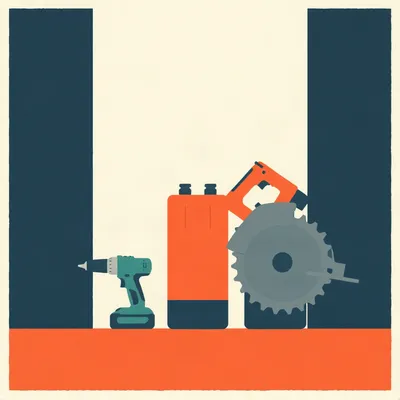
And voltage is the ceiling. That's the part Daniel's prompt gets exactly right. The voltage of your platform determines the upper bound on what tools you can ever add without buying a second platform. Twelve volt gives you drills, drivers, small saws, lights, maybe a compact rotary tool. Eighteen volt gives you circular saws, reciprocating saws, angle grinders, heat guns, blowers, the entire catalog. So the question isn't what you need today, it's what the largest tool you can imagine owning is. I've said this before about platforms generally, but it applies here with real money attached.
And the floor on weight and cost. A twelve volt drill is lighter, smaller, cheaper. An eighteen volt drill is heavier and more expensive. That's not a flaw, that's the physics of cramming more cells into a pack.
Right, and the honest caveat, the thing Daniel actually discovered on his own, is that for a casual user the difference between a good twelve volt and a good eighteen volt tool is smaller than the spec sheet suggests. For drilling holes in wood and driving screws, they feel close. The twelve volt Bosch he has will do almost everything a hobbyist asks of it. The gap shows up at the edges, sustained torque, big hole saws, masonry, sawing, not in the everyday eighty percent of tasks.
So the real lesson is that a drill is a consumable and the battery is the platform. If the battery is the platform, then the first thing to understand is what the voltage tiers actually give you.
Let's walk them concretely. Twelve volt is the light, compact, cheap tier. The tool bodies are smaller, which matters more than people expect when you're working overhead or in a tight cabinet. The batteries are lighter, so the tool balances differently in your hand. For screwdriving, light assembly, drilling into wood and drywall, twelve volt is excellent. Daniel's experience bears this out. The limitation is the catalog. Once you want a circular saw, a reciprocating saw, or anything that draws serious current for sustained periods, the twelve volt options thin out fast. Some exist, but they're compromised versions, lower power, shorter runtime, and the selection is a fraction of the eighteen volt shelf.
And that's where the year two problem hits. You buy the twelve volt drill, you love it, and then you need to cut some lumber or demo a wall, and suddenly you're shopping for a second platform.
Eighteen volt is the mainstream workhorse tier. Widest tool selection, best battery availability, every manufacturer's full innovation goes there first. It's the tier where one battery, many tools actually pays off, because you can buy a bare tool, no battery, no charger, for less money and just slot it into the system you already have. That's the economic model that makes the ecosystem real.
And twenty one volt. This is the one where I want people to check the label, because twenty one volt is often a nominal marketing figure on budget lines rather than a distinct standard. A five cell lithium pack is eighteen volts nominal, twenty one volts at full charge. Some budget brands print the peak voltage on the box because it's a bigger number. It's the same cells.
Treat twenty one volt as eighteen volt adjacent. The actual cell configuration is what matters, not the number on the side. If it says twenty one volts and it's a five cell pack, it's an eighteen volt system wearing a marketing costume.
Which is exactly the kind of thing that trips up a beginner who's trying to compare specs across brands and thinks one is meaningfully more powerful.
Makita's thirty six volt trick is the clearest example of an ecosystem design choice that changes what a beginner's first purchase can grow into. They run two eighteen volt batteries in series inside the tool to deliver a thirty six volt load. So a Makita user with a stack of eighteen volt packs can step up to higher power tools, bigger saws, more demanding gear, without buying a separate thirty six volt battery line. The batteries you already own are the high voltage system.
That's clever, and it's the kind of thing that only matters if you're already in the Makita ecosystem. If you bought a different brand, the fact that Makita does this is interesting but irrelevant to you.
The physics behind the tiers is straightforward. Voltage sets the ceiling on power delivery for a given current. Higher voltage tools can do more work per amp, which means for a given power output they can run at lower current, which means less heat, less stress on the wiring and the cells. But higher voltage means more cells in series, which means heavier packs and bulkier tools. Twelve volt isn't worse, it's scoped. It's optimized for a different envelope.
The honest comparison Daniel flagged is the one most reviews won't give you. A good twelve volt drill and a good eighteen volt drill feel closer in the hand than the voltage difference implies. The twelve volt Bosch he has will drive screws and drill holes all day. The eighteen volt version does the same tasks, just with more headroom and more weight. The gap shows up when you push sustained torque, big hole saws, drilling into concrete, or sawing. For the everyday eighty percent, you'd be hard pressed to tell them apart blindfolded.
And the ecosystem lock-in mechanism is the part people don't think about until it's too late. Battery mounts are proprietary and generally not cross-compatible. There are adapters, some of them sketchy, that let you run one brand's battery on another brand's tool, but they're a compromise. The official position is simple: once you buy into a brand, you're in that brand.
Unless you're willing to run two platforms, which some people do deliberately. A twelve volt compact system for fine work, an eighteen volt system for the heavy stuff. But that's a decision you make on purpose, not one you stumble into.
And the mistake people make is stumbling into it. They buy the drill, love it, buy a second tool from a different brand because it's on sale, and then discover the batteries don't fit. That's the moment the platform becomes real, and it's usually a moment of quiet fury in a hardware store aisle.
Voltage is half the decision. The other half is whose batteries you're buying, and that's where the brand families and the non-OEM market come in.
Brand families are ecosystems, not just tool quality. All the majors make good tools. The differences that matter to a beginner are catalog breadth, battery availability, and how easy it is to find parts and documentation. Bosch is the documentation brand. Daniel's right about this, and it's not a small thing. Accurate part numbers, clear separation between consumer and professional lines, compatible parts within each line. If you're the kind of person who wants to repair rather than replace, who wants to look up a part number and order the exact right thing, Bosch's German engineering paperwork is a real virtue.
It's the difference between a brand that treats its parts catalog as an afterthought and a brand that treats it as part of the product.
Makita's differentiator is the eighteen volt to two by eighteen volt architecture and a deep catalog. The thirty six volt path means you're not stuck if you outgrow eighteen volt, you just buy the bigger tool and use the same batteries. That's a genuine ecosystem advantage for someone who thinks they might scale up.
DeWalt is the other major family, its own mount, its own loyalists, and a huge catalog. The yellow tools have a gravity of their own. People who start with DeWalt tend to stay with DeWalt, not because the others are bad, but because the ecosystem is sticky and the catalog is deep.
And the loyalists exist for specific reasons. Makita for the eighteen volt to thirty six volt path, Bosch for the documentation and the pro consumer line structure, DeWalt for its own ecosystem gravity. None of those reasons is the others are bad. That's the thing to internalize. You are not choosing between good and bad. You're choosing which set of tradeoffs fits your life.
Tier two lines like Kendo are the interesting economic signal. They clone a major's battery form factor and pitch themselves on compatibility with non-OEM batteries. Daniel's right that the IP position is questionable, but the fact that these lines exist and persist tells you something real about the market.
It tells you the non-OEM battery market is large enough to sustain a whole tier of tool makers. If consumers were at risk of being stranded, if the majors were going to pull the rug and orphan their battery mounts, these tier two companies wouldn't exist. Their business model depends on the major form factors remaining stable and the non-OEM battery supply remaining healthy. The existence of Kendo is a market signal that you're not going to be stranded.
That's the part people miss when they worry about lock-in. The lock-in is real, but the catastrophe scenario, the brand discontinues the mount and you're left with a pile of useless batteries, that's much less likely than the anxiety suggests. The installed base is too large.
And the tier two lines are also a signal about where the value is. They're not trying to compete on tool quality with Bosch or Makita. They're competing on battery cost. Their pitch is, buy our tool body, it fits the DeWalt mount, and then buy whatever battery you want, ours or a third party's. The battery is where the margin is, and they're undercutting it.
Which brings us to the OEM versus non-OEM battery question, and Daniel's instinct here is right. For a casual user with two batteries, the question is largely moot. Two packs in your voltage give you substantial latitude. One charges while the other works, and they last a long time. The cost difference between an OEM battery and a non-OEM battery matters when you're buying ten of them, not two.
The scaling math is the real dividing line. A hobbyist has two batteries, maybe three. The difference between a sixty dollar OEM battery and a thirty dollar non-OEM battery is thirty dollars, once or twice, over several years. That's not a budget line item. A professional running ten tools across a platform, with multiple batteries per tool and spares, that's a different calculation. The battery cost becomes a real operating expense, and the non-OEM savings become thousands of dollars a year.
And in markets like Israel, where everything is more expensive, the pattern Daniel describes is common. Buy the tool body locally, pick up batteries while traveling, or buy non-OEM variants. The tool body is the part that's hard to source cheaply. The batteries are the part where the price gap is exploitable.
The non-OEM batteries themselves are a mixed bag. Some are good, rebuilt with quality cells, and some are cheap packs with no thermal protection and a fire risk. The problem is you can't always tell from the outside. For a casual user with two batteries, the downside risk is limited. For a pro running a fleet, a bad battery that fails on a job site costs more than the savings.
So the heuristic is not non-OEM is always a false economy. The heuristic is, the question only becomes economically interesting at scale. Two batteries, buy whatever's convenient. Ten batteries, do the math carefully.
And the heuristics for picking a brand family, this is what Daniel asked for, and I think they're clearer than people expect. First, match the brand to the tool catalog you'll actually grow into. Don't pick based on the drill you're buying today. Pick based on the saw or the grinder or the blower you'll want in year two. Look at what each brand offers in the categories you care about, and pick the one that covers your likely future.
Second, check local battery and part availability. A brand that's easy to get in Germany might be a pain in Israel, and vice versa. The best tool in the world is useless if you can't get a replacement battery for it without paying shipping from another continent.
Third, weight documentation and part number discipline if you plan to repair rather than replace. This is where Bosch earns its reputation. If you're the kind of person who fixes things, who wants to order the exact right part and have it arrive, that documentation is worth money.
And fourth, none of the majors is a bad choice. The loyalists exist for specific reasons, and those reasons are real, but they're reasons about fit, not about quality. Makita for the thirty six volt path, Bosch for the paperwork, DeWalt for the catalog gravity. Pick the one whose reason matches your life.
The mistake is treating it as a moral question. There's no wrong answer among the majors. There's just the answer that fits your projects and your repair philosophy and your local market.
The other thing I'd add is that the beginner who's paralyzed by this decision is overthinking it. Daniel's own experience is the proof. He bought a twelve volt Bosch, loves it, and the only regret is not researching eighteen volt more. But the practical consequence of that regret is close to zero for what he's actually doing with the tool.
The regret is theoretical. It's the knowledge that the eighteen volt catalog is wider, not an actual limitation he's hitting in his work. If he never buys a circular saw, the twelve volt platform was the right call. If he does buy a circular saw, he'll buy an eighteen volt platform then, and the twelve volt drill stays in the drawer for fine work. Neither outcome is a disaster.
The disaster scenario is the person who buys a second brand's tool on sale and discovers the batteries don't fit. That's the real mistake, and it's the one the platform framing is meant to prevent.
Hilbert: The mount is the whole product. Nobody reads the mount.
Hilbert: I worked the returns desk at a hardware chain for two years in the mid nineties, chain's gone now, and I was the battery guy because I was the only one who'd read the warranty fine print. The single most common return wasn't a dead tool. It was a person who'd bought a second brand's tool because it was on sale, got home, discovered the batteries didn't fit, and came back furious at the store. Not at themselves. At us. Like we'd personally designed the mount to spite them.
Hilbert: I'd open the box, show them the battery, show them the tool, point to the little plastic rails that don't line up, and they'd still argue. One man told me I was lying to protect the manufacturer. I was making eight dollars an hour and he thought I was in on the conspiracy.
Hilbert: The mount is the whole product. The drill is just the thing the mount comes attached to.
Hilbert: I still have a box of orphaned batteries from that era in the garage. Different brands, different voltages, all of them orphaned by people who returned the tool but forgot the battery, or returned the battery but kept the tool, or just abandoned the whole mess. I kept them because one day the right tool will show up. Thirty years, hasn't shown up yet, but I'm not throwing them out.
The orphaned battery box as a monument to exactly the mistake we're warning about.
The thing is, those batteries are all dead now. Lithium ion wasn't even common in the mid nineties, those are nickel cadmium packs, and they've all self-discharged into bricks. The box isn't a spare parts inventory, it's a museum.
Hilbert: They're not all dead. The nickel cadmium ones are. There's a nickel metal hydride Makita stick battery in there that still takes a charge. I don't have a Makita tool to put it in.
That's the ecosystem argument in physical form. A working battery with no tool to match it.
The reason he kept it is the same reason people don't switch platforms. The sunk cost of the battery feels like it should be recoverable someday.
Hilbert: My brother-in-law sold power tools for fifteen years. He says the same thing you two are saying, but he says it differently. He says people don't buy tools, they buy batteries, and the tool is just the excuse. He also says never trust a man who tells you his off-brand battery is just as good as the real one, because the only person who knows that is the person who took it apart.
Hilbert: He's not to be trusted, my brother-in-law. But he's right about the batteries.
The off-brand battery point is the one place where the casual versus pro divide gets sharp. A hobbyist with a thirty dollar non-OEM battery that dies in two years has lost thirty dollars. A pro with ten of them that die on a job site has lost the job.
The tier two lines are the market's way of saying the off-brand battery isn't going away. Kendo exists because enough people are buying non-OEM batteries to sustain a whole tool line. That's the economic reality, whatever the IP lawyers say.
The IP question is real, but it hasn't made these lines vanish, and it probably won't, because the patents on the physical battery mounts have expired in most cases, and what's left is brand enforcement and trademark, which is harder to win when the tier two line is careful to say compatible with rather than using the major's name.
The beginner's actual risk isn't being stranded by a discontinued mount. It's the slow creep of buying one tool here, one tool there, without noticing that they've accumulated three incompatible platforms.
Hilbert: The box in my garage is the slow creep. One battery at a time, none of them matching, all of them kept because they might be useful. It's not a collection, it's a warning.
The warning is that the first purchase matters because it's the one you make before you know what you're doing. By the time you understand the ecosystem, you're already in one.
The open question for the next decade is whether the consolidate or fragment. Battery platforms have been pretty stable for a while now, the majors have their mounts and they're not changing them, and the tier two lines are cloning the stable mounts. Does the pick your ecosystem carefully advice get more or less important as that stability continues?
I think it gets less important in the sense that the catastrophe scenario recedes. The mounts are stable, the non-OEM market is healthy, the tier two lines are cloning the majors, so you're not going to be stranded. But it gets more important in the sense that the catalog differences compound. The longer you stay in a platform, the more tools you accumulate, the more expensive it is to switch.
The research question before the first purchase is smaller than people think. The practical difference between a good twelve volt and a good eighteen volt is small for most users, and all the majors are good. The real decision is just, which catalog do you want to grow into, and whose batteries do you want on your shelf.
Daniel's regret is the right size. He didn't make a mistake. He made a choice that was slightly less informed than it could have been, and the consequence is that if he ever wants an eighteen volt circular saw, he'll start a second platform. That's a mild inconvenience, not a tragedy.
The tragedy would have been buying the eighteen volt kit blind, hating the weight, and then discovering he never needed the extra power. That's the thing the marketing never tells you, the bigger number isn't automatically the better fit.
This has been My Weird Prompts, the human AI collaboration podcast. Thanks to our producer, Hilbert Flumingtop, for keeping the show running and for the orphaned battery box, which I suspect is going to linger in my mind longer than the voltage tiers.
If you enjoyed this episode, leave us a review wherever you get your podcasts, or visit my weird prompts dot com for more. We'll be back soon.