
Context and Memory
299 episodes · Page 7 of 13
#2181: When RAG Becomes an Agent
RAG in chatbots is simple retrieval. RAG in agents is a multi-step decision loop. Here's what actually changes.
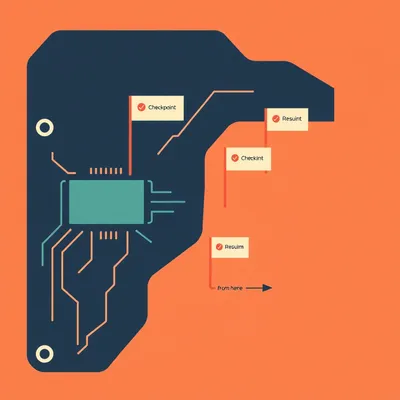
#2179: Building Cost-Resilient AI Agents
Failed API calls in agent loops aren't just technical problems—they're direct budget drains. Here's how checkpointing, retry strategies, and cachin...

#2178: How to Actually Evaluate AI Agents
Frontier models score 80% on one agent benchmark and 45% on another. The difference isn't the model—it's contamination, scaffolding, and how the te...
#2173: Inside MiroFish's Agent Simulation Architecture
MiroFish generates thousands of AI agents with distinct personalities to predict social dynamics. But research reveals a critical flaw: LLM agents ...

#2164: Why Bigger Context Windows Don't Fix Attention
Frontier models have million-token context windows, but attention degrades well before you hit the limit. New research reveals why bigger isn't bet...

#2163: Designing Autonomy Boundaries for AI Agents
Production data reveals a surprising truth: fully autonomous AI agents waste 98% of their context window on tool descriptions. Here's why the indus...
#2139: AI Wargame Memory: Beyond the Context Window
Why simply extending context windows fails in multi-agent simulations, and how layered memory architectures preserve strategic fidelity.
#2134: The Fog-of-War Problem in AI Wargaming
Why shared AI brains make secret-keeping a nightmare, and the four architectural patterns researchers use to fix it.

#2125: Why Agentic Chunking Beats One-Shot Generation
A single prompt can't write a 30-minute script. Here’s the agentic chunking method that fixes coherence.

#2114: 2026 ERP: From Filing Cabinet to Autonomous Core
In 2026, ERP systems have evolved from digital filing cabinets into autonomous, AI-driven cores that predict and execute business decisions in real...
#2113: Goldfish vs Elephant: The Stateful Agent Dilemma
Stateless agents are cheap and fast, but stateful ones remember your window seat. Which architecture wins?

#2110: Tuning AI Personality: Beyond Sycophancy
AI models swing between obsequious flattery and cold dismissal. Here’s why that happens and how to fix it.

#2092: Why AI Thinks You're American (Even When You're Not)
Even when we tell Gemini we're in Jerusalem, it defaults to US-centric assumptions. We explore the root causes of this persistent AI bias.

#2074: Generative Social Science: When AI Agents Develop Theory of Mind
See how a new framework models 10,000 virtual citizens to test policies before spending a dime.

#2062: How Transformers Learn Word Order: From Sine Waves to RoPE
Transformers can’t see word order by default. Here’s how positional encoding fixes that—from sine waves to RoPE and massive context windows.
#2061: The Memory Bottleneck That Drives Attention Design
Attention is the engine of modern AI, but it’s also a memory hog. Here’s how MQA, GQA, and MLA evolved to fix it.

#2057: How Agents Break Through the LLM Output Ceiling
The output window is the new bottleneck: why massive context doesn't solve long-form generation.

#2038: UI-First vs Architecture-First: Choosing Your AI Agent
LobeHub vs. Dify vs. n8n: We break down the chaotic landscape of local AI agents to find the right "brain" for your workflow.

#2020: 1,000 AI Agents Built a Religion in Minecraft
An experiment drops 1,000 autonomous agents into Minecraft, and they spontaneously invent religion, democracy, and taxes.
#2013: Non-Coders Are Hijacking the Terminal
Why finance analysts and researchers are ditching GUIs for command-line AI tools like Claude Code.

#2011: Saving AI Knowledge Beyond the Chat Window
We're brilliant at prompting AI, but terrible at saving the answers. Here's why that "digital masterpiece on a chalkboard" vanishes.
#2010: Building Better AI Memory Systems
We obsess over AI inputs but treat outputs like Snapchat messages. Here's why that's a massive blind spot.

#2008: Needle-in-a-Haystack Testing for LLMs
New AI models claim to be genius-level, but can they actually find a specific fact in a massive document?

#1993: Hiding the Kitchen: Why AI Shouldn't Show Its Work
Why single-model chatbots fail at complex tasks—and how multi-agent swarms solve it.