Hannah wants the mineral deposits out of our water system, without salt and without reverse osmosis. The familiar cartridge full of siliphos balls has already had its chance, and she says it did nothing useful. She's willing to look on AliExpress for the replacement. The kettle has exhausted local diplomacy.

The replacement I'd investigate is template-assisted crystallization, usually called TAC. A properly specified system, with independently tested media. That recommendation has a very particular boundary, though. It can reduce new scale forming on equipment. It does not remove the dissolved calcium and magnesium from the water.
That boundary is what the old cartridge seems to have arrived without. If somebody sells you treatment for avnit, you're expecting less white rock attached to things. You're not buying an opportunity to distinguish several varieties of disappointment.
Her observation that the cartridge wasn't effective deserves to stand. Explaining why is trickier. Polyphosphate chemistry is real, but whether that cartridge delivered enough of it, under the right conditions, for the job she expected... we don't know. We can explain what it was capable of, and what it never was.
Starting with the phrase printed across half this market. Salt-free water softener. Very generous use of softener.
The Water Quality Association defines soft water as below one grain per gallon of total hardness. That's about seventeen milligrams per litre expressed as calcium carbonate. A device leaving the hardness in place hasn't softened the water by that definition.
A hardness test before and after might give you the same result even when the treatment works. That's a fairly awkward product demonstration.
It measures a different outcome. TAC and polyphosphate conditioning aim to change how scale forms, rather than take the hardness minerals away. Soap consumption, the feel of the water, and deposits after complete evaporation can therefore remain issues.
Particularly the evaporation. If I leave a puddle on the shower screen until all the water has gone, the calcium hasn't politely left through the bathroom window.
You'll still have mineral residue. It may behave differently, but promising spotless glass from a conditioner is asking too much. Corn, would you accept visible residue if the heating element stayed substantially cleaner?
Yes. I'd rather wipe glass than replace a heater. But I'd want that distinction on the box, not discovered during an argument with customer service. Hannah asked for deposits to stop being a problem. We shouldn't quietly substitute softer-feeling water, or promise either one without asking where the deposits are.
Under her constraints, scale prevention is the realistic target. Actual mineral removal needs a separation process. Salt-regenerated ion exchange and reverse osmosis are the familiar domestic choices. Other processes exist, including distillation, but those aren't sensible whole-house recommendations here.
We're not installing a distillery so I can rinse a plate.
The useful distinction within salt-free equipment is between a particular medium with measured scale-reduction performance and devices sold mainly through broad claims. TAC has substantial independent laboratory results. That doesn't transfer automatically to every tank carrying those three letters.
You're about to fall in love with a German test rig.
I have reasons.
You always have reasons. That's how the equipment gets in.
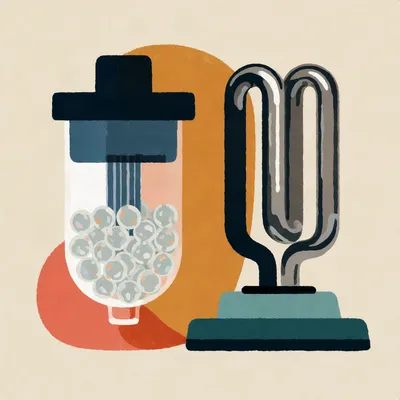
Before the test rig, the balls. Siliphos cartridges are consumable chemical dosing devices. Water passes around the granules, some material dissolves, and that dissolved material travels downstream. Calling the unit a filter makes people picture something being captured. Here, something is being added.
A filter that leaves by the outlet.
Usually we're talking about glassy sodium polyphosphates, sometimes blended with silicates. Their scale-inhibiting action works at low concentrations. The chains adsorb onto growth sites on newly forming calcium carbonate crystals. They interfere with those crystals growing and joining into strongly attached deposits.
Not enough chemical to grab every calcium atom individually, then. More like interfering with the stage where dissolved minerals become a solid nuisance.
That's threshold inhibition. It changes crystal growth at a dose much smaller than you'd need to bind all the hardness chemically. Small particles can stay dispersed and leave with flowing water rather than cementing themselves onto a heating element.
Which means flow matters twice. It controls what dissolves from the cartridge, then whether the little particles actually go anywhere.
Contact time, peak flow, hardness, and temperature all matter. A cartridge that behaves acceptably with one tap running may deliver a different dose when several outlets open. As the granules dissolve, their geometry and available surface change. The cartridge isn't a fixed-performance component you can forget.
You know I'm going to object to a device that changes while I'm asleep.
I predicted that objection the moment we said consumable.
Fair. But an invisible chemical dose is a better objection than my sleep schedule. You can look through the housing and see balls without knowing what concentration is reaching the heater.
Seeing remaining media doesn't prove adequate dosing. Nor does a famous brand establish that the cartridge is sized for the household's actual demand.
I also don't want us to rescue the product with a story we invented. Hannah says it wasn't effective. We don't know whether she was judging old deposits, fresh deposits, or both.
We shouldn't diagnose her particular installation from the complaint alone. Existing scale is one clear limitation. Polyphosphate doesn't reliably strip an established calcium carbonate layer from a pipe, heat exchanger, or appliance. A very thin recent film may loosen slowly, but that's unpredictable.
The crust you can already see isn't awaiting its annual appointment with the beads.
Envo Chemical puts the mismatch bluntly. The product did not fail; it was asked to do the wrong job. That's a useful explanation when the expectation was removal of old scale, not proof that every disappointing cartridge performed correctly.
That last qualification matters. Sometimes the wrong job was printed on the packaging.
My medical reflex is a flu shot. Prevention has been bought and judged as a cure for an infection already underway. The preventive intervention can be legitimate while the promised cure never existed.
Your old clinic had fewer pictures of sparkling shower heads.
Fewer, yes. The other complication is that the preventive material itself changes after dosing. Polyphosphates hydrolyse. Long chains break into shorter chains and eventually orthophosphate. Higher temperature and longer residence time speed that process.
Then the cold inlet is a flattering place to judge it. The cartridge might dose water correctly there, while the water sitting hot downstream has different chemistry.
A distant hot loop can receive much less useful scale inhibition than you'd expect from looking at the inlet installation. Heat can accelerate media dissolution as well as chain degradation. More material leaving the cartridge does not necessarily mean more protection where you need it.
Faster consumption. Less useful chemistry. Excellent subscription model.
A cold-rated cartridge shouldn't simply be moved onto a hot line. Temperature ratings and the intended application matter. Even installed on the cold supply, the downstream storage and heating arrangements affect what the treatment accomplishes.
Would you still use polyphosphate for a specific appliance, where you knew the flow and temperature, rather than asking one cartridge to defend every fixture in the house?
Potentially. It's much easier to specify a controlled application. Utilities also use phosphate, principally for corrosion control, sometimes at doses up to three milligrams per litre expressed as phosphate. That doesn't validate a domestic cartridge, but it establishes that we're discussing real water-treatment chemistry.
A municipal dosing system has rather more supervision than a clear bowl under the sink.
Anyway, that's the distinction between the chemistry and the cartridge.

Hilbert's Anteater Trivia. Anteaters have tiny eyes and small rounded ears. I have spent years in radio and no one has ever once suggested I look better in a close up.
Radio remains merciful.
The cartridge specification has another trap. Siliphos began as a trade name and has become a loose commercial label. One supplier may sell glassy sodium hexametaphosphate, another a silicate-phosphate blend, another compacted crystalline phosphate.
The name is doing the work a composition sheet should do.
Different granule sizes and dissolution rates can give different dosing behaviour. The same word on two bags doesn't guarantee chemically or physically identical media. Replacement balls bought by appearance can therefore change the treatment without changing the housing.
That's what would worry me about shopping by photograph. Clear beads, blue cap, reassuring waterfall. None of those tells you what's dissolving.
Would you pay more for traceable media in an ordinary housing, or for a polished complete system with vague refill specifications?
Traceable media. The polished housing isn't going into solution. Although, given some listings, I'd like that confirmed too.
That distinction will matter when we get to sourcing. First, TAC gives us a different mechanism, with a measured result that makes it worth investigating rather than merely hoping.
Ninety-nine point six percent. That was the effectiveness factor for nextScaleStop TAC media in a test at the DVGW Water Technology Center in Karlsruhe under the W five twelve protocol.
There's your German rig. You can stop pretending you weren't excited.
The exciting part is what they measured. On the heating coils, untreated rigs accumulated roughly four-tenths of a mole of calcium and magnesium deposits. Treated rigs accumulated about one-thousandth of a mole. They recovered deposits rather than judging photographs of a shiny element.
That's a substantial difference. Still a result for that medium in that water, not a ninety-nine percent promise for every house.
Correct. Well... specific, not trivial. The test ran treated and untreated equipment in parallel, with two rigs in each group. That gives you a direct comparison under matching conditions rather than a before-and-after picture taken in different lighting.
My favourite water treatment is improved lighting.
The rigs operated around eighty degrees Celsius for twenty-one days, passing roughly three thousand litres through each. That's a demanding heated-water test, with enough operation for deposition to be assessed.
More useful than pouring a glass through the unit at a trade stand. What counted as scale? Only what stuck to the heating coil?
They also measured deposits on the vessel walls and larger residual solids. The wall deposits were dramatically lower too. You don't want a treatment declared successful merely because it relocated the same troublesome mass from the element to the bottom of the tank.
That's the part I trust most. Somebody remembered to inspect the rest of the container.
The test water was characterised, including its calcium, magnesium, pH, and tendency to precipitate calcite. Those conditions matter when comparing the report to a household supply. The figure belongs with that test description.
Explain why the media works before you start reading us the water's birth certificate.
TAC provides surfaces where calcium carbonate can nucleate as small crystals. Those crystals detach and travel with the water, reducing the tendency for new scale to form on equipment. The calcium remains present. The media encourages crystallization somewhere less troublesome than the heater.
Does that mean it can get used up like the phosphate?
It doesn't work by deliberately dissolving a phosphate dose. But it still has a service life, operating limits, and sensitivity to water conditions. Calling it salt-free doesn't make maintenance disappear.
A tank without a salt bag still needs an owner.
Another comparison, using a related heated-water protocol, found TAC scale reduction above ninety percent. The available summaries put it ahead of the electrical and magnetic devices tested. I'd give the detailed Karlsruhe report more weight than a vendor's summary of another study.
Especially when the vendor leaps from reduced scale to equal to ion exchange. Equal at what? An ion-exchange softener changes the water's hardness. This doesn't.
A later standardized comparison across seven technology classes produced scale reductions ranging from zero to one hundred percent. That's the danger in treating salt-free as a performance category. It's a description of something the equipment doesn't use.
Like selling cars as horse-free. Some additional specification would help.
Magnetic and electronic descalers have much less convincing, consistent evidence. You can find claimed effects and individual positive results. What I wouldn't do is treat a wire wrapped around a pipe as equivalent to media with strong deposition-test results.
The wire is temptingly easy to install. No plumbing, no pressure vessel, just an electricity bill and optimism.
Convenience deserves a place in the decision, after performance. Corn, suppose a seller gives you that Karlsruhe percentage but won't identify the media inside its own tank. Would the report move you?
No. It's a report about somebody else's product at that point. I'd want the tested medium identified and linked to what actually ships. Otherwise I could attach the same report to a sack of aquarium gravel.
That's the AliExpress answer in practical terms. The marketplace name doesn't tell us whether a particular system is suitable. We don't have a basis for declaring everything there safe, fake, good, or bad.
We can separate buying the container from buying the treatment. But a housing is still a pressurised vessel connected to drinking water. Cheap plastic can produce an expensive indoor fountain.
I wouldn't call an unknown pressure vessel low-risk. A standard housing from a traceable manufacturer can be a sensible place to save money. Verify pressure and temperature ratings, potable-water contact suitability, connection dimensions, and replacement availability.
Media is where I'd resist the anonymous bargain most strongly. Generic TAC on a listing isn't evidence that it's the tested material. Generic siliphos was already too vague before we involved international postage.
Ask for media identity and the relevant test report. With dissolving phosphate, composition, granule size, and dissolution behaviour matter. TAC needs its own operating specifications. A dissolution-rate sheet for phosphate isn't a substitute for evidence about crystallization media.
Food grade wouldn't settle it either. Flour is food grade. I don't want the main supply running through it.
Potable-water approval concerns the exact material and its contact conditions. The destination market's requirements matter. Then there is sizing. Continuous flow and peak flow affect treatment contact time. A tank selected for a brochure household may be wrong for the actual plumbing demand.
Particularly when the shower and washing machine negotiate that demand without consulting the brochure.
Source-water analysis should cover hardness, alkalinity, pH, and potential interfering constituents such as iron, manganese, silica, and chloride. The supplier should tell you whether the water is within the media's envelope, rather than simply offering the next tank size up.
My recommendation would start one step before that. Confirm the white deposit is actually carbonate scale, then get the existing buildup removed appropriately. Otherwise a new prevention system inherits a filthy demonstration site.
Descaling can involve acid, a chelant, or mechanical cleaning, depending on the equipment and materials. Then examine why the scale formed so readily, including temperature, flow, and water chemistry. Install prevention after that diagnosis.
Not a glamorous order. The shopping happens last.
It can also reveal that only one vulnerable appliance needs treatment. A whole-house system should earn its footprint. Polyphosphate adds phosphorus, too, which can matter where wastewater nutrient discharge is restricted.
We called continuously managing that dose across a house impractical for a reason. Somebody has to keep checking what the cartridge is actually doing.
Impractical is too strong, Corn. Unsupervised is the word. I've been checking mine for years. I'm in a dispute with the neighbour over our shared line. Spiral notebook. Dates, times, and a column headed deposit events. Kettle fur, shower blockage, upstairs tap running slow. Forty-one since March. Herman, I've allowed more space for temperature since your explanation, though not as much space as you used.
What qualifies as a deposit event? A new deposit, or you encountering the old one again?
A tally. A repeat needs a separate line. The notebook is for the water-quality tribunal when they call me. I've written my opening statement. Every page is laminated, for the damp. The neighbour thinks I'm collecting it for him. He's not getting the original. My snout catches the spiral when I lean over it, so I've moved the headings.
The old deposit and a new one would need distinguishing in the record. Otherwise the same clogged shower head could appear to be several failures.
I'll add a column this week. I've bought a wider marker. Corn, your cough before the word glamorous is coming out. The statement is ready, but I need Mr Varga to witness the entries. I met him once on a ferry. He laminated a timetable without removing it from the noticeboard. I've kept his number for that reason. The doser is still bolted to the outside wall of the neighbour's bedroom. Too large for either cupboard. My father had a laundrette, and a man checked that doser every fortnight.
With every page sealed, the next column needs to go on the outside. Your witness will be witnessing the laminate.
Fine. I'll put that in the heading.
Hannah's best candidate is a documented TAC system for preventing new equipment scale, after the existing deposits are dealt with. The open question is how its tested performance carries over to her particular water and demand. I don't have a defensible universal hardness ceiling, and equal to ion exchange promises go beyond what these results establish. Keep old deposits separate from new ones when judging it.
Soft-feeling water would still require a different answer. For scale prevention, though, that's a concrete technology worth pricing, not another bag of unidentified balls. Thanks to Hilbert Flumingtop for producing the show.
If this was your kind of episode, go back for episode eighteen sixty-one, Emergency Prep You Can Sing To; and episode fourteen oh eight, Israel Wartime Readiness Field Guide. This has been My Weird Prompts, the human-AI collaboration podcast. If you enjoyed it, leave us a review wherever you listen.
We'll see you tomorrow.


 chatterbox-regular