Daniel's prompt this week starts with a moment every passenger knows — you're thirty thousand feet up, you peel back the foil on that tray, and the chicken is actually... not bad. And somewhere between bites you wonder, where was this cooked? His operating image, especially since he orders kosher, is a gigantic industrial plant near the airport where ingredients get mixed by some kind of algorithm, portions are dropped into aluminum trays automatically, sealed, and shipped. He says he'd be amazed to learn any chef or human was involved, because the scale seems impossible to work any other way. And then he asks two things. What kind of facilities actually produce these meals at scale? And besides aviation, what other sectors need to churn out vast numbers of prepared meals every single day?

The answer to the first question is going to disappoint the algorithm theory a little, but not in the way he expects. The facilities are gigantic and industrial. The process is unapologetically a factory. But the hands are still very much in the room.
So let's start with what these facilities actually are, because the answer is not what most passengers imagine.
The first thing to get straight is the scale. Worldwide, the airline catering industry produces somewhere on the order of a hundred million meals a year. It's a multi-billion dollar sector. And the plants that do this work are not kitchens. A large catering facility near a major hub like Heathrow or JFK occupies hundreds of thousands of square feet.
Hundreds of thousands. So we're talking the footprint of a Costco, but with kettles the size of small cars.
And they run twenty-four seven. The big ones — think LSG Sky Chefs, Gate Gourmet, DO and CO, Newrest — a single facility can produce thirty to fifty thousand meals per day. That's not a yearly figure. That's a Tuesday.
And all of it has to be on a plane within hours.
That's the part that makes this sector different from almost every other food operation on earth. From the moment a batch of chicken is cooked to the moment that tray is reheated at thirty-five thousand feet, the window is usually under twenty-four hours. Often much less. You cook, you blast-chill, you assemble, you chill again, you load into insulated trolleys, the truck drives to the aircraft, the trolleys go into the galley, and the crew reheats. It's a cold chain with a flight manifest attached.
So the chicken in your tray was probably walking around a farm, in some form, less than a week before you ate it. And it was cooked maybe eighteen hours before you ate it.
Sometimes less. And here's the thing about the cooking itself. The ingredients arrive at these facilities pre-processed. Vegetables already washed and cut. Meat already portioned or at least butchered. The facility isn't breaking down whole carcasses. It's receiving industrial inputs and running them through industrial processes.
So the romantic image of a chef in a toque reducing a sauce is... not what's happening.
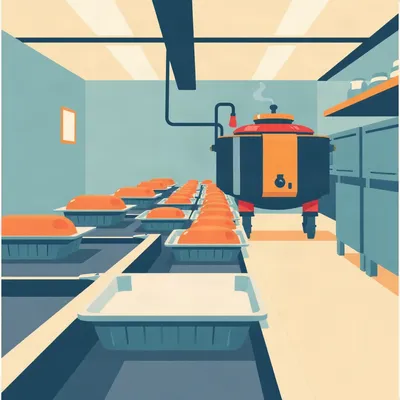
The sauce is being reduced in a steam kettle that holds eight hundred liters. The ovens are combi ovens that can hold hundreds of trays at once. The rice is cooked in continuous steamers. It's batch cooking at a scale where the unit of measurement is not the quart, it's the pallet.
And then the assembly line. This is where Daniel's image of automation starts to actually match reality, but only partly.
Right. Once the food is cooked and chilled, it moves to assembly. Conveyor belts. Workers in hairnets and gloves. Each person has a station. One person places the protein. The next adds the vegetable. The next adds the starch. The next puts the lid on. The tray moves down the line. It's exactly what you'd picture in a factory that makes electronics or toys, except the product is coq au vin.
That's the part that always gets me. The same motion, thousands of times a shift. A person whose entire job, for eight hours, is to place exactly one piece of broccoli on exactly one tray.
And that's the reality that undercuts the full-automation theory. Robots are bad at this particular job. The food is irregular. The trays are irregular. The portions shift slightly. A human hand with a pair of tongs can adjust in real time in a way that a robotic arm still can't do cheaply. The economics haven't flipped yet.
So the human is there because the human is cheaper and more flexible than the robot.
For now. And that's a big theme across all of this. But let's talk about the chef, because Daniel said he'd be amazed to learn a chef was involved. A chef is absolutely involved. But the job is not what he thinks.
It's not cooking. It's engineering.
It's recipe engineering. The chef at one of these facilities is designing food that has to survive a gauntlet. It gets cooked, then blast-chilled to near freezing, then held cold for hours, then reheated in a convection oven at altitude. And at altitude, your taste buds are dulled. Cabin pressure and dry air suppress your perception of salt and sweetness by something like twenty to thirty percent. So the chef is not cooking for your palate in a restaurant. They're cooking for your palate in a pressurized metal tube where everything tastes blander.
So they over-season.
They compensate. More salt, more umami, more acid. A sauce that tastes perfect in the test kitchen will taste flat at thirty-five thousand feet. So they design for the worst-case scenario. They also design for the reheating process. The meal has to be able to go from chilled to hot in a galley oven that can't brown, can't sear, can't do anything except blow hot air. So you can't put a crispy thing on the tray. It won't be crispy.
Which is why airline food is always braised, stewed, or in sauce. Anything that needs a Maillard reaction at the last second is dead on arrival.
The chef's job is to work within those constraints and still produce something that tastes like food. And then there's the meal code system, which Daniel mentioned with the kosher angle. Airlines order from a catalog of standardized meal types. Vegetarian, vegan, kosher, halal, gluten-free, low-sodium, diabetic, child meal, Hindu meal, Muslim meal. Each has a code. The production schedule is driven by the flight manifest.
Which updates constantly. A flight from New York to Tel Aviv might have forty kosher meals booked when the manifest first posts, and then by departure it's fifty-two. The facility has to adjust. The window for changes can be hours.
And kosher specifically adds a whole layer. Kosher meals require certification. A rabbi or a kosher supervision agency has to be involved. Often there's a separate preparation area, separate equipment, separate ovens. Sometimes the kosher meals are produced in a completely different facility and brought in. The meals are double-sealed with a tamper-evident wrapper so the crew can heat them without opening the seal. The passenger opens it themselves. That's a halachic requirement, not just a quality thing.
So when Daniel orders kosher, his tray is not coming off the same line as the standard chicken. It's a separate production run, separately certified, separately sealed. And that's why it sometimes looks different, tastes different, and comes with its own little sticker.
And the sticker is the certification. The mashgiach, the kosher supervisor, is a real person who was in that facility. Daniel's image of a fully algorithmic plant with no humans is almost inverted for the kosher line. That line has more humans per tray than almost any other part of the operation, because there's a religious supervision layer on top of the industrial process.
So the answer to Daniel's first question is: yes, it's a gigantic industrial plant near the airport. No, it's not fully automated. Yes, there are chefs. But they're recipe engineers, not line cooks. And the humans on the assembly line are doing repetitive physical work that robots still can't do profitably.
And the whole thing is governed by a cold chain that gives you less than twenty-four hours from kettle to cabin. To understand how this works, you have to picture the physical plant itself — and it looks nothing like a restaurant kitchen.
So that's the airline model. But airlines aren't the only ones trying to feed thousands of people on a tight schedule. Let's look at who else does this.
The obvious comparison is cruise ships, and the contrast is actually more instructive than the similarity. A ship like Royal Caribbean's Wonder of the Seas carries over six thousand passengers. That ship will serve somewhere between ten and twenty thousand meals per day. That's a staggering number. But the way they do it is completely different from an airline.
Because the ship has a kitchen.
The ship has dozens of kitchens. A galley crew of several hundred. On the biggest ships, you're talking three hundred, four hundred people working in food service. They're cooking fresh throughout the voyage. The ship has the space, the power, the water, and the staff to run what is essentially a floating hotel kitchen operation. They're not blast-chilling meals and reheating them. They're cooking to order, or at least cooking in batches that go straight to the dining room.
So the cruise ship is the opposite of the airline. The airline has no cooking capacity onboard at all. The galley on a plane is a warming cabinet and a coffee maker. The cruise ship has a full industrial kitchen that happens to be floating.
And that's the key constraint that makes airline catering unique. The aircraft environment has no cooking. No open flame, no deep fryer, no grill. The ovens are convection boxes that circulate hot air. So everything has to be produced on the ground and reheated in flight. No other food sector has that exact constraint.
What about hospitals? That's the one I always think of when someone says institutional food.
Hospitals are a fascinating comparison because the constraint is different again. A large hospital will produce thousands of meals a day. But each meal is often patient-specific. The dietitian has prescribed a particular diet for this particular patient. Low sodium, renal diet, texture-modified, allergen-free, diabetic, post-surgical. The production process is closer to pharmaceutical compounding than mass catering.
So the tray isn't just food. It's a prescription.
The tray card is a medical document. The kitchen has to track that Mrs. Rosen in room four-twelve gets the low-potassium version of the vegetable soup, and Mr. Chen in room two-oh-three gets the thickened liquid version. The error tolerance is extremely low, and the consequences of a mistake are medical, not just culinary.
That's a different kind of zero-error than the airline. The airline's zero-error is about logistics — the meal has to be on the plane in time. The hospital's zero-error is about correctness — the meal has to match the patient.
And the hospital kitchen is often running a hybrid system. Some food is cooked fresh on site. Some is brought in pre-prepared and rethermalized. The trend in recent years has been toward what they call cook-chill, which is actually very similar to the airline model. Cook the food, blast-chill it, hold it, reheat it at the point of service. Hospitals have adopted airline-style cold chains for efficiency.
So the airline model has actually leaked into the hospital sector, not the other way around.
In many cases, yes. And then there's the contract catering industry, which is probably the closest analog to airlines in terms of pure scale. Companies like Compass Group and Sodexo. Compass alone serves billions of meals a year across corporate cafeterias, school lunch programs, hospitals, sports venues, military bases. They're the largest food service company in the world.
Billions. With a B.
Billions with a B. And they're doing it across thousands of locations in dozens of countries. But here's the difference. Compass is not producing meals in a central plant and shipping them out. They're operating kitchens inside their clients' facilities. The cafeteria at a corporate headquarters in Frankfurt is run by Compass staff, cooking on site. The school lunch in Ohio is cooked in the school kitchen by Compass employees. It's distributed food service, not centralized production.
The scale is comparable to airlines, but the model is the opposite. Airline catering is centralized production with distributed consumption. Contract catering is distributed production with on-site consumption.
That's a clean way to put it. And each model has different problems. The centralized model has the logistics problem — how do you get the food to the consumer while it's still safe and edible? The distributed model has the consistency problem — how do you make the same dish taste the same in four thousand different kitchens?
The McDonald's problem.
The McDonald's problem, but with a thousand different menus. Compass and Sodexo have to standardize recipes, train staff, manage supply chains, and maintain quality across an absurd number of sites. It's a management challenge more than a production challenge.
Then there's the sector that nobody thinks about but probably moves more prepared meals than any of these. Military field feeding.
The MRE sector. Meals Ready to Eat. The U.S. military alone produces millions of MREs a year. Those are shelf-stable, no reheating required, eat them in a foxhole. The production is fully industrial, fully automated in many parts, and the constraint is durability, not freshness. A meal has to survive being dropped from a helicopter, frozen, baked in the sun, and still be edible three years later.
That's the far end of the spectrum. The airline meal has a twenty-four hour window. The MRE has a thirty-six month window. And the food is designed accordingly.
The military industrial food complex has actually influenced civilian food. A lot of the retort pouch technology, the shelf-stable packaging, the preservation science — that came out of military research. The tuna in a pouch you buy at the supermarket descends directly from MRE technology.
Daniel's question about sectors that churn out prepared meals daily — the answer is: airlines, cruise ships, hospitals, corporate cafeterias, schools, military, prisons, stadiums. But each one has a different constraint.
That's the insight. The constraint defines the food. The airline's constraint is no onboard cooking plus a tight cold chain plus zero-error logistics. That combination is unique. No other sector has all three at once.
The cruise ship has the scale but not the logistics problem. The hospital has the zero-error but not the scale. The military has the scale and the logistics but not the freshness requirement. The airline is the only one that has to produce thirty thousand meals a day, chill them, load them onto a vehicle that flies away, and have them reheated correctly by a flight attendant who is not a cook, all within twenty-four hours, with no room for error because a missed meal can delay a flight.
A delayed flight costs the airline far more than the meal ever did. That's the real economic pressure. The meal itself might cost the airline four or five dollars in economy. But if the catering truck is late and the flight pushes back twenty minutes late, the knock-on costs can run into the tens of thousands. So the entire system is built around reliability, not culinary excellence.
Which brings us back to Daniel's algorithm question. Is the production schedule software-driven? Absolutely. The flight manifest feeds into a production planning system. The system calculates how many of each meal code to produce. It schedules the cooking batches, the assembly runs, the chilling cycles, the truck loading. That part is algorithmic.
But the cooking and assembly still require human hands. The robots haven't taken over the assembly line because the economics don't work yet. A robotic arm that can place a piece of chicken on a tray costs more than a human worker doing the same job. And the human worker can handle variation. The robot can't.
Yet. The cost of robotic automation keeps dropping. And labor shortages in the food service industry keep getting worse. At some point those curves cross.
They will. And then the airline catering facility becomes the fully automated plant Daniel imagined. But we're not there yet. And there's a real question about whether the food gets better or worse when that happens.
The premium cabins are already pushing in the opposite direction. First class and business class meals are becoming more customized, more chef-driven. Some airlines partner with celebrity chefs. The meals are designed to be plated, not just reheated. There's a whole tier of catering that's closer to fine dining than to factory food.
At the bottom end, the buy-on-board model is pushing the other way. Low-cost carriers don't include meals. They sell you a sandwich or a snack box that's shelf-stable and was produced months ago. That's industrial food with no pretense.
The industry is bifurcating. The middle — the standard economy meal — is the one that's stuck in the industrial cold-chain model. And that's the one Daniel is eating when he orders his kosher meal at thirty thousand feet.
That middle is where the real engineering is. The premium stuff is just catering. The buy-on-board stuff is just packaged food. The standard airline meal is the only food product that has to be cooked, chilled, transported, loaded, and reheated in a pressurized tube within a day, for a consumer whose taste buds are chemically dulled, at a cost of a few dollars, with zero tolerance for delay. That is a hard problem.
It's solved, every day, millions of times, by a system that most passengers never think about.
Hilbert, you were in one of these facilities once.

I was.
Six months, quality control, 1994. A place near Heathrow. My girlfriend at the time, her uncle ran the operation. I stood on the kosher line with about forty other people in hairnets and white coats, putting food on trays by hand. There was one chef. He walked around tasting sauces and yelling at people. The rabbi spent more time looking at the ovens than the food.
The ovens had to be kosher. The food was already kosher by the time it got to us. The real work was the certification paperwork and making sure the seals were right. The rabbi checked the seals. That was his whole job, near enough. He'd stand there and look at the little plastic strip on every tray.
My job was catching mislabeled trays. The meal codes would get mixed up. A standard beef tray would end up in the kosher rack. A vegetarian would end up in the halal rack. It happened more than you'd think. The line moved fast and everyone was tired.
I missed one. Once. A kosher passenger got a standard beef tray. I don't know what happened to him. Probably opened it, saw the tray, called the flight attendant, made a complaint. Or maybe he ate it. I never heard. But I think about it sometimes. Some man over the Atlantic, opening his little foil tray, and it's the wrong thing. And I was the one who was supposed to catch it.
The fact that it only happened once in six months is actually remarkable.
That's what the uncle said. He said, one mistake in six months is better than the industry average. I said, tell that to the man who got the beef.
The interesting thing about that story is that the error wasn't in the cooking or the assembly. It was in the labeling. The food was fine. The system just put the right food in the wrong category.
The food was never the problem. The food was fine. It was the paperwork that failed.
Which is true of almost every industrial process. The physical thing works. The information layer is where it breaks.
The kosher line had the most paperwork of any line in the building. Every tray had a certificate, a batch number, a rabbi's signature. The standard line just had a meal code printed on the foil. The kosher line had a whole folder that went with every trolley.
I still have the white coat. It's in a box somewhere. The hairnet I threw away.
The certification layer you're describing is still how it works. The kosher meal is double-sealed, the passenger opens it themselves, the crew never breaks the seal. The crew heats it in the sealed container. That's a halachic requirement that dates back decades.
We heated them in the sealed container too. The oven didn't care. The seal stayed on.
The kosher meal is the one part of the airline food system where the industrial process has a religious supervisor standing next to the conveyor belt. That's a strange collision of worlds.
The rabbi was a nice man. He brought his own lunch.
Of course he did.
He didn't trust the facility food. Said it was kosher, but he'd seen the line. He brought a sandwich from home.
That might be the most damning review of airline catering I've ever heard. The kosher supervisor wouldn't eat the kosher food.
He said the certification was about the process, not the taste.
That's the whole industry in one sentence. The process is certified. The taste is not the point.
The taste was fine. I ate it every day. You get used to it.
Did you ever eat the standard line food?
Sometimes. The beef was better than the kosher beef. The kosher beef was always a little dry.
Because kosher meat is salted and soaked to draw out blood. That process removes moisture. It's a known issue in kosher cooking. The meat requires different handling to stay tender.
The chef knew that. He'd add extra sauce to the kosher trays. He said the sauce was the only thing keeping it edible.
The recipe engineer was doing his job. Compensating for the process.
He was good at it. He'd been there fifteen years. Knew every meal code by heart. Could tell you the salt content of every sauce without looking at a sheet.
That's the institutional knowledge that never shows up in the process documentation. The guy who just knows.
He retired a few years after I left. The place went more automated. More machines, fewer people. I don't know if the food got better.
That's the open question, isn't it? As the automation curve keeps dropping, these facilities are going to look more like Daniel's original image. Fully algorithmic, fully robotic. And the question is whether the food gets better or worse when the last human hands leave the line.
Whether the economics of buy-on-board eventually hollow out the standard meal entirely. If the low-cost carriers keep selling shelf-stable snack boxes, the full meal service might become a premium product, and the industrial cold-chain kitchen might shrink to serving only business and first class.
The next time you bite into an in-flight meal, consider what just happened. A chef designed that recipe to survive a blast chiller and a convection oven at altitude. A human hand placed that piece of chicken on the tray. A cold chain rushed it from a kettle to a trolley to a truck to a galley. A flight attendant reheated it without ever cooking it. And you ate it in a pressurized tube going five hundred miles an hour. That's a small miracle of industrial logistics that most passengers never think about.
Daniel's image of the algorithmic plant was half right. The scheduling is algorithmic. The cooking is not. Not yet.
Thanks to our producer, Hilbert Flumingtop, for keeping this show on schedule, which is more than he could say for the kosher line at Heathrow.
This has been My Weird Prompts. If you enjoyed this episode, leave us a review wherever you listen. It helps other people find the show.
Email us at show at my weird prompts dot com with your own prompts. We read everything.
We'll be back soon.