
History and Culture
The human past, language, religion, philosophy, arts, media, and food.
#5999: Who Teaches Actors Those Accents?
Dialect coaches break accents into six moves, not forty — and the science says imitation ability is a bell curve, not a gift.

#5988: Can You Engineer a Toddler's Accent?
A 15-month-old, a 20-word posh vocabulary list, and the science of whether you can actually install an accent on purpose.
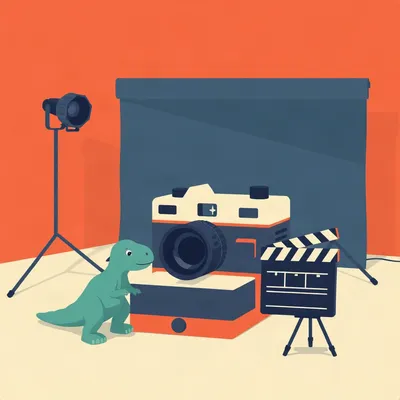
#5987: The LEGO Cam: When LEGO Gave Kids a Movie Studio
It won Toy of the Year and flopped anyway. The LEGO Studios set that handed kids a camera, an editing suite, and a dinosaur.

#5980: 95% of Intelligence Comes From Open Sources
Dead drops, illegals, and the Cambridge Five — do spy agencies share one discipline, or does each have a fingerprint?
#5979: Why We Shake Hands: A 2,800-Year History
The handshake wasn't inevitable — it won. From Assyrian treaty reliefs to Quaker radicalism, how one gesture conquered the world.

#5978: God Bless, Inshallah, Be'ezrat Hashem: Three Ways to Say Maybe
Same God, same syntax, three completely different social lives — how "God bless," "Inshallah," and "be'ezrat Hashem" do totally different jobs.
#5977: Spy Codenames, Dead Drops, and the Phrases That Fooled Everyone
Real recognition phrases from the 2010 Russian illegals case — and the twist that some were written by the FBI.
#5976: What North of North Assumes You Know About Inuit
A crash course in Inuit history, language, and modern life — the context the show assumes you already have.

#5951: The Reasonable Person Is a Legal Fiction
Courts say they judge you by a neutral "reasonable person." Who decides what that person would do — and whose average is it?
#5932: What the 1964 White Paper on the Twin Towers Actually Said
Three pages from 1964 concluded a 707 impact would cause only local damage. Fire was never in the analysis.

#5930: The World's Greatest Drunk Foods
From Dublin's spice bag to Seoul's chimaek, a tour of the dishes nations eat at 2 a.m. — and the science of why alcohol makes us hungry.

#5924: Living Among the Dead: Cemetery Housing, Cairo to Manila
Cairo's City of the Dead holds roughly a million residents. Manila North, six thousand. Nobody has ever counted the global total.
#5920: The Psychiatrist in Those 1950s Patient Films
A drug salesman's papers, a bathtub, and the 1950s interviews with Dr. Heinz Edgar Lehmann that still pull millions of views.

#5917: The Women Who Were Computers Before Computers Existed
Before machines did the math, people did — and most of them were women. Reconstructing the desk of the human computer.

#5891: Four Ways Humanity Kept Records for 1,200 Years
The Shōsōin never burned. The Vatican lost a third of its archive. The Geniza kept 400,000 fragments by accident. Four preservation strategies.
#5890: Fifteen Miles an Hour Through a Metal Pipe
Paris ran 427 km of pneumatic tube under its streets and moved 30 million messages a year. Then the fax machine replaced it.
#5887: Gears That Did Calculus: Mechanical Computers
From the Antikythera mechanism to battleship fire control, how gears and cams did real math — and why the approach never fully died.
#5886: From Leviticus to the Kilogram: Honest Scales
Ancient Athens had ten inspectors and a rock. The kilogram had one cylinder in a vault. Both were asking the same question.
#5885: The World's Oldest Software Still Running
From a 1958 Pentagon contract system to Voyager's 68KB computer, some software refuses to die. What's the oldest code still in production?

#5878: How a Sloth Learned to Talk: Corn's Origin Story
A neural interface gave Corn the bandwidth for speech. Nobody can explain where the accent, the manner, or Mongolia came from.