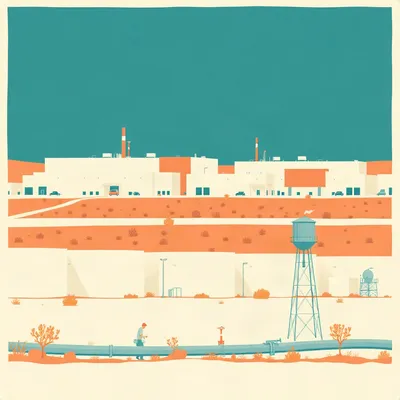
The most powerful AI model ever built wasn't trained in Silicon Valley or some desert bunker. It was trained in Abilene, Texas. Population, give or take, a hundred thousand. Daniel's prompt this week is really three questions stacked on top of each other. First, what does it physically take to stand up a hundred thousand GPUs across ten data centers in one city? Second, why Abilene, of all the places on earth? And third, how are the people who live there reacting to suddenly hosting the engine of the American AI arms race in their backyard?

And the consortium angle matters here. This isn't just OpenAI deciding to build a big training run. Starlink LLC is the vehicle, and the whole point of Starlink is that American AI dominance is now treated as a national security imperative. Abilene is where that bet gets cashed. The physical location of the bet.
So let's start with what a hundred thousand GPUs actually means when you have to plug them into a real city.
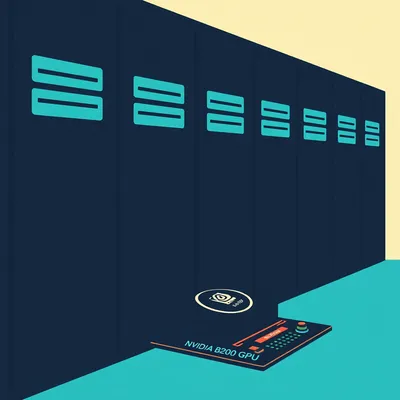
A hundred thousand GPUs is not a data center. It's a new industrial city. Each modern accelerator under full load draws somewhere between seven hundred and a thousand watts. Do the multiplication and you're at roughly a hundred megawatts just for the compute silicon, before you account for cooling, networking, storage, lighting, or the coffee machine in the security office.
A hundred megawatts. I keep trying to find a comparison that makes that feel real.
A hundred megawatts is on the order of a hundred and fifty thousand homes. But here's the thing, real training clusters don't run at a hundred percent utilization continuously. They run at sixty to eighty percent, with all the overhead that comes with it. So the actual continuous draw for a cluster this size is closer to a hundred and fifty to two hundred megawatts. That's not a customer of the grid. That's a power plant that happens to be shaped like computers.
And this is the part where the story stops being about AI and starts being about natural gas, water, and zoning board meetings.
Right. The binding constraint on all of this is power. Not chips. Not talent. Not even money, at the scale we're talking about. Power. The Texas grid, ERCOT, is famously fragile. Winter Storm Uri in twenty twenty-one killed hundreds of people and nearly took the whole grid down for weeks. You cannot train GPT-6 on a grid that might not be there on a cold February morning. So the answer in Abilene is to not use the grid, at least not as the primary source.
They're building their own power plant.
A dedicated natural gas plant, on site, serving the Stargate campus. The Texas Observer has been documenting this. This is a fundamental shift from how data centers have worked for twenty years. The old model was, you find cheap land, you call the local utility, you negotiate a big power purchase agreement, and you plug into the grid. The new model is, you bring your own generation. You become your own utility. And that changes the politics completely, because now you're not competing for grid capacity, you're competing for natural gas supply, for water, for pipeline rights, and for the patience of everyone who lives downwind.
That's the thing I keep coming back to. A data center used to be a quiet tenant. This is a heavy industrial facility that happens to produce intelligence instead of steel.
And then there's the cooling. A hundred thousand GPUs generating a hundred and fifty megawatts of heat, in West Texas, where it's hot and dry and getting drier. You've got two options. Evaporative cooling, which uses enormous amounts of water, or closed-loop liquid cooling, which uses less water but costs more upfront and adds a lot of plumbing complexity. The choice of cooling technology determines the water bill, and in a drought-prone region, the water bill is a community flashpoint. The Texas Observer has documented local complaints about water competition. This isn't theoretical. It's people looking at their aquifer levels and then looking at a facility that evaporates millions of gallons a day.
So you've got a facility that doesn't want to use the fragile grid, doesn't want to use the scarce water, and needs to be built fast. What does that leave you with?
Natural gas and a lot of very expensive pipes. And that's before we even talk about the networking. A hundred thousand GPUs don't train one model unless they act as one machine. That requires a network fabric, either fat-tree or torus topology, with hundreds of thousands of optical interconnects. The physical layer alone, the fiber runs, the switch racks, the cable management, is a logistics nightmare. People picture GPUs in racks. I picture a city's worth of fiber optic cable, all of it needing to be installed, tested, and maintained by people who know what they're doing. There aren't that many people who know what they're doing.
So you're building a power plant, a water system, and the world's largest single computer, all at once, in a town of a hundred thousand people.
And the construction timeline is not a one-year project. It's multi-year, multi-billion-dollar. The natural gas plant alone is a massive construction effort. The city has been transformed into a twenty-four-seven industrial construction zone. Think about what that does to a place. The noise, the truck traffic, the road wear, the influx of construction workers who need housing and services, and then, when it's done, most of them leave. That's the part people don't think about. The construction phase is the most disruptive and the most visible, and it's temporary. What's left behind is a facility that runs with very few people.
Let's sit with that for a second, because I think it's the core of the resentment Daniel's asking about. A factory that employs five hundred people is a civic asset. A data center that employs a hundred technicians is a different thing entirely. It's a piece of infrastructure, not a workplace.
Ten data centers, once built, maybe a hundred to two hundred permanent technicians total. Maybe. The construction jobs are real but they're temporary. So Abilene gets the disruption, the water use, the gas demand, the road damage, and the tax base, but it does not get the employment boom that a factory or a military base would bring. That's the trade. And it's a trade that a lot of people are starting to question.
And this is where the political story gets interesting. Because the assumption, I think, from the outside, is that a conservative West Texas town would welcome a massive industrial project with open arms. Jobs, growth, national security, all of that. And at first, that was probably true. But the EconoTimes reporting shows Texas Republicans are now turning against AI data centers. The election backlash is real. The same party that rolled out the red carpet is now facing constituent anger over grid strain, water use, and the sense that rural Texas is being sacrificed for coastal tech profits.
That's the twist. The backlash is coming from the right, not the left. This isn't environmentalists in Austin protesting. This is Republican county commissioners and state representatives in West Texas saying, wait a minute, we gave you the abatements and the permits, and now our constituents are telling us the water pressure dropped and their electricity bill went up and the roads are destroyed. And by the way, where are the jobs you promised? The answer is, there aren't any. There never were.
The jobs were always going to be in San Francisco and Seattle and New York. The land, the water, and the political cover were always going to be in Abilene. That's the deal. And I think a lot of people are realizing the deal is not what was advertised.
Why Abilene though? Let's actually answer Daniel's second question directly. It's a trifecta. Cheap land. Available power, or at least the ability to build generation quickly. And political friendliness. West Texas has hosted oil infrastructure, wind farms, military bases for decades. The zoning and permitting culture is built for industrial-scale projects. You can get a permit in months, not years. Compare that to California or New York, where environmental review alone could kill the project before it starts.
Texas has no state income tax, aggressive property tax abatements for large employers, and a regulatory environment that says, essentially, if you're willing to build it, we're willing to sign it. That's the pitch. And for a project that needs to move at the speed of an arms race, that's the only pitch that works.
But the political friendliness cuts both ways now. The same speed that got the project approved is now the thing that makes people feel like they had no say. A city of a hundred thousand people suddenly has a project that outsizes its entire municipal infrastructure, and the project was approved under abatements and fast-tracked permits that the city council signed before anyone really understood what they were signing.
And then you layer on the national security framing. Starlink LLC's whole mandate is to keep the US ahead of China in AI. That's not a corporate slogan. That's the stated purpose of the consortium. And for a lot of people in Abilene, that's a point of genuine pride. They're hosting the thing that keeps America ahead. But it also means the project is effectively untouchable. You can't protest a national security imperative without being painted as unpatriotic. That's the trap. The city is in a trap where any pushback is framed as undermining the country.
And the trap is real. If you're a county commissioner and you say, actually, we need to renegotiate the water agreement, the response is, do you want China to win the AI race? That's not a conversation. That's a conversation ender. And it works. It works on people who care about national security, which is most people in West Texas.
But here's the thing. The national security argument is being made by a consortium that includes private companies with private shareholders. The profits from this are not going to the United States Treasury. They're going to OpenAI and its investors and the other Starlink partners. So the patriotism is real, but the profit motive is also real, and they're bundled together in a way that makes it very hard to untangle.
And the economic reality on the ground is that the city gets the tax base, but the tax abatements mean the immediate revenue is often far less than people expect. The long-term economic benefits are speculative. Meanwhile, the water use, the grid strain, the noise, the construction disruption, those are immediate and concrete. People can see the trucks. They can hear the generators. They can watch their water bill. The benefits are abstract. The costs are physical.
Abilene was a railroad town, then an oil town. Now it's becoming an AI company town. But here's the inversion. A railroad or an oil company needed the local workforce. It hired the people who lived there. It built schools and hospitals because its workers needed them. A data center doesn't need the local workforce. It needs the land, the power, and the political cover. The relationship is extractive in a way that's new for the city. It's not a company town where the company employs the town. It's a company town where the company owns the town's resources and employs almost no one.
And that's the resentment Daniel's getting at. It's not that people in Abilene are anti-technology. It's that they're being asked to host the most expensive piece of infrastructure in human history, and their reward is a few hundred jobs and a tax abatement that means the city doesn't even get the full property tax revenue it would have gotten from a Walmart.
The Texas Observer has documented the specific harms. Noise. Construction disruption. Water competition. And the feeling, which I think is the deepest wound, that a city of a hundred thousand has no say in a project that will outsize its entire municipal infrastructure. The decision was made by people in San Francisco and Washington and the boardrooms of the consortium partners. Abilene was informed, not consulted.
And now the Texas GOP is feeling the heat. The EconoTimes piece is clear that this is an election issue. Candidates are being asked about data centers in town halls. Incumbents who supported the abatements are being challenged from the right. The political consensus that said, all industrial development is good development, is cracking. Because the voters have figured out that a data center is not a factory. It doesn't hire your kids. It doesn't sponsor the little league team. It sits there, humming, using your water, and sending its profits to California.
The infrastructure story and the political story are the same story. The reason Abilene got picked is the reason Abilene is now unhappy. The things that made it attractive, cheap land, fast permits, political friendliness, are the things that now make it vulnerable. The city was chosen because it wouldn't say no, and now it's discovering that it can't say no, even if it wanted to.
The project is only the first one. That's the part that keeps me up. GPT-6 was trained on a hundred thousand GPUs. The next model, whatever it is, will need more. The one after that, more still. Abilene is the test case. If this works, there will be ten more Abilenes. If it doesn't work, if the backlash grows, then the whole Stargate strategy has a political problem that no amount of compute can solve.
Let's talk about the misconceptions, because Daniel's prompt implies a few of them, and I think they're worth naming directly. First, the idea that data centers bring massive local employment. They don't. The construction phase is real but temporary. The permanent workforce is tiny. Second, the idea that AI runs on renewable energy. The Stargate Abilene campus is powered by a dedicated natural gas plant. This is a fossil fuel project wearing an AI hoodie. Third, the idea that rural communities welcome these projects because they're good for the local economy. The tax abatements mean the immediate revenue is often minimal, and the long-term benefits are speculative.
Fourth, the idea that national security projects are politically uncontroversial. The Texas GOP backlash proves that's false. Even the party that enabled this is feeling the heat from constituents. National security is a powerful argument, but it doesn't pay a water bill.
Where does that leave us? We've got a hundred thousand GPUs in West Texas, powered by natural gas, cooled by water that's getting scarcer, connected by a network fabric that's one of the largest single construction projects in the country, and sitting in a town that's starting to wonder if it made a deal with the devil.
The scale is almost incomprehensible. Let me try to make it concrete one more way. When you stand up a hundred thousand GPUs, you're not just buying chips. You're building a power plant, a water system, a network, a security apparatus, and a logistics operation that runs twenty-four-seven. The chips are almost the easy part. They arrive on pallets. The hard part is everything else.
The chips are the easy part. That's a sentence that would have sounded insane five years ago.
Five years ago, a thousand-GPU cluster was a big deal. Now a hundred thousand is a single training run. The scaling curve is vertical. And the physical infrastructure is not scaling the same way. The grid isn't scaling. The water supply isn't scaling. The political patience isn't scaling. That's the collision. The technology scales exponentially, and the physical world scales linearly, if it scales at all.
Abilene is where those two curves cross. That's what makes it such a good story. It's not a story about chips. It's a story about what happens when exponential ambition meets linear reality.

It was seventy-two hundred dollars an acre.
Say that again.
Seventy-two hundred an acre. That's what we offered ranchers in the late nineties for a cell tower easement. One-time payment. Plus a little bit of annual rent. And the county got a tower permit fee and a promise of better coverage. That was the pitch. Better coverage for the town, a little money for the landowner, and the county got to say it was bringing in the future.
You did site acquisition.
Eighteen months. I was the guy who showed up at county commissioner meetings to convince ranchers that a three-hundred-foot tower was good for their land value. I've been watching the Abilene story and it's the same playbook. Find a cash-strapped rural county, promise tax revenue and jobs, get the abatements signed, and then the jobs never materialize at the promised scale. The cell towers did bring jobs, but it was four guys in a truck, not the fifty permanent positions they promised the county.
You're saying the city council is making the same mistake.
At a hundred thousand times the scale. The abatements are structured so that if the town tries to renegotiate or push back, they owe the company millions in clawbacks. We used to call them golden handcuffs. The town signs a deal that looks good on paper, and then five years later they realize they can't afford to enforce their own ordinances, because enforcing the ordinance triggers the clawback.
The clawback is the mechanism that removes the town's leverage.
It's the whole game. You promise the moon, you get the abatement, and then the abatement is the thing that prevents the town from ever asking for more. I haven't seen the actual Abilene contract. But I know the template. It's written by people who've done this before. And the people who've done this before are very good at making sure the town never gets a second chance to negotiate.
The national security framing is the new part, but the financial structure is the same old extractive playbook.
The national security framing is the part that's new. In the nineties, we couldn't say, if you don't approve this tower, the Chinese will win. We said, you'll get better cell coverage. Now they say, you'll keep America ahead. It's a better pitch. Harder to vote against. But the contract underneath is the same. The town gets the disruption, the water use, the road damage, and a tax abatement that means it doesn't even get the full property tax revenue. And the jobs that were promised, they're not coming. They were never coming.
The difference is the scale of the resource extraction. A cell tower doesn't use water. It doesn't strain the grid. It doesn't require a dedicated natural gas plant. The footprint is a fifty-foot square of gravel and a chain-link fence. This is a hundred thousand GPUs and a power plant.
The town still can't say no. That's the part that hasn't changed. In the nineties, the county commissioners could have said no to the tower. Some did. But most didn't, because the money was on the table and the future sounded good. Abilene could have said no, in theory. But when the consortium shows up with a national security mandate and a billion-dollar budget, and the governor is on the phone, and the abatement is structured so that the city gets something, anything, the no doesn't happen. The no was never on the table.
The question Daniel's really asking, underneath the infrastructure and the politics, is whether a town of a hundred thousand can host the engine of the American AI arms race and still be a town. Or whether it becomes something else. A resource colony for the intelligence economy.
It becomes a resource colony. That's what happened to the cell tower towns. They got the tower, they got the four guys in a truck, and they got a little bit of annual rent. And the coverage, the actual benefit, went to the people driving through on the interstate. The town itself didn't change. It just got a tower. Abilene is getting a power plant, a water system, and a network fabric. The town will change. But whether it changes for the better, that's the part nobody can answer yet.
The cell tower comparison is useful because it shows the pattern. The pitch is always the same. We're bringing the future to your town. And the future is real, the technology is real, the benefit to the country is real. But the benefit to the town is always thinner than the pitch. And the costs are always heavier.
The costs are always heavier. That's the line. I used to sit in those county commissioner meetings and watch the commissioners nod along, and I knew, I knew, that five years later they'd be angry. But they signed anyway, because the future was on the table and the future is hard to vote against. Abilene's commissioners signed. And now they're angry. And the clawbacks mean they can't do anything about it.
The historical perspective is that this isn't new, it's just bigger. The extractive playbook is the same. The numbers are different. The stakes are different. But the dynamic, the town that can't say no, the abatement that becomes a trap, the jobs that never materialize, that's been happening for thirty years.
It'll keep happening. The next Abilene is already being scouted. Some town in Oklahoma or New Mexico or another part of Texas, same profile, cheap land, fast permits, political friendliness. The playbook works. That's why they keep using it.
That's the systemic implication. Abilene is not a one-off. It's a template. And the template is being refined with every project. The next deal will have better clawbacks, tighter abatements, more national security framing. The towns won't stand a chance.
The question that leaves me with is, what happens when the next hundred thousand-GPU cluster gets announced, and the next? Abilene is the test case for whether rural America can host the AI arms race without being destroyed by it. And the early returns are not encouraging.
The Texas GOP backlash suggests the political consensus is cracking. If the party that enabled this turns against it, what does that mean for the next Stargate site? Do the abatements get harder to pass? Do the water permits get slower? Does the national security framing lose its power when voters have seen the actual deal?
The AI arms race isn't just about models and benchmarks. It's about who gets to say no to a power plant in their backyard, and whether national security is a trump card that silences local democracy. That's the real question Daniel's prompt is poking at. Not can we build it. We can build it. We are building it. But should a town of a hundred thousand people have to host it, and what do they get in return?
The answer, so far, is that they don't get much. They get the disruption, the water use, the road damage, and a tax abatement that means the city doesn't even get the full property tax revenue. They get to be the place where the future is built, but the future doesn't stay. The future lives in the cloud, and the cloud lives in Abilene, but the people of Abilene don't get to touch it.
There's a detail from the research that didn't fit anywhere else, but it's been sitting with me. The dedicated natural gas plant isn't a backup. It's the primary power source. The grid couldn't handle this facility, so they built their own grid. That's the whole story in one sentence. The grid couldn't handle it, so they built their own. And the town is just supposed to live next to it.
That's the open question we're left with. The next time a consortium shows up in a small town with a national security mandate and a billion-dollar budget, will the town be able to ask the hard questions? Will the abatement be structured differently? Will the water deal be public? Or will the playbook just run again, faster this time, with better clawbacks?
If you want to understand where AI is really being built, not in the cloud but in the dirt, this was the episode for you. Rate, review, and tell a friend who thinks AI runs on magic.
Thanks to our producer, Hilbert Flumingtop, for keeping the whole thing running.
This has been My Weird Prompts. We'll be back soon.