Forty-one percent. That's how much of the vote Joe Biden got in Loving County, Texas, in twenty twenty. Which sounds competitive until you realize Loving County has about sixty registered voters and the entire county is two ranches and a gas station. Daniel's wife is from Dallas, and Daniel just spent a few weeks driving around the U.S. Hearing the word purple for the first time. Not the color. The shorthand. Red for Republican, blue for Democrat, and purple for the places where neither side owns the map. He'd always assumed Texas was one big red block, and he wants to know what the traditional vote actually looks like across a state the size of a small empire. Which parts vote Republican, which parts vote Democrat, and which parts are up for grabs. So today we're going to color in the map of Texas, and maybe redraw a few assumptions about the South along the way.

The first thing to understand is that purple is not a blend. It's not that you mix red and blue and get a place where everyone's a moderate. Purple means the outcome is unstable. A purple county is one where the margin between the two parties is small enough that a shift of a few thousand votes flips it. It can lean one way for a decade, then swing the other way in a single cycle.
So it's less a color and more a warning label.
It's a warning label for campaign strategists, yes. And the color scheme itself is newer than most people think. Before two thousand, there was no fixed standard. Different networks used different colors. NBC had a map where Democrats were red and Republicans were blue for years. The current convention, red for Republicans, blue for Democrats, solidified during the two thousand election coverage, because that's the election where everyone stared at the same map for five weeks.
The Florida recount gave us a national color wheel.
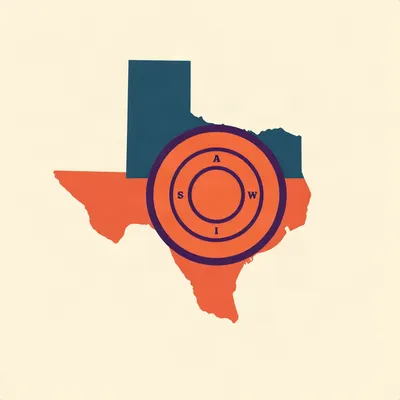
It did. And once the colors locked in, purple emerged as the obvious term for the in-between. Cartographers and journalists started making county-level maps where the red and blue mixed visually into purple, and the label stuck. But here's what Daniel's question gets at. The statewide map of Texas looks red. It's not even close. But the county-level map looks like a target. Blue bullseyes in the cities, red everywhere else, and a ring of purple suburbs around each bullseye.
So let's zoom into the state itself. What's the traditional geography of the Texas vote?
Texas is vast. It's about seven hundred and fifty miles from the Panhandle to the Rio Grande. The political geography breaks down into three big layers. The urban cores are Democratic strongholds. The rural expanse is Republican. And the suburbs, especially the inner ring around the big metros, are the battleground.
Start with the blue islands.
The big three are Houston, Dallas, and Austin. Austin is the most liberal city in the state, and it's not close. Travis County, which is Austin, went for Biden with over seventy percent of the vote in twenty twenty. That's a blowout. Austin has the state government, the University of Texas, a massive tech sector, and a political culture that's been proudly countercultural for decades. The slogan there used to be keep Austin weird. That's not a neutral statement.
I've heard that slogan. It always sounded like a municipal threat.
It's a promise. Houston is more complicated. Harris County is huge, over four point seven million people, and it's now reliably Democratic in presidential races, but it's a different kind of Democrat. Houston is an energy town. It's diverse, it's working class in parts, it has a massive immigrant population, and its Democratic Party is more pragmatic and business-friendly than Austin's. Dallas County itself is solidly blue now. It's been trending that way for twenty years. The city of Dallas is a Democratic stronghold, and the county has followed.
What about San Antonio and El Paso?
Both lean blue. San Antonio, Bexar County, is a majority-Hispanic city with deep Democratic roots, though it's more culturally conservative than Austin on some issues. El Paso is overwhelmingly Hispanic and heavily Democratic, but it's also got a strong military presence with Fort Bliss, which complicates the picture. El Paso is a border town, and border politics in Texas don't map cleanly onto the national red-blue divide.
That's a thread worth pulling later. But first, the red expanse.
The red expanse is most of the state geographically. West Texas, the Panhandle, the Hill Country outside Austin, and much of East Texas are reliably Republican. Some of these counties vote eighty, eighty-five, ninety percent Republican. Loving County, which is the least populous county in the whole country, went for Trump with something like ninety percent of the vote. There are counties in the Panhandle where the Democratic Party barely exists as an organization. The energy industry dominates West Texas. The Permian Basin is oil country, and oil country votes Republican. East Texas is culturally part of the Deep South, with a strong evangelical Protestant presence and a political tradition that runs from the old Southern Democrats straight through to the modern GOP.
So the map is blue in the cities, red in the country, and then there's this ring.
The ring is where the action is. The suburbs around Dallas, Houston, and Austin have been shifting from solid red to competitive over the last fifteen years. Collin County, north of Dallas, was one of the most reliably Republican counties in the country for decades. It's now purple. Williamson County, north of Austin, went for Trump by about nine points in twenty sixteen, then flipped to Biden by about one point in twenty twenty. Hays County, south of Austin, has been trending blue as the city's population spills outward. Fort Bend County, southwest of Houston, was once a Republican stronghold and is now solidly Democratic, driven by an influx of Asian and Black families moving into the suburbs.
What's driving the shift? Is it just people moving from California?
That's part of it, and there's a term for it. Texodus. The migration of Californians and other out-of-staters into Austin, Dallas, and Houston has accelerated since the pandemic. The newcomers tend to be younger, more educated, and more Democratic. But it's not just migration. The suburbs are changing from within. College-educated white voters, especially women, have been moving away from the GOP since twenty sixteen. That's a national trend, and it's hitting the Texas suburbs hard. Meanwhile, the suburbs are also becoming more racially diverse. The old model of the white-flight suburb voting Republican is breaking down.
So the suburbs are purple because the people in them changed, not because anyone changed their mind.
That's a huge part of it. But there's also a historical layer here that gets missed. Texas was a Democratic state for most of the twentieth century. The Solid South was solidly Democratic, and Texas was part of it. From Reconstruction through the nineteen seventies, Texas voted Democratic in nearly every presidential election. The state produced Democratic giants like Sam Rayburn, Lyndon Johnson, and Lloyd Bentsen.
So the red Texas is a recent invention.
It's a product of the national realignment. The GOP's rise in Texas started in the nineteen sixties, when the national Democratic Party embraced civil rights and Southern white voters began to drift. The Southern Strategy, Nixon's explicit appeal to those voters, accelerated it. Texas first voted Republican for president in nineteen fifty-two for Eisenhower, then again in fifty-six, but it went back to the Democrats for Kennedy and Johnson. The real break came in nineteen eighty, when Reagan won Texas, and by the nineties the state was firmly Republican at the federal level. The last Democratic presidential candidate to win Texas was Jimmy Carter in nineteen seventy-six.
And that flip wasn't uniform. It left the cities blue.
It left the cities blue and the countryside red. The old Southern Democrats in rural Texas didn't all become Republicans overnight. A lot of them kept calling themselves Democrats for years, even while voting Republican. That's a cultural identity thing, and it's still visible in some places. There are counties in East Texas and West Texas where the local officials run as Democrats but govern like Republicans.
That's the old school Democrat label. It means something different in Texas than it does in Vermont.
Completely different. The Democratic Party in Texas was never a monolith. It contained conservative rural whites, urban machines, Hispanic voters in South Texas, and labor unions. That coalition held together as long as the national party was ambiguous on race and culturally conservative. Once the national party moved left on civil rights and social issues, the coalition shattered. The rural whites went Republican, the urban voters stayed Democratic, and the Hispanic voters became the swing constituency everyone fights over.
So the current map is the wreckage of that old coalition.
The blue islands are the descendants of the urban machines and the labor unions. The red expanse is the descendants of the rural Southern Democrats. The purple suburbs are the new arrivals and the realigned professionals who don't have a century of partisan loyalty to either side.
Let's talk about the Hispanic vote, because that's the part of Texas politics that confuses outsiders. Daniel's wife is from Dallas. He's probably seen that the Hispanic vote in Texas doesn't behave the way the national narrative says it should.
The Rio Grande Valley is the best example. The Valley is overwhelmingly Hispanic, heavily Catholic, and historically Democratic. But in twenty twenty, Trump made significant inroads there. Zapata County, which is about ninety-five percent Hispanic, flipped from Clinton in twenty sixteen to Trump in twenty twenty. That shocked a lot of people. The Valley has a strong law enforcement culture, a strong small business culture, and a socially conservative streak that doesn't fit the national Democratic brand. It's also a border region, and border security is not an abstract issue there. It's daily life.
So the assumption that growing Hispanic population automatically means a bluer Texas is wrong.
It's more complicated than that. Hispanic voters in Texas are not a bloc. They split by generation, by geography, by religion, by class. A third-generation Hispanic professional in a Dallas suburb votes differently from a first-generation immigrant in El Paso, who votes differently from a ranch owner in the Valley. The Democrats have been losing ground with working-class Hispanic voters, especially men, and that's one of the reasons Texas hasn't flipped despite the demographic projections.
Let's pull back now. Texas isn't an island. Daniel asked about the South as a whole. Is the South as uniformly Republican as the stereotype says?
It isn't, and the last few cycles have made that obvious. Georgia flipped to Biden in twenty twenty. Then Democrats won both Senate seats in the twenty twenty-one runoffs, with Raphael Warnock and Jon Ossoff, driven by Atlanta's suburbs. That was a seismic shift. Georgia had been a Republican stronghold since the late nineties. The Atlanta metro area is now a Democratic machine, and the surrounding suburbs are purple.
And Virginia?
Virginia is the cleanest example of the purple-to-blue transition. Virginia voted Republican in every presidential election from nineteen sixty-eight to two thousand four. Then Northern Virginia exploded. The D.C. suburbs grew, the federal workforce expanded, the tech sector moved in, and the state flipped. Obama won Virginia in two thousand eight and twenty twelve. Clinton won it in sixteen. Biden won it by ten points. Virginia is now a reliably blue state in presidential elections, though the governorship still swings back and forth.
North Carolina is the interesting one, because it's been purple for twenty years and nobody can quite call it.
North Carolina is the perpetual battleground. It's gone for the Republican in most recent presidential elections, but the margins are always close. The Research Triangle, Raleigh, Durham, Chapel Hill, is a growing blue hub. Charlotte is blue. The rural counties are deep red. The suburbs around Charlotte and Raleigh are where the state gets decided. It's the same pattern as Texas, just further along.
So the South is not a monolith. It's a patchwork with the same three layers everywhere. Blue cities, red countryside, purple suburbs.
And the purple suburbs are the swing district of American politics. The twenty twenty-two midterms showed this. Democrats held Senate seats in Georgia and Arizona, won a Senate seat in Pennsylvania, and held their own in North Carolina, largely because suburban voters rejected the most Trump-aligned candidates. The suburbs have become the decisive battleground of American elections, and the South is where the suburbs are growing fastest.
There's a term for why the map looks more polarized than the vote actually is. The big sort.
The big sort. It's the phenomenon where people cluster with like-minded neighbors. Americans have been sorting themselves geographically by politics for decades. Liberals move to cities and inner suburbs. Conservatives move to exurbs and rural areas. The result is that counties become more homogeneous, even as the statewide vote stays close. A state can be competitive while most of its counties are blowouts. That's Texas. The statewide margin in twenty twenty was about five and a half points. That's competitive, but the county map looks like a civil war.
Because the competition is concentrated in a few counties.
In twenty twenty, Trump won Texas by about five and a half points. But Biden won Travis County by over forty points. He won Harris County by about thirteen. He won Dallas County by about thirty-two. Meanwhile, Trump won most rural counties by forty, fifty, sixty points. The statewide result is the sum of a few very blue counties, a few very red counties, and a handful of purple counties where the margin was under five points.
So when Daniel asks which parts of Texas are purple, the honest answer is a short list of counties that everyone watches every cycle.
The bellwethers. Tarrant County is the big one. Fort Worth. Tarrant voted for Trump in twenty sixteen by about nine points. Then it flipped to Biden in twenty twenty by about half a point. Then it swung back to Trump in twenty twenty-four. That's a purple county. It's not a fifty-fifty split. It's a place where the outcome changes every cycle based on turnout and the national mood. Collin County is similar. Williamson County, Hays County, Denton County. These are the counties where the statewide result gets decided.
Tarrant County is interesting because Daniel's wife is from Dallas. Dallas County is now solidly blue. But Tarrant, right next door, is the purple battleground. The metro area contains both the blue stronghold and the swing district.
And that's the thing about Texas politics. The metro areas are not single political units. Dallas County and Tarrant County are part of the same urban sprawl, but they vote differently. The city of Dallas is blue. The city of Fort Worth is more purple. The suburbs around both are a mix. A ten-minute drive can take you from a precinct that votes eighty percent Democratic to one that votes eighty percent Republican.
So the yard signs tell the story.
The yard signs are the real polling data. If you drive through a Dallas suburb in October, you'll see a mix of signs that would look schizophrenic to an outsider. A house with a Trump sign next to a house with a Harris sign next to a house with a local school board candidate and a sign about a bond issue. That's purple. It's not that everyone agrees. It's that nobody's sure who's going to win.
Let's talk about the limits of the purple label. Because there's a version of this story that says Texas is inevitably turning blue, and I don't think the data supports that yet.
It doesn't. The demographic projections have been saying Texas will flip for twenty years, and it hasn't. The GOP's rural margins are enormous, and the state's redistricting process has been aggressive about protecting Republican seats. After the twenty twenty census, the Texas legislature drew maps that shored up Republican incumbents and diluted Democratic strength in the suburbs. The state also has voter ID laws and other restrictions that reduce turnout among groups that lean Democratic.
So the purple potential is real, but the structural barriers are also real.
The structural barriers are part of why Texas is still red. The state's electoral votes have gone to the Republican in every election since nineteen eighty. That's forty-plus years. The Democrats have been saying next time for most of that. The twenty twenty result, five and a half points, was the closest a Democrat has come since nineteen ninety-six, but it was still a loss. Twenty twenty-four reverted to a larger Republican margin. So the trend is not linear. It's a jagged line, and it might stay jagged for a while.
What would actually flip Texas?
Three things would have to happen at once. The suburbs would have to keep trending blue. The Hispanic vote would have to stop drifting right. And turnout in the urban cores would have to hit levels the state has never seen. That's a tall order. The Democrats have been pouring money into Texas for cycles now, and the return has been incremental. The state is getting more competitive, but competitive and winnable are different things.
And the midterms are coming up. The twenty twenty-six cycle is going to be the first test of whether the purple suburbs hold or snap back.
The counties to watch are the ones we've been naming. Tarrant, Williamson, Hays, Collin, Fort Bend. If the Democrats can hold their suburban gains and expand in the cities, the statewide margin tightens. If the GOP wins back the suburbs, the state stays red for another decade. The twenty twenty-eight presidential race will be the real test, but the midterms will give us the signal.
Let's circle back to Daniel's wife and Dallas. What would she see if she drove around her home county today?
Dallas County is a Democratic stronghold. The county has been blue since two thousand six, and the margin has grown. The city of Dallas itself is heavily Democratic, and the inner suburbs are following. But the moment you cross into Tarrant County or Collin County or Denton County, the picture changes. Those counties are purple. They swing. And the swing is not random. It tracks education, age, and diversity. The more college-educated the suburb, the bluer it's trending. The more working-class, the redder it stays.
So the traditional vote in Texas is three different traditions stacked on top of each other. The urban Democratic tradition, the rural Republican tradition, and the suburban swing tradition.
And the suburban swing tradition is the newest and least stable. It's the one that will decide the next decade. The old Texas Democratic Party is gone. The old Texas Republican Party is still here, but it's being reshaped by the same forces that are reshaping the national GOP. The suburbs are where the new Texas is being built, and the new Texas doesn't have a settled partisan identity yet.
That's the thing about purple. It's not a permanent condition. It's a transition state. A purple county is a county that hasn't decided what it is yet.
Texas is a purple state in the same sense. It's not that the state is evenly divided. It's that the state is in motion. The demographics are shifting, the suburbs are realigning, and the old coalitions are breaking down. The map looks red, but the map is a snapshot. The underlying motion is toward something more competitive.
When Daniel hears purple, he should think of it as a verb, not a color.
That's the best way to put it. Purple is a process. It's the sound of a place changing its mind.

I wouldn't call Tarrant County purple. I'd call it red with a purple collar.
Say more.
I did poll watching there in two thousand. Between jobs. I'd finished a stretch doing rodeo clown work and hadn't started the telemarketing gig yet. The county paid poll watchers forty dollars for the day, and I figured I'd see democracy up close. What I saw was a room full of paper ballots and a poll worker handing Spanish-language ballots to people who'd asked for English ones. Took three hours to sort out. Every provisional ballot was a small drama. That's the thing about a purple county. On paper it's competitive. In practice, the machinery of the place still leans one way. The precinct maps, the polling locations, the way the districts are drawn. Tarrant County voted Republican for decades because the system was built by Republicans, and the system doesn't flip just because the vote totals do.
That's the gerrymandering point. The county-level vote can be purple while the district-level representation is still red.
The maps get drawn by the people who won the last census. That's not a secret. And the people who won the last census in Texas were not confused about what they were doing.
You said the system leans one way. What did you see on the ground that made you think that?
The precinct I was in was on the north side of Fort Worth. Working class. The poll workers were all old-timers, and they knew everyone who walked in. Friendly, but they'd known everyone for thirty years. The new people, the ones who'd just moved in from somewhere else, they got the provisional ballots. Not because anyone was trying to stop them. Because the system didn't know who they were. And a provisional ballot in a purple county is a vote that might not count.
That's the voter roll issue. New residents, people who've moved within the county, people whose registration doesn't match their current address. They're more likely to end up with a provisional ballot, and provisional ballots get rejected at a higher rate.
My ex-wife's family is from out in West Texas. Near Midland. They still call themselves Democrats. Old school Democrats, they say. They've voted Republican since Reagan. But if you ask them, they're Democrats. The party left them, they didn't leave the party. That's what they'll tell you. I don't know if it's true, but it's what they believe. The label matters to them even though the vote hasn't matched the label in forty years.
That's the cultural identity thing we were talking about. The old Southern Democratic identity survived the partisan flip.
It's not just Texas. You see it all over the South. People whose grandfathers were New Deal Democrats, who still call themselves Democrats, but who vote Republican in every federal election. The party label is a family inheritance, not a current affiliation.
My ex-wife's uncle used to say he was a Democrat because his daddy was a Democrat, and his daddy was a Democrat because the Republicans were the party of Reconstruction. That's a hundred years of family history in one sentence. The vote changed. The identity didn't.
The purple county is not just a place where the vote is close. It's a place where the old identities and the new demographics are colliding.
That's exactly what it is. Tarrant County is full of people who moved there from somewhere else and people whose families have been there since before the oil boom. The newcomers don't have the old loyalty. The old-timers don't have the new politics. The result is a county that can't make up its mind. But the machinery of the place, the districts, the precincts, the poll workers, that machinery was built by the old-timers. So the county votes purple but governs red.
That's a useful distinction. Purple on paper, red in practice.
The paper is the vote total. The practice is everything else. The county commissioner's court, the school boards, the local judges. Those don't flip just because the presidential vote did. They flip a cycle or two later, or they don't flip at all because the districts are drawn to keep them where they are.
When Daniel's wife looks at Dallas and sees a blue county, she's seeing the end result of a process that took twenty years. And Tarrant is still in the middle of it.
Tarrant is still in the middle of it. And the question is whether it finishes the flip or snaps back. My money's on snap back. The place is too old, too rooted. The new people are there, but the old people are more there.
That's the open question for the whole state, really. Whether the demographic shift outpaces the structural drag.
The midterms are going to give us the first read on that.
Watch the precinct maps, not the county maps. The county map will tell you it's close. The precinct map will tell you who's actually winning.
The twenty twenty-six midterms and the twenty twenty-eight presidential race are the real test. Tarrant County, Williamson County, Hays County. Those are the early indicators. If the suburbs hold blue or keep swinging, Texas tightens. If they snap back, the red map holds for another decade.
Next time you're in Dallas, Daniel, look at the yard signs. Not the billboards, not the campaign ads. The yard signs. That's where you'll see the purple up close. A block with a Trump sign and a Harris sign and a sign for a school board candidate who's running on a platform about the library. That's the new Texas. It's messy, it's contested, and it hasn't decided what it is yet.
The traditional vote in Texas is three traditions stacked on top of each other. The blue cities, the red countryside, and the purple suburbs where the future is being fought over one precinct at a time. Thanks to Hilbert Flumingtop for producing.
This has been My Weird Prompts. Email us at show at my weird prompts dot com.
We'll be back soon.