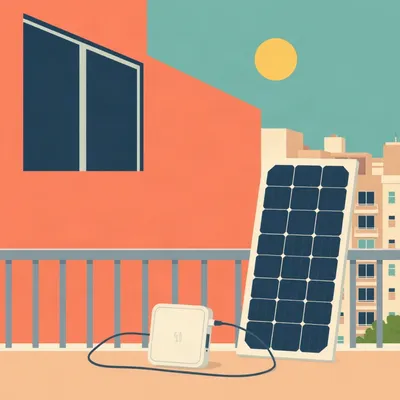
One point eight to two thousand kilowatt-hours per square meter per year. That's how much sun Jerusalem gets, and it's nearly double what Germany gets. And yet the only part of that sun Daniel actually controls is a balcony railing.
Daniel's question this week is about the absolute ceiling for solar on a rented balcony in Jerusalem. He's had south-facing balconies in both his current and previous apartments, he's seen small USB panels work fine, he knows he can run decorative lights. But what if you wanted to push it as far as physics and the lease would allow? Is there a way to store the power in a backup battery? Could you, hypothetically, wire it into the building's electrical supply? He knows that would be irresponsible and almost certainly violate the rental agreement, but he's asking what the actual limits are. And then there's the less ambitious version, a weatherproof power reservoir on the balcony that charges phones, runs speakers, handles low-draw devices. So the real question is, what can you do with sunshine when you don't own the roof, in one of the sunniest cities on Earth?

And the answer is more than most people think, and less than the fantasy version. Let me start with the resource itself, because the numbers are almost absurd. Israel gets roughly eighteen hundred to two thousand kilowatt-hours per square meter per year of global horizontal irradiation. Germany, which is the country that has actually built an entire legal framework around balcony solar, gets about a thousand to eleven hundred. So the same panel in Jerusalem produces close to double what it produces in Berlin.
Which is why it's slightly strange that Germany has eight hundred thousand registered plug-in solar devices and Israel has, as far as I can tell, no category for them at all. The sunniest country in the conversation hasn't bothered to write the rules.
Right, and that's the arc of this whole thing. The physics of capturing sun on a balcony is solved. The hardware is off-the-shelf. What's missing is the legal category, and that's where Germany becomes the useful precedent. But let's start with what a balcony can actually produce, because the numbers are the foundation for everything else.
So walk me through the ceiling. Daniel's balcony is south-facing, decent sun throughout the day. What's the absolute most he could pull off that railing?
A standard Jerusalem balcony has maybe four to six square meters of usable railing or floor space for panels. At roughly twenty percent panel efficiency and Jerusalem's irradiation, the theoretical maximum is somewhere around sixteen hundred to twenty-four hundred kilowatt-hours per year. But that's before you account for angle, shading, ventilation, inverter losses. Real world, you're looking at sixty to seventy percent of that, so maybe a thousand to fifteen hundred kilowatt-hours a year.
For context, what does that run?
A fridge and a laptop. Not a household. A typical Israeli apartment uses maybe five to eight thousand kilowatt-hours a year. So a maximized balcony array covers fifteen to twenty-five percent at best. The misconception I want to kill immediately is that balcony solar meaningfully offsets your electricity bill. It doesn't. It's a resilience play, a hobby, or a way to run specific loads.
That's the first bubble. But the practical sweet spot is smaller than the theoretical max anyway. Two to four panels of four hundred to five hundred watts each, so eight hundred watts to two kilowatts of nameplate capacity. On a Jerusalem balcony, a single four hundred watt panel facing south at a decent tilt generates one and a half to two kilowatt-hours per day in summer. That's phones, a speaker, a laptop, LED lights all evening. In winter it drops to half a kilowatt-hour to eight tenths per day.
And the winter number is where the angle question gets interesting. The optimal fixed tilt for Jerusalem's latitude, about thirty-one point eight degrees north, is around thirty degrees. If you mount a panel vertically on a railing, you lose twenty to forty percent of annual yield compared to that optimal tilt. That sounds bad, and over a full year it is. But vertical panels on a south facade actually outperform tilted ones in winter, because the sun sits so low in the sky.
So the seasonal curve flips. In December, the vertical panel is catching the low winter sun better than a thirty-degree tilt would. In June, the tilt would win but the vertical panel is still producing more than enough. Jerusalem's winters are mild but cloudy, so that winter advantage actually matters more than the raw annual number suggests.
That's the thing most coverage gets wrong. Vertical railing mounting is not a poor choice, it's a trade. You give up summer surplus to gain winter production, and in a place where winter sun is scarce, that's often the right trade.
And then there's the hardware that makes this plug-and-play possible at all. Micro-inverters.
Modern balcony kits use micro-inverters that convert each panel's DC to grid-compatible AC individually. That's the thing that makes the whole form factor work. A string inverter takes all the panels in series, and shading on one panel drags down the whole string. A micro-inverter per panel means each panel operates independently. The efficiency hit versus a string inverter is small, one to three percent, but the safety and simplicity gains are enormous.
Because each panel is already outputting standard AC, so you're not running high-voltage DC across a balcony railing where a toddler could grab it.
And the real constraint on Daniel's balcony isn't generation, it's surface area. He could theoretically host two kilowatts of panels, but the building facade, the railing weight limits, and wind loading all bite well before the sun does. A four hundred watt panel weighs around twenty kilos. Four of them is eighty kilos hanging off a railing that was designed for flower pots.
So the sun is not the limiting factor. The railing is. That's the first structural insight. The second is that generation is only half the question. What do you do with the power when the sun is shining and you're not home?
And that's the storage question Daniel raised, which is where things get practical. A balcony system with a one to two kilowatt-hour lithium iron phosphate battery can shift your evening load. Charge during the day, run lights and devices at night. LFP is the standard for small solar storage now because it's safe, it doesn't catch fire the way older lithium chemistries can, and it cycles thousands of times.
The economics in Israel are the catch. Electricity is about half a shekel per kilowatt-hour, roughly thirteen cents. A one kilowatt-hour battery costs three to five hundred dollars. So the payback period is slow. This is not an investment, it's a hobby or a resilience play.
And that's the second misconception worth naming. More sunlight does not make balcony solar more worthwhile in Jerusalem than in Germany. It's actually the opposite, because German electricity is around thirty euro cents per kilowatt-hour, roughly four times Israel's rate. The same hardware in Germany pays for itself much faster, even though it produces half the energy. The economics are driven by what you avoid paying, not what you generate.
Which is why Germany has eight hundred thousand of these things and Israel has none. The German renter is avoiding thirty cents a kilowatt-hour. The Israeli renter is avoiding thirteen cents.
Right. But Daniel's actual use case, the weatherproof reservoir on the balcony, that's practical and the economics don't matter much. A sealed enclosure with a charge controller, a battery, and USB and AC outlets. Products like the EcoFlow PowerStream or the Jackery systems with solar input do exactly this. For phones, speakers, LED string lights, a three hundred to five hundred watt panel plus a one to two kilowatt-hour battery covers a full evening of entertainment indefinitely.
So the less ambitious version of Daniel's question, the one he called less ambitious, is actually the sweet spot. It's a solved product category. You buy the thing, you put it on the balcony, you plug your phone into it.
And it runs forever, basically. The sun comes up, the panel charges the battery, the battery runs the lights and charges the phone at night. There's no grid connection, no electrician, no lease violation beyond the fact that you've bolted something to the railing.
Let's talk about the lease violation, because Daniel raised it directly. The grid-tied version. Wiring it into the building's electrical supply. What would that actually involve?
This is where Germany becomes the essential reference point. Germany created a legal category for balcony solar, the Balkonkraftwerk, that treats a small plug-in solar system as an appliance, not a fixed installation. Up to eight hundred watts of inverter output, you plug it into a standard Schuko outlet, you register it with the grid operator and the market master data register, and you're done. No electrician, no special meter, no grid connection agreement.
Eight hundred watts. That's the threshold. Below it, it's an appliance. Above it, it's a power plant.
That's the regulatory insight, and it's a good one. The eight hundred watt limit exists because below that threshold, the risk calculus changes. The inverter is designed to stop feeding power the instant the grid goes down, which is the anti-islanding protection. The current is small enough that a standard outlet and wiring can handle it. The backfeed is within the tolerance of a standard meter.
And above eight hundred watts, you need an electrician, a dedicated circuit, and a bi-directional meter. Full grid compliance. The regulatory sweet spot is real, not arbitrary.
Now, Israel has no equivalent framework. The Israel Electric Corporation and the Electricity Authority have no balcony-solar category. Israel's solar boom has been rooftop and ground-mount focused, with net metering for homeowners who own their roofs. For renters, there's no path. You can't sign a grid connection agreement for an apartment you don't own.
So the Israeli renter who wants to feed the grid is in regulatory no-man's land. Not explicitly illegal in the sense that there's a law against it, but there's no legal way to do it either. The category doesn't exist.
And the reason it doesn't exist is that Israel's rooftop solar has already met its targets. The institutional pressure to create a renter-solar category just isn't there. Cheap natural gas and a successful rooftop program mean nobody's pushing for the regulatory hack Germany needed.
Which brings us to the dangerous part of Daniel's hypothetical. Wiring into the building's supply without a proper disconnect. Let's name the specific hazard.
Islanding. If you backfeed a shared circuit and the grid goes down, your inverter keeps energizing a line that an electrician thinks is dead. The lineman working on the outage touches a wire that should be cold and it's live, because your balcony panel is pushing power into it. That's the classic islanding hazard, and it's exactly why grid-tied inverters are required to have anti-islanding protection that shuts them down within milliseconds of a grid failure.
So the danger isn't that you'll overload a circuit. It's that you'll create a live wire where a professional reasonably expects a dead one.
That's the specific thing that gets people killed. And it's why the German eight hundred watt limit is so carefully chosen. Below it, the inverter is certified to shut down instantly on grid loss, and the current is small enough that even a fault is manageable. Above it, you need a proper disconnect, a dedicated circuit, and a bi-directional meter.
So Daniel's hypothetical, wiring into the building, is dangerous, not just illegal. The workaround is off-grid. Generate, store, consume, and never touch the building's wiring at all.
And here's the thing. A two kilowatt balcony array with five kilowatt-hours of storage is technically trivial. The parts are off-the-shelf. You can buy everything you need for a few thousand dollars. What's missing is not the technology, it's the legal category that lets a renter participate in the energy transition without owning property.
Germany solved it with a regulatory hack. Israel hasn't bothered because rooftop solar already meets its targets. The constraint isn't technology, it's ownership.
Let me put a concrete system on the table for Daniel's actual use case. Two four hundred watt panels, a two kilowatt-hour LFP battery, and a thousand watt hybrid inverter. Total cost roughly twelve hundred to fifteen hundred dollars. That runs phones, speakers, a laptop, and LED lighting indefinitely through the summer, completely off-grid.
And for the evening entertainment use case, that's overkill in a good way. The battery would rarely drop below half. You'd have headroom for cloudy days, for a friend charging their phone, for running a small fan.
The hybrid inverter is the piece that makes it flexible. It takes solar DC in, charges the battery, and outputs AC for whatever you plug in. Some of them also accept grid input as a fallback, so if the battery dies during a long cloudy stretch, you can top it up from a wall outlet. But the key is that the grid connection is one-way, into the inverter, never back out.
That's the safety line. The inverter is a load, not a source, as far as the building is concerned.
And that's the distinction that keeps you out of the islanding hazard entirely. You're not feeding the building, you're just charging a battery from the sun and using that battery to run your stuff.
The responsible version of Daniel's hypothetical is completely achievable. The irresponsible version, wiring into the building, is where the physics and the law both say no. And the law says no for a reason that isn't just bureaucracy.
The reason is that a shared electrical system in a multi-family building is a safety-critical infrastructure. Every wire in that building is someone else's responsibility. When you backfeed into it, you're making a change to a system you don't own and don't fully understand, and the person who dies from your mistake is not you, it's the electrician who came to fix an outage.
That's the moral core of the grid-tie question. The risk isn't to the person doing it, it's to the person who doesn't know it's been done.
That's why the German framework is actually a safety framework, not just a convenience. The eight hundred watt limit, the registration requirement, the certified inverter list, all of it exists to make sure that when a grid worker opens a circuit, they know exactly what's on it.
Let's talk about what Israel could learn from Germany, because that's the forward-looking part of this. The hardware is already there. The question is whether the right to generate becomes a renter's right or stays tied to property ownership.
That's a genuine open question. Israel's rooftop solar program has been successful enough that there's no political pressure to create a balcony category. The electricity is cheap enough that the economics don't push renters to demand it. So the most likely outcome is that Israel simply skips the balcony-solar phase entirely and goes from rooftop to utility-scale storage.
Which would be a missed opportunity, because the renter market is exactly the market that can't participate in rooftop solar. You've got a whole population of people who would happily bolt a panel to their railing and generate some of their own power, and there's no legal way for them to do it.
The physics is solved. The hardware is cheap. The only thing standing between Daniel and a grid-tied balcony system is a regulatory category that doesn't exist.
Let's sit with that for a second. Daniel's balcony could power his evening. Phones, speakers, lights, laptop. The only thing standing between him and that is a legal category that doesn't exist yet.
The off-grid version doesn't need the category. He could buy the panels, the battery, and the inverter tomorrow, bolt it to the railing, and be running his speakers off sunshine by the weekend. The only thing he'd be violating is the lease clause about attaching things to the railing.
Which is a different conversation. The building owner's objection to a solar panel on the railing is aesthetic and structural, not electrical. The wind load, the weight, the drilling into the railing. Those are real concerns, but they're not the same as the grid-safety concerns.
The wind load is not trivial. A four hundred watt panel is roughly one by one point seven meters. That's a sail. In a Jerusalem winter storm, that panel is catching real wind. If it's not properly secured, it's coming off the railing and landing on someone's car.
Even the off-grid version has a safety dimension. It's not the electrical hazard, it's the mechanical hazard. The panel has to be mounted as if it's going to survive a storm, because it will.
That's where the German balcony-solar standards are actually useful even if you're not grid-tied. They specify mounting requirements, wind load ratings, cable management. The framework is about more than just the electrical connection.
The full answer to Daniel's question has three layers. The physics layer says a south-facing Jerusalem balcony can generate a thousand to fifteen hundred kilowatt-hours a year, enough for a fridge and a laptop. The storage layer says a one to two kilowatt-hour LFP battery shifts that generation to the evening, making it useful for exactly the low-draw devices Daniel cares about. And the legal layer says the grid-tied version is a German invention that Israel hasn't adopted, and the off-grid version is available now if you're willing to bolt it to the railing.
The economics layer says this is not an investment in Israel. It's a hobby. The payback is measured in years, not months, because electricity is cheap. But the resilience value, the ability to keep your phone charged and your lights on during an outage, that's real and it's not priced in shekels.
Israel has brownouts. We've talked about that before. A balcony battery that keeps your phone and a fan running through a summer brownout is worth more than the thirteen cents per kilowatt-hour it saves.
That's the thing about the off-grid reservoir. It's not competing with the grid, it's supplementing it. When the grid is up, it's a convenience. When the grid is down, it's the only power you have.
The weatherproof reservoir Daniel described is not just the less ambitious version. It's the version that actually makes sense in Israel. The grid-tied version is the one that's legally and economically out of reach.
That's a useful conclusion. The fantasy version, wiring into the building, is dangerous and illegal for good reasons. The practical version, the sealed box on the balcony with a battery inside, is a solved product category that you can buy off the shelf.
Let's put a number on the full off-grid setup one more time. Two panels, two kilowatt-hours of battery, a hybrid inverter. Twelve to fifteen hundred dollars.
In Jerusalem's sun, that system produces enough power every day to run a laptop for eight hours, charge four phones, run a speaker for an evening, and keep LED lights on until midnight. Every day. For years.
The LFP battery cycles thousands of times. Ten years of daily cycling and it's still at eighty percent capacity. The panels degrade maybe half a percent a year. This is not a device that wears out quickly.
The weak point is the inverter. Cheap inverters die. A good hybrid inverter costs three to five hundred dollars on its own, and that's the part that will fail first, probably at year five or six.
Budget for an inverter replacement. The panels and battery are solid, the inverter is the consumable.
That's the honest assessment. Now, Hilbert, I know you've been sitting on something.

Shlomo did this in Tel Aviv in nineteen ninety-eight. Sound engineer, I was working for a small production company, and Shlomo had a single fifty watt panel bolted to the studio balcony railing. Wired to a car battery through a charge controller the size of a shoebox. It ran the emergency lighting and the coffee machine. Barely.
The coffee machine was the whole reason he built it. He wanted his coffee to be solar-powered. The panel produced enough to keep the battery topped up, and the battery ran the coffee machine for about four minutes a day. He timed it. Four minutes of solar coffee.
Four minutes of coffee a day is a commitment.
He was obsessed. He'd check the charge controller every morning. He had a notebook with the voltage readings. And then one afternoon the battery caught fire because he'd used the wrong gauge wire. Small fire, contained, no injuries. But the studio smelled like burnt rubber for a month.
That's the lesson that hasn't changed. The fundamentals, wire sizing, ventilation, charge controller quality, those are the same in twenty twenty-six as they were in nineteen ninety-eight. The technology improved, but the failure modes didn't.
The fire was the wire. The wire was too thin for the current, it heated up, the insulation melted, and the battery terminals were right there. If he'd used the right gauge, nothing would have happened. He knew that. He just didn't want to spend the money on thicker wire.
The fire was a cost-cutting decision, not a design flaw.
That's what I told him. He said the wire was fine. Then the wire wasn't fine.
That's the thing about the modern off-grid kits. The wire sizing is done for you. The connectors are standardized. The charge controller is built into the inverter. The failure pattern that Shlomo had to manage by hand are now designed out.
But the balcony is the same. South-facing, railing-mounted, Tel Aviv sun. Daniel's describing the same setup thirty years later. The difference is that in nineteen ninety-eight, this was a fringe hobby and a genuine fire risk. Now it's a consumer product category and the only thing that catches fire is the inverter if you buy a cheap one.
The more things change.
The sun's the same. The railing's the same. The wire's the same. The only thing that changed is the price.
The safety. LFP batteries don't catch fire the way Shlomo's car battery did. A car battery in nineteen ninety-eight was lead-acid, which vents hydrogen when overcharged. That's what made the fire so easy. LFP doesn't vent hydrogen. It doesn't catch fire unless you puncture it.
Shlomo's battery was a lead-acid car battery sitting on a wooden shelf next to a coffee machine. Looking back, it's a miracle the fire was as small as it was.
The historical anchor is that Daniel's idea isn't new. It's been done. The difference is that in twenty twenty-six, the parts are cheap, efficient, and safe. In nineteen ninety-eight, it was a car battery and a prayer.
The prayer was the main safety feature.
That's about right.
The point I wanted to make is that the weatherproof reservoir Daniel wants isn't a new idea. It's what every off-grid cabin and every yacht has done for decades. The difference is that now you can buy it in a box for twelve hundred dollars instead of building it yourself with a car battery and a shoebox.
The box won't catch fire.
The box won't catch fire if you use the wire that comes in the box.
That's the whole thing in one sentence. The technology improved, but the fundamentals haven't changed. Wire sizing, ventilation, charge controller quality. Shlomo's fire was a wire gauge problem. The modern kits solve that by making the wire gauge a non-decision.
The open question for Israel is whether the regulatory framework catches up. Germany normalized balcony solar. The hardware is there. The question is whether the right to generate becomes a renter's right or stays tied to property ownership.
My guess is that it stays tied to property ownership for a while. Israel's rooftop program is successful, electricity is cheap, and there's no political pressure to create a balcony category. The renter market will keep being served by off-grid systems like the one Daniel described.
Which is a strange outcome. The sunniest country in the conversation has the least developed renter-solar framework. The country with half the sun built the legal category. The constraint was never the sunshine.
The constraint was always the ownership. And that's the thing Daniel's prompt gets at without quite saying it. The sun is free, but the roof isn't yours. What do you do when the resource is public and the surface area is private?
You bolt a panel to the railing and hope the landlord doesn't notice.
If the landlord does notice, you point out that it's not connected to the building's electrical system, it's just sitting there charging a battery. It's an appliance.
Which is exactly the German argument. It's not a fixed installation, it's an appliance. The regulatory hack is linguistic.
That's the thing Israel hasn't adopted. The linguistic move that turns a power plant into a toaster.
Daniel's balcony could power his evening. The only thing standing between him and a grid-tied version is a legal category that doesn't exist. The off-grid version is available now, off the shelf, for twelve to fifteen hundred dollars.
In the sunniest city in the conversation, it'll produce nearly double what the same hardware produces in Germany. The physics is on Daniel's side. The law is just lagging.
Thanks to Hilbert Flumingtop for producing, and for the story about Shlomo's four minutes of solar coffee.
This has been My Weird Prompts.
Email us at show at my weird prompts dot com if you've got a balcony solar setup or a Shlomo story of your own.
We'll be back soon.