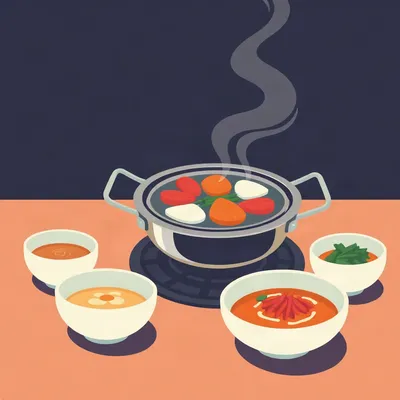
So Hannah's been watching K-dramas, and she's noticed something. The food isn't background decoration — it's framed like a co-star. Every bowl of ramyeon, every sizzling grill, every careful bite gets lingered on. The camera doesn't just show the food. It holds on it. Steam rising. The sound of the broth bubbling. The way the chopsticks lift the noodles. And she wants to know: is this deliberate? And if it is, what happens when you try to bring that food into a completely different framework — one where pork, shellfish, and mixing meat with dairy are all off the table?
Her actual question is more specific than that. She's been getting into Korean cooking, reading about it, trying dishes at home, and she's eaten at Seoul House here in Jerusalem — which is kosher and vegetarian, so it's great, but it means she hasn't touched the meat side at all. She's watching these barbecue scenes where the pork belly sizzles on the grill and the characters wrap it in lettuce with ssamjang, and she's thinking: I want that. But I want it kosher. So she's asking us to design it. If you had to open a Korean restaurant that's also fully kosher, what would the concept be? Barbecue as the anchor? Fried chicken? A broader menu? Which dishes actually translate without becoming watered down? And since drinking is so woven into Korean food culture, what does that experience look like when soju meets kashrut?
So we're designing a restaurant today. But first, we have to understand why Hannah — and about a hundred million other people — suddenly want Korean food in the first place.

It's not an accident. The food placement in K-dramas is a deliberate, state-subsidized export strategy. South Korea's Ministry of Agriculture, Food and Rural Affairs — MAFRA — and the Korea Agro-Fisheries and Food Trade Corporation, which goes by aT, provide low-interest loans and direct subsidies to production companies. The deal is: you feature our flagship K-Food products in shows bound for international audiences, and we help fund your production.
So when the lead couple in Crash Landing on You shares that meal, someone in a government office signed off on it.
Exactly the meal they wanted signed off on. And the chaebol structure makes it even tighter. CJ Group — they're one of the big conglomerates. CJ ENM produces the content. They made Parasite, Crash Landing on You, Goblin. Meanwhile, CJ CheilJedang supplies the food. Those bibigo-brand dumplings and kimchi and rice that show up on screen? Same parent company. They've built a pipeline from aspirational on-screen lifestyle straight to the supermarket aisle.
Vertical integration as cultural diplomacy. That's almost beautiful in its efficiency.
And the numbers back it up. There was a content analysis published last year in Global Media and Communication — they looked at eight top Netfllix K-dramas and found five hundred and seven labeled products from seventy-eight unique brands. Automobiles came first, food and beverages second. And it's not just Korean brands. Indonesian coffee candy — Kopiko — has paid for placement in over a dozen K-dramas since twenty twenty-one. Started with Vincenzo, kept going through Castaway Diva, Connection, and most recently some show called Genie, Make a Wish.
The ramyeon thing though — that's the one that gets me. "Want some ramyeon?" as an invitation. It's Korea's version of Netfllix and chill, except it predates Netfllix.
By decades. It's cultural shorthand now. The food isn't just product placement — it's narrative grammar. When a character offers ramyeon, the audience knows exactly what's being proposed. The food carries meaning. And that's the deeper thing Hannah picked up on, I think. The food isn't just there to look good. It's doing narrative work. A shared meal is intimacy. A solo meal is loneliness. A refused meal is rejection. The drama uses food the way a western drama might use a kiss or a slap.
So Hannah is living proof the machine works. She watched the shows, she got fascinated, she started cooking. That's the whole point of the strategy. But here's what I find interesting — she didn't just start cooking Korean food. She started cooking kosher Korean food. Which means she's already doing the adaptation work in her own kitchen. She's the target demographic and the test kitchen at the same time.
Which brings us to the harder question. What happens when you try to bring that food into a kosher framework? Because Korean cuisine is, in some ways, almost perfectly designed to violate kashrut.
Pork is the obvious one. It's everywhere. And not just as a protein option — it's central. It's the star of some of the most iconic dishes.
Kimchi jigae, bossam, samgyeopsal — pork belly is practically a national treasure. It's not just that pork exists in the cuisine. It's that pork belly specifically, with its layers of fat and meat, is the cut that Korean barbecue culture is built around. The way it renders on the grill, the way the fat crisps at the edges — that's the experience people are watching in those dramas. Shellfish too — seafood pancakes, a lot of broths. And then there's the meat-and-dairy mixing, which Korean cuisine does freely. Cheese buldak, cream-based sauces, butter on everything. I've seen recipes where they literally just lay a slice of American cheese on top of spicy chicken and let it melt. Three separate kashrut problems, and they're all core to the cuisine.
So what do actual kosher Korean restaurants do about it? Because there are a few. And I'm curious whether they solved these problems or just worked around them.
Three worth looking at, and they took three completely different approaches. First, Seoul House — the one Hannah's been to, right here in Jerusalem's Old City. Opened in twenty fourteen. The owner is Tzipporah Rothkopf, born Kim Bongja in Seoul. She converted to Judaism, moved to Israel, and brought her family recipes with her.
Her strategy was to sidestep the entire meat problem.
Completely. Seoul House is pescatarian and vegetarian. No meat at all. Which means no meat-dairy separation to worry about, no pork, no shellish issues. The menu is japchae, bibimbap, kimbap, tteokbokki — both a spicy version with gochujang and a sweet one with date syrup and soy sauce — tofu jorim, grilled salmon, and a full spread of banchan. Kosher certification is Badatz Mehadrin Jerusalem.
And she used to smuggle her own gochugaru. This detail kills me.
This is my favorite detail. For years, Rothkopf would fly to Seoul and bring back hundreds of pounds of Korean chili peppers in her luggage because she couldn't find kosher-certified gochugaru anywhere. Think about that image. This woman, this Korean-Jewish grandmother, loading her suitcases with dried chili peppers in Seoul and walking them through customs at Ben Gurion. In twenty twenty-three, OK Kosher finally certified gochugaru and five other essential Korean ingredients. She doesn't have to smugle anymore.
There's something deeply right about a Korean-Jewish grandmother figure hauling chili peppers through Ben Gurion. That's not just dedication. That's the entire diaspora experience compressed into one person. Bringing the flavors of home across borders, through airports, past customs agents, because the alternative is not having them at all.
She's said that customers have cried at her tables. People who love Korean food and never thought they'd eat it kosher. She had one guy weeping and blessing her. Imagine carrying a cuisine across the world, adapting it to a completely different dietary law, and then watching someone from that tradition sit at your table and weep because they finally get to eat it.
Second case study.
Seoul Bite, in Teaneck, New Jersey. Completely different approach. The owner is Jack Kim — he's not Jewish. He's Korean, he wanted to open a Korean restaurant, and the space he found happened to be in Teaneck, which is a heavily Orthodox Jewish suburb. He decided to go kosher.
So a non-Jewish Korean guy accidentally opens a kosher Korean restaurant. That's not a business plan, that's a sitcom pilot.
He's quoted saying he felt like God was guiding him. The menu includes meat — bulgogi, buldak spicy chicken, Korean fried chicken. But he kept it intentionally small because he didn't want to overwhelm customers who don't know Korean food terminology. And here's the detail I love: they use a robot fry cook for the fried chicken.
Wait. A robot. Like an actual mechanical arm?
A robot arm that handles the double-frying. Consistent results every time, and it's apparently the only way to do Korean fried chicken at scale without a dedicated fry cook who does nothing else. The double-fry is specific — you fry once at a lower temperature to cook through, then again at higher heat for the crust. Timing has to be exact. A human fry cook gets tired, gets distracted, loses track of which batch went in when. The robot doesn't.
That's not a gimick, that's just honest engineering. If the dish requires precision at volume, you automate the precision.
And then there's the third approach, which just opened this past June. The Tables at Fireside in Monsey, New York. This is the high-end version. A hundred and fifty dollars per person, four-course all-you-can-eat kosher Korean barbecue and hot pot. Two-month waitlist already. The chef is Uri Elbaum, who was on Hell's Kitchen.
A hundred and fifty a head. That's not a Tuesday night dinner. That's an event.
Course one: ten small appetizers in forty-five seconds. Course two: hot pot. Course three: tableside Korean barbecue — steak, short ribs, filet mignon, duck, chicken. Course four: desert. Cocktails billed separately. The whole thing is structured as a theatrical experience. They bring the food out in waves, timed, choreographed. It's dinner as performance.
So the landscape is: vegetarian in Jerusalem, small-menu meat in New Jersey, and luxury barbecue in Monsey. What's missing?
The middle. There is no mid-market korean barbecue option. No standalone korean barbecue restaurant that's kosher and walk-in. Seoul House doesn't do meat at all. The Tables at Fireside is a prix-fixe private dining experience with a two-month wait. If you want bulgogi cooked at your table in a regular restaurant setting — walk in, sit down, grill your own meat, pay a normal check — it doesn't exist in the kosher world.
Which is exactly the gap Hannah's question points at. She doesn't want the hundred-and-fifty-dollar theater. She wants what the characters in the dramas are doing — sitting around a table with a grill in the middle, cooking meat, drinking, talking. Regular people eating regular food. So let's design it.
Korean barbecue as the anchor. That's the biggest gap in the market, and it's the most social, most distinctively Korean dining experience. But not exclusively barbecue — a broader menu that includes fried chicken, bibimbap, japchae, and banchan. The barbecue is the centerpiece, not the whole menu. You need the other dishes to round out the table, to give people who don't want a full grill experience something to order, and to provide the anju for the drinking side.
Let's go dish by dish. What translates without any adaptation at all?
Bibimbap is the easiest win. Rice bowl, sauteed vegetables, beef bulgogi or tofu, a fried egg on top, gochujang sauce. Every single component is inherently kosher-compatible. No pork, no dairy, no shellish. You can serve it with meat or without, and it's a complete meal in a bowl. It's also visually stunning — the vegetables arranged in color-coded sections, the egg yolk bright orange in the center. It's the most Instagramable dish on the menu, and it requires zero adaptation.
Bulgogi itself.
The backbone of the whole concept. Thinly sliced beef marinated in soy sauce, sugar, sesame oil, garlic, and grated Asian pear. The pear is a natural tenderizer — it's not just sweetness, it's enzymatic. The enzymes break down the meat fibers without turning them to mush the way an acidic marinade might. No pork, no dairy. This is what you build the barbecue experience around. If you get the bulgogi right, everything else can lean on it.
Japchae.
Glass noodles made from mung bean starch, stir-fried with vegetables and beef in sesame oil and soy sauce. If you leave out the beef it's pareve — neutral, neither meat nor dairy. It's served at room temperature, it scales well, and it's one of those dishes that's better than it has any right to be for how simple the ingredients are. The noodles have this slightly chewy, bouncy texture that's completely different from wheat noodles. It's the dish that people who've never had Korean food before always ask about.
Korean fried chicken.
Double-fried, soy garlic or sweet and spicy sauce. No dairy, no pork. This is the dish that should have been franchised by now and hasn't. Seoul Bite's robot fry cook makes it work consistently. The chimack pairing — chicken and beer — is the most accessible entry point for the drinking experience. And it's the dish that crosses over most easily. Everyone understands fried chicken. The Korean version is just better — thinner crust, more sauce adhesion, juicier meat because of the double-fry.
Tteokbokki.
Chewy rice cakes in gochujang sauce. Naturaly vegan. Naturaly pareve. Seoul House does two versions. It's street food that translates perfectly. The texture of the rice cakes is the thing — that dense, springy chew that's totally unfamiliar to western palates but addictive once you get used to it. It's comfort food. It's what Korean kids eat after school. It requires exactly zero adaptations.
Pajeon — scalion pancakes. Kimbap — seaweed rice rolls. Mandu — dumplings filled with beef or tofu or vegetables.
All of these are either already kosher or require one substitution. Mandu wrappers are flour and water. The filling is whatever you want it to be. There's a recipe blog that calls its beef mandu "Jew Mandu" — Korean dumplings meets Jewish kreplach, served with black vinegar dipping sauce. That's the kind of fusion that writes itself. Two diaspora food cultures that both figured out that wrapping meat in dough is a good idea.
The kimchi problem though. This is where it gets real.
Traditional kimchi uses saeujeot — salted shrimp — or fish sauce. That's the single biggest dish-level challenge. Kimchi is the national food of Korea. It's on every table, at every meal. It's not a side dish, it's a foundational element. And the standard version is not kosher. But it's a solved problem. Vegetarian kimchi is widely available. Seoul House serves it. You lose a little depth from the fermented seafood, but you keep the gochugaru, the garlic, the ginger, the fermentation funk. It's still kimchi. The fermentation is the point. The shrimp paste is just the traditional vehicle for salt and umami.
And the other banchan are easy. Seasoned bean sprouts, spinach, zuchini, seaweed salad — all naturaly kosher. The banchan spread might actually be the easiest part of the whole restaurant to execute.
Now the drinking. This is where it gets interesting, because Korean drinking culture is built around anju — food eaten with alcohol. The principle is that drinking and eating are inseparable. You don't drink without food in front of you. The traditional pocha, the Korean pub, serves big shared dishes alongside alcohol. A proper Korean drinking session isn't just drinks. It's a table covered in food, where the eating and the drinking are the same activity.
So the restaurant already has the food. The question is what goes in the glasses.
Soju is the national drink. Clear, neutral spirit, traditionaly made from rice but now often from sweet potatoes or tapioca. It's dropped from twenty percent alcohol in two thousand six to about fifteen point seven percent now — that's a twenty-one percent reduction over twenty years. Health consciousness, regulatory pressure, changing tastes. The government actualy incentivized lower-alcohol soju through tax breaks. They wanted people to drink more moderately, and the industry responded.
Is it kosher?
Generaly not certified, but some brands are. A kosher restaurant would need to source certified soju or work with an importer. The alternative is Israeli kosher wine, which would serve the same ritual function even if it's not the same drink. There's an argument that the specific alcohol matters less than the ritual around it. But I think soju matters. It's the taste of the thing. It's what the characters in the dramas are pouring. If you're building a restaurant that exists because of K-drama food placement, you want the soju.
Makgeoli.
Milly, slightly fizy rice wine, six to eight percent alcohol. Served in a bowl traditionaly. It's fermented rice and water — inherenty kosher-compatible if the production is supervised. Some craft producers have certification, but it's rare. Makgeoli is having a moment right now — craft breweries are doing small-batch versions with different grains and flavors. It's the drink that would set a kosher Korean restaurant apart. Nobody expects makgeoli. But it's traditional, it's distinctive, and it pairs beautifully with pancakes and fried food.
Beer is the easy one.
Korean beers — Hite, Cass, OB — are widely available and many are kosher-certified. The chimack pairing, chicken and beer, is the most accessible kosher drinking experience by far. You don't need to source anything exotic. You just need a fridge full of Korean lager and a plate of double-fried chicken.
The ritual itself is what makes it work though. You never pour your own drink. You pour for others, they pour for you. You hold the glass with two hands when receiving. You turn away from elders when drinking.
All of that translates perfectly. It's not about the specific alcohol — it's about the social grammar. A table of people pouring soju or wine for each other, eating Korean fried chicken and pajeon, doing the two-hand receive — that's authenticaly Korean regardless of what's in the bottle. And here's the thing: Jewish dining has its own social grammar around wine. Kiddush, havdalah, the blessing over the cup. There's a resonance there. Two cultures that understand that drinking together is a ritual act, not just hydration.
So here's the restaurant. Korean barbecue at the center — bulgogi, short ribs, maybe duck and chicken for variety. The grills are built into the tables. You cook it yourself, or the staff helps. The smoke gets pulled down through vents, not up into your face. The room smells like sesame oil and charred meat but you don't leave with it in your clothes.
The banchan arrive first — eight or ten small dishes, including vegetarian kimchi, bean sprouts, spinach, seaweed salad, pickled radish. They're refilled freely. That's important — banchan are unlimited in Korean dining, and a kosher restaurant shouldn't change that. The generosity of the banchan spread is part of the hospitality. You don't charge for refills. You just keep bringing them.
Then the barbecue. Then you've got the broader menu — bibimbap, japchae, tteokbokki, pajeon, kimbap, mandu. Korean fried chicken as its own station, maybe with that robot arm. The kitchen is split into meat and pareve sections, which any kosher restaurant already knows how to do.
And the drinking menu: kosher-certified soju if you can source it, definitely kosher Korean beer, Israeli wines, maybe makgeoli if you can find a certified producer. The anju dishes — the fried chicken, the pancakes, the tteokbokki — are all pareve and pair perfectly with everything on the drinks menu.
The price point sits between Seoul Bite and The Tables at Fireside. Not fast casual, not a hundred and fifty dollars a head. A regular restaurant where two people can eat well for, say, eighty or ninety dollars total. Walk in, sit down, grill your meat, drink your soju, pay a normal check, go home happy.
The gap in the market is real. Seoul House proves there's demand — it's been running for over a decade. Seoul Bite proves a meat-inclusive menu works. The Tables at Fireside proves people will wait two months and pay a hundred and fifty dollars for kosher Korean barbecue. Nobody's put barbecue in the middle yet. Nobody's built the neighborhood Korean barbecue joint for people who keep kosher.
And Hannah is proof the demand keeps growing. Every new K-drama season creates more people who want to eat this food. The South Korean government spent billions making her want exactly this. The question is whether the kosher food industry can keep up.
I think there's someone here who's been waiting to say something about pears.

It's not just a tenderizer.
The pear in bulgogi marinade. Everyone calls it a tenderizer, and it is — the enzymes break down the meat. But that's not why it's there. It's the flavor. Non-Korean palates taste it and think it's sugar. They'll say "oh, the marinade is sweet." It's not sweet. It's pear. That specific, floral, almost gritty note. You lose that, you lose bulgogi. And I've seen recipes that substitute apple or kiwi or even pineapple. Don't do that. The pear is not interchangeable. It's the whole point.
I worked the line at a Korean fusion place in LA. Late nineties. Before anyone in America knew what a K-drama was. Before Korean food was cool. The owner was Korean, immigrated in the eighties. His business partner was Jewish, so I was learning both cuisines at the same time — what makes Korean food work, and what kashrut requires. I was the only non-Korean, non-Jewish guy in the kitchen. I just kept my head down and learned.
The thing nobody talks about with kosher Korean is that the best adaptations don't subtract. You don't build the menu by listing what you can't use. You lean into what's already there. The sesame. The gochujang. The fermentation. Korean food has this incredible depth from fermented pastes and aged soy and sesame oil that's toasted until it's almost smokey. None of that touches kashrut at all. The flavor base of the entire cuisine — the deep, savory, funky, spicy foundation — is completely available to you. The restrictions are at the edges, not the center.
I tried to make kosher kimchi once. For the Jewish partner. Substituted fish sauce with kelp powder and miso paste. It worked. It fermented properly, had the right funk, the right heat. The owner wouldn't serve it. Said it's not real kimchi.
He wasn't wrong, exactly. But he also wasn't right. The fermentation is the point. The shrimp paste is a vehicle for salt and umami. If you get there another way, you're still making kimchi. You're just making it for different people. That's what I couldn't get him to see. The adaptation wasn't a compromise. It was a translation.
How did the partner react? The Jewish one?
He ate the whole batch himself. Took it home in mason jars. Said it was the best kimchi he'd ever had. But he also understood why the owner wouldn't put it on the menu. There's a difference between cooking for yourself and cooking for the public. When it's your name on the sign, every substitution feels like a concession.
That robot fry cook at Seoul Bite, by the way — that's not a gimick. Double-frying is brutal at volume. First fry at three-twenty-five, rest, second fry at three-seventy-five. The window between perfect and burned is maybe fifteen seconds. A human can do it for twenty orders a night. A robot does it for two hundred and never drifts. I'm surprised more places haven't adopted it. The technology's been around for years. It's just that most restaurant owners are scared of it.
The kelp-and-miso substitution is clever. That's the same umami mechanism — glutamates from the kelp, fermentation depth from the miso. You're basicly rebuilding the flavor profile from parallel ingredients.
Worked fine. Tasted like kimchi. He just couldn't get past the idea. And I get it. When you grow up with something, the specific way your mother made it, the specific ingredients she used — that becomes the definition. Anything else feels like a lie. But the thing is, his mother probably used a different brand of fish sauce than the next town over. There's no single authentic kimchi. There's ten million authentic kimchis. One more isn't going to break anything.
That's the tension at the center of this whole thing, isn't it. Authenticity versus adaptation. At what point is it not Korean food anymore.
At what point is Seoul House not Korean food. It's run by a woman born in Seoul cooking her family's recipes. She just doesn't use shrimp paste. Is her food less Korean because she keeps kosher? Or is it Korean food that happens to also be kosher? I know which answer makes more sense to me.
The partner — the Jewish one — he'd bring in these long Korean radishes from a farm up in the Valley. Thicker than your forearm. We'd slice them paper-thin for the banchan. I've still got the mandoline I used. The blade's probably dull as a butter knife by now. But I can't throw it out. It's got too many hours on it.
The radish banchan is underated. Kongnamul — the bean sprouts — gets all the attention, but the radish has that crunch and the gochugaru just clings to it. The texture is better. The bean sprouts are soft, kind of yielding. The radish fights back.
Salt it first. Draws out the water. Otherwise the sauce gets watery and nothing sticks. That's the trick with any vegetable banchan — control the moisture before you add the seasoning. Most home cooks skip that step and wonder why their banchan is soup.
So if you were building this restaurant, you'd start with the pear, the sesame, and the fermentation, and build outward from what's already kosher.
I'd start with the grill. Everything else follows the grill. You design the kitchen around the barbecue stations, the ventilation, the fire suppression. Then you build the menu around what comes off those grills. The pear, the sesame, the fermentation — that's the flavor. But the grill is the experience. And the experience is what people are paying for.
The single biggest misconception people have about kosher Korean food is that it's inherenty compromised. That you're starting with a cuisine built on pork and shellish and dairy-mixing, and stripping it down until what's left is a watered-down imitation.
And the reality is the opposite. Bibimbap, bulgogi, japchae, Korean fried chicken, tteokbokki, pajeon, kimbap, mandu — these are core dishes. They're not adaptations. They're the cuisine. They just happen to be kosher-compatible without anyone having to change a thing. The dishes that don't work — bossam, samgyeopsal, cheese buldak — are real losses. But the dishes that do work aren't consolation prizes. They're the greatest hits.
The question Hannah's left us with — the one that actualy matters for whether this restaurant ever exists — is whether kosher-certified soju and makgeoli become more available as demand grows. And whether someone looks at that gap between a vegetarian spot in Jerusalem and a luxury tasting menu in Monsey and sees the mid-market Korean barbecue concept sitting right there, waiting for someone to claim it.
The K-drama food machine worked on Hannah, and on millions of viewers worldwide. The soft-power strategy did exactly what it was designed to do. The kosher food industry just hasn't caught up yet. But the pieces are all there. The ingredients are getting certified. The customer base is growing. The case studies prove the concept works at both ends of the market. Someone just has to build the middle.
Thanks to Hilbert Flumingtop for producing.
This has been My Weird Prompts. If you want us to design your dream restaurant — or explore whatever niche obsession is taking over your life — email us at show at my weird promts dot com.
We'll be back soon.