I've been trying to find a way to describe this story to Herman all morning and I keep landing on the same word, which is that it's fantastic. Not inspiring. Fantastic, in the original sense. Somebody built a whole underground world under their house.

I have been waiting for you to say the word "under" since you sat down.
Daniel's prompt this month came out of his own basement, more or less. He's been building an internal warehouse system for the family's stuff after an unplanned move, inventory tool and all, and now and then he catches himself thinking the whole thing is a bit absurd. Then he finds somebody online who makes his project look like tidying a shelf.
Who is she.
Kala. Goes by Tunnel Girl, handle is engineer dot everything. She started excavating a tunnel and an underground chamber beneath her house in Herndon, Virginia, documented the whole thing on TikTok with a candor that is funny, built her own digging machinery, and got a temporary stay order slapped on her when the city called it an unauthorized excavation.
And then.
And then she came back. That's the part Daniel wants charted. The story to date, the rise to internet fame, the whole arc, for everybody who draws encouragement from DIYers who take their biggest ambitions and pour kerosene on them.
Well. I have read everything about this woman I could find, including a piece from last November where she says the permit process was harder than the digging, and I want to walk through it properly.
Her name is just Kala. First name only, deliberately, and not out of mystique. When the coverage started she asked that her full name and exact location be withheld because people were already finding her address. She's in Herndon, which is about twenty miles northwest of D.C. She bought a two-story house there in 2010.
And she'd already built once.
She'd put a two-story addition on the place with a basement and a subbasement. So the tunnel isn't the first time she's cut into this house. It's the third or fourth floor of the same impulse, pointing down instead of up. As of the 2023 coverage she was thirty-seven. And here's the first correction to the handle. Engineer dot everything, right? She has no engineering degree.
Business and finance.
Studied business and finance in college, then worked in IT as a software engineer. Which is engineering in the job-title sense and not remotely in the load-bearing sense. Everything she knows about rock and concrete she taught herself out of two books.
Which two.
FEMA 453, which is the shelter design guidance, and a civil engineering handbook called Rock Mass Classification. That second one is the interesting choice. Rock mass classification is how you decide what a rock face will actually do when you cut into it, based on the joints and the bedding and the water. It's the book you'd want if you were about to dig a tunnel by yourself with no oversight.
She started in August 2022.
August 2022, framed as a storm shelter. First TikTok in October 2022. And by the numbers, by late 2023 she had a tunnel thirty feet long and twenty to twenty-two feet deep. That's the version the news reported when it first blew up.
And then it kept going.
It kept going. By last November the description was an eighty-foot passage dropping more than thirty feet, with sump pits, drainage, reinforced concrete walls, and a homemade elevator. She'd burned through ten jackhammers and hauled out fourteen dumpsters of excavated rock. The city now classifies the whole thing, officially, as a storage tunnel.
Fourteen dumpsters. I want to sit with that for a second. That's not a hole. That's a mining operation with a mailing address.
It's roughly what you'd move to put in a small swimming pool. Which is a normal thing to do. Except the pool is under the house and you built the machine that dug it.
Walk me through the actual geometry, because I keep picturing a shaft and I don't think that's right.
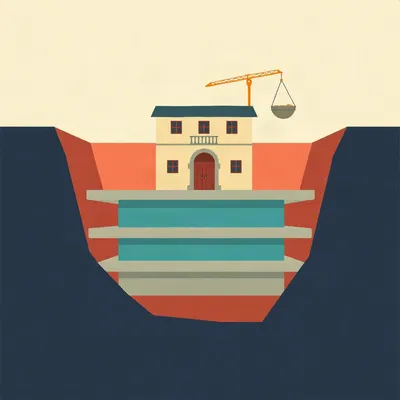
Her own description to a local station is the clearest. You enter, descend about thirty feet to a small landing area, and then there's a second descent of roughly another twenty feet. So it's a stepped system, not a single vertical drop. There's an antechamber at the bottom. She called it a tunnel system by August 2023.
And the elevator.
A makeshift one she built to get rock and dirt out. That's the part I keep coming back to, because the elevator is the constraint the whole project bends around. A person with a bucket can move maybe half a ton of spoil a day if they're hurting themselves. Fourteen dumpsters of rock is not a bucket operation. She had to solve material handling before she could solve anything else, and she solved it with a hoist she fabricated.
That's the thing that doesn't make the headlines. Everyone talks about the hole. The hole is the easy part.
The hole is the easy part, yes. Getting the hole out of the hole is the project.
Somewhere in there she found building stones under the house.
She did. There's stone under that property, and she mined it rather than treating it as waste, and set it aside for later projects. Which tells you something about how she thinks. To most people digging a tunnel, rock is spoil. To her it's material she already paid to excavate.
And the jackhammers. Ten of them.
Ten burned through by last November. I'd guess a mix of burned-out motors and chipped or seized tooling. Nobody's meant to run a demolition hammer in a residential basement for four years. The duty cycle alone will kill them.
What was she actually trying to get out of this.
This is where the record gets interesting, because there's a version floating around that doesn't hold up. Daniel's prompt mentions a line about childhood nostalgia for mines and opening a portal to the underworld, literally. I went looking for that as a quote and I couldn't find it from any primary source. It doesn't appear in the network interviews, it doesn't appear in the magazine pieces, it doesn't appear in the anniversary video.
So it's a paraphrase.
It's a paraphrase of the vibe, not a quote from her. What she actually says, in her own words, is this. "I wouldn't say doomsday bunker, because I'm not really a prepper, but I just thought it would be neat to have like a little protective shelter area. And also it's a challenge and I live for challenges. It keeps me preoccupied and keeps me entertained."
Not a prepper. That's a specific denial, and it matters, because the lazy read is that she's building a bunker.
She explicitly rejects the bunker framing. Not a prepper, not preparing for anything. Bored and challenged. And in the anniversary video she posted this month, four years on, she says it started because she was bored due to the pandemic and wanted to try something new. So we have the reason, and it's not survival. It's a person who got restless in 2022 and picked a hobby.
A hobby. Fourteen dumpsters.
Her line, and I think this is the line that actually explains her, is: "People always ask why. My answer is usually, why not?"
It's a good line and it's also slightly terrifying in this context.
The other thing she says, and this is the one that tells you how she operates, is "It doesn't take much for me to pick up a skill. I can often learn skills just by doing it with minimal instruction." That's not bravado, it's an observation about herself, and it's accurate. She has the thing where she assumes competence is a thing you go get.
Where did the audience actually come from, though. How does a woman digging a hole become a phenomenon.
Accidentally, and through a mistake. Her first viral moment was in 2022, and it wasn't the tunnel. She wired a welder outlet incorrectly and got roasted by electricians in the comments. Which is a normal thing to do and a normal way to be told.
And she didn't delete it.
She didn't delete it. She took the criticism and learned in real time, on camera, with strangers. And the people doing the correcting were electricians and mining engineers and civil engineers. She said the audience became almost like a community project, because she was getting valuable input from a whole lot of experts.
So the crowdsourcing wasn't a marketing move. It was a byproduct of being publicly wrong in a way that invited correction.
That's the whole thing. Most people post a mistake and quietly take it down. She left it up and made the correction part of the build. So by the time the tunnel was dangerous and tedious and technical, she already had a standing bench of professionals watching.
Which is the actual interesting structural fact about her story. She outsourced peer review to TikTok.
She outsourced peer review to TikTok, and TikTok, remarkably, showed up with qualified reviewers.
So she's got this tunnel, this elevator, fourteen dumpsters of rock. And then the city comes knocking.
December seventh, 2023. Local building authorities inspected the tunnel, declared it unsafe, and told her to vacate until an engineer evaluated the structure. That's the sequence people forget. It's not that they asked a question. They looked at it, judged it unsafe, and told her to leave the house.
And on the thirty-first she announced it publicly.
New Year's Eve she posted that town officials had told her to stop construction. And she did something I don't think most people would do, which is she said, on camera, that she'd cooperate with the mandatory engineer evaluation and go get proper permits.
Which is the fork in the road. That's where this could have become a three-day story.
That's the fork. And the path she took is the one that took two years. She hired geotechnical and structural engineers. She went through months of it. And she described it, to a local station, as having to get a lot of engineering certifications, a lot of tests, provide documentation, calculations, information for the permit process.
That sentence has four nouns in it that each mean somebody got paid.
It's a paperwork project the size of the dig. And the comment under one of her videos, from a TikTok user, is the best summary of it I've seen. Digging is one thing, but navigating a complex permitting process after the work has already been done is nearly miraculous.
That's the paradox, isn't it. She did the work first, then had it legalized retroactively.
Retroactive legalization is not how the system is designed to work. You're supposed to get the engineering first, the permit second, and the work third. She inverted the whole order and then had to go back and build the paper trail for a thing that already existed. There's no standard procedure for that, because the standard procedure exists to prevent exactly what she did.
So she didn't get away with it. She paid for the permission after the fact.
She paid for it in engineering hours and time. Two years of it. And in March 2025 the permits cleared, and her video of that moment is her getting a phone call and unrolling stamped construction plans. She says the next step is for the government to inspect the work already completed, that there will be some remedial work to be in compliance with her own plans, but that the hard part is behind us.
Stamped plans. That's the sound of two years of engineering ending.
The permits cover only the work she'd already wrapped up. There's a note allowing future expansion, but to go deeper she'd have to redo the engineering and the permitting again. So the part of the tunnel that exists is now legal. The part she wants next is not.
She went on a tear after the green light.
She did. She said it herself, and the November 2025 description, eighty feet, sump pits, reinforced walls, is the result. The city now calls it a storage tunnel, which is a phrase I find very funny. Four years ago it was an unauthorized excavation. Now it's storage.
Now I want to push on the thing that's been sitting there since you read the safety quote.
Go ahead.
She says safety is her number one, number two and number three priority. And she says that for the most part, ninety-nine point nine percent, everything has gone according to plan, with only a few very, very minor mishaps. And the city looked at it and told her to leave the house. Those two things can't both be fully true.
No, and I think the resolution is more interesting than a contradiction. The city's standard for unsafe isn't whether it held last week. It's whether it will hold under load and water and time, and whether you can show the math. She was judging by observed behavior. The inspector was judging by predicted behavior with no calculations behind it. Both of those are measurements. Only one of them is admissible.
So "ninety-nine point nine percent went to plan" is a statement about her experience, and "unsafe" is a statement about what the structure can prove.
And the part that makes it defensible rather than just lucky is her own line about it, which I think is the best thing she's said. "We have a lot of ego. Since I don't have that level of experience, I just compensate by overbuilding."
That's not a defense. That's an engineering policy.
That's a real method. Overbuilding is what you do when you can't compute the margin, so you buy the margin instead. Look at what's in there. Reinforced concrete walls. Sump pits. Drainage. That's water management, which is the thing that kills underground work and the thing a hobbyist is least likely to think about. She either thought about it or was told to.
Probably told to. By the electricians.
By the bench, yes. The audience of mining engineers and civil engineers is doing the second shift on her safety. She's not doing this alone, even if she's the one holding the hammer.
Which is the novel part of this. Nobody credentialed designed it before the fact. A crowd of credentialed people argued about it after each video.
And argued in public, which is the important bit. The criticism was visible. She couldn't quietly ignore it and hope. When an electrician says your wiring will burn the house down, in the comments, in front of everyone, you either fix it or you look like a person who doesn't fix things.
Let's do the numbers.
Followers went from about three hundred and thirty thousand in November 2023 to over five hundred thousand a month later to five hundred and thirty-seven thousand by January 2024 to somewhere between six hundred nineteen and six hundred fifty-seven thousand in March 2025. She's posted more than two hundred videos going back to October 2022. Spending went from roughly fifty thousand dollars by November 2023 to roughly a hundred thousand by November 2025.
A hundred thousand dollars, four years, one house, and a legal process that took two of them.
And the follower growth is the interesting part, because it doesn't track the drama. It tracked steadily through the shutdown, which means the audience wasn't there for the fight. It was there for the building.
The two comments that I think capture the whole phenomenon, though. One is the "are we allowed to build tunnels?" one. Under her one-year recap.
A person watching a year of tunnel footage and only then asking whether it's permitted is the most human possible reaction. Nobody checks the license plate until the car is on fire.
And then there's the viewer who wrote, I love how clearly skilled you are in engineering and fabrication, but this still scares me for your safety. That's the whole audience in one sentence. Simultaneous respect and alarm.
That's the exact register this story operates in. Everybody watching loves it and is a little afraid of it, including, I suspect, her.
One more thing to clear up, before we leave it. There's been some aggregator chatter about a possible lawsuit from Virginia officials. Is there anything to it.
Nothing. The only source raising it is a low-quality aggregator with no named officials and no primary reporting, and no credible outlet has confirmed a lawsuit as of now. I'd treat it as noise until somebody with a byline reports it.
Good. Because that's the kind of thing that gets repeated until it's true.
Right.
So Kala got a permit, got back to digging, and then this month posted a four-year anniversary video where she says, plainly, that she didn't start it out of necessity. She was bored during the pandemic and wanted to try something new.
The reason is the least dramatic part of the story and it's the part that matters. Nobody needed this tunnel. Not for shelter, not for storage, not for survival. It exists because a person was bored and decided that a large enough challenge would fix it.

The clay will kill you before the rock does.
What clay.
Say Herndon sits on that Piedmont stuff, the red stuff. Expansive clay. You dig a wall, the clay's happy, it's been under pressure since the ice age. You take the weight off the bottom and it starts taking on water and swelling, and it will push a poured wall in six inches over a winter. Two winters and there's a crack, and the crack is where the water gets in, and after that it's not about the tunnel anymore, it's about the drain.
That's what the sump pits are for.
And they work, most of the time, if you clean them. Nobody cleans them. My brother-in-law has one and it's got a foot of silt in it and he tells people it's fine.
Had you ever seen this done before? Under a house, that scale?
Not under a house. I did foundation work one summer, and I've dug three cellars in my life, one of them twice. There was a fellow in that camp with a spring, and we spent four days chasing it with a trench before somebody pointed out we were digging uphill and the water wasn't coming from above us at all, it was coming up from a seam, and it had been coming up since before the house was built and probably for a thousand years since long before that too. Homeowner never knew. Might be under all of these, is all I'm saying. You find out when you open it.
Which one's the one you'd bet on here. Clay or spring.
Clay. She's got drainage and she's got sump, so she's thought about the water, and I'd bet she thought about it because somebody in her comments told her. Springs you can't design for anyway. Clay you can grade for, you just don't know it until it moves, and you don't find out on the day, you find out in about a year and a half.
That's the part that bothers me most about footage like hers. You dig, you film, it works, and the video's up before the wall's had a full wet season on it.
Right, and it's quiet, that's the thing. Nothing cracks while you're standing there looking at it. You look at it and you're satisfied, you film a hundred and thirty one more tons out of it, you go to bed, and then the rain comes. And twelve hundred dollars of shotcrete later you know you were wrong. Look, you're on your own time, I just want the level on the second channel, it's riding hot. Where was I. Yeah. The rain comes, and it comes sideways at the wall at the bottom of the shaft where nobody put anything, and the wall moves a half inch, and half an inch is fine, it's the next half inch that gets you.
That's a nice way to put it.
It isn't nice, it's just what happens. I've got a concrete ledger on Old Meadow Road from a parking deck, I've kept every sheet since eighty four since before you two ever saw a microphone, and it says exactly that in it, plain, in the inspector's handwriting. "Movement nominal, monitor quarterly." Quarterlies, that's how they caught it, on the quarterlies, and by then they'd built around the whole deal, so they jacked the deck up. Cost them more than the deck.
That's the whole thing, isn't it. The quarterly doesn't feel like what saves you.
The quarterly's not an event, it's a habit. Whole reason I do the show notes the way I do them.
Whose is it now. The tunnel.
It's hers. She never got a document, if that's what you're after. She built it, she's under it, it's her house. I'm not saying that about the ledger, that's the county's, I just know a fellow whose crew kept a copy. Anyway, we're behind, we need to clip the last segment before the break, you lost about two words on the front and I'll take it out in the mix, I've got the file open. Anyway. She's paying the quarterly on it. That's the whole of what she signed.
There's a line in her own commentary that rhymes with that. She says overbuilding compensates for experience, and she says it like it's a shortcut. It's not a shortcut. It's the same instinct as the inspector writing "monitor quarterly." You buy the margin because you can't calculate it, and then you're the one who has to watch it, every quarter, forever.
Which raises the thing for me. She's spent about a hundred thousand dollars and four years and she's now the unpaid maintenance department for a storage tunnel under her own house.
That's the sober version of the story. The permits don't end the project. They convert it into a property she has to maintain, forever, to somebody else's drawings. The moment the stamp landed, the tunnel stopped being a hobby and became infrastructure.
And that's true whether she goes deeper or not. If she expands, she reruns the entire process. If she doesn't, she owns what she built, which now has a paper trail naming her as the person responsible for it.
The other thing I keep turning over is what her story actually portends for the crowdsourced engineering model. She got real engineers to review a real build in public, for free, in the comments. That's a functional peer review panel that forms around a person willing to be wrong on camera.
It only works if the person is willing to be wrong on camera, though. That's the whole engine. The electrician roast in 2022 was the audition, and most people fail it by deleting.
Most people fail it by deleting, and most projects like this die of quiet loneliness long before the city shows up. Her tunnel survived because she kept the mistake up and made correction part of the entertainment.
I think the thing I'm left with is that the "why not" ethos cuts both ways, and she'd agree with both edges of it. Why not dig a tunnel. Why not get an engineer and do it properly. Same person, same sentence, four years apart.
Which might be the actual lesson of the whole saga. Not "do the absurd thing," but "do the absurd thing and then go get the paperwork when the paperwork turns out to be part of the absurd thing."
Nothing is coming to me that I'd change about that. Which means it's time.
It is. Thanks to Hilbert Flumingtop for producing this one, and for the note about the second channel.
This has been My Weird Prompts, the human-AI collaboration podcast. If you got anything out of this, leave us a review, it helps people find the show.
We'll be back soon.
Take care.