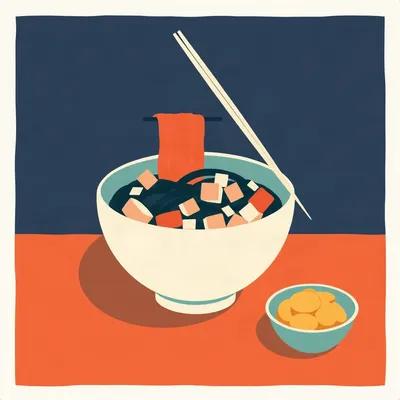
You ever notice in K-dramas, the characters order what they call Chinese food, and it's always the same three things? Jet-black noodles, a bowl of red soup that's visibly trying to hurt someone, and this pile of fried pork with a little dish of sauce on the side.

And the yellow pickled radish. Never forget the danmuji.
Never. It's like the one constant in every drama, every delivery scene, every moving-day episode. And if you've eaten actual Chinese food — or even Chinese-American food — none of it looks familiar. The noodles are the wrong color, the soup is the wrong temperature of rage, and the sweet-and-sour pork is... not what you'd get in Chengdu.
It's its own universe.
Hannah sent us this one. She's been watching enough K-dramas that the food has become a character in its own right, and she wants to know what she's actually looking at. Where did Korean-Chinese food come from, what are the classic dishes, how closely related are they to food you'd actually find in China, and would someone from China recognize any of this as Chinese at all. She also wants to know what role it plays in Korean life — because from TV it looks like greasy delivery comfort food, but also something you might go out for with a big group. Which is it?
Both. And that's actually the thing that makes this cuisine fascinating — it occupies two completely different social spaces at the same time.
So today we're going to Incheon, to a Chinatown that created a cuisine Korea now eats by seven million bowls a day, and that most of China has never tasted.
Let's start with the obvious question — what even is Korean-Chinese food, and how did it get its own identity?
The Korean name is junghwa yori, 중화요리, and it's a distinct diaspora food tradition. It was born in Incheon's Chinatown in the late nineteenth century, after Korea opened its ports to foreign trade in the eighteen-eighties. Qing China established a concession in Incheon in eighteen eighty-four, and Chinese laborers, merchants, and cooks started arriving.
Here's the key demographic fact that shapes everything: over ninety percent of those early migrants were from Shandong province, which is directly across the Yellow Sea from Incheon. So the culinary roots of this entire cuisine are specifically Shandong — not broadly Chinese, not Cantonese, not Sichuan. Shandong cooking is known for its emphasis on salt, on fermented pastes, on wheat-based foods rather than rice. That's the seed.
And the tree that grew from it is something Koreans now universally call Chinese food, but someone from mainland China would largely not recognize. There's a great line from the Seoulz — ask any Korean where jajangmyeon comes from, and they'll point to the corner Chinese restaurant. Travel to China and order it, and you'll get something else, or a blank stare.
That's the paradox the whole episode revolves around. A cuisine created in Korea, by Chinese migrants, that Koreans think of as Chinese, and that Chinese people think of as... not.
The spaghetti comparison is the one Koreans themselves reach for. Both dishes have noodles, meat, and a sauce, but nobody confuses Italian ragù with a bowl of black bean noodles. Cousins, not twins.
To understand how that happened, we have to go back to Incheon in the eighteen-eighties, when a port opened and a community arrived that would change Korean eating forever.
The origin story starts with one restaurant. Gonghwachun, in Incheon Chinatown, opened between nineteen-oh-five and nineteen-oh-eight by a Shandong migrant named Woo Hee-gwang. It was originally called Sandong Hoegwan — Shandong Assembly Hall — and it was renamed Gonghwachun in nineteen twelve to honor the new Republic of China. It's widely credited as the first restaurant to sell jajangmyeon under that name.
And the building is now the Jajangmyeon Museum. The only museum in the world devoted to a single noodle dish.
That's a lot of pressure on a noodle.
What I love is that the dish didn't start as some chef's artistic creation. It was cheap, filling food for dockworkers. Jajangmyeon was born out of hunger and migration, not culinary artistry. Shandong zhajiangmian — the Chinese ancestor — is a bowl of wheat noodles topped with a sauce made from fermented soybean paste, diced pork, and a little bit of vegetable. It's brown, salty, and comparatively dry. The sauce sits on top of the noodles. You mix it in yourself.
And the Korean version is... not that.
The single industrial innovation that created modern jajangmyeon happened in nineteen forty-eight. An Incheon company called Yeonghwa Foods started mixing caramel into the fermented bean paste. That created chunjang — darker, sweeter, glossier than the Chinese original tianmianjiang. Jet black instead of brown. Cooks also began thickening the sauce with a starch slurry — cornstarch or potato starch — so it would cling to the noodles and hold its heat during delivery.
So the color, the sweetness, the texture, the cling — all of that is a nineteen-forty-eight industrial food science decision.
Right. And then the Korean War and its aftermath turned a regional port food into a national obsession. After the war, the United States supplied enormous quantities of wheat flour as aid. Through the nineteen-sixties, the Korean government actively promoted bunsik — flour-based eating — to reduce reliance on rice, which was scarce and expensive. Jajangmyeon, built on wheat noodles, was perfectly positioned to ride that wave.
Cheap American flour, caramelized bean paste, and government policy. That's the origin story of Korea's most beloved comfort food.
But there's a much harder part of this story, and it's the thing most people don't know when they're ordering delivery.
The Hwagyo paradox.
The ethnic Chinese community in Korea — the Hwagyo, 화교 — created this cuisine. And they faced decades of severe discrimination. Successive Korean governments treated them as foreign nationals. They faced restrictions on land and property ownership. Naturalization was out of reach for generations. They were pushed into the restaurant business by exclusion — it was one of the few industries open to them.
The restaurant was a survival strategy, not a choice.
The Hwagyo population peaked at around eighty-two thousand in nineteen forty-two under Japanese colonial rule. Then it shrank dramatically as families emigrated onward to Taiwan or the United States. The original Gonghwachun closed in nineteen eighty-three — a closure widely linked to these same restrictive policies.
So the dish stayed and thrived and became beloved, while its creators were pushed to the margins.
That's the tension at the heart of this cuisine. Seven million bowls a day, twenty-four thousand restaurants, and the community that invented it was systematically excluded from the country that now claims the food as its own cultural symbol.
And that's not just an interesting historical footnote. It shapes the food itself.
How so?
Think about what happens when a cuisine is created by a small, restricted community that can't own land, can't easily pass businesses to the next generation, and is constantly losing its population to emigration. You don't get a sprawling, evolving, regionalized food culture. You get a canon. A fixed set of dishes that can be taught and passed down without variation, because the people doing the teaching might not be there next year.
That's... I hadn't thought of it that way. The standardization of the menu isn't just about delivery logistics. It's a form of cultural preservation under pressure.
We'll come back to that. But first, let's talk about what actually ends up in the bowl — and why someone from China would be confused by it.
The big three. Every Korean-Chinese restaurant in the country serves them. Jajangmyeon, jjamppong, and tangsuyuk. The menu is so standardized that a restaurant in Seoul serves the same core dishes as one on Jeju Island, or even on Marado — a tiny island with a population of about a hundred and forty people that somehow has nine Korean-Chinese restaurants.
Nine.
Nine. On an island you can walk across in twenty minutes.
That's not a market. That's a commitment.
Let's go dish by dish. Jajangmyeon — thick wheat noodles under a glossy black chunjang sauce with diced pork, zucchini, onion, and potato. The Korean version uses far more onion than the Chinese original, and the sauce is thickened with that starch slurry until it's almost gravylike. It's sweet, savory, deeply oniony, and jet black. A standard restaurant portion runs about six to seven hundred calories.
And the Chinese zhajiangmian it's descended from?
Uses tianmianjiang — saltier, thinner, browner, comparatively dry. The sauce doesn't cling the same way. The pork is often in larger pieces. There's usually no potato. The onion quantity is much lower. It's a different product. The Seoulz comparison is perfect — both share noodles, meat, and a sauce, but nobody confuses the two.
What about the variations?
You've got ganjjajang — dry jajang, where the sauce is served on the side, undiluted, so the noodles don't get soggy. Samseon jajangmyeon is the deluxe version with squid, shrimp, and other seafood. Yuni-jjajang uses minced meat. Sacheon-jjajang is a spicier Sichuan-style variant. And then there's jjajangbap, which is the same sauce over rice instead of noodles.
And the soup?
Jjamppong. Fiery red seafood noodle soup. And here's the thing — the spiciness is a Korean innovation from the nineteen-sixties and seventies. Earlier versions were mild and pale, resembling Japanese champon or mild Chinese seafood noodles. Korean-Chinese chefs added generous amounts of gochugaru and chili oil to satisfy Korean cravings for heat. What you're eating now is a dish that was fundamentally reinvented to match the Korean palate.
So both of the main dishes — the noodles and the soup — are Koreanized versions of things that started somewhere else.
And tangsuyuk makes three. It's double-fried battered pork or beef with a sweet-and-sour sauce. The batter is made with potato or corn starch, which gives it a lighter, crispier texture than the flour-based batters you'd find in Chinese sweet-and-sour pork. And the sauce is usually served on the side.
Which brings us to the debate.
The debate. Bumeok versus jjikmeok. Pour the sauce over the fried meat, or dip each piece individually. This is a genuine cultural phenomenon. It appears in advertising, in TV segments, at dinner tables. People have opinions. Strong ones.
Where do you land?
Jjikmeok. Dip. You preserve the crispiness of the batter. Pouring sauce over fried food is a countdown to sogginess.
I respect the principle. I'm bumeok. I want every piece coated, and I'm eating fast enough that sogginess isn't a factor.
Most restaurants serve the sauce on the side by default, which is basically the restaurant industry abdicating responsibility and letting the customer fight it out.
Beyond the big three — what else is on the menu?
This is where the cuisine shifts from delivery comfort food to family banquet dining. You've got yusanseul — a luxurious stir-fry of velveted meat and seafood in a mild white sauce. Palbochae — eight treasures seafood stir-fry. Yangjangpi — cold mung bean starch sheets with a sharp mustard sauce, served as a palate-opener at the start of a meal. Kkanpunggi — spicy garlic fried chicken, which is essentially the Korean-Chinese answer to General Tso's. Gunmandu — pan-fried dumplings.
And the sides?
Danmuji — the yellow pickled radish — and raw onion with a little dish of chunjang for dipping. Those two are as close to universal constants as this cuisine has. Kimchi is also commonly served alongside, but it's not the star.
So the dual role. Hannah asked whether this is greasy delivery food or a family dining experience, and the answer is yes. Both. Depending on what you order and how many people are at the table.
A solo diner or a small group orders individual bowls — jajangmyeon, jjamppong, maybe a shared tangsuyuk. Larger groups shift toward banquet-style dishes ordered to share at the center of the table. The Korea Herald quoted a Korean woman in her late forties who put it perfectly — getting Chinese food delivered is for convenience, for eating something quickly. It lacks the experience. She went to the restaurant to really indulge in the food, the taste, the experience.
And the delivery infrastructure itself is part of the story.
Korean-Chinese restaurants essentially invented Korea's modern delivery culture. Long before smartphones and delivery apps, junggukjip restaurants perfected home delivery using the cheolgabang — the steel bag. It's a stacked stainless-steel carrying case strapped to the back of a scooter or bicycle, designed to keep noodle bowls upright and soup from spilling. Delivery workers could reach homes within ten or fifteen minutes. And here's the detail I love — the driver would return later to collect the empty ceramic dishes. Real plates, real bowls, picked up after the meal. That system predates disposable packaging by decades.
So the infrastructure that now delivers fried chicken and jokbal and everything else in Seoul was built by Chinese restaurants delivering black noodles in steel boxes.
And it set the template for Korea's entire food delivery ecosystem, which is now among the fastest in the world.
Jajangmyeon also has this specific cultural role on moving day. Isa.
When the kitchen is packed and cooking is impossible, ordering jajangmyeon became the practical solution. And it evolved into an unbreakable cultural tradition. You move house, you eat jajangmyeon. It's practically a law.
And then there's Black Day. April fourteenth.
A modern, self-deprecating holiday. Singles who received nothing on Valentine's Day or White Day gather — often dressed in black — to eat jajangmyeon together in a tongue-in-cheek show of solidarity. It's commercially amplified, definitely, but it's observed. People actually do this.
There's something perfect about the loneliest holiday being celebrated with the most comforting food.
The jajangmyeon index is another fascinating angle. Koreans use the price of a bowl as an informal cost-of-living gauge — a homegrown cousin to the Big Mac Index. When the price jumps, it makes the news. The disappearance of the cheap, sub-two-thousand-won bowl has become shorthand for the squeeze on household budgets.
And it's subject to government price control.
The only foreign-origin food among Korea's top hundred cultural symbols to be so regulated. Think about what that says. A dish created by a discriminated-against ethnic minority has become so central to Korean identity that the government treats its price as a matter of public welfare.
The K-drama feedback loop is the last piece of this. Hannah's watching these dramas, seeing the food, and now she's asking us about it. She's not alone.
K-dramas — especially Reply 1988 — made jajangmyeon iconic internationally. And here's the wild part. After K-dramas became popular in China, some Chinese restaurants started serving the Korean version of jajangmyeon. Because Chinese viewers wanted to taste what Korean celebrities were eating on screen.
So the dish is now re-exporting itself back to China in its Koreanized form.
A Shandong noodle dish goes to Korea, gets caramelized and sweetened and thickened, becomes a national icon, gets broadcast back to China through television, and Chinese restaurants start making the Korean version. That's a full circle.
A hundred and twenty years, and the food has looped back to where its ancestors came from, unrecognizable to the people who stayed.

Nineteen ninety-eight Honda Elite eighty. With the steel box mounted on the back. The cheolgabang.
Wait, what?
Delivered for a place called Seoul Garden Chinese Restaurant. Western and Olympic, Los Angeles. Koreatown. The owner was a Korean man named Mr. Ahn. He'd learned the cuisine from a Hwagyo chef in Incheon — a man who'd worked at a restaurant two blocks from the original Gonghwachun site before emigrating. Mr. Ahn would get irate if the sauce-to-noodle ratio was off. He'd stand at the kitchen door and watch the ladle go in. Too little chunjang, he'd send it back.
What year was this?
Two thousand two, two thousand three. The steel box system was still in use, decades after it started in Korea. Same ceramic bowls, same pickup run after the delivery. The customers were mostly Korean immigrants and Korean-Americans who'd grown up with the food. They expected the bowl to look exactly the way it looked in Seoul.
The standardization held across an ocean and a generation.
It's more than standardization. The menu was a canon. Mr. Ahn could train a new cook in six weeks because there were only about fifteen dishes that mattered, and every one of them had a fixed recipe. No variation, no improvisation. He said that's how he'd been taught, and that's how the Hwagyo chef had been taught, and that was the point. The consistency wasn't about efficiency. It was about keeping the thing intact.
Because the community was small and shrinking and couldn't afford to lose the knowledge.
Mr. Ahn had a regular — an older Korean man who'd grown up in Incheon, near the port. He'd come in on Tuesday afternoons when the restaurant was empty and Mr. Ahn would make him a different jajangmyeon. Off-menu. Extra caramelized onion, darker chunjang — almost bitter. He said it was closer to what Gonghwachun served before the nineteen forty-eight caramel innovation. Before the sauce got sweet.
So there are regional and generational variations within the standardized menu that most diners never see.
The canon has footnotes.
And the footnotes are in the heads of old cooks and the regulars who remember.
The thing I wanted to ask — this delivery system you were describing. The steel box, the ceramic bowls. If someone wanted to set up a small operation now, not a restaurant, just... a thing. Would the food hold in that setup if you were going further than fifteen minutes? Say forty minutes, with the right insulation.
The starch slurry in the chunjang is designed to retain heat and cling to the noodles. In a preheated steel container, you'd probably get thirty minutes before the texture starts to degrade noticeably. Forty is pushing it. The noodles would start to absorb too much moisture from the sauce.
Thirty minutes.
The jjamppong would be the bigger problem. The noodles would continue cooking in the hot broth the whole time. By forty minutes they'd be mush.
You'd separate the broth and the noodles. Pack them in different compartments.
That would work. The cheolgabang has separate compartments already — you could modify the configuration.
Hm.
What are you planning to deliver for forty minutes?
Nothing yet. Just wondering.
That's a great detail — the off-menu jajangmyeon — and it gets at something we haven't resolved. Where does this cuisine go from here?
The Hwagyo community's situation has changed. Naturalization has become easier in recent decades. The discrimination isn't what it was. And Korea's relationship with its ethnic Chinese population is slowly shifting.
Does the cuisine evolve? Or has it become so canonized — so fixed in the culture — that it's frozen in time?
I think the K-drama feedback loop suggests it's already evolving, just not in Korea. The re-export to China means Chinese diners are encountering Korean-Chinese food as its own thing. The question is whether they'll eventually see it as a legitimate regional variation — like, say, Hong Kong-style Western food — or whether it'll always be the Korean version, in quotes.
The other variable is the Hwagyo diaspora itself. There are Korean-Chinese restaurants in Los Angeles, in New York, in Taipei, in places where the community resettled. Each of those is adapting to local ingredients and local palates while trying to preserve the canon. That's a recipe for divergence.
The canon itself — the fixed menu — might actually be what enables that divergence. Because the core is so stable, you can riff on it without losing the identity. The off-menu jajangmyeon Hilbert described is only meaningful because there's a standard version to deviate from.
The next time you see characters in a K-drama eating black noodles on moving day, you'll know the full story. Migration from Shandong, a port city in Incheon, caramelized bean paste in nineteen forty-eight, American wheat aid, a community pushed to the margins, a steel delivery box on the back of a scooter, and seven million bowls a day.
The cutting-room floor detail I can't let go of — the split-bowl jjamjjamyeon, half jajangmyeon and half jjamppong in one bowl, was patented in nineteen ninety-nine. Someone looked at these two dishes and said, I want both, simultaneously, in the same vessel, and I want legal protection for this idea.
That's the most Korean thing I've ever heard.
Thanks to Hilbert Flumingtop for producing, and for the steel box memories.
This has been My Weird Prompts. If you want to send us your own questions about food, or delivery infrastructure, or anything else you've been wondering about, email us at show at my weird prompts dot com.
We'll be back soon.