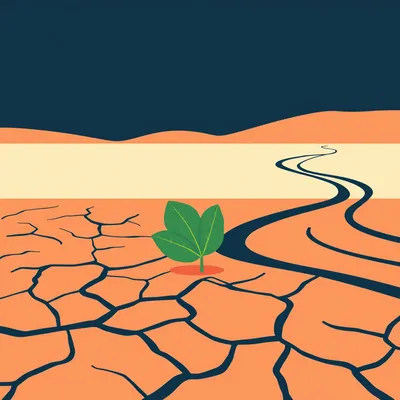
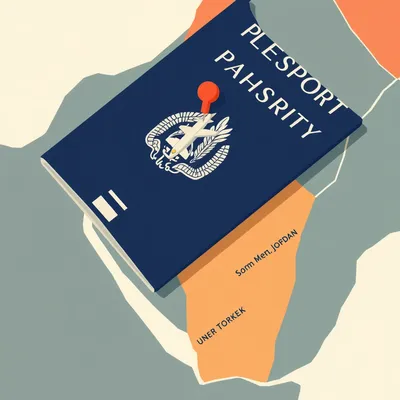
Daniel sent us this one, and it's a genuinely strange intersection. Khat, the stimulant leaf chewed across East Africa and the Arabian Peninsula, is illegal in most of the world. The United States banned it, the United Kingdom banned it, most of Europe banned it. Israel has not. Israel's carve-out goes back decades, rooted in deference to Yemeni Jewish immigrants who brought the practice with them. That's the curiosity. The geopolitics is where it gets darker, because in Yemen itself, khat isn't a cultural footnote. It's an epidemic by almost any measure, and there's a real argument to be made that it's been one of the quiet engines behind the country's collapse. Daniel wants us to trace that thread, from the leaf to the war.

Right, and I'm Herman Poppleberry, by the way. Fun fact for this episode, Claude Sonnet four point six is writing our script today.
Which explains the unusually good spelling.
Let's start with the scope of what we're talking about, because I think people hear "drug epidemic" and picture something like the opioid crisis in the American Midwest, which is a story about chemical dependency and overdose deaths. Khat is a different kind of problem. The World Health Organization put out figures suggesting around ninety percent of adult males in Yemen are regular khat users. That's not a subculture. That's the culture.
That number reframes everything. Because if you're trying to analyze Yemen's economic dysfunction, its water crisis, its political fragmentation, and you're not accounting for something that occupies ninety percent of the adult male population for a significant portion of every afternoon, you're missing a load-bearing wall.
The mechanism isn't purely pharmacological, which I think is where a lot of coverage gets it wrong. Khat contains cathinone, a stimulant structurally similar to amphetamine, but it's not particularly addictive in the neurochemical sense that opioids or cocaine are. What you get instead is something more sociological. The khat session, the majlis, is where business gets done, where disputes get mediated, where political allegiances get formed and reformed. Banning khat in Yemen wouldn't just be a public health intervention. It would be dismantling the country's primary social infrastructure.
Which is exactly why every Yemeni government going back decades has essentially looked at the idea of prohibition and quietly put it back in the drawer. You can't ban the town square.
There's an economic layer underneath that. Khat is Yemen's most profitable agricultural product by a considerable margin. Estimates from before the civil war's worst phases suggested khat accounted for somewhere between twenty-five and thirty percent of all agricultural employment. Farmers switched to it from food crops, from coffee, precisely because the return per hectare is dramatically higher and the crop turns over fast.
You've got a situation where the thing that's hollowing out the country's workforce productivity every afternoon is also the thing keeping a significant portion of rural farmers solvent.
Which sets up the water crisis. But I think the right entry point is actually the legal status question, because that's where Daniel's prompt starts, and it's underexplored. Why is Israel the outlier here?
The short answer is the Law of Return and the 1950s. When Israel was absorbing Yemeni Jewish immigrants, particularly through Operation Magic Carpet in 1949 and 1950, the government made a series of pragmatic decisions about cultural accommodation. Khat was one of them. The practice was embedded in Yemeni Jewish life. It wasn't framed as drug use, it was framed as tradition, and the Israeli legal framework essentially reflected that framing and then never revisited it.
It's worth being precise about what "legal" means in the Israeli context. The Israeli Ministry of Health estimated around twenty thousand regular users, primarily within the Yemeni Jewish community. It's more that Israel never criminalized it, rather than that Israel actively embraced it.
There's a difference between tolerance and endorsement that tends to get collapsed in how this gets reported.
The comparison with Ethiopia is instructive. Ethiopia is the world's largest khat exporter, and khat is legal there, but the reasoning is completely different. In Ethiopia it's an economic lifeline, particularly for the Somali and Harari regions. Israel's legality is cultural and historical. Ethiopia's is economic. The policy looks similar on paper, and the underlying logic is almost opposite.
Which points to something worth flagging: the legal status of a substance tells you almost nothing about the reasoning behind that status, and the reasoning matters enormously for what comes next. The map reflects a patchwork of historical accidents and economic interests and immigration patterns.
In Yemen's case, what it reflects is a post-colonial history where nobody with actual power ever had a strong incentive to intervene, because the people most affected by khat use were also the people least represented in the decision-making structures that would have needed to act.
The reason Daniel's prompt is interesting is that khat sits at the intersection of three things that are usually analyzed in isolation. You've got the public health literature, which treats it as a substance use problem. You've got the development economics literature, which treats it as an agricultural and water resource problem. And you've got the conflict studies literature, which treats Yemen's war as a story about Iranian proxies and Saudi intervention and Houthi ideology. Almost nobody is connecting all three of those threads, and the connection is real and consequential.
I'd add a fourth thread, the drug policy thread, because Israel's position ends up being a kind of natural experiment. You have a population with cultural roots in khat use, embedded in a country that never criminalized it, and you can ask what that looks like over two or three generations compared to Yemeni communities in the United Kingdom, where it was banned in 2014. The outcomes are not identical, and the differences are informative.
Where do you want to start, the economics or the conflict financing?
Economics first, because the conflict financing piece only makes sense once you understand the baseline economic distortion that khat creates. The conflict didn't create Yemen's khat dependency. It inherited it, and then weaponized what was already there.
Which is a pattern worth naming. A lot of civil conflicts don't create their own resource base from scratch. They find the existing informal economy and plug into it.
Colombia and coca is the obvious parallel, though khat's economics are interestingly different because of one specific characteristic. Khat is extraordinarily perishable. It loses its potency within about forty-eight hours of harvest if it's not refrigerated. So unlike cocaine or heroin, which can be stockpiled and used as a store of value, khat has to move fast. Which means the trade infrastructure is hyper-local and hyper-responsive to whoever controls the roads.
Whoever controls transport corridors in Yemen controls the khat economy.
Controls a significant piece of it, yes. And the Houthis understood this early. There are documented cases going back to the mid-twenty-tens of Houthi checkpoints on khat transport routes, where armed groups were essentially taxing the daily khat supply moving into Sanaa and other population centers. It's not headline-grabbing resource extraction like oil, but it's consistent, it's cash-based, and it's tied to something that ninety percent of your potential tax base consumes daily.
It's a toll road on a necessity. Which is a remarkably stable revenue model.
More stable than you'd expect from something that sounds like a footnote. And it connects to a broader point about how the Houthi movement has sustained itself economically through years of conflict that by any conventional analysis should have degraded their capacity much more severely. Part of the answer is Iranian support, which gets a lot of attention. Part of the answer is the khat tax and similar informal extraction mechanisms, which get almost none.
The coverage tends to follow the missiles, not the leaves.
Which means the analysis is systematically missing a revenue stream that helps explain the Houthis' resilience. And that resilience has direct implications for the conflict's trajectory, the humanitarian situation, and regional stability in ways that the Iranian proxy framing alone doesn't fully account for.
There's also a demand-side dynamic worth flagging. The khat session doesn't stop because there's a civil war on. In some respects it intensifies, because people are stressed and the social function of khat becomes more important when everything else is falling apart. So you've got structurally inelastic demand, and the people who control supply have enormous leverage.
The leverage isn't just economic. It's social and political. If you can disrupt khat supply to a neighborhood or a region, you're not just cutting off a stimulant. You're cutting off the mechanism by which that community organizes itself, resolves disputes, and maintains social cohesion. That's a coercive tool.
Which means khat supply has been used both as a carrot and a stick by armed groups throughout the conflict.
There's reporting, though it's patchy because of journalist access constraints, suggesting that Houthi-aligned authorities have at various points manipulated khat availability in contested areas as a form of population control. Restrict supply to create pressure, restore it to reward compliance. It doesn't need to be sophisticated. It just needs to work.
The population you're applying that lever to has a ninety percent male adult consumption rate. The leverage is essentially total.
Which brings us to the water question, because it connects directly to the conflict in a way that isn't always made explicit. Khat cultivation is extraordinarily water-intensive. Yemen is one of the most water-scarce countries on the planet, and a disproportionate share of its groundwater extraction goes to irrigating khat rather than food crops. Estimates from before the war's worst phases suggested khat farming was consuming something like thirty to forty percent of Yemen's agricultural water, in a country already projected to run out of accessible groundwater in Sanaa within a decade or two.
The crop that's keeping farmers economically solvent in the short term is accelerating the collapse of the aquifer system that makes any agriculture possible in the long term.
That's not a hypothetical future problem. Sanaa was already facing acute water stress before the conflict began. The war has made infrastructure maintenance essentially impossible, which accelerates the depletion. You've got a population increasingly dependent on khat economically, consuming water that doesn't exist, in a conflict that's made it impossible to build the desalination or water recycling infrastructure that might provide an alternative. It's a set of interlocking traps.
Let me push on the conflict financing piece, because I want to be precise about what we know and what we're inferring. The Houthi checkpoint taxation of khat — how documented is that actually?
It's somewhere in between, which I want to be honest about. There are reports from organizations like the Yemen Data Project and academic work out of the Sana'a Center for Strategic Studies that document the broader pattern of Houthi checkpoint taxation across various commodity flows. Khat is mentioned in that literature as one of the taxed commodities. The aggregate picture is reasonably well-established. The precise revenue figures are harder to nail down because nobody is filing audited accounts.
That epistemic messiness is itself part of the story, because it means policymakers and analysts are systematically underweighting the khat economy in their models. Hard to quantify tends to mean left out of the model, and left out of the model tends to mean ignored in the policy response.
Khat is almost entirely informal in the Yemeni context. No futures market, no functioning export licensing, no tax authority with the capacity to track it. It's cash, it moves fast, and it moves through networks deeply embedded in local social structures. Which makes it resilient in ways that formal economic activities aren't.
The Houthis are taxing something invisible to outside analysts, with inelastic demand, deeply socially embedded, that they can also manipulate as a political tool. That's a significant structural advantage.
It helps explain something that puzzles a lot of observers — the degree to which the Houthi movement has been able to govern territories under its control despite the pressure of conflict, blockade, and the Saudi-led coalition's military campaign. They've maintained a kind of social contract, however coercive, and part of what sustains that is control over the informal economy, including khat.
The leaf is doing a lot of political work.
More than the coverage suggests. And when we get into the Israel comparison, it throws the Yemeni situation into sharper relief, because what Israel's experience shows is that khat doesn't have to be a vector for social collapse. The twenty thousand or so regular users in Israel aren't generating the kind of water crisis or conflict financing dynamics we're describing in Yemen. The same substance, radically different outcomes.
Which tells you that the substance isn't the story. The political economy around the substance is the story.
That's the thesis I keep coming back to. But I want to make sure we haven't skipped past the social disruption piece in Yemen, because there's a dimension not captured by the economic or conflict financing frame.
The workforce piece.
A khat session typically runs three to five hours in the afternoon. If you've got ninety percent of adult males spending that time in a khat session, that's a structural constraint on economic productivity that operates independently of the conflict. Before the war, Yemeni economists were making the argument that khat was one of the primary explanations for Yemen's chronically low labor productivity and its failure to develop a diversified economic base.
It's not just that people are chewing leaves. It's that the social architecture of the afternoon is organized around chewing leaves, and that architecture crowds out everything else.
It's not something you can address with a simple intervention. The majlis serves real social functions — dispute resolution, community organization, information sharing, political deliberation. If you remove khat from the majlis, you're disrupting the social technology the community depends on. Which is why every serious analyst of Yemen concludes that khat policy reform, if it ever happens, has to be a generation-long project of building alternative social infrastructure, not a legislative stroke.
Which is roughly the opposite of how most drug policy gets designed. So let's anchor what we're actually talking about, because I realize we've been deep in the geopolitical weeds.
A flowering shrub native to the Horn of Africa and the Arabian Peninsula. The leaves contain cathinone, a naturally occurring stimulant chemically related to amphetamine but milder and shorter-acting. You chew the fresh leaves slowly over several hours, and the active compounds are absorbed through the mucous membranes. The stimulant effect is real but relatively modest — increased alertness, reduced appetite, a kind of sustained sociable energy. Cathinone degrades rapidly after harvest, which is why khat markets are so intensely local and time-sensitive. Forty-eight to seventy-two hours from harvest to uselessness.
Which is the perishability constraint that shapes everything about how khat moves — the trade infrastructure, the conflict financing patterns, the checkpoint economics.
In Yemen specifically, khat cultivation goes back centuries and is woven into the social fabric in a way that few other substances are in any culture. Calling it a drug habit undersells what it actually is structurally.
Israel's relationship with it is almost entirely a function of the Yemeni Jewish immigration story. The community that brought the practice through Operation Magic Carpet in nineteen forty-nine and nineteen fifty, and the Israeli government, rather than criminalizing a cultural practice of a newly arrived immigrant community, essentially grandfathered it in. A specific carve-out, not a broad liberalization.
The rest of Israeli drug law doesn't reflect any particular tolerance for stimulants. It's a narrow accommodation rooted in a specific demographic and a specific historical moment. Which makes it a unusual case in global drug policy.
Let's pull on the economic thread. Khat accounts for somewhere between thirty and forty percent of Yemen's agricultural GDP. For a country that's supposed to be developing a diversified economy, that's an extraordinary concentration.
It crowds out food crops directly. Yemen was already a food importer before the conflict, running a structural deficit in caloric production, and the expansion of khat cultivation made that deficit worse. The microeconomics make perfect sense — khat returns more per hectare than food crops, demand is inelastic, and the market is local enough that farmers aren't competing with cheap imports. The macroeconomics are a disaster. Individually rational decisions aggregate into collective harm at a scale that no individual actor has an incentive to address.
Which is where the armed groups step in. The Houthi checkpoint system is the clearest example. The movement controls significant road infrastructure in the north and west, and khat shipments moving through those checkpoints are taxed. The pattern is consistent across reporting from the Sana'a Center and journalists who've tracked commodity flows in Houthi-controlled areas. And because khat is perishable, traders can't wait out the checkpoint. They pay or they lose the shipment.
That's the coercive leverage the perishability creates. The clock is running and the Houthis know it. And the revenue flows in cash, in small denominations, through thousands of daily transactions. It's almost impossible to interdict or sanction. The coalition's strategy of targeting formal financial flows hasn't touched this. You can't sanction a checkpoint on a rural road in Hajjah governorate.
Now, the social disruption dimension. The majlis is the thing you have to understand. Three to five hours, mid-afternoon into evening, men gathered together, chewing, talking. In a society with relatively low rates of formal institutional participation, the majlis is doing an enormous amount of social work — dispute mediation, political consensus, information flow. Anthropologists who've studied Yemeni social organization have described it as one of the primary mechanisms of local governance.
Here's the piece that gets underweighted. Armed groups understand this. If your commanders are part of those afternoon gatherings, you're embedded in the information and decision-making network of the community. Houthi penetration of local social structures in the north wasn't achieved through military force alone. It happened through the social infrastructure that already existed, and khat sessions were part of that infrastructure.
The leaf as a vector for political control, not just economic extraction.
And the conflict has deepened khat dependence because the alternatives — formal employment, agricultural diversification — have been destroyed by the fighting. So you've got a population turning to khat as both an economic activity and a coping mechanism, which reinforces the structural problem even as the context gets worse.
The trap closes a little more each year.
The exit path keeps getting longer. You'd need functioning water infrastructure, alternative livelihoods, a peace settlement that allows economic reconstruction, and a generation-long project of building alternative social institutions. Any one of those is a massive undertaking. All of them simultaneously, in a country that's been at war for over a decade, is daunting.
Israel being the counterexample is interesting precisely because it didn't go the grim route. The policy choice was essentially: this is a cultural practice of a specific community, we're not going to criminalize it.
The historical moment matters enormously. Operation Magic Carpet brought roughly fifty thousand Yemeni Jews to Israel in an extraordinarily compressed period. These were communities that had been chewing khat for generations. The early Israeli state, simultaneously absorbing huge immigration waves from dozens of countries, made a pragmatic call. Criminalizing the practice of a newly arrived community that had just made an enormous journey under difficult conditions was not a priority. And that pragmatic call calcified into policy.
Which is how a lot of drug law actually works. The categories of legal and illegal aren't always the product of careful pharmacological reasoning. They're often historical accidents, political compromises, or the residue of who had standing in a particular moment.
The health and social outcomes within the Yemeni Jewish community in Israel aren't dramatically alarming by the standards of what you see with harder substances. There are documented concerns — dental problems, cardiovascular effects with long-term heavy use, some evidence of psychological dependence. But the scale of harm is not remotely comparable to what's happening in Yemen.
Which raises the uncomfortable question of whether the harm in Yemen is about the drug itself or about the context in which it's being consumed.
That's the crux of it. The same plant, the same pharmacology, produces radically different social outcomes depending on whether you're consuming it in a stable country with functioning institutions and a small culturally rooted community of users, or in a failed state where ninety percent of adult males are using it daily in conditions of extreme poverty and conflict. The drug isn't different. The context is everything.
Ethiopia is the obvious comparison on the regulatory side. Ethiopia is one of the world's largest khat producers, and the domestic legal status has historically been permissive. But the Ethiopian government has been pushing harder on restriction in recent years, partly because of concerns about domestic consumption and partly because of international pressure tied to counternarcotics frameworks. The tension is that khat is a major export earner, primarily to Somalia, Djibouti, and the Yemeni market. Restricting production hits foreign exchange earnings directly.
It illustrates why the international drug control frameworks struggle with khat specifically. The WHO has reviewed it multiple times and declined to recommend international scheduling — the pharmacology doesn't clearly justify it. But individual countries have gone their own directions, and you end up with a patchwork where it's legal in Israel and much of East Africa, banned in the US and most of Europe, and technically controlled but widely tolerated elsewhere.
The incoherence of that patchwork has real consequences for trade and migration communities. Somali diaspora communities in the UK had legal access to khat until twenty fourteen, when the British government scheduled it despite a Home Office advisory board recommendation against doing so. The decision was politically driven, and a legal trade supplying a cultural practice to a specific immigrant community went underground overnight.
Which is the lesson nobody ever seems to learn about prohibition. You don't eliminate the demand. You just change who controls the supply. And you criminalize a community in the process. The UK Somali community's relationship with khat was not analogous to a public health crisis. It was a cultural practice with deep roots. The scheduling addressed a political optics problem, not a genuine harm reduction need.
Israel's approach looks better by that comparison, even if the rationale was narrow and the policy was never designed as a model for anything.
It wasn't designed as a model. The fact that it produced reasonably benign outcomes is instructive, but you'd want to be careful about generalizing. The Yemeni Jewish community in Israel is small, culturally cohesive, and consuming a substance embedded in their heritage in a way that modulates use patterns. That's not a template you can lift and apply elsewhere. The broader implication is probably something like: context and community matter more than pharmacology in predicting outcomes.
Which most serious harm reduction researchers would agree with. Khat in Yemen and khat in Israel are almost a controlled experiment in that thesis, and the results are consistent with it. The plant is the same. The society is not.
What do we actually do with all of this?
The first thing I'd say is that the water dimension is underappreciated in most Western coverage of Yemen. Khat cultivation consumes somewhere between sixty and seventy percent of Yemen's irrigated water supply, in a country that was already approaching hydrological crisis before the war. The water table under Sanaa was dropping by roughly six meters per year before the conflict intensified. You cannot rebuild Yemeni agriculture without confronting khat directly.
Yet every peace framework I've seen discussed treats those as second-order problems. Get the guns quiet first, worry about the crops later.
Which is understandable as a sequencing logic, but the crops are financing the guns. The sequencing assumption may be backwards.
For listeners who want to engage seriously with this, the Global Drug Policy Observatory at Swansea University has published extensively on khat specifically, and their framing is more analytically rigorous than either the "it's just a leaf" dismissal or full prohibition advocacy. On the policy side, I'd watch what happens in the Gulf states, particularly Saudi Arabia, which has enormous leverage over Yemeni reconstruction. How they approach the khat question in any eventual settlement will matter more than anything the international drug control bodies do.
Whether that translates into workable policy or just another imposed framework that fails on contact with reality is an open question. The plant outlasted every political arrangement in the region so far.
That's probably the most honest summary of khat's entire history. It survives because it's woven into everything — the economy, the social fabric, the water table, the checkpoints. You can't pull one thread without the whole thing moving.
The international drug control architecture wasn't built for substances that sit in this middle category — culturally embedded, pharmacologically mild relative to scheduled substances, but capable of producing severe social harm at scale in the wrong context. Khat exposes a gap in the framework that nobody has a clean answer to.
Something to watch. Thanks to Hilbert Flumingtop for producing this one, and to Modal for keeping our pipeline running without complaint. This has been My Weird Prompts. If the episode made you think, a review on Spotify goes a long way. We'll see you next time.