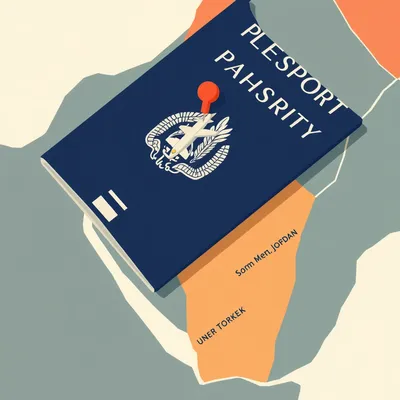
Here's what Daniel wrote to us. Quote. Dubai has emerged in recent years as a major tourist destination for Israelis, something that would have been absolutely unthinkable a few years ago but which is the by-product of the Abraham Accords. Most people, including me, know relatively little about the UAE or Dubai, however. Beyond the fact that it's probably awfully hot and has a massive tower. I know that the UAE has a large expat and worker population, in fact, a gigantic one relative to the size of its local population. Let's learn about the history of this territory and what there is to know about it besides Dubai and the Burj Khalifa. End quote.

The tower is very tall.
That's your opening.
I'm just saying, it's a factual statement. It is very tall. But Daniel's right — most people's knowledge stops right there. Tower, heat, maybe a vague sense of oil money. And the thing that actually defines the place, this nine-to-one expat-to-citizen ratio, is the one fact that should make anyone stop and ask how that even works.
Nine out of ten people in the country aren't citizens. That's not a tourist statistic, that's the entire society. So what does the word nation even mean when ninety percent of the people living there can never belong to it?
That's the tension that runs through everything. And the surprising part is, when you trace how it got this way, it's not a story of oil wealth run amok. It's a story of survival through adaptation — three distinct economic shocks, each one forcing a pivot that nobody planned.
So let's actually learn about this place. Not the postcard version, but the real one. And Daniel's framing gives us three threads to pull: the history of how this territory became a country, the demographic inversion and what it means, and the Israel connection that would have been unthinkable a decade ago.
And the through-line in all three is the same thing. Every chapter of UAE history is someone looking at a collapsing business model and finding a new one before the old one kills them. Pearling, oil, and now tourism and finance — each one a bet that the previous thing wouldn't last.
To understand why ninety percent of the people in this country aren't citizens, you have to go back to the pearling boats and the British gunboats. So start there.
Right. So before it was the UAE, before it was even seven separate emirates in the modern sense, this stretch of the Gulf coast was known as the Trucial States. The name comes from a series of maritime truces signed with the British starting in eighteen twenty. And the official story is that the British were suppressing piracy. Which they were, technically.
The unofficial story being that piracy was defined as competition with British shipping lanes.
That's exactly what it was. The British East India Company had established dominance over the Gulf trade routes, and any local power that challenged that was labeled piracy. So the truces were essentially a protection racket — the sheikhs agreed not to interfere with British shipping, and in return they got British naval protection and a degree of political recognition. This arrangement lasted for a hundred and fifty years.
A century and a half of being a protectorate. That's a long time to not be a country.
And during most of that period, the economy was built on a single thing: pearls. The Gulf's shallow, warm waters produced some of the finest natural pearls in the world. The entire coastal economy revolved around pearling — the boats, the divers, the merchants who sold to jewelers in Bombay and London. It was brutal work. Divers would descend dozens of times a day with nothing but a nose clip and a weighted rope, holding their breath for up to two minutes in water that could hit ninety-five degrees.
So the heat isn't new. Daniel's "awfully hot" observation has deep historical roots.
Deep and economically relevant. The pearling fleet in the early nineteen hundreds employed something like seventy thousand men across the Gulf. It was the region's lifeblood. And then, in the nineteen thirties, it collapsed. Almost overnight.
Japan.
Japan. Kokichi Mikimoto perfected the process for culturing pearls — inserting a nucleus into an oyster and letting it coat the irritant with nacre, producing a perfectly round pearl on demand. The quality was consistent, the supply was predictable, and the price was a fraction of what natural pearls commanded. By the late nineteen thirties, the Gulf pearling industry was dead. The economy of the Trucial States was devastated. There was no backup plan.
So the first economic shock was the collapse of something they'd built their entire society around. That pattern's going to repeat.
Twice. And the second one is the one everyone thinks they know but mostly gets wrong. Oil was discovered in the region, but the timeline matters. Abu Dhabi exported its first crude in nineteen sixty-two. Dubai didn't start until nineteen sixty-nine. And here's the key thing that shapes everything about modern Dubai: it barely had any oil compared to Abu Dhabi.
Wait. Dubai's whole reputation is oil wealth.
That's the misconception. Abu Dhabi sits on about ninety percent of the UAE's oil reserves. Dubai's reserves were modest and always had a visible expiration date. The emirate's leadership understood this from the beginning. Sheikh Rashid bin Saeed Al Maktoum, who ruled Dubai from nineteen fifty-eight to nineteen ninety, looked at his limited oil and said, essentially, we need to build something that outlasts the wells.
So Dubai diversified into trade and logistics not because it was visionary in some abstract sense, but because it had no choice.
Necessity is the entire story. While Abu Dhabi could afford to be patient with its massive reserves, Dubai borrowed heavily to build infrastructure. Jebel Ali port, which opened in nineteen seventy-nine, is now the busiest port in the Middle East and one of the largest man-made harbors in the world. They built it when Dubai was still a relatively small trading town, betting that if they created the capacity, the shipping would come. And it did.
That's a genuine gamble. Build the port first, hope the global supply chain notices.
And they paired it with free zones — designated areas where foreign companies could own one hundred percent of their business, repatriate all profits, and pay zero corporate tax. This was radical for the region. It essentially created pockets of economic liberalism inside a Gulf monarchy. The Jebel Ali Free Zone launched in nineteen eighty-five and became the template for dozens of others. Today there are more than forty free zones in the UAE, covering everything from media to finance to healthcare.
So the Dubai model was: we don't have enough oil to fund a welfare state forever, so we'll build a platform and charge rent for access to the region.
That's exactly the model. And it worked because of geography. Dubai sits at the intersection of Europe, Asia, and Africa — roughly two-thirds of the world's population lives within an eight-hour flight. If you're a company that needs to reach markets in the Middle East, South Asia, and East Africa, Dubai is the natural hub. The free zones just made it frictionless to set up there.
But we haven't gotten to the people yet. The demographic inversion.
Right. So in nineteen seventy-one, the British announced they were withdrawing from east of Suez. The Trucial States — these tiny coastal sheikhdoms with populations in the tens of thousands — suddenly had to figure out statehood. Seven of them federated into the United Arab Emirates. Two others, Bahrain and Qatar, went their own way. The federation was a defensive move — individually, none of these entities could survive as independent states. Together, they had a chance.
And then the oil money started flowing.
Not instantly, but yes. And when it did, it created demand for labor that the tiny local population simply couldn't supply. The UAE's citizen population at independence was maybe two hundred thousand people. You can't build ports, roads, airports, and skyscrapers with two hundred thousand people. So the country imported workers. From South Asia — India, Pakistan, Bangladesh. From the Philippines. From Egypt, Lebanon, Yemen. Construction workers, engineers, doctors, domestic workers, retail staff. The entire service economy.
And the mechanism that made this possible was the kafala system.
The sponsorship system. A foreign worker's visa is tied to their employer — the kafeel, or sponsor. The sponsor controls whether you can enter the country, whether you can switch jobs, and whether you can leave. If you quit without your sponsor's permission, you can be blacklisted. If your sponsor cancels your visa, you have a limited window to find a new sponsor or you have to leave. It creates a structural power imbalance that's been criticized by human rights organizations for decades.
And the UAE has tried to reform it.
They have, especially in the last five or six years. They've introduced reforms that make it easier to switch employers, they've abolished the requirement for a no-objection certificate in many cases, and they've introduced some labor protections. But the fundamental structure remains: your legal presence in the country is tied to your job. Lose the job, lose the visa.
Which means the expat population is permanently temporary. No matter how long you've lived there — and many people have been there for decades — you can never become a citizen. Your children born in the UAE don't get citizenship. There's no path to naturalization for almost anyone.
And that's the demographic inversion in its full form. Roughly ninety percent of the roughly ten million people in the UAE are not citizens. The citizen population — the Emiratis — are about one point one to one point two million people. They're a small privileged class living atop a massive labor pyramid. Citizens receive generous state benefits: free education, free healthcare, subsidized housing, government jobs with high salaries. The expat workforce funds this through their labor and consumption, but receives none of the benefits.
It's a model that works until it doesn't.
That's the structural vulnerability. As long as the economy is growing and jobs are plentiful, the system hums along. But a major economic shock — a sustained drop in oil prices that forces cuts to citizen benefits, or a regional conflict that disrupts trade — and the tensions built into the model become visible.
Which brings us to the third thread. The one that Daniel flagged as the reason this conversation is happening at all. Israelis in Dubai.
September fifteenth, twenty twenty. The Abraham Accords are signed at the White House. The UAE becomes the first Gulf state to normalize relations with Israel, followed by Bahrain, and later Morocco and Sudan. It broke the Arab League's decades-old logic that normalization with Israel could only happen after a Palestinian state was established.
And the thing most people miss is that this wasn't a sudden shift. The UAE and Israel had been quietly building ties for years before twenty twenty. Intelligence cooperation, back-channel diplomacy, business relationships. The Accords formalized something that was already happening.
Right. The relationship was never really about ideology. It was about shared interests. Both countries see Iran as the primary regional threat. Both want access to each other's markets — Israel's technology sector, the UAE's capital and logistics network. And for the UAE specifically, normalization with Israel was part of the long-game strategy of becoming the region's indispensable hub. If you're the neutral ground where everyone can do business, you win no matter who's fighting whom.
The immediate effect was direct flights. Tel Aviv to Dubai is about three hours. Within months of the Accords, multiple airlines were running multiple daily flights. Israeli passport holders suddenly had visa-free access to a major tourist destination that had been completely off-limits before.
And Israelis went. In large numbers. Dubai welcomed over eighteen million international visitors in twenty twenty-four — that was a record year. Israeli tourists became one of the fastest-growing segments. Estimates put the number of Israeli visitors in twenty twenty-four at over three hundred thousand. That's a lot of people for a country of about nine and a half million.
Three hundred thousand Israelis in Dubai in a single year. A decade earlier, that number would have been zero. Not low — zero. Israeli passport holders couldn't enter the UAE at all.
And then came the stress test. June twenty twenty-six. The war between Israel and Iran.
Which put the UAE in an extraordinarily delicate position.
Incredibly delicate. The UAE has its own history of tension with Iran — there's a territorial dispute over three islands in the Gulf, and the UAE has long viewed Iran's regional ambitions with suspicion. But it also shares a maritime border with Iran. It can't afford open hostility. So when the war broke out, the UAE publicly criticized Israel's actions — they issued statements calling for de-escalation, they participated in emergency diplomatic meetings. But privately, the economic relationship stayed intact. Flights kept operating. Business deals kept closing.
The Christian Science Monitor reported in late July that the UAE actually emerged from the war diplomatically strengthened. By positioning itself as a mediator rather than a combatant, it reinforced the narrative that it's the stable, neutral platform in a volatile region.
The tourism numbers held up. Forbes reported just last week that Dubai's government is actually launching paid incentives to attract visitors back — which tells you two things. One, tourism is now so central to the post-oil economy that the government will pay to sustain it. And two, the bet is that the security situation is stable enough that people will come.
Wait, they're literally paying people to visit?
That's what Forbes reported on July twenty-third. The government is offering financial incentives to boost tourist numbers after the war. It's a remarkable signal of how far the economy has shifted from oil dependency. Tourism and hospitality now account for a significant chunk of Dubai's GDP — some estimates put it around twelve to fifteen percent — and the government treats it as strategic infrastructure, not just a nice-to-have.
Let me pull these threads together. The UAE starts as a pearling economy, collapses in the thirties. Oil saves it, but Dubai has barely any, so it builds ports and free zones and becomes a trade hub. The citizen population is tiny, so the country imports millions of workers who can never become citizens. Then in twenty twenty it normalizes relations with Israel, creating an entirely new tourism market. A war breaks out in twenty twenty-six, and instead of collapsing, the UAE emerges as a mediator with record tourism numbers and a government paying people to visit.
That's the arc. Every shock produces a pivot. The pearling collapse forced diversification. The limited oil forced the trade and logistics bet. The regional instability forced the tourism and finance push. And the demographic model — this massive expat population with no path to citizenship — is both the engine that makes all of it possible and the thing that could eventually unravel it.
The citizen population is, what, a bit over a million people in a country of ten million. They're essentially a shareholder class in a corporation called the UAE. They collect dividends in the form of state benefits — housing, education, government jobs — while the expat workforce generates the revenue.
The corporation has been extremely well-managed, by the standards of statecraft. The UAE's sovereign wealth funds — the Abu Dhabi Investment Authority, Mubadala, the Dubai Investment Corporation — are among the largest and most sophisticated in the world. They've reinvested oil revenues into global assets that will generate returns long after the oil runs out. Norway's sovereign wealth fund gets more attention, but the UAE's funds are collectively larger.
The Norway comparison is interesting, actually. Norway used its oil wealth to create a pension fund for its citizens. The UAE used it to build a platform for global business. Same resource, completely different model.
Different tradeoffs. Norway's model is egalitarian — every citizen benefits roughly equally. The UAE's model creates extreme stratification. Citizens at the top, then a hierarchy within the expat population — Western professionals at the high end, South Asian laborers at the low end, with salaries and living conditions that vary enormously by nationality and profession.
The kafala system reinforces that hierarchy. A British investment banker and a Bangladeshi construction worker are both on sponsored visas, but the banker's employer has every incentive to keep them happy, while the construction worker's employer...
Has different incentives. The reforms of the last few years have tried to address the worst abuses — the passport confiscation, the inability to switch employers, the fear of reporting labor violations. But enforcement is uneven, and the fundamental power imbalance remains. Your legal status is contingent on your employer's goodwill.
What do we actually take away from all this? Three things, I think, that reframe how you see Dubai next time it's in your feed.
Go ahead.
First, the UAE is a masterclass in strategic adaptation. Every economic shock — the pearling collapse in the thirties, the awareness that oil wouldn't last forever, the regional conflicts — has been met with a pivot. The current push into tourism, finance, and technology is the latest iteration. Dubai isn't a city that got lucky with oil. It's a city that knew the oil would run out and built an alternative before it did.
The free zones were the mechanism. By creating spaces where foreign companies could operate without local partners, without corporate tax, without currency controls, Dubai essentially said: we'll be the region's Switzerland. Bring your capital, bring your talent, we'll provide the infrastructure and the legal framework, and we'll take a cut. It's a platform business model applied to a country.
Second, the demographic inversion is the country's greatest strength and its greatest vulnerability. The expat workforce built the skyline, staffs the hospitals, runs the airports, and keeps the entire economy moving. But it also means the citizen population is a small privileged class living atop a massive labor pyramid. That model works when the economy is growing and everyone's getting something out of it. In a sustained downturn, the tensions between citizen and expat, between different tiers of expat, between those with a path to somewhere else and those with no path at all — those tensions get harder to manage.
Third, the Israel-UAE relationship shows how quickly geopolitical realities can shift when interests align. The Abraham Accords didn't create the relationship — they formalized years of quiet cooperation. And the twenty twenty-six Iran war didn't destroy it — it tested it and, by most measures, the relationship passed. The UAE publicly criticized Israel while privately maintaining economic ties. That's not hypocrisy. That's statecraft.
It's also a bet. The UAE is betting that economic integration creates its own momentum — that once you have three hundred thousand Israeli tourists a year, once you have Israeli tech companies operating in Dubai's free zones, once you have Emirati sovereign wealth invested in Israeli startups, the relationship becomes too valuable for either side to walk away from. Political disagreements become manageable because the cost of escalation is so high.
That bet has held so far. The war didn't break it. The Palestinian issue — which the UAE officially still supports — didn't prevent normalization. The model is: we can disagree on politics and still do business. That's not a new idea, but it's new in the Middle East.
The next time you see Dubai's skyline — the Burj Khalifa, the Palm, the Marina — understand it as the product of deliberate policy choices. Free zones, tax incentives, a willingness to be the region's neutral ground, and a labor system that imports millions of workers who will never be citizens. It's not just oil money. It's a calculated, multi-decade strategy to build a platform that outlasts the resource that funded it.
The story is still being written. The oil revenue that funds the citizen welfare state will eventually decline — not tomorrow, but on a long enough timeline, it's a finite resource. The question is whether the post-oil economy — tourism, finance, logistics, technology — can generate enough value to sustain the social contract with the citizen population. And whether the expat-dependent model can survive a major regional shock that disrupts trade and travel for more than a few months.
The Iran war was a short conflict. If it had dragged on for a year, if flights had been grounded for months, if shipping through the Gulf had been disrupted — the stress on the model would have been much greater.
That's the open question. The UAE's entire strategy is built on stability — on being the safe port in a dangerous neighborhood. If the neighborhood gets dangerous enough that the safe port isn't safe anymore, the model cracks. Tourism dries up, foreign companies relocate their regional headquarters, and the expat workers — who have no permanent stake in the country — start looking for the next opportunity.
The UAE is a bet that the Gulf will remain stable enough for business to continue. It's been a good bet for fifty years. Whether it stays a good bet is the thing to watch.
If you take one thing from this, it's that Dubai isn't a city that oil built — it's a city that the fear of running out of oil built. The skyscrapers, the ports, the free zones, the tourism push — all of it traces back to the awareness that the resource wouldn't last, and the only way to survive was to become indispensable for something else.
The demographic model — nine out of ten people with no path to citizenship — is the cost of that strategy. It's not an accident or a temporary phase. It's the design.
What happens when the design meets the next shock is the question worth asking. And the twenty twenty-six war gave us a partial answer — the model held. But partial answers have a way of becoming the wrong answers when the circumstances change.
This has been My Weird Prompts. Thanks to our producer Hilbert Flumingtop.
If you enjoyed this deep dive, rate and review the show wherever you listen — it genuinely helps. And send us your weird prompts. Daniel did, and now we all know what the kafala system is.
We'll be back soon.